

The Cost of Maybe
Last week, a member asked whether The Pineapple articles could be made available as audio.
It was a perfectly reasonable request.
People are busy. Reading requires time and attention. Audio can travel while someone walks, drives, cooks or cleans.
Press play.
Simple.
Except that the play button does not arrive by itself.
Behind it sits a Sunday.
The Parked Idea
The request did not create the idea.
Towards the end of 2024 and into early 2025, I experimented with NotebookLM and Sam & Claire. I could see the possibility of turning written articles into something people could listen to.
Then Janita joined Brida.
Priorities changed, and the idea was parked.
Parked is the entrepreneurial word for placing something in a corner while continuing to think about it.
Then somebody asked whether The Pineapple could provide audio.
The parked idea immediately switched its headlights back on.
I began with OpenAI.
The result was acceptable.
Acceptable is a dangerous word in the creative process. It means something works, while also reminding you that it could be better.
The voice was clear. The file played. The article had technically become audio.
But The Pineapple carries the rhythm of real conversations. It contains personality, pauses, strange turns and small details. A voice can pronounce every word correctly and still miss the article.
I returned to NotebookLM.
This time, the result had more movement. The articles became conversations rather than readings.
One test became another.
A test became a process.
A process began looking suspiciously like a product.
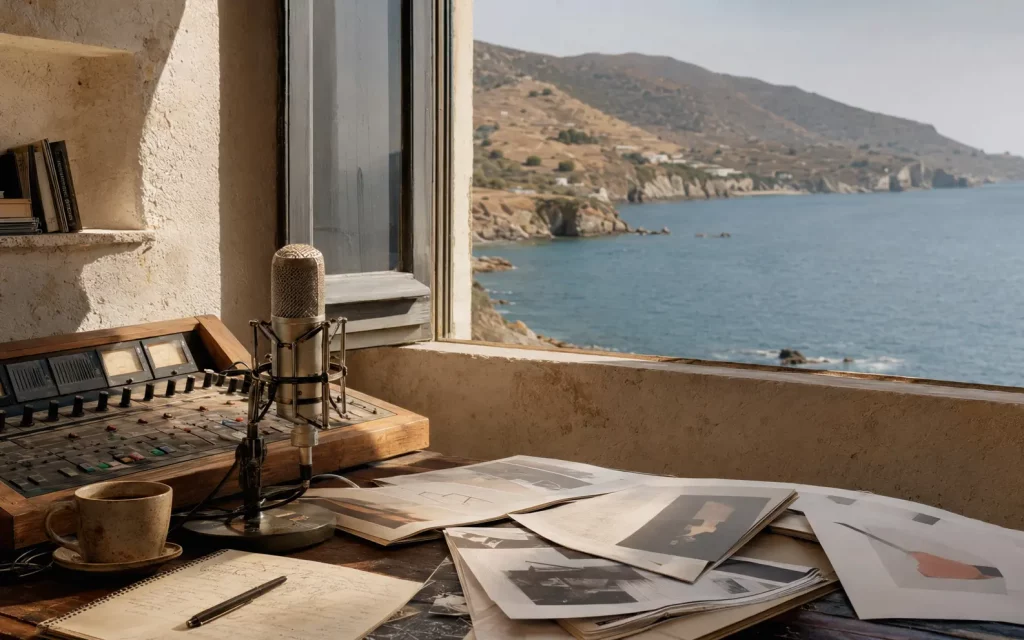
Radio Brida appeared.
It needed a name, a place to live, files, links, images and descriptions.
Nobody wakes up on Sunday morning intending to build a radio station.
You begin by testing one article.
By lunchtime, you are running one.
The Unopened Email
Eventually, I had a test version.
This was after we had released a test audio version and sent it out with Pineapple 20.
The email remained unopened.
That does not make them a bad person.
People are busy. Emails disappear. A sincere intention in the morning can be buried beneath twelve other things by lunchtime.
They may still open it.
They may listen next week.
Perhaps during a walk.
Perhaps on holiday.
Perhaps one day, when everything has settled down and nothing else requires attention.
But I had already spent the Sunday.
That was the moment I recognised the difference between interest and commitment.
Interest is light.
Commitment has weight.
Interest says:
“I would listen to that.”
Commitment opens the email and presses play.
For the person making the request, the idea remains a possibility.
For the person building it, the possibility becomes work.
A Greeting Is Part of the Work
The next morning, I spoke with someone arranging work on a garage.
The job involved pipes, drilling and quotations ranging from a few hundred euros to several thousand.
One tradesman had created uncertainty through poor communication.
Another sent a proper message, including a greeting and salutation.
That small detail helped him win the work.
Before he arrived with a drill, he had already demonstrated something.
He had acknowledged the customer.
He had communicated clearly.
He had created confidence.
The work began before the drill started.
It would be easy to turn this into a complaint about declining professional attitudes.
Tradespeople should reply properly. They should arrive when promised. They should provide invoices. Courtesy and reliability are part of the work.
But there is another side.
A Serious Customer
Customers also arrive with attitudes.
They ask for multiple quotations.
They want professional quality at the lowest possible price.
They expect immediate answers and then take days to respond.
They ask for detailed advice before deciding whether they are serious.
They may take a tradesman’s time, knowledge and calculation without ever acknowledging the quotation.
The customer sees competition.
The tradesman sees another evening preparing an estimate that may lead nowhere.
That does not excuse poor behaviour.
But attitude does not develop in a vacuum.
Sometimes reluctance is accumulated experience.
Sometimes the professional has learned that enthusiasm becomes expensive when the customer is only exploring a maybe.
The tradesman must be serious about the work.
The customer must be serious about the request.
A greeting is part of the work.
So is opening the reply.
Wanting More for Less
We have created a strange market.
We expect speed, quality, flexibility, personal attention and low prices at the same time.
We want artisans to care deeply about their work while continually asking them to prove their value for free.
We want local businesses to survive but buy elsewhere to save two euros.
We want original writing but expect it to cost nothing.
We want audio because we are too busy to read.
Then we are too busy to listen.
The customer is overwhelmed.
The maker becomes overwhelmed trying to make life easier for the overwhelmed customer.
Everyone wants more convenience.
Nobody has more attention.
The result of Radio Brida would have been a small button.
The listener sees the button.
I see the article selection, generation, review, rejected version, file, upload, link and the word that was pronounced strangely.
The easier the result appears, the easier it is to underestimate what made it possible.
The customer experiences the final minute.
The maker carries all the minutes that came before it.
Less Is More
Radio Brida has changed how I understand LESS IS MORE.
It cannot mean refusing every new idea.
Audio could add something valuable. Some people may genuinely prefer listening. The experiment may still have a future.
But every possibility does not deserve immediate construction.
Every expression of interest is not demand.
Every request is not a commitment.
Perhaps less is more when we ask for fewer things and genuinely use what we request.
Perhaps less is more when small businesses stop trying to satisfy every hypothetical customer.
Perhaps less is more when customers stop expecting unlimited experiments, quotations and alternatives before making a decision.
The provider should be able to say:
“This is what I do. This is what it costs.”
The customer should be able to answer:
“Yes.”
Or:
“No, thank you.”
Both are useful.
Maybe is often the most expensive answer.
Shelved
For now, Radio Brida is parked again.
Not cancelled.
Not declared a failure.
Parked.
The experiment proved that the idea is possible.
It did not prove that the demand exists.
One unopened email does not mean nobody wants audio.
But it is enough to stop me spending another Sunday building something people might perhaps use one day.
If the demand is real, it will return.
Not only as interest.
As attention.
As listening.
As commitment.
Until then, The Pineapple will continue doing what it already does.
It will carry the conversations.
It will arrive on Friday.
It will be read by the people who make room for it.
That may be less.
It may also be enough.