
Growing Upside Down
A Mayor’s Pen reflection on Australia, Brida, growth, usefulness, and looking from another angle
When you grow up in Australia, you learn at an early age that the rest of the world thinks you are upside down.
Maps do not help.
Most maps place Europe somewhere near the middle and Australia somewhere near the bottom, as if it were an afterthought attached to the edge of the planet.
Seasons do not help either.
Christmas arrives in the middle of summer. School holidays happen at the wrong time. Even the stars seem to be arranged differently.
As a child, you accept this without thinking much about it.
It is simply the way things are.
Only later do you realise that being “upside down” has an unexpected advantage.
It teaches you that there is usually more than one way to look at the world.
The advantage of another angle
Over the years, I have noticed a curious pattern.
Many of the things I have found most valuable in life started with doing the opposite of what seemed obvious at the time.
Not because I wanted to be different.
Not because I was trying to rebel.
Simply because the usual way did not always make sense.
The older I get, the more often I hear the same feedback.
“You are doing the opposite of what people normally do.”
For a long time, I treated this as an observation.
Recently, I have begun to wonder whether it is actually a compliment.
Growth is not always the first question
Most organisations start by asking how they can grow.
It is a reasonable question.
Growth is visible.
Growth can be measured.
Growth looks impressive in reports and presentations.
Yet some of the most meaningful things I have experienced did not begin with growth.
They began with usefulness.
A conversation that helped someone think differently.
An unexpected connection between two people.
A story that made somebody feel recognised.
A small act that created value long before anybody thought about scale.
If you start with growth, people can sometimes become numbers.
If you start with usefulness, people tend to remain people.
What growth is actually for
That does not mean growth is bad.
A tree that does not grow is not healthy.
A community that never welcomes new people becomes closed.
A project that never develops slowly loses energy.
Growth matters.
But growth is not the same thing as health.
It is not the same thing as meaning.
It is not the same thing as usefulness.
There is, rather nicely, a growing awareness that growth is not always what it was once made out to be.
For a long time, growth was treated almost as a law of nature.
Grow the company.
Grow the economy.
Grow the audience.
Grow the numbers.
Bigger was assumed to be better.
But perhaps a better question is not:
“How big can this become?”
Perhaps the better question is:
“What is this growth actually for?”
A garden does not grow forever.
At some point, it must also produce, rest, renew and feed the people who tend it.
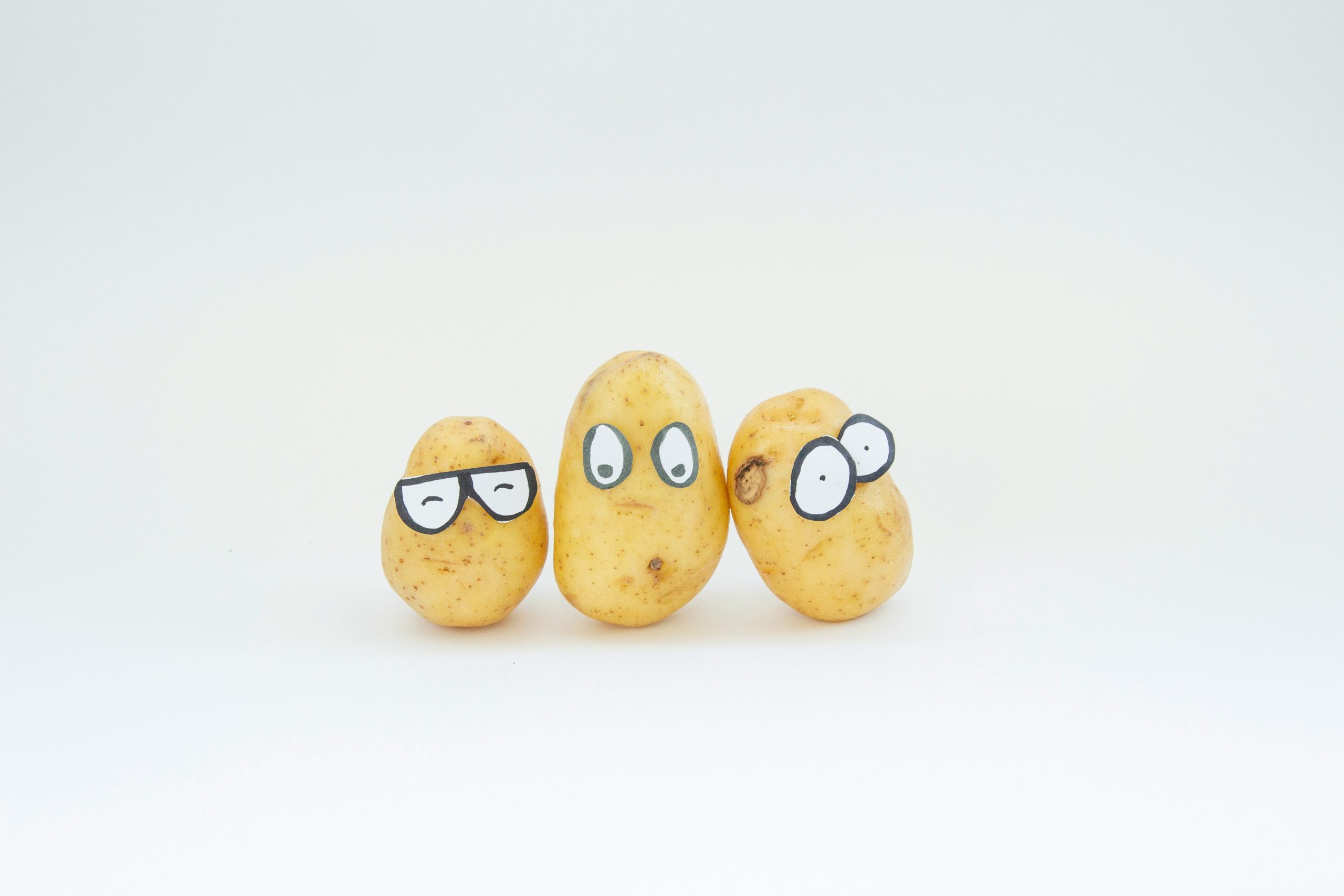
A potato patch that only spreads but never gives potatoes is not much use to anyone.
In that sense, the purpose of growth is not growth.
The purpose of growth is fruit.
Or, in our strange little Brida world, potatoes.
The usefulness of looking the other way
This is where the upside-down view becomes useful.
If everybody is running in one direction, it can be valuable to have somebody nearby who instinctively looks the other way.
Not to stop progress.
But to question its direction.
Not to criticise for the sake of criticism.
But to ask whether the road still leads somewhere worth going.
In Brida, Fruitloop often plays that role for me.
She is still upside down in South Africa, living under a different sky, in a different season, with a different rhythm of life.
She is a generation younger than I am.
She is a woman.
She is a mother in the middle of laundry mountains, school homework, family logistics, work pressure and ordinary domestic chaos.
I am none of those things.
I am the Mayor, sitting somewhere else, thinking in systems, projects, folders, Potato Patches and strange Brida operating models.
On paper, this should probably not work as well as it does.
Yet it does, precisely because we do not see the same thing in the same way.
When I drift too far into structure, she reminds me of life.
When I become too theoretical, her world brings the discussion back to the kitchen table, the school bag, the tired child, the WhatsApp message, the real person.
When I decide, occasionally, that perhaps I should try doing things normally for once, I still need an upside-down anchor.
Friction is not failure
That is not always comfortable.
Different perspectives rarely are.
They create friction.
They slow things down.
They complicate simple plans.
They force explanations that one would rather skip.
But they also prevent blindness.
They stop one person’s logic from becoming the only logic in the room.
The same is true of going against the grain more generally.
The grain offers certainty.
It offers approval.
It offers the reassuring feeling that we are doing what everybody else is doing.
Swimming against the current is harder.
It requires patience, trust and occasionally the willingness to look slightly ridiculous while doing it.
The Australian habit of improvising
Australians understand this instinctively.
Living on an island continent at the far edge of the map creates a certain practical independence.
You learn to improvise.
You learn not to panic when things are different.
You learn that there is little value in complaining about reality.
It is generally more productive to work with what is in front of you.
Perhaps that is why the idea of being upside down never bothered us very much.
From our perspective, maybe everyone else was upside down.
The dangerous question
The interesting thing is that many meaningful discoveries begin with somebody looking at the accepted way of doing things and asking a dangerous question.
“What if we tried the opposite?”
Sometimes the answer is disastrous.
Sometimes it changes everything.
The challenge is knowing the difference.
Going against the grain is not automatically wise.
Being different for the sake of being different is just another form of conformity.
The value comes from understanding why the grain exists in the first place, and then deciding consciously whether it still serves a purpose.
The best alternative paths are not acts of rebellion.
They are acts of curiosity.
They emerge from paying attention.
From noticing something that others have overlooked.
From seeing a possibility where others see only habit.
What this means for Brida
Looking back, I suspect many of the things we value most in Brida emerged this way.
Not through grand plans or complicated strategies, but through simple questions that pointed in an unexpected direction.
What if conversation came before content?
What if usefulness came before growth?
What if we did not begin by asking people to join us, but by asking how we could help them?
What if ordinary life was not a distraction from community building, but the very soil in which community grows?
There is a certain freedom in that.
A willingness to look at the world from another angle.
A willingness to believe that there may be another way.
A willingness to accept that the view from the bottom of the map may reveal things that are harder to see from the middle.
Turn the map around
Perhaps growing up upside down taught me something I did not fully appreciate at the time.
Not everything that everybody else is doing needs to be copied.
Not every trend deserves to be followed.
Not every measure of success deserves to be measured.
Sometimes the most valuable thing you can do is stop, turn the map around, and look at the world from another angle.
From down here, some things suddenly make a lot more sense.