
The Holiday Report Continues: Martin Returns from the Digital Wilderness
Martin
Later, after my Fritzbox had staged its small but effective rebellion, I wrote to The Mayor.
I had to explain myself, because in the middle of Manfred’s Croatian field study I had simply disappeared. This was not because the questions had become too difficult. It was not because the killer ants had somehow reached my house. It was because my internet had gone on strike.
I told The Mayor that I was sorry. Unfortunately, my internet had refused to work. Now I was in the office and therefore connected to the world again.
At first, I had hoped it was only a Fritzbox update. They like doing that. Quietly. At the wrong moment. With the calm arrogance of German household technology.
I also asked whether one could actually send messages by Teletext.
This was only half a joke. When the internet disappears, civilisation immediately feels thinner. Suddenly the old technologies begin to look surprisingly reliable. Teletext, fax machines, carrier pigeons, smoke signals from the balcony — all of them seem more dependable than a router that has chosen philosophy over function.
I told The Mayor I would look at the remaining questions.
Then I wished him a great week, because even after a technological betrayal one should remain polite.
The Mayor, of course, had more questions waiting.
He asked me what role the bicycle played in Manfred’s story. Was it transport, companion, opponent, or silent philosopher?
For me, the answer was clear. The bicycle had its role as the direct connection to the bakery. Therefore I would say it was the true companion.
This is important. In Manfred’s holiday system, the bicycle was not merely a vehicle. It was not just something with two wheels and a saddle. It was the bridge between the campsite and the morning rolls. Without the bicycle, the day would not begin properly. Without the bakery, the coffee would stand there sadly, wondering what had happened to its purpose.
So the bicycle was companion, yes. Possibly even spiritual adviser. But above all, it was the trusted diplomatic channel between Manfred and breakfast.
The Mayor then returned to the difficult moment — the wildlife crisis, the seagull attack, the ants with terrorist training — and asked what this told us about Manfred under pressure. Or about camping’s talent for making small problems very important.
I said Manfred is always well prepared, as a real camper should be. That is true. He is not the kind of man who enters a campsite with vague hope and a plastic bag. He brings systems. Experience. Knowledge. Probably several solutions for problems that have not happened yet.
Only in terms of food protection, he still has to find a solution.
But I admitted that I would not have any idea either.
How does one protect lunch from giant killer seagulls? You cannot reason with them. You cannot appeal to their better nature, because their better nature has apparently joined a criminal organisation. You cannot simply explain that the sandwich belongs to your wife. They already know. That is why they want it.
Maybe, I thought, the whole thing could be turned into a filming location for a movie called The Killer Seagulls.
I could see it immediately. A peaceful Croatian campsite. Comfortable temperatures. A chair by the lake. Morning rolls. Then, above the horizon, wings. Screaming. Chaos. A lunch taken directly from a hand. Manfred standing there, not frightened exactly, but deeply offended by the breakdown of order.
The sequel, of course, would be The Killer Ants.
Possibly with drone attacks.
Then The Mayor asked whether comfort sometimes gets in the way of clear thinking.
I said no.
Comfort is the only way of clear thinking.
This may be the central theory of the whole experiment. Many people believe that difficulty produces wisdom. Perhaps sometimes it does. But I think the brain works better when the chair is right, the coffee is present, the internet is functioning, and the killer ants have agreed to a cease-fire.
Discomfort does not automatically create insight. Sometimes it only creates bad posture and suspicious thoughts about insects.
The Mayor then asked what I would call the caravan in this experiment: shelter, laboratory, enemy, or badly folded philosophy.
I called it a laboratory-like shelter.
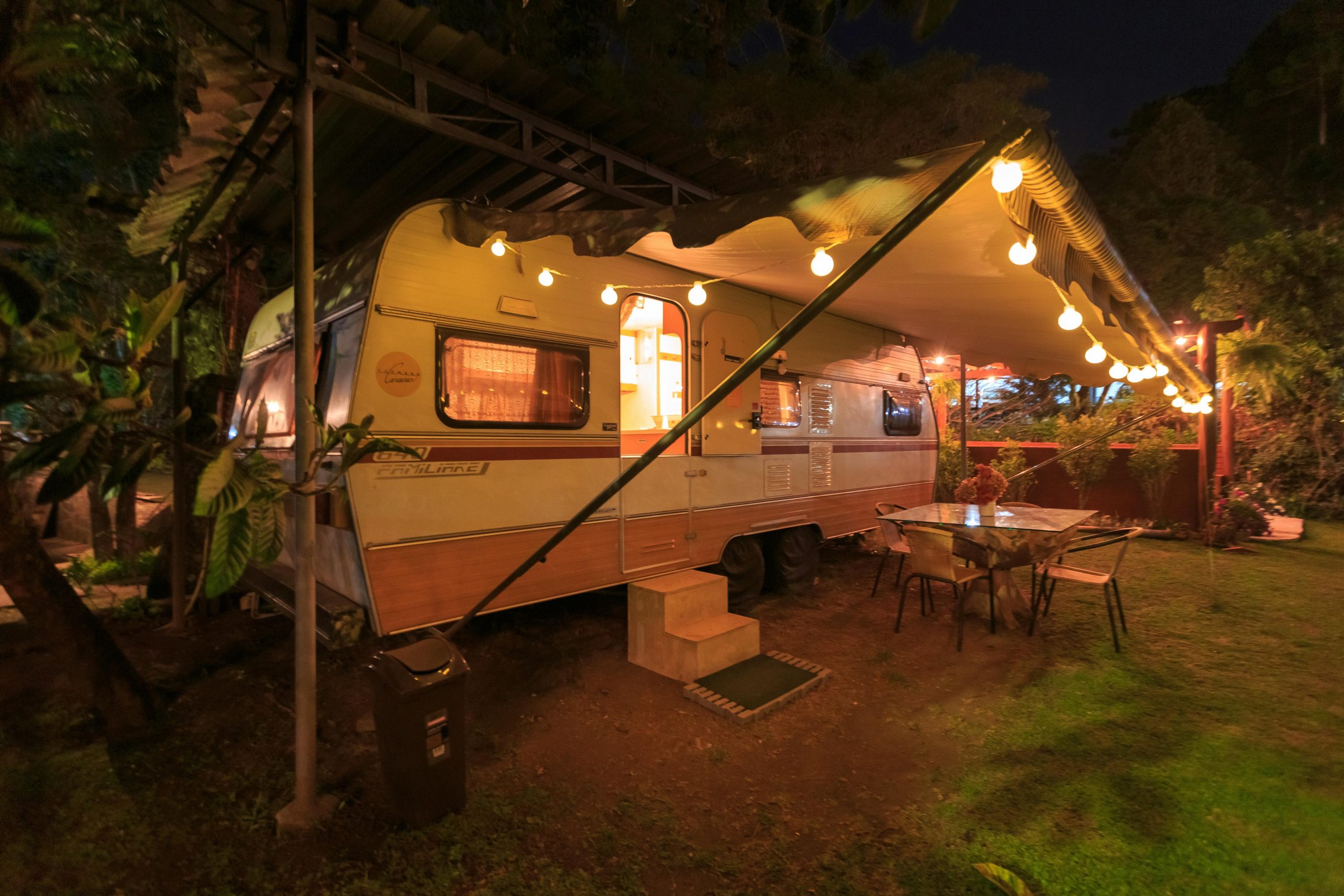
That seemed accurate. Manfred’s caravan is not only a place to sleep. It is a controlled environment. It carries home into the unknown. It allows field research without surrendering completely to chaos. It is shelter, yes, but also laboratory: a place where one tests comfort, routine, equipment, weather, bread logistics, and the limits of peaceful coexistence with local wildlife.
The caravan is also proof that Manfred’s home is mobile. This became clearer when The Mayor asked whether missing something is part of the experiment. Do we only understand home properly when we have temporarily removed it?
I thought that was true. Even without feeling homesick, it is nice to be back home after a long journey. If only so you can reflect on everything in peace.
But in Manfred’s case, there is a complication.
Manfred’s home is always with him anyway.
That is the genius of the caravan. It blurs the whole experiment. You leave home, but you bring a version of home with you. You travel, but you do not fully surrender yourself to the unknown. You are away, but your chair, your systems, your breakfast logic, and your personal order of things come along for the ride.
So perhaps Manfred does not return home in the normal way. He simply parks one home beside another.
Finally, The Mayor asked whether the question “Why am I doing this?” is a sign that the experiment is failing, or whether it is exactly the moment when the experiment becomes interesting.
I said it was a good sign.
It means you are doing something that might be irrational, but is good for the soul precisely because of that.
That is probably the best definition of a real holiday. Not everything has to be efficient. Not everything has to make sense. Cycling to update an ice-cream parlour guide may not be strictly necessary. Sitting by the sea and negotiating a cease-fire with ants may not be a recognised therapeutic method. Camping in a place where seagulls behave like airborne lunch thieves may not appear in a wellness brochure.
But somehow these things are good for the soul.
When it comes to killer ants, though, my answer is a bit different.
There are limits to philosophy.
Even for me.