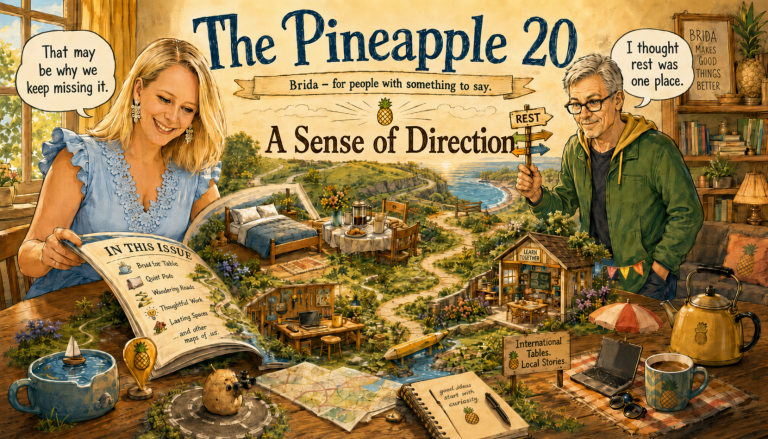
In this Issue
The coffee has gone cold again.
It sits on the edge of the desk, a dark, still pool next to a mountain of open tabs, sticky notes and proof sheets. Outside, the world is moving at its usual, loud pace. Cars hum down the street, neighbours argue about the fence line, and the day marches on.
But inside the screen, a completely different universe is unfolding.
We build blanket forts when we are kids because the living room feels too exposed. We need a space where the rules of the adults don’t apply, a small domain where a couch cushion can be a castle wall. As adults, we don’t stop building them. We just change the materials. We use books, projects, schedules and quiet corners to cordon off a little piece of reality we can call our own.
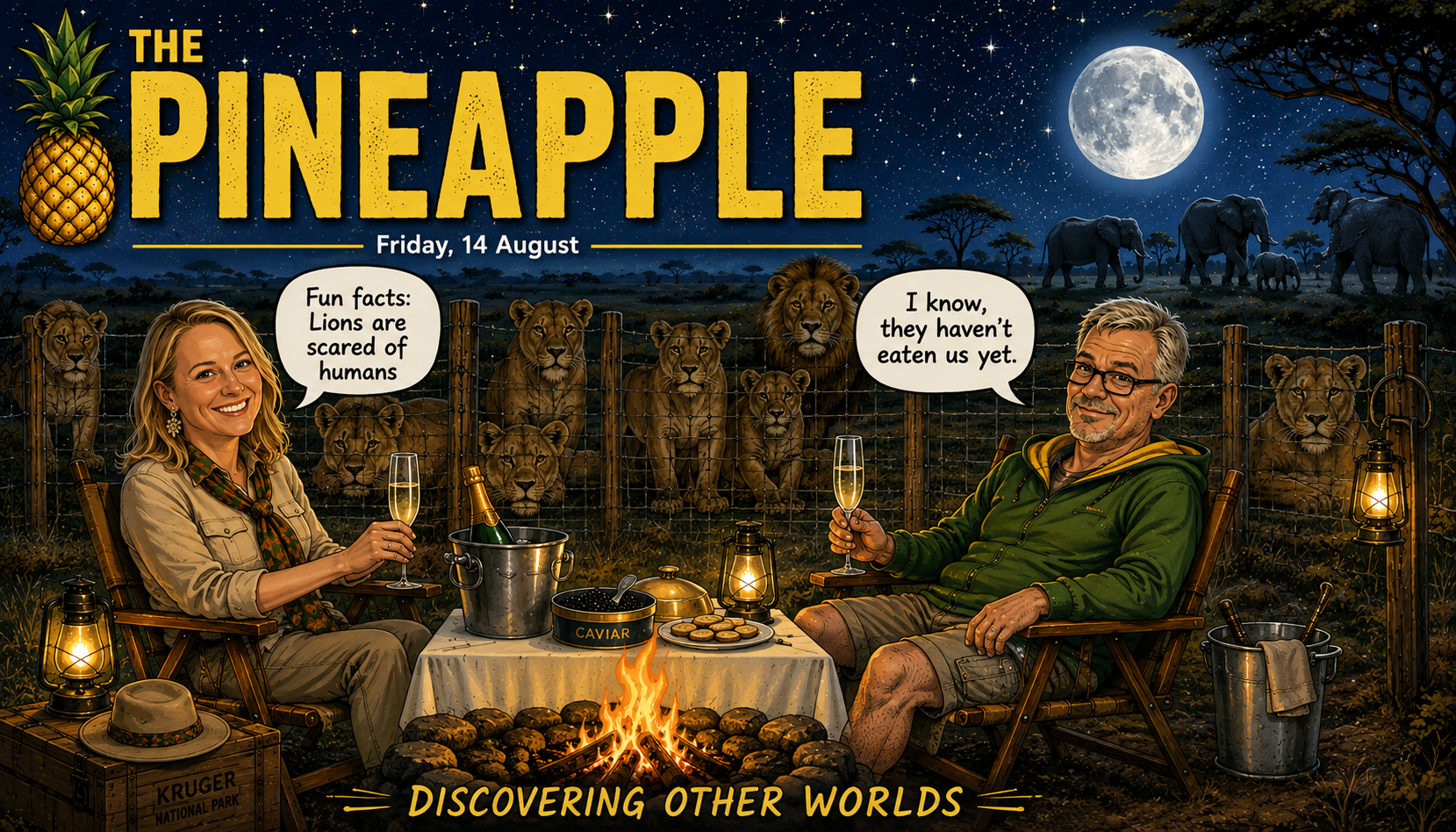
Welcome to Issue 24 of The Pineapple. This time around, we are looking at what happens when we step outside our own little forts—and what we find when we dare to look into someone else’s.
The Architecture of Our Own Making
It starts with the small choices, the micro-worlds we construct just to get through the day. In our Editorial, we take a long look from the safety of that blanket fort, wondering how the view changes when we finally peek through the folds of the fabric.
Sometimes, the worlds we build are literal, moving pieces of architecture. Take the Swimming Club, who remind us that home isn’t always a fixed coordinate on a map. In My Mobile Home Is My Castle, we explore the strange, liberating reality of packing your existence into a few square metres on wheels. It’s the ultimate fort—one that can be parked somewhere new, taking its small version of home along for the ride.
Then there is Fabrice, whose world exists Two Metres Above the Road. As our feature article for this issue, it takes us into the cab and gives us a view most of us pass every day without really seeing.
From up there, the road looks different—but so does the work. Fabrice’s world is full of other workers, drivers, cyclists and the constant responsibility of moving a very large vehicle safely through spaces shared with everyone else. Sometimes that responsibility even means climbing down from the cab to help someone outside it. What looks ordinary from pavement level turns out to require judgement, awareness and a kind of competence that becomes almost invisible precisely because it is practised every day.
Perhaps stepping into somebody else’s world is partly about noticing what they have learned to see.
- The View from the Blanket Fort: A quiet look at our self-made boundaries.
- My Mobile Home Is My Castle: Finding freedom inside four moving walls.
- Two Metres Above the Road: Seeing the road—and the responsibility that comes with it—from another height.
The Friction of Leaving the Familiar
We like to think we understand our spaces. We know which window catches the morning light, when the rubbish goes out, where the traffic gets bad and which neighbour is likely to appear at exactly the wrong moment.
Then imagine handing all of that to somebody else—and going to live inside their ordinary life instead.
In Peeling Potatoes 59, we tackle the uncomfortable truth that The Answer Is the Question. We spend so much time looking for solid ground, for final definitions, that we forget the beauty of the unknown. We want the world to be simple, but it rarely is.
Ismar & Ritesh make that idea wonderfully literal in Before You Hand Over the Keys. They imagine swapping homes for a month and discover that a home is much more than the place where somebody sleeps. To live in another person’s world, even temporarily, means learning its windows, neighbours, rubbish collection, traffic, food, language and all the small instructions that usually disappear into habit.
The keys may get you through the front door. They don’t automatically teach you how the world on the other side works.
And then Hello, World takes us into another collection of worlds that appear, from the outside, to be one.
It begins with something almost absurdly small: a component worth around thirty cents that can threaten production. From there, the view widens. Purchasing sees one reality. Logistics sees another. Engineering, hardware and software each have their own map of the same territory. And now AI introduces yet another way of seeing what the system is, what matters inside it and what might happen next.
Everyone can be looking at the same company, the same product, even the same problem—and still be standing in a different world.
Maybe understanding each other begins with recognising that.
The Pull of Faraway Horizons
There is a specific kind of magic in anticipation. It’s the feeling of looking at a calendar and realising your current reality is about to shift.
Babette captures this perfectly in Eighteen Days Until Egypt. It is the chronicle of the countdown, the mental packing and the way a destination starts to inhabit your mind long before you ever board the plane. The ordinary days become coloured by the extraordinary ones waiting just around the corner.
For a different kind of escape, we take a trip through Postcards, landing in An English Seaside Town. Here, another place becomes an invitation to look around, notice its rhythms and spend a little while somewhere outside the boundaries of our own ordinary day.
Meanwhile, Bruce offers a more internal kind of travel in The Freedom to Think Further. His journey doesn’t require a suitcase. It asks what happens when we push beyond the familiar boundaries of our own thinking and allow an idea to carry us somewhere we had not expected to go.
Some worlds are reached by road or plane.
Others begin with a thought.
Domestic Universes and the Spaces Between
Ultimately, we always come back to the centre. To the kitchen. To the table. To the places, people and things we find ourselves returning to.
That question sits at the heart of Rosii & Monica’s At The Table: What is something you keep coming back to?
In What Pulls Us To The Singing Fridge, the answers move in all directions. Mountains. Childhood places. Skiing. Volleyball. Family. Food. Music. One answer opens another door, and suddenly the table contains a whole collection of personal worlds—places and experiences that exert their own quiet gravity long after we have left them.
The singing fridge is there too, of course. But perhaps its real trick is not calling us into the kitchen. It is giving us an excuse to ask what keeps calling us back.
Ralf gives us a more literal reason to gather around food with Chicken Asado.
This is not a dish that quietly looks after itself. A whole chicken is marinated with orange, lime, garlic, paprika and cumin, then cooked over a hot barbecue, turned and basted again and again. Ralf’s instruction may be the best summary of the required commitment: you stand there “like a small soldier of the chicken.”
Some worlds require contemplation.
This one requires attention, heat and a willingness to stay at your post.
And in Fruitloop’s Reflections, The Middle Ground brings us back toward home. The world outside remains full of forces we cannot control. The question becomes what we do with the smaller radius that we can influence: our homes, our families, our immediate surroundings and the choices available to us there.
Maybe the middle ground is not a compromise between hiding and charging into the storm.
Maybe it is simply the place where our reach becomes real.
The Boundaries of What We Know
As this issue closes, we look toward the horizon.
In In the Next Issue, we preview The Limits of Knowing. It is a gentle reminder that no matter how many worlds we enter, how many perspectives we borrow or how carefully we learn somebody else’s rules, there will always be things beyond our reach.
And perhaps that is exactly why looking matters.
The cold coffee still sits on my desk. The sun has shifted, casting a long shadow across the room. The blanket fort is still here, its corners soft and familiar.
We don’t explore other worlds to escape our own.
We explore them so that when we finally crawl back into our tiny, ordinary spaces, we can look at the old walls with entirely new eyes.
Turn the page.
Let’s see what’s outside the fort.