
In This Issue
Questions That Change Something
What happens when somebody asks one more question?
In Pineapple 23, the answer might be a new dance, a marriage, a boundary, a better wardrobe, a journey through somebody else’s ordinary life or a thousand words of carefully generated rubbish. It might also be a glowing portal behind the washing machine.
Curiosity Opens the Door
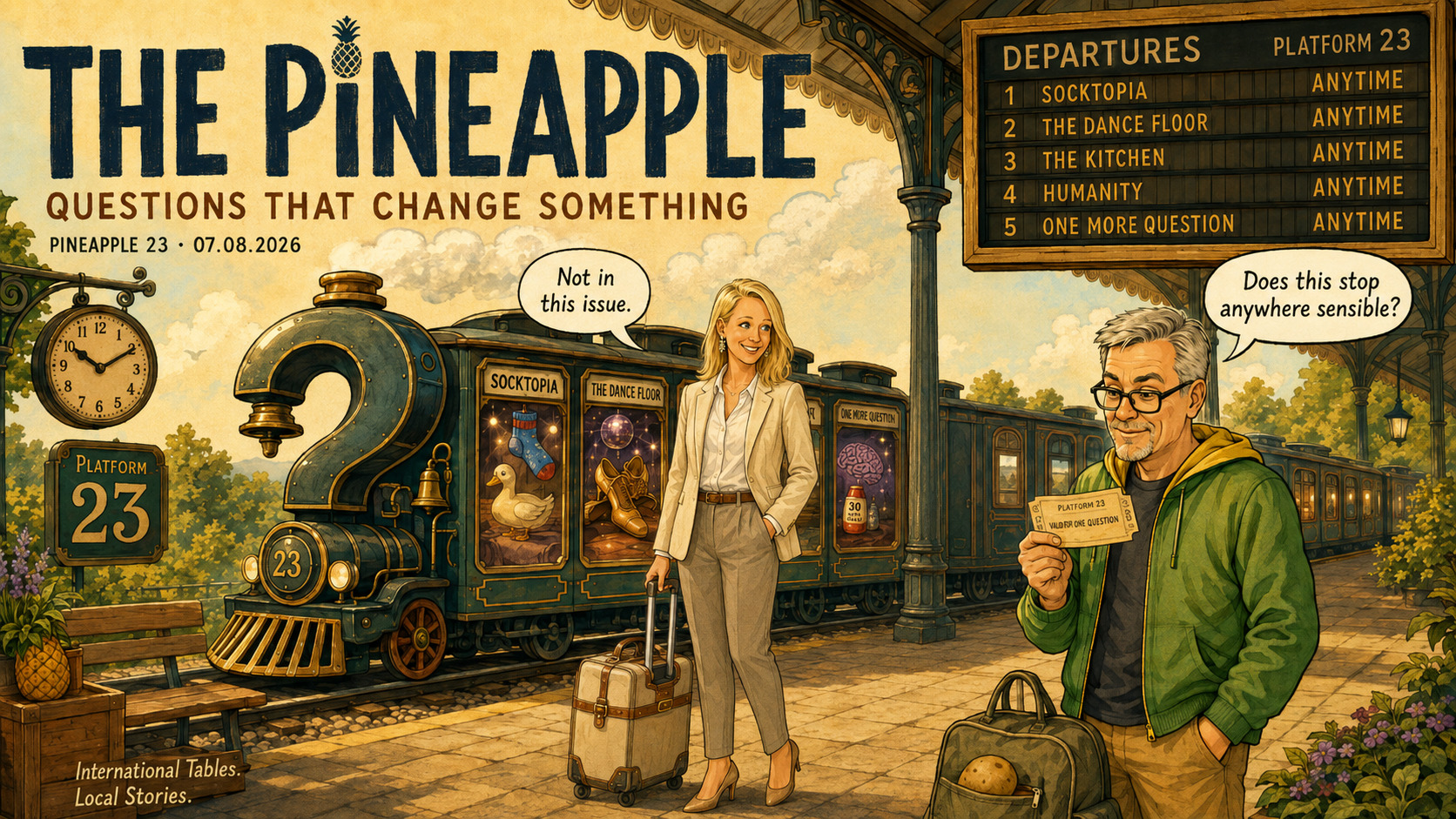
Janita opens the issue by taking the Mayor to Socktopia, a world of escaped socks, revolutions, suspicious ducks and laundry-basket racing. The adventure is gloriously unnecessary, which is precisely why it matters. After a difficult July, two people give themselves permission to invent another world and remember how good it feels to laugh together.
The Mayor responds by writing his own obituary. After years of asking what Brida is, who it is for and whether anybody might eventually pay for it, curiosity has apparently proved fatal. He leaves behind several pineapples, a growing number of potatoes and two questions Fruitloop has been asking for some time: where is the business, and where is the money? Interest may nod politely and go home, but curiosity misses the bus—and the Mayor has been missing buses for years.
Ismar shows us what can happen when a question changes direction. A long conversation about Brazil turns towards ballroom dancing, and suddenly we are talking about loneliness, music, movement and the pleasure of meeting people without needing to solve the problems of the country first. At sixty-five, Ismar does not know whether he will become a good dancer. He does know that dancing is one of the best things he has started in five years, and something he cannot regret.
Other Worlds at the Table
Rosii and Monica remind us that discovering another world does not always require a passport. A conversation can carry us into the traffic of São Paulo, the quiet of a French village, an Australian morning, a South African barbecue or the shock of discovering that spoken English sounds nothing like the dialogues in a textbook. Their table reaches one of the clearest conclusions in this issue: every person already lives in a world we have not experienced, and every genuine conversation offers us a small passport to visit it.
Ralf’s story begins with a question that was practical rather than romantic: “Are you the man who can cook?” Twenty years later, the answer includes three forks, one terrible knife, approximately forty-five better knives, soup, bicycles, triathlons, cold coffee and two people continuing to open unfamiliar worlds for one another. Ralf brought food, memory and a properly equipped kitchen into his wife’s life. She brought him into a sporting world he never expected to love.
Babette brings curiosity back into the routines of ordinary family life. A new wardrobe becomes larger, cheaper and slightly too large; working from home offers flexibility but removes the natural pauses of the office; and planning a holiday becomes a negotiation involving cost, comfort, weather, language and several competing family opinions. Her contribution does not ask us to find a brilliant answer. It asks us to pause before assuming that the familiar way is the only way.
The Right to Ask—and the Right Not to Answer
Fabrice adds an essential boundary. Curiosity depends not only on the question, but also on who is asking, why they are asking and whether the other person feels safe enough to answer. Around a village festival, a fireplace and thirty apple trees, he shows how a personal question can become a good story when trust is present. He also gives us one of the issue’s most important rules: you may ask, but the answer still belongs to the other person.
Bruce and the Mayor take the issue into larger territory. They begin with several artificial intelligence systems competing to produce the best thousand words of rubbish and end with morality, work, parenthood, power, human judgement and cautious faith in humanity. AI can generate arguments, compare possibilities and reveal contradictions at extraordinary speed, but it cannot decide what we should value, when we should stop or whether we are willing to act on what we learn.
Fortunately, Martin arrives from the Swimming Club before everybody becomes too impressed. His Emergency Question Department requires citizens to prove that they have already thought for thirty seconds before asking anything. Martin accepts that instant answers can be useful, but he remains suspicious of confident nonsense, human laziness and machines that encourage us to forget the equipment already installed between our ears. His advice is simple: reconnect your brain, retain a little doubt and remember that the quickest route is not always the richest one.
Looking, Cooking and Coming Home
Manfred gives us time to look rather than argue. His final Dutch postcard takes us through Hoorn, a historic harbour town in North Holland whose old centre, waterways and trading buildings still carry traces of its maritime past. The photographs bring streets, water and quiet observation into an issue filled with questions, allowing another world to arrive without needing to explain itself.
Ralf then returns to the barbecue with his Roadkill Chicken. The chicken is flattened, seasoned, cooked slowly and repeatedly painted with piri-piri butter, garlic, bacon and herbs. This is not a press-button-and-walk-away recipe. As Ralf reminds us, you must remain present, watch, smell, turn and paint, because a barbecue is a relationship.
Janita closes the issue as Google with Feelings, the exhausted search engine for a small boy who would like immediate explanations for teachers, homework, food, missing shoes, bedtime and the general injustice of not yet being an adult. His curiosity is genuine, relentless and occasionally weaponised. It begins before Janita’s first coffee and continues until her own brain displays a low-battery warning.
One More Question
Together, these contributions show curiosity in many forms. It can be playful, practical, intimate, exhausting or dangerous. It can help us leave the house, enter another person’s world, challenge a routine, protect a boundary or notice the story hidden beneath a more serious conversation.
Not every question changes the world. Some change the room. Some change the person asking. Some need twenty years before we understand the answer.
And some simply make life warmer, stranger and more alive.
Welcome to Pineapple 23: Questions That Change Something.