
A Bed Is Not Always a Bed
At the Atlantic Corridor table, a conversation about sleep moved through pillow sizes, noisy motorcycles, missing mosquitoes, childhood darkness and the simple conditions that allow a person to wake restored.
Ritesh started this conversation a week earlier. He had said that he wanted to become more aware of his sleep.
On Monday evening, he tried to join us from Bangalore. He arrived home from work, adjusted his laptop, explained that dinner had not yet been decided—and then disappeared because of network problems.
He returned briefly. He had slept well after tiring himself with household work and going to bed at half past ten. He had woken fresh, with nothing wrong in his rhythm.
Then we lost him again.
“You will read about it in The Pineapple on Friday,” The Mayor wrote to him.
This left Ismar and The Mayor at the table: morning in Brazil, afternoon in France, and a question that sounded simple until we began answering it.
What does it take not only to sleep, but to wake restored?
The Body Knows First
When Ismar woke that morning, he felt that he had not slept enough.
If there had been no Brida meeting and no errands waiting for him, he would probably have slept for another hour. His body felt slightly dizzy. He did not want to get up.
“I started working when I was seventeen,” he said. “Since then, I think I never slept enough for a long period, because I always have something to do.”
Then his answer moved somewhere less certain.
Perhaps, he wondered, wanting to sleep more was sometimes a way of escaping from something. He could not say exactly what the problem was. It was simply a thought that had appeared while he was speaking.
The Mayor had slept longer than usual too. He normally gets up at five, but that morning he had stayed in bed until six. He had worked through most of the weekend and was already on his fourth call of the day.
“I don’t think I’ll be doing very much work after this,” he said. “I don’t think anybody will punish me.”
Sleeping longer had not automatically produced more energy.
That became the first distinction of the conversation: the number of hours matters, but it is not the whole story.
A Bed Is Not Always a Bed
The Mayor then asked Ismar to describe his actual bed.
Not his ideal bed. Not the bed from a hotel advertisement. The real one.
At his mother’s home, Ismar sleeps in a single bed. In his apartment, he has a double bed with what is called an orthopaedic mattress in Brazil. It is harder than an ordinary mattress, which suits him. He does not like a very soft bed.
When the weather is cooler, he uses blankets. During warmer nights, a sheet is enough. His pillow must not be too high or too soft, because he will wake with pain in his neck.
This led The Mayor into the international politics of pillows.
In France, pillows are often square: sixty centimetres by sixty. In Germany, they may be eighty by eighty. British pillows are rectangular. The bedding in The Mayor’s house follows British measurements, which means that replacement covers often have to be bought in England.
Then there is the duvet, filled with feathers, which is ordinary in one country and less familiar in another.
“A bed is not always a bed,” The Mayor concluded.
The object may be universal, but its shape, firmness, covering and place in the home are not.
The Sounds That Belong to the Night
At his apartment, Ismar sometimes hears motorcycles.
He does not know why motorcycles in Brazil seem so much noisier than cars, but even from a neighbouring street they can make themselves known. He also hears a neighbour crossing the floor in high-heeled sandals.
The sounds disturb him before he falls asleep.
“After I start sleeping, it doesn’t matter,” he said. “I don’t hear anymore.”
The Mayor wondered whether complete silence might also feel strange. His village in France becomes almost entirely quiet at night. Could someone accustomed to traffic, engines, and neighbours sleep comfortably when there was no sound at all?
Ismar thought he probably could. Silence would be better.
But an open window was another matter.
In Brazil, mosquitoes may enter. In France, The Mayor had not seen or heard a mosquito all summer. He had not been bitten, and neither had Mary—who normally attracts them first.
“We use our enemies for sleeping,” Ismar said.
Mosquitoes may have the right to exist, The Mayor decided, but they are not friends.
Before Electricity, There Was the Sky
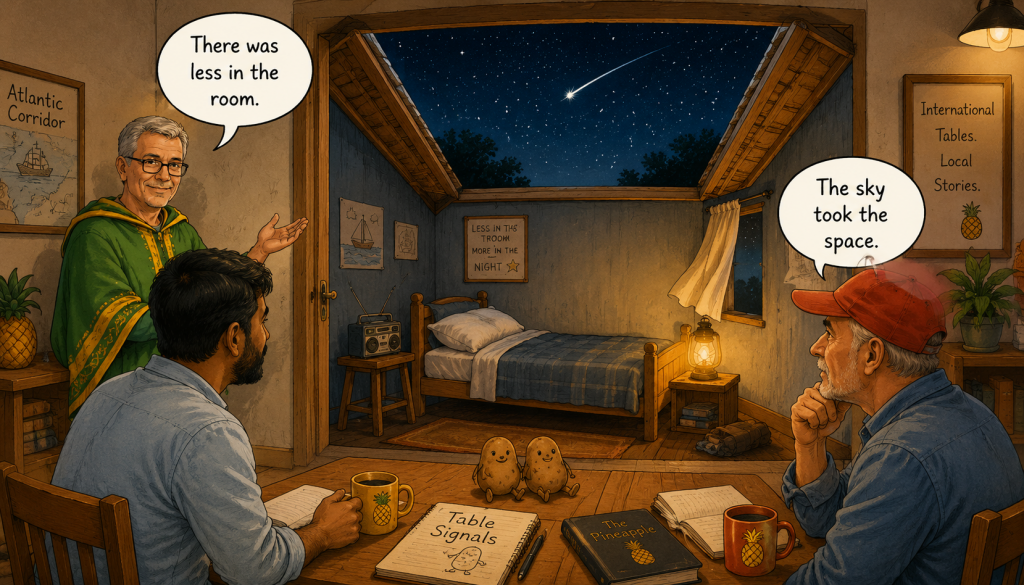
The richest part of the conversation arrived when Ismar remembered sleeping on the family farm.
Before he was eight, the family had no electricity at home. They went to bed at around eight in the evening. They had a battery-powered radio, which they listened to together.
Sometimes the family stayed outside at night.
There were no nearby cities and no artificial light. Ismar remembers sitting with his parents and looking up at the sky. Occasionally, they saw a shooting star.
“Today, I remember this time,” he said. “I liked it when we stayed at night outside, looking at the sky.”
It was a childhood with fewer things in the bedroom and more sky outside it.
There was also less privacy. Ismar shared a bedroom with his sisters. A room of his own was available only in some of the houses where the family lived.
He now thinks a private bedroom can be important for a child.
“It is a kind of privacy, and you are developing your identity.”
Less light pollution gave him the stars. More personal space might have given him another kind of freedom.
The conversation did not try to decide which childhood was better.
It simply noticed what each arrangement made possible.
We Choose the Bathroom, Not the Sleep
Ismar’s apartment bedroom faces west.
The afternoon sun heats the room, making it less comfortable at night. He believes apartments on the opposite side of the building, facing east, are probably better for sleeping.
Some Brazilian buyers consider this when choosing a home.
The Mayor realised that he had not.
When he and Mary viewed their present house, the room that helped them decide was the bathroom. Their previous home had an old bathroom. This one was modern, spacious and sleek.
They inspected the bedroom and decided that the furniture would fit. They did not ask what the quality of their sleep might be.
Years earlier, they had rented a house in a French town centre. During street festivals and neighbourhood parties, they sometimes could not sleep for several nights. In later years, they escaped elsewhere during the celebrations.
We inspect the kitchen. We measure the rooms. We calculate the rent or mortgage. We look for supermarkets, buses and bathrooms.
Ismar himself chose his apartment mainly because it was close to a supermarket and convenient for his mother.
Yet sleep occupies a large part of life, and we may never ask whether a new home will allow it.
Sleep Is Not Equally Available
A quiet room, stable electricity, clean air and the freedom to open a window can feel like ordinary details.
They are not ordinary everywhere.
Ismar said that sleeping in a favela would be very different from sleeping in a high-class condominium. In some places, safety determines whether a window can remain open. Heat, unreliable infrastructure and crowded housing may also become part of the night.
Even within the same city, two people may not have the same access to rest.
This was where the comparison between Brazil and Europe became something larger.
The difference was not simply between countries. It could exist between two streets, two buildings or two sides of the same apartment block.
The Sleep Inspector Arrives
The Mayor invented a new public official: the sleep inspector.
This person would visit bedrooms, examine mattresses, investigate routines and report on the nation’s sleeping conditions.
Ismar’s inspector would quickly discover one of his strongest rules: he cannot go to bed without taking a shower.
He has seen people return from the street, remove their shoes and lie directly on the bed. He has seen people walk barefoot around the house and then climb under the sheets without washing their feet.
For him, this is impossible.
“I think I won’t sleep well. I have to take a shower before.”
His perfect night required no expensive technology.
The temperature would be somewhere between twenty and twenty-five degrees. The neighbours would make no noise. There would be no mosquitoes, no nightmares and no repeated interruptions. He would have around eight hours available.
That was almost the entire design.
No luxury mattress system. No intelligent sleep monitor. No machine producing a personalised atmosphere.
Just enough time, reasonable weather, quiet neighbours and a body left in peace.
Less Is More—But Not Less Sleep
At the end, The Mayor asked whether Ismar wanted to change anything.
Ismar did not believe there was a substantial change available to him. His sleep is sometimes interrupted during the night, but he normally goes to bed between ten and eleven and sleeps a reasonable number of hours.
He would prefer to need less sleep.
More waking hours would give him more time for French, Pilates, Toastmasters, helping his mother and everything else that fills an ordinary day.
But his body refuses the negotiation.
When he sleeps too little, his eyes burn and his mood deteriorates. He has known this since he was young, when he worked through the day and attended school at night.
Perhaps “less is more” does not mean removing hours from sleep.
Perhaps it means fewer interruptions. Less heat trapped in a west-facing room. Less noise from motorcycles and high heels. Less light from a phone beside the bed. Less technology trying to solve conditions that a breeze, a curtain or a quiet street might solve better.
And perhaps restoration begins with something even simpler:
Not treating sleep as the empty space between the important parts of life.