
The World Outside the Telephone
Fabrice on forest silence, practical traditions, young people, schnapps, cricket, and the things a screen cannot teach.
This began as a conversation about digital rest.
For many people, this means switching off notifications, deleting an application, or planning a weekend without a telephone. For me, it is less complicated. I do not have Facebook. I have LinkedIn and email because sometimes I need them for work, but I use them when I must.
They are useful. They are simply not my life.
Then Janita asked me to imagine that one or two young people put away their phones and spent a Saturday with me in and around Cleebourg.
What would I show them?
That was a better question.
A Saturday Outside
We would begin in the village and then walk through the fields and into the forest.
There are old places to see. There are remains of a castle and old anti-tank defences from the Second World War. We could walk to the highest point and look across the landscape. There are fruit trees, mushrooms, fields and forest.
There is also silence.
The silence in the forest is very nice. The Mayor can confirm this, although during our last walk the silence was sometimes interrupted by heavy breathing.
The Mayor says I do not follow the main paths. This is perhaps true. He likes small roads instead of highways, and I like small paths instead of the large forest routes.
Sometimes there is no path.
You walk through the trees, continue upwards and eventually come out somewhere.
It just depends where.
A young person who spends this Saturday with me would not need to complete a programme. There would be no checklist. The important thing would be to walk, look and notice what is already there.
The Knowledge Between People
During our walk the previous week, The Mayor and I had spoken about local traditions. We wondered what would happen to them when the older generation was no longer here.
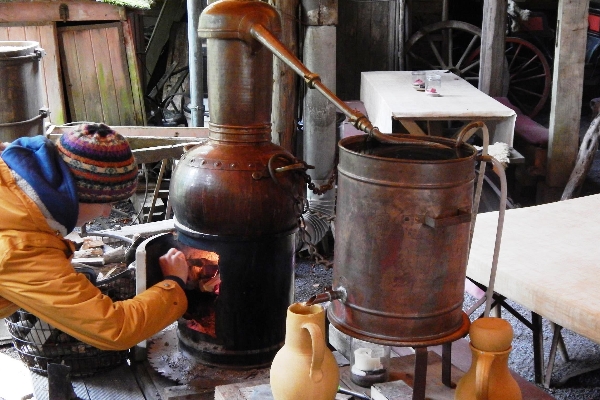
I mentioned that one or two younger people want to learn how to distil schnapps. I will call them when I do it again during the winter.
I did not learn this from the internet.
My grandfather distilled when I was young, but at that time I was too young and not interested. Later, when I became interested, he was already dead.
I began about ten or eleven years ago. A friend showed me how to do it. During the first two years, he stayed with me and helped me through the process. After that, I began doing it alone.
It was learning by doing.
Learning by doing is effective, but it is not always comfortable.
Once, I opened the equipment while part of it was still extremely hot. I burned my legs badly. I went to the hospital, received treatment and then returned to finish the work. We continued until around two o’clock in the morning.
My friend looked at my legs and made a joke about boiled shins.
The mark looked a little like the map of Australia.
I have not forgotten the lesson.
There are some things a video can explain. A video can show the order of the work and the equipment. But it cannot stand next to you and notice that something is wrong. It cannot smell the air, feel the heat or understand the particular conditions on that day.
It also cannot laugh at your Australian leg.
Working, Waiting and Talking
When two people work together, the process is easier.
One person can clean and prepare while the other takes care of the next task. There are short periods when many things must happen quickly. Then there are long periods when you sit and wait.
During this waiting, you can speak with each other.
This may be one of the things we are losing.
When I was young, we did not have mobile phones. We were outside all day—in the fields, in the forest, alone, with friends or with my grandfather. There was always some activity.
Today I sometimes see two young people sitting next to each other. Both have a telephone in their hands. They may be using Instagram, TikTok, messages or something else.
They are next to each other, but they are not having a discussion.
For me, this is the biggest difference between my generation and the younger generation.
I am not saying that all social media is bad. A little is fine. It can be useful. But there is too much of it, with too many choices, and sometimes people lose human contact.
There are also fewer families going into the forest together. People live more separately. They meet a neighbour, say hello and continue.
Perhaps we have made life easier, but not always richer.
A Lion Does Not Need Wi-Fi
Janita did not completely agree with the idea that screens only take people away from nature.
She follows pages from Kruger National Park. When she sees elephants, giraffes and zebras online, it makes her want to return to the park.
The screen can therefore open a door.
But at some point, you must go through it.
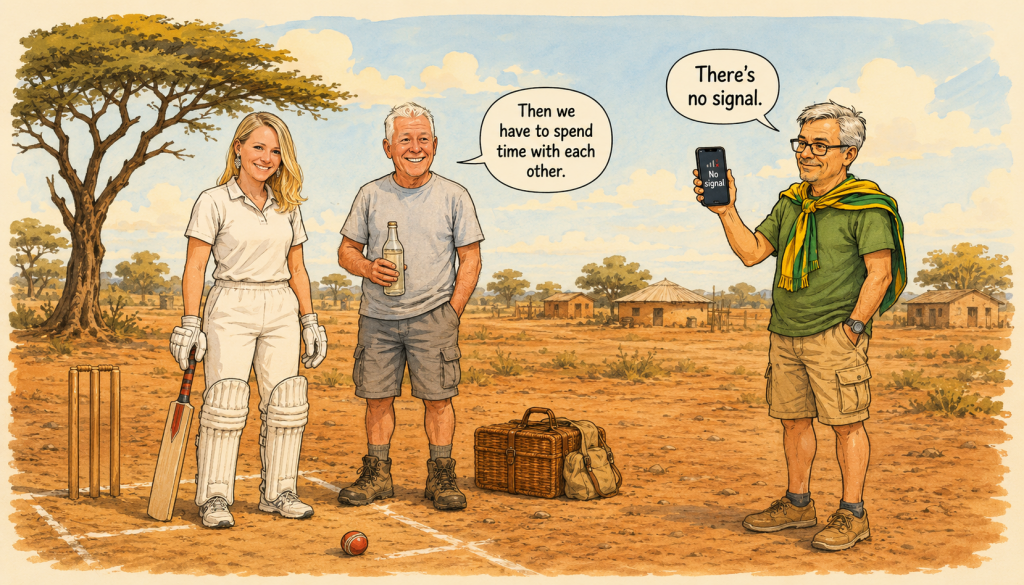
Janita explained that there is little or no signal while driving through much of Kruger. Her son was once unhappy because he could not play on his phone.
She gave him a practical explanation:
“A lion does not use Wi-Fi.”
This is difficult to argue with.
Technology can help us find a place, learn about animals or become curious about something new. But seeing an elephant on a screen is not the same as being quiet because an elephant is standing nearby.
Information may begin the experience. It cannot replace it.
Somehow, We Arrived in Chad
At this point, the conversation became less organised.
This often happens at Brida.
The Mayor calculated that if Janita walked north from South Africa and we walked south from Cleebourg, we could meet somewhere around Chad.
Janita was not completely convinced about the safety of this plan.
The Mayor then developed an alternative international delivery system for schnapps. It involved bottles, the Atlantic Ocean and possibly Namibia. Janita suggested that DHL might be faster.
Eventually, an agreement appeared.
I would provide the schnapps. Janita would teach us cricket.
I do not understand the rules of cricket. To me, it looks similar to baseball, although Janita says this is not correct. She grew up with cricket because her father loved watching it. The Mayor claims that listening to cricket on the radio is pure meditation.
We decided that a tennis ball would be safer because a real cricket ball is hard and painful. This would also protect the windows and, more importantly, the schnapps bottle.
The plan now includes a forest walk, distilling, basket-making, cricket, a barbecue and beer.
Possibly in Chad.
This may not sound like a conversation about digital rest anymore, but perhaps it is.
None of these ideas appeared because somebody was scrolling alone. They appeared because three people were talking, misunderstanding each other, correcting words, making jokes and allowing the conversation to go somewhere unexpected.
Put the Telephone Down and Do Something
Digital rest does not have to mean sitting in an empty room without a screen.
It can mean replacing the screen with something real.
Walk into a forest. Learn the names of mushrooms. Help someone prepare fruit. Ask an older person to show you a practical skill. Play cricket badly. Sit beside a fire. Wait for something that cannot be hurried.
Most importantly, speak with the person next to you.
I will use technology when I need it. I may even use the internet to learn one rule of cricket before Janita tests me.
But the telephone should remain a tool.
The world outside it is still there.
Someone only has to say:
“Come. I will show you.”