
The Small Things That Keep Us Alive
Johannesburg. Adelaide. São Paulo. Cleebourg.
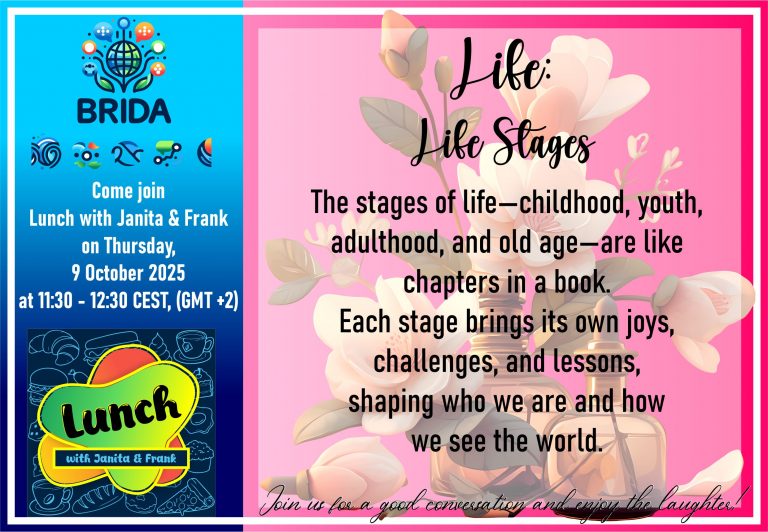
Four screens glow in three time zones. It’s Thursday again — time for the Brida Lunch with Janita & Frank. A ritual stitched together by humour, accents, and the strange intimacy of online friendship. Today’s topic: joy and meaning in life.
Janita — “Frootloop” to the others — hosts from a sunny South African morning. Monica joins from Australia, already deep into her evening. Rosii beams in from São Paulo, her voice bright with warmth, at 6.30 am; And Frank, the Mayor, co-hosts from his French village, a philosopher with mischief in his tone.
They begin, as always, with laughter. Then, quietly, with gratitude.
The Clock That Connects Time Zones
Frank opens with a comic confession — he’s keeping two clocks now. One for local time, and one labelled “Frootloop Time”. When the clocks go back to Winter Time and there will be an hour’s time difference between South Africa and France
“When Frootloop says, ‘I have twenty seconds for you, Mr. Mayor,’” he chuckles, “I look at the Frootloop clock. I’ll still get it wrong, of course.”
It’s the kind of detail that says everything about this group: the mix of affection and absurdity that keeps their digital lunches human. Across continents and connections, they’ve built a rhythm.
When the Wi-Fi wobbles, someone jokes. When someone disappears, another fills the silence. When Rosii’s computer finally reconnects, Frank cheers: “That’s a little joy in your life — your computer says hello and works!”
The Joy in Small Things
Janita opens the theme: What’s one small thing that made you happy today?
Monica smiles. “That poisonous snake was going away from my house, not toward it.”
Only in Australia could a brush with an eastern brown snake — one of the deadliest in the world — end in gratitude and Birkenstocks in hibernation.
Rosii’s joy is of another kind: giving. Every Christmas, her family “adopts” poor children, buying them shoes, clothes, and panettones. “When you make someone else happy,” she says softly, “you feel happy too.”
And Frank? His happiness began earlier in the week — a difficult week, he admits. “But I thought, I have to be here. Because I get enormous pleasure from speaking with all of you.”
Sometimes joy is as simple as showing up.
Nails, Cocktails, and the Sacred Ordinary
“What about you, Frootloop?” Frank teases. “What made you happy today?”
“My nails,” she grins. “I love them. The colour reminds me of summer — and my favourite cocktail, which I won’t name here.”
Everyone laughs. Even Frank, recovering from illness, is delighted by the sheer normality of it all. The conversation spirals from nail polish to Halloween plans to medical horror stories about burnt paperclips and smashed fingers — proof that humour, like joy, thrives in the absurd.
“Even in an economic downturn,” Monica notes, “the nail salons are always full. We’ll save on electricity, but not on nails.”
Takeaway: Joy doesn’t need a reason. Sometimes it’s as small as a painted fingertip — or the sound of laughter spilling through three time zones.
The Anticipation of Escape
Rosii, planning a weekend at the beach, beams through the screen. “I will drive my car — only women, nine of us! I need days off to relax my mind, eat ice cream.”
Frank, ever the mischief-maker, interrupts: “But you made a terrible mistake! You asked your boss for Tuesday off, but not Wednesday. That’s your birthday!”
Laughter erupts. “I would fire your boss,” he declares. “Call the White House. We’ll get you the day off!”
What could be more universal than this — the longing for rest, the bureaucracy of work, the dream of sea air? Her story radiates something bigger than humour: the right to pause, to reclaim a moment of happiness.
Birthdays, Seasons, and the Art of Remembering
The talk drifts to birthdays and childhood memories.
Janita recalls being born on Good Friday, the only baby in the hospital. Every year her grandmother gave her a rabbit. “I had so many teddy bears because of this,” she laughs.
Rosii remembers having just one photograph of her childhood — now used by her school to celebrate Teachers’ Day. “They took my child picture and put it next to me today,” she says. “It was a different and beautiful gift.”
Janita remembers the garden of her childhood, her first best friend, the feeling of stepping into kindergarten. Monica recalls her first day at school — terrified someone might steal her water bottle.
It’s funny what memory preserves: not the big events, but fragments, textures, sensations. A smile, a smell, a touch.
Reflection: What’s your earliest happy memory — and when was the last time you thought of it?
Gardens of Happiness
Janita’s final question lands like a poem:
“Imagine your happiness as a garden. What flowers or trees would grow in it?”
Rosii doesn’t hesitate. “Orchids. They live long. Every year they bloom again. Like happiness — sometimes you think it’s gone, but it comes back.”
Monica chooses sunflowers: “They’re always happy, bright, and yellow. You can even eat the seeds.”
Frank smiles wistfully. “My fig tree was cut down last week. I hope the roots remain and it grows again. Eating a fig straight from the tree — that’s paradise.”
Janita’s answer blooms from her homeland: “Amaryllis. They’re everywhere here in spring — red, tall, beautiful. My mother has them. My grandmother has them. They remind me that joy returns every year.”
In that moment, their gardens overlap — orchids, sunflowers, figs, and amaryllis — four continents, one quiet metaphor for resilience.
The Meaning Between the Lines
As the meeting draws to a close, the conversation slows.
Janita gathers the threads:
“Joy is all around us — in the simple moments, people, experiences, the small things we do. When we connect, even through a screen, we grow something meaningful.”
Frank nods. “It’s good to be back.”
And it is.
What Can We Take Away?
Happiness doesn’t always announce itself.
It hides in routine, humour, generosity, and remembrance — the scent of orchids, the laughter over nails, the relief of seeing a friend’s face again.
Maybe that’s the meaning: not chasing big fireworks, but tending to small lights.
Because, as this global lunch reminds us, life’s meaning is not found in grand moments — it’s cultivated in the garden of small ones.
What flowers would grow in your garden of happiness?
Brida residents can listen to the podcast in the Voice Pavallion.