
Please Stop Feeding the Drawer.
Rosie in Sao Paulo, Fruitloop in South Africa, The Mayor in Cleebourg. Monica, who found the fjords of Norway more attractive, sent her regards.
From mystery cables and faded receipts to old radios, corks and instruction manuals, one ordinary drawer reveals a surprisingly human reason why we struggle to let things go.
There is a drawer in Fruitloop’s house that she is slightly afraid to open.
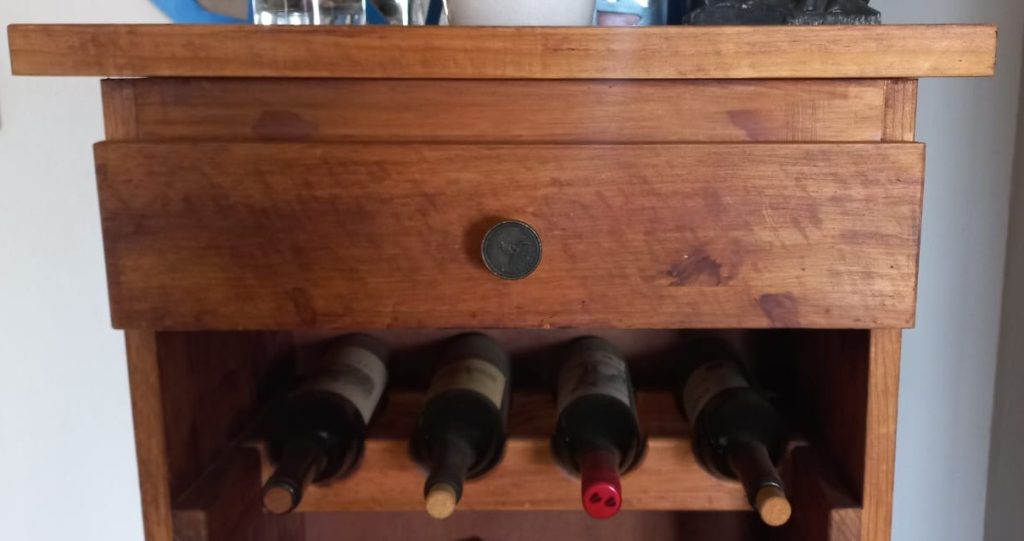
From the outside, it looks innocent enough. It sits above a wine rack and is roughly the size of an ordinary kitchen drawer. Inside, however, civilisation appears to have been quietly storing its leftovers.
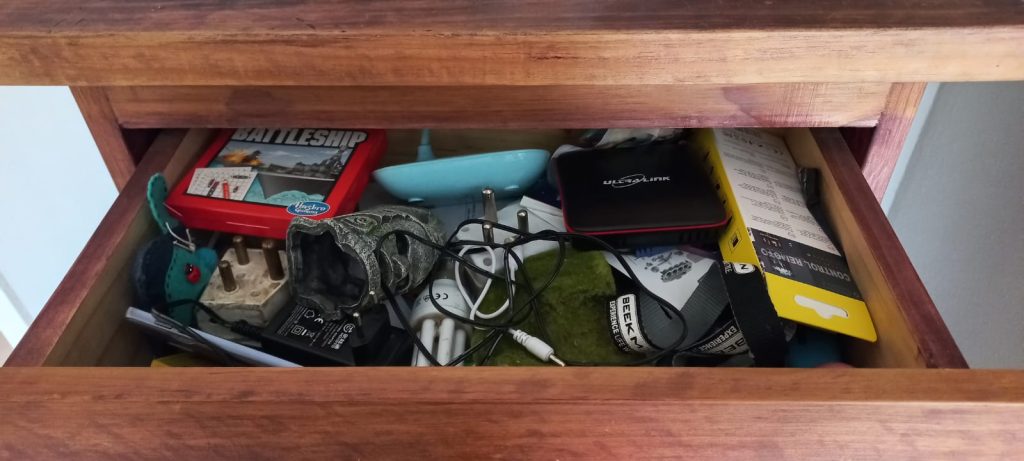
There are old passport photographs of her husband and kindergarten photographs of her son. Batteries. Cables. Chargers. A remote control that may or may not belong to anything still living in the house. A Battleships game played on paper. Old ornaments from an aquarium. A pocket knife. A lighter. Her son’s sunglasses, including a broken pair he probably sat on.
And, naturally, more batteries.
The Mayor wondered whether the aquarium ornaments included a mummified fish.
“No, no, not the fish,” Janita assured him.
This was how Lunch began its investigation into one of the great everyday mysteries: Why do we keep things we never use?
Every house has one.
Rosii immediately knew the kind of place Fruitloop meant. Hers is not technically a drawer but a space above her closet. When she opened it recently, she found a large bag filled with little toys, photographs and old things she had almost forgotten. There were even floppy disks.
Then came an object she had completely forgotten buying: an electric racket for killing mosquitoes and flies. It had been sitting there unused because she lives in an apartment where she does not really need it. At the beach house, however, it could suddenly become useful again.
Fruitloop knew the device immediately.
“We also have one of those,” she said, “but we don’t use it for the mosquitoes or the flies. We use it on each other.”
The Mayor considered this evidence of a particularly loving family.
“Yes,” Fruitloop agreed. “We love each other very much. So much that we shock our love into each other.”
Already, the mystery was becoming clearer. We do not necessarily keep useless things. We keep things that are currently useless. That is a very different category.
Rosii’s old radio is another example. She no longer uses it, and at some point it was damaged after being connected to the wrong voltage at the beach. She had it repaired and still keeps it, partly because she finds its design beautiful.
That led her to remember older record players and the wooden television her family once had. These objects belong to another technological age, yet that is precisely what gives them some of their appeal. Something can stop being useful and become interesting simply because the world has moved on without it.
Perhaps yesterday’s appliance is tomorrow’s vintage treasure.
Or perhaps it is just taking up space.
That is the problem.
The Mayor does not have a junk drawer.
The Mayor initially struggled to identify his junk drawer because, as he put it, “I think the entire house” may currently qualify.
On closer inspection, however, specialised junk zones began appearing everywhere.
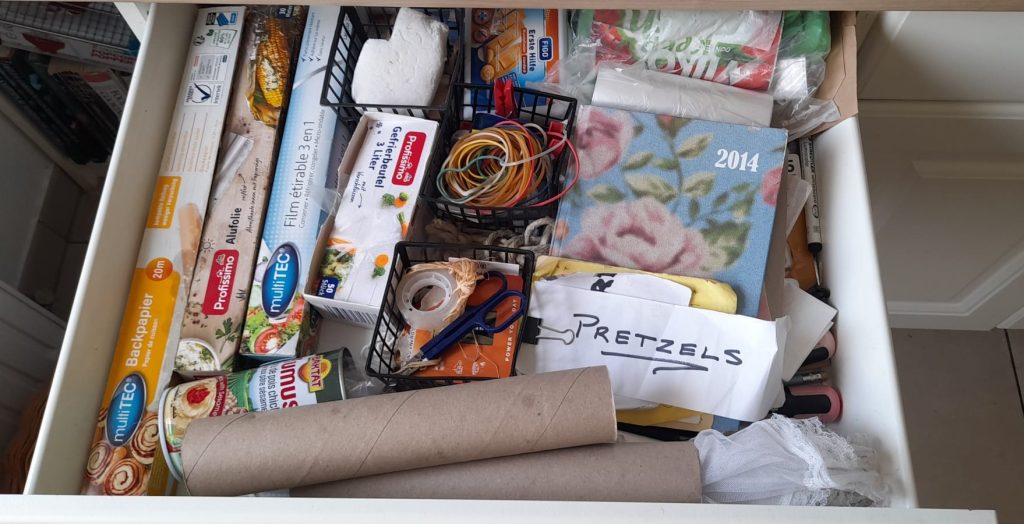
The kitchen has a utility drawer containing food tents, an old notebook recording meals, rubber bands, sticky tape, batteries for the scales, cling film, aluminium foil and freezer bags.
Then there is the magnificent specimen nearby: a medicine cabinet inherited from his paternal grandfather and now more than a hundred years old.
Its current contents are somewhat less historic.
There are coloured markers he no longer uses, cables, Sellotape, masking tape, keyboard cleaner, pens, pieces of paper, laminating supplies for equipment he no longer owns and an in-tray containing still more treasures.
Batteries.
Three passport photographs in which the Mayor believes he looks like a criminal.
More batteries.
Thumbtacks, paper clips, staples, keys, a camera, a staple remover, ink cartridges for a fountain pen he no longer has, glue, an onyx good-luck charm and, inevitably, more batteries.
At the bottom are materials his wife once used for making greeting cards. They may have been sitting there untouched for around fifteen years.
There is also a night light.
Just in case.
This phrase—just in case—may be the unofficial motto of junk drawers everywhere.
Even the Mayor’s famously misplaced hose returned to prove the point. It had disappeared, was eventually found, and now needs to come out of hibernation because its replacement has failed.
The thing you nearly throw away today has an irritating habit of becoming exactly what you need tomorrow.
Exhibit A: the instruction manuals.
Then the Mayor disappeared briefly and returned with evidence.
“I present you Exhibit A.”
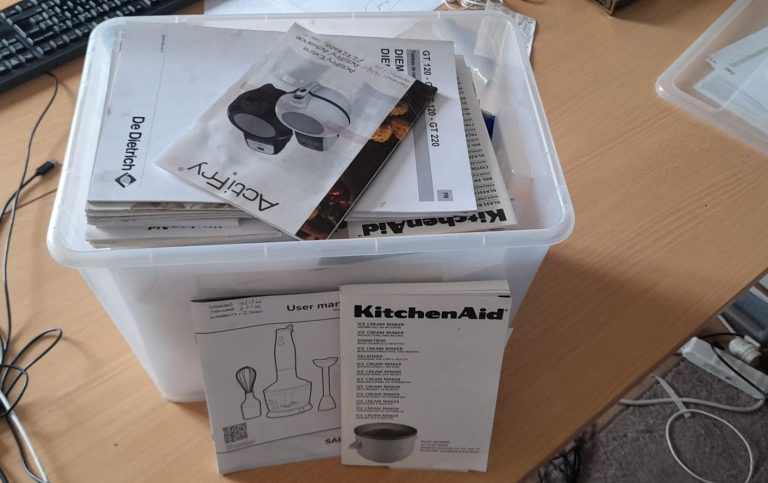
It was a plastic container filled to the rim with instruction manuals.
There was a manual for a blender. Instructions for an ActiFry. Plans for the heating system. KitchenAid manuals. Warranty documents. Guides for assorted appliances.
And then came the jewel of the collection: the instruction manual for a Kenwood blender system they no longer own.
The booklet is more than 140 pages long, not because operating the blender requires an advanced degree, but because the instructions appear in 19 languages. The English section itself is only a few pages.
Fruitloop’s philosophy is simpler. Once she knows how something works and the warranty has expired, the manual goes. If something breaks later, there is YouTube, Google or ChatGPT.
“This is the generational divide,” declared the Mayor.
Perhaps. But his box has one considerable advantage: if the internet disappears tomorrow, the Mayor may be one of the few people left in Europe who can operate an obsolete blender.
Assuming he can find the blender.
A box full of boxes.
Fruitloop has developed her own version of the same habit.
She has a box full of boxes. Phone boxes. Packaging from small electronics. Warranty information. Documentation. Manuals. All stored inside other boxes in case somebody, someday, needs something.
Ridiculous?
Not entirely.
When a button stopped working on her husband’s watch while it was still under warranty, the original packaging was required for the return. They still had it. The watch was sent back, declared faulty and replaced with a completely new one.
Including a new box. So the box full of boxes had justified its existence. And this is exactly how clutter wins.
One useful incident provides another ten years of legal protection for every unidentified cardboard box in the house.
The cable bag.
Then there are cables.
Fruitloop has an entire shopping bag full of them.
Charger cables. Connection cables. Cables belonging to devices nobody can identify. Possibly cables whose devices disappeared several technological generations ago.
Why are cables particularly difficult to throw away? Because somewhere inside us lives a tiny voice whispering: You are going to need this.
The Mayor offered a theory involving the old days when gadgets often came with their own specialised cables. Lose the cable and replacing it could become expensive or difficult. So people kept spares. Then they kept spares for the spares.
Soon, the cables had “families”.
Fruitloop knows the cycle. She cleans the drawer, tests the batteries, throws away the dead ones and keeps the good ones. Then she reaches the cables.
By that point, she no longer has enough energy to work out which cable belongs to which device.
So they go into the cable bag. The drawer looks better. Two days later, according to Fruitloop, it has had babies and is messy again.
Rosii recognises the same strange hesitation. She can hold something she knows she does not need, decide to throw it away—and then not do it. Maybe one day.
Maybe somebody will need it. Maybe.
That one word can apparently fill an entire cupboard.
The cork problem.
The Mayor then brought an urgent domestic matter before the table.
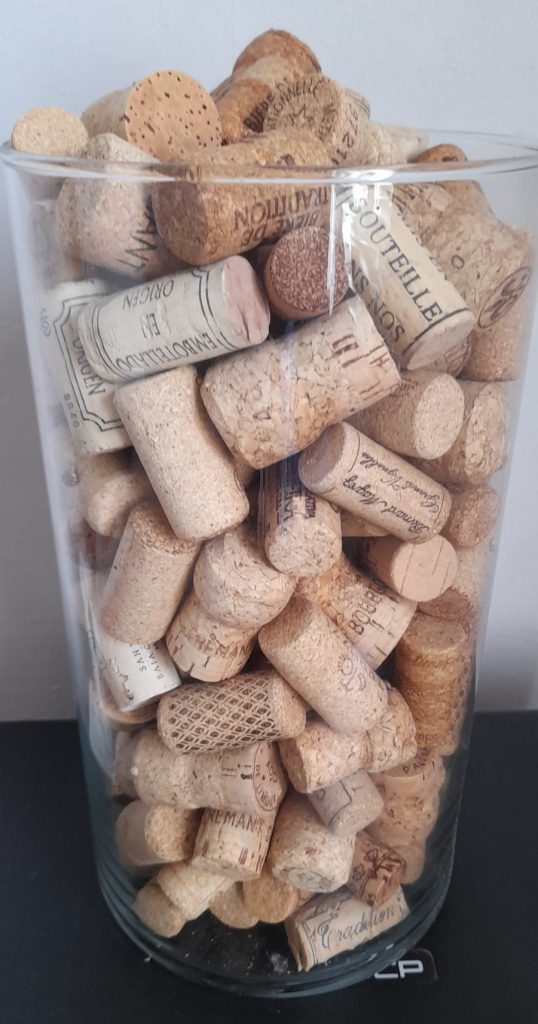
In his kitchen stands a glass container about 60 centimetres tall, filled with proper corks from bottles of wine and sparkling wine.
It is now full.
What should he do?
Start a second container?
Or recycle the corks?
His defence was emotional.
“There are memories in there.”
Celebrations, Fruitloop suggested. Birthdays. Special occasions. Each cork belonged to some moment.
She offered a solution inherited from her mother and grandmother. When a proper cork came from an important celebration—a wedding, a 21st birthday or another milestone—they would write the date on it and keep that one.
The others could go.
The Mayor liked the idea, although he immediately proposed opening wine and dating corks more regularly because “every day is special.”
Rosii sided with Fruitloop.
Two against one.
The cork mountain appears to be living on borrowed time.
Exhibit B: the receipts.
The next Fruitloop question concerned another drawer resident.
Imagine an old receipt suddenly standing up and announcing: “I am important!”
What ridiculous reason would it give for never being thrown away?
For Rosii, the answer turned out not to be ridiculous at all. She keeps receipts from petrol stations and shops because they can help her recognise transactions later when checking her credit-card statement. Sometimes the name appearing on the statement is different from the name of the shop, and the forgotten receipt solves the mystery.
The Mayor responded in the only appropriate way.
“I present you Exhibit B.”
August’s shopping receipts appeared.
He has been building a program to track shopping expenses, which means receipts have become data. They contain the shop, address, VAT information, purchases, transaction numbers, dates, times and other details.
He even described a receipt from Strasbourg that accompanied one espresso and a cinnamon bun costing €8.
The receipt was about 75 centimetres long.
Somewhere, presumably, a small tree sighed.
The Mayor also discovered another possible purpose for keeping receipts: an alibi. If he were ever wrongly accused of a crime, an ancient supermarket receipt could prove that at precisely 8:02 that morning he was somewhere else buying groceries.
Fruitloop identified one flaw in this otherwise excellent legal strategy.
Receipts fade. Eventually the precious alibi may become a blank strip of paper proving only that, at some unknown point in history, somebody bought something somewhere.
Still, her imaginary receipt knew exactly what to say:
“You are going to need me tomorrow.”
That may be the most powerful sentence any piece of clutter can utter.
When the drawer starts talking.
Then Fruitloop gave the drawers themselves a voice.
If Rosii’s mystery space could speak, she thought it might ask: Why did you forget me here? Why do you keep putting old things inside me that you don’t use?
The Mayor’s drawer had a much darker story.
Inside, he imagined territorial battles taking place. Batteries complained because cords were wrapping themselves around them. A clothes peg protested because it had been denied its right to hang washing. Everything fought for limited space.
The forgotten objects had nowhere to go and nothing to do. Occasionally the drawer opened and they were suddenly dragged into the terrible bright light before being pushed back into darkness.
“It is just hell,” the Mayor concluded.
Fruitloop’s drawer had a simpler request.
It wanted to lose weight.
“I’m too heavy. I’m bloated. Please don’t feed me anything unhealthy anymore.”
A fair complaint from a drawer containing old photographs, mystery remotes, broken sunglasses, batteries, cables and whatever else has reproduced in there since Janita last checked.
And perhaps that is why the junk drawer is such a wonderfully ordinary mystery.
We keep things because they might become useful. Because they once were useful. Because they cost money. Because they contain information. Because throwing them away feels wasteful. Because they are beautiful. Because they remind us of somebody or somewhere. Because technology changes faster than our cupboards do.
Sometimes we even keep the thing because we have forgotten enough about it that we are afraid to throw it away.
The mystery drawer is therefore not really filled with rubbish.
It is filled with possibility.
A cable might fit something. A receipt might prove something. A box might be needed for a warranty. An old radio might become valuable. A forgotten hose might return from hibernation. A cork might contain a celebration.
And beneath all the jokes, the Lunch table discovered something wonderfully familiar.
Brazil has its forgotten objects. South Africa has its cable bags. Europe has its instruction manuals and cork collections. Different homes, different countries, different languages—and somehow the same strange little habits.
As the Mayor put it, we can sit in Brazil, South Africa or Europe and discover that, deep down, “we all do the same stuff.”
Perhaps that is the real treasure hidden in the drawer everyone has.
Not the batteries.
Not the cables.
Not even the 140-page instruction manual for an appliance that no longer exists.
It is the comforting discovery that somewhere, in a house thousands of kilometres away, somebody else is staring at an unidentified cable and thinking exactly the same thing:
I’d better keep that.
Just in case.