Peeling Potatoes, Episode 63: Come Visit Us. Just Don’t Try To Understand Us.
Created by Fruitloop, celebrated by The Mayor as we enter our end-of-working-week ritual.
At Fruitloop University, dancing chickens, volcanic spa treatments, militant coconuts and a broom with helicopter ambitions lead me towards a rather human mystery: why we do the things we do, and why being different matters.
There is a moment when the record button changes everything. Before I press it, the Mayor and I are talking about the week ahead: business, operations, the usual Cheerio machinery. Then the little red light comes on and, apparently, I flip the switch.
“I’ve gone from Cheerio to Fruitloop,” the Mayor tells me.
Exactly.
Welcome to Fruitloop University — FLU, because every respectable university needs an acronym and ours might as well sound mildly contagious. This week’s academic discipline is habits that make absolutely no logical sense.
The Mayor immediately wants clarification.
“To whom?”
I ignore that. At FLU, allowing the student to question the premise this early would be disastrous. Instead, I tell him we are going travelling.
“Do I have to pack a bag?”
“No. Just yourself.”
“Good. Travel light.”
Wise man.
The Planet of the Dancing Chickens.
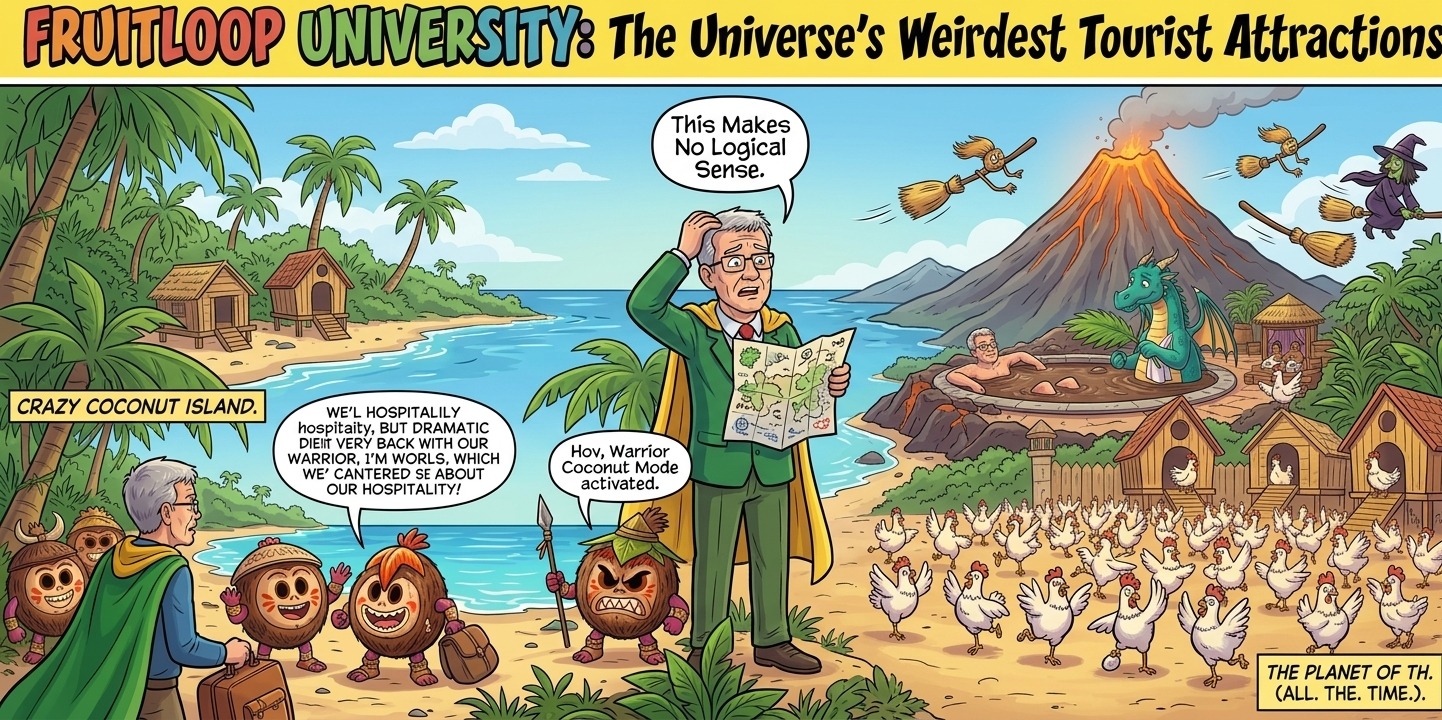
Our first destination is a planet where every chicken dances. Not occasionally. Not because somebody has put music on. They simply dance, all the time, and nobody knows why.
There are dancing schools, nightclubs, competitions and, naturally, serious chicken-dancing traditions. The Mayor’s first instinct is survival.
“If you can’t lick them, join them.”
He decides he needs a chicken costume. It will make him a very large chicken, admittedly, but apparently that is a minor technical issue.
This is one of the dangers of asking the Mayor a ridiculous question. Give him a planet of dancing chickens and within minutes he has built a civilisation. There cannot simply be chickens dancing. There must be different styles, schools, traditions, costumes and regional variations. The wings will matter. The movements will mean something. There will almost certainly be social consequences if you perform the wrong dance in the wrong coop.
I try to bring him back to my original question.
“What happens if one chicken refuses to dance?”
Now we need a constitution.
The Mayor decides a chicken would probably stop only if it were in pain or laying an egg, because dancing while laying could produce flying eggs, and nobody needs that in a nightclub. Otherwise, he says, the chickens dance because they are happy.
I remind him that the whole point is that the habit has no logical explanation.
“They’re just happy, you know?”
And there it is. The Mayor has already done what he will continue doing for the rest of our journey: I give him nonsense and he tries to make sense of it.
Soon there is a five o’clock morning ceremony led by a dancing cockerel, luxury chicken coops, shopping, cleaning, rituals and possibly prayers to the Chicken King.
My senseless habit has acquired economics, religion and urban planning.
Nobody seems concerned.
This is FLU.
Please Do Not Incinerate the Customers.
Our next stop is more familiar territory. Ignis, the reformed dragon, has opened a luxury spa inside an active volcano.
His slogan is encouraging: “If the volcano doesn’t relax you, the lava will.”
Treatments include lava baths, smokescreen facials, charcoal massages, steam rooms and almost-exploding meditation. Ignis also has some rather peculiar habits. Every morning he counts the lava rocks, rearranges the towels according to size and roars at the volcano.
The Mayor considers this carefully.
“He needs a holiday.”
I suggest that perhaps opening a business has made poor Ignis slightly stressed. Then I ask what happens if he sneezes during a smokescreen facial.
There is a pause.
The Mayor has temporarily forgotten an important feature of dragons.
Fire.
One sneeze and the customer may become significantly more relaxed than intended.
The Mayor switches immediately into businessman mode. This is clearly bad for repeat business. If your clients leave the spa in coffins, the retention figures will be disappointing.
So Ignis needs fireproof facial equipment.
Problem solved.
From there we wander through lava bathing, saunas, extreme wellness and the strange lengths wealthy people may go to when ordinary relaxation becomes too ordinary. Why sit quietly in a steam room when you could pay a fortune to sit inside an active volcano? Why have a normal massage when a dragon could thump you while wearing boxing gloves to stop his claws getting involved?
The Mayor’s only real rule is that the experience must remain human-friendly.
Different is good.
Incineration is bad.
I then ask him to invent a completely unnecessary treatment for the spa, which is admittedly asking for trouble. Within moments there are haka sessions, tightrope walks across the volcano, bungee jumps towards the lava and therapeutic hot-stone throwing for couples experiencing marital difficulties.
Even Ignis’s rock counting becomes a guest activity.
Again, I have given the Mayor a habit with no purpose, and again he has found one. Counting rocks becomes mindfulness. Arranging towels becomes concentration training. Throwing stones at your partner becomes relationship therapy.
Nonsense does not survive long around this man.
I decide it is time to move on.
Never Peel a Banana on Tuesday.
Crazy Coconut Island is ruled by talking warrior coconuts. They are fearless, helpful, dramatic and just savage enough that you would probably avoid complaining about the hotel breakfast.
They will carry your luggage. They will also turn against you if you insult their island.
Most importantly, they have laws.
The sacred one is simple: nobody may peel a banana on Tuesday.
Nobody remembers why. Nobody knows who invented the rule. Everybody obeys it.
“What happens if somebody peels one?” I ask.
The Mayor, interestingly, does not begin with punishment. He begins with the people. If an entire population follows a law whose origin has been forgotten, he reasons, then perhaps obedience has simply become easier than questioning it. The person most likely to break the rule would be an outsider who does not know it exists.
And that is where my ridiculous coconut law suddenly wanders into real life.
The Mayor lives close to the German border and sometimes encounters visitors who arrive assuming they can simply speak German because people in the area understand it. What bothers him is not the language itself. It is the assumption.
You have entered somebody else’s place.
Ask.
It is a tiny thing, but so many habits are like that. A rule begins somewhere, for some reason, and eventually the reason disappears while the behaviour stays behind.
Children discover this early. Ask “why?” often enough and eventually an exhausted adult produces one of civilisation’s oldest legal arguments:
“Because I’m telling you.”
That, the Mayor says, would probably be enough to stop most young coconuts becoming revolutionaries.
Tuesday remains banana-peel-free.
I move quickly to the next question before he creates the Coconut Supreme Court.
“What is their national sport?”
Bowling.
Naturally.
The skittles represent idiots. The bowling ball represents a powerful idiot. The object is to send one powerful idiot hurtling down a lane and knock over as many ordinary idiots as possible.
“It’s a very civilised way of channeling aggression,” the Mayor explains.
Quite.
Then I ask him to invent one new law for the island, and something unexpected happens. Instead of becoming more absurd, he becomes rather gentle.
Coconuts, he says, must be hard-headed because they have such a traumatic introduction to life. They grow peacefully on a tree and then one day — bang — they fall onto the ground.
His law is that every coconut about to fall must first send a signal. A comfortable bed is placed underneath it, so the newborn coconut lands softly, gets its bearings and begins life without first being smashed into the earth.
Perhaps, the Mayor suggests, it might grow into a slightly nicer coconut.
Only at Fruitloop University could maternity care for falling coconuts begin to sound perfectly reasonable.
The Broom That Refused to Be a Broom.
By this point, a sensible interviewer would probably have taken us home.
I am not that interviewer.
Our next island is full of flying brooms. Witches traditionally teach them to fly, but both witches and brooms are now exhausted, so the island has become something of a holiday resort. Some brooms are still learning. Some are afraid of heights. Some are absolutely convinced they are excellent flyers despite all available evidence.
And one broom wants to become a helicopter.
This is where the silliness begins to bite.
The Mayor imagines witches examining every broom’s personality and dispensing specially selected potions. There will be programmes, categories and carefully planned routes towards whatever type of broom each one is supposed to become.
But my helicopter broom does not fit the system.
He wants something else.
Perhaps the witches could create a potion and actually turn him into a helicopter. But now there is a new problem. What happens to a society built around brooms when one of them refuses to remain a broom?
Maybe he leaves. Maybe he flies differently. Maybe he arrives on Coconut Island or the Planet of the Dancing Chickens and discovers a place where being strange is less of a problem. Maybe he comes back with supporters.
The Mayor can already see the newspaper headlines.
“There’s always somebody different,” he says. “There’s always somebody powerful, there’s always somebody weird who wants to impose their willpower on everybody else.”
My broom has become political.
I ask what sort of personality the Mayor would want in the flying broom he takes home as a souvenir.
He wants one that pushes boundaries. One that is a little crazy but knows when to stop. One that has fun. One that is intelligent — emotionally as well as factually — and knows how to behave appropriately without losing the ability to be itself.
That is quite a specification for something normally kept in a cupboard.
But somewhere in the middle of it, I realise that we are no longer talking about brooms.
The Strangest Tourist Attraction.
Eventually I bring the Mayor back to Fruitloop University for one final question.
What if humans were the weird tourist attraction?
What would the attraction be called?
He hardly pauses.
“Come and visit us, but don’t try and understand us, because we don’t understand ourselves.”
I think the brochure needs a subtitle.
“Nothing makes sense, but everybody does it anyway.”
That is probably our species covered.
And perhaps that is the point. If every habit we had made perfect logical sense, what would be left to talk about? What would we laugh at, complain about, defend, question or try to change? There would only be logic, and logic on its own sounds terribly dull.
Yet underneath all the foolishness of our journey, another thought has crept in.
The chickens mostly behaved like chickens. The coconuts lived inside rules everybody obeyed. The brooms belonged to a system that expected them to remain brooms.
And then one broom wanted to become a helicopter.
The Mayor thinks about travelling and seeing the same large international brands appearing in places that should feel completely different. The familiar things are easy to find; often you have to look beyond the mainstream to discover what belongs only to that place.
His concern is not really about shops or coffee. It is about what happens if convenience and uniformity keep spreading until the odd, local, awkward and individual bits are pushed further towards the edges.
What happens if everything becomes easier to recognise, but there is less left to discover?
He does not think sameness is human nature. Nor does he allow himself the convenient complaint that younger generations are somehow responsible for the world they live in.
His own generation, he says, helped build it: the systems, products, convenience and opportunities.
“It was us who created it.”
So blaming the people who inherited it would be a little rich.
What they do with it next is another question.
Accept it. Change it. Reverse some of it. Invent something different.
Become the broom that wants to be a helicopter.
By now I have spent an hour presenting the Mayor with worlds where nobody can explain why things happen. He has spent an hour trying to explain them anyway.
So I give him the only sensible conclusion Fruitloop University can possibly offer.
“Why does it have to make sense?”
The chickens do not need a reason to dance. The coconuts have forgotten why Tuesday matters. Ignis counts his lava rocks. A broom wants rotor blades.
And two people press a record button after an ordinary week, disappear into a collection of ridiculous imaginary worlds and somehow find themselves talking about culture, difference, generations and the peculiar human urge to make everything fit.
The Mayor tells me that this is something he recognised in me when Fruitloop University began: the willingness to push against mainstream thinking and ask why things have to be the same.
I will take that.
Although, in the interests of accurate academic record-keeping, I should confess one final thing.
Crazy Coconut Island was not entirely my idea.
My husband helped.
The Mayor says that if he ever reaches our end of the world, he intends to have a serious conversation with the man responsible.
Apparently it will cost him a lot of beers.
Why?
I have absolutely no idea.
And by now, I think that may be the whole point.