
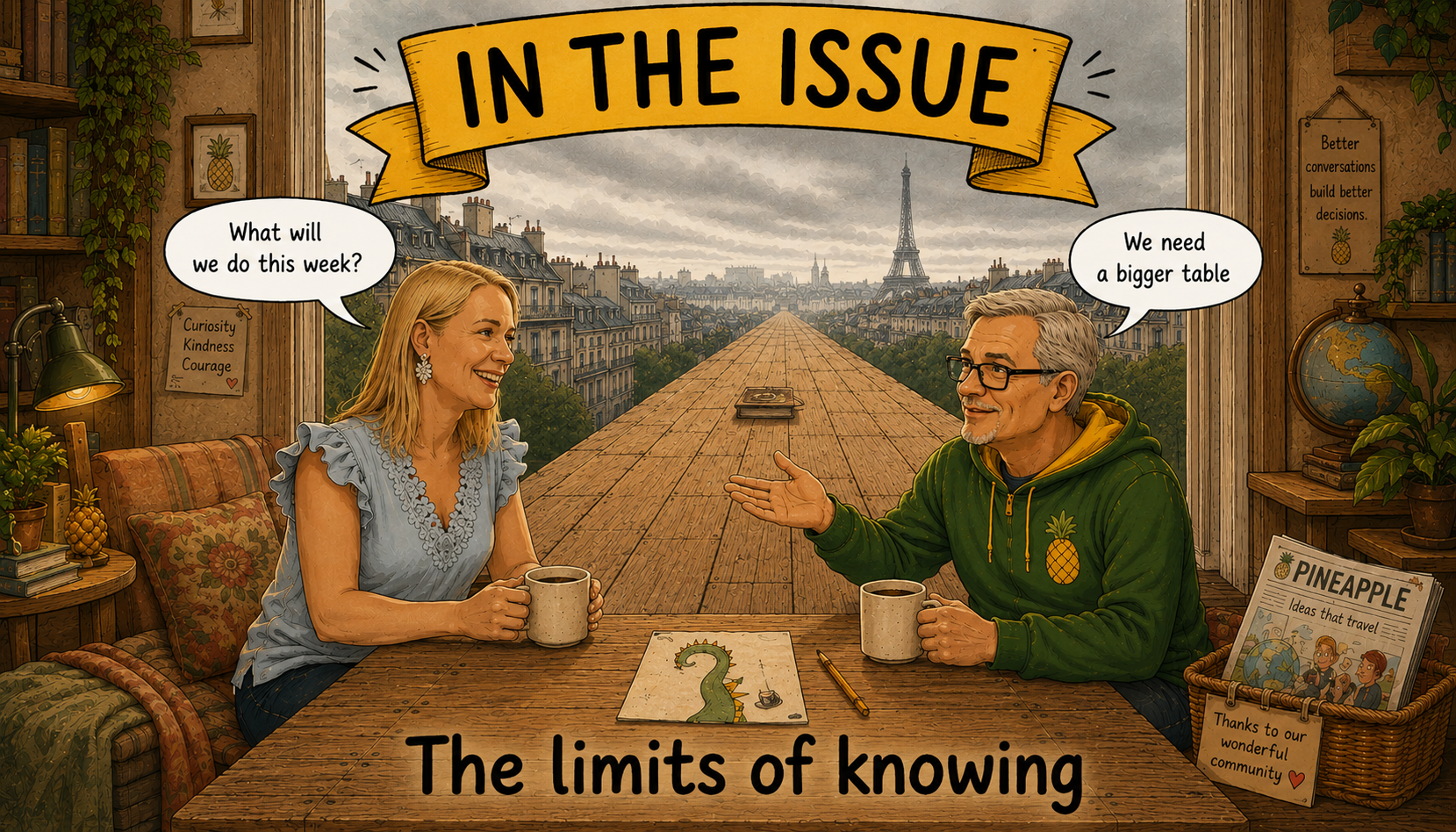
In This Issue
What happens when we reach the edge of what we can know?
In Pineapple 25, the answer might begin with a photograph from another country, a seven-year-old’s remarkably confident plan for adulthood, a dragon that refuses to remain imaginary, or a lunch table where somebody wonders whether every question should really be asked.
Stepping Through the Doorways
Monica sends us a Postcard from Frankfurt, Germany — a quiet sequence of photographs from her continuing journey through Europe.
Fabrice takes us into rather less predictable territory. He likes things direct, preferably black or white, but Danger Is My Second Name finds him encountering some of the grey that appears when people, questions and cultures meet.
Back at home, my seven-year-old son seems to have adulthood largely sorted out. There will be a wife, children, somewhere to live and, importantly, convenient access to McDonald’s. Some details remain under review.
The Mayor, meanwhile, discovers that ridiculous questions have a habit of following you around. A dragon that began in Peeling Potatoes escapes into the real world — and suddenly the question of what it wants does not seem quite so ridiculous.
Unmapped Territory
Sylvie stays closer to home for her holiday, although staying local does not necessarily mean staying still.
Babette is looking in the opposite direction. Egypt is getting closer, the countdown continues, and there are still waterslides, cocktails and the prospect of doing very little waiting somewhere ahead.
Then we pull up a chair at the Lunch table, where curiosity itself becomes the subject. How curious is too curious? When does a question help us understand another person — and when should we perhaps leave it alone?
Somewhere between Frankfurt, Fabrice’s grey areas, childhood certainty, dragons, holidays and the questions around the lunch table, The Limits of Knowing begins to take shape.
Not as an answer.
More as a place to look.
Welcome to Pineapple 25.