
Please Reconnect Your Brain
An Anti-Handbook for receiving instant answers without becoming an idiot.
By Martin
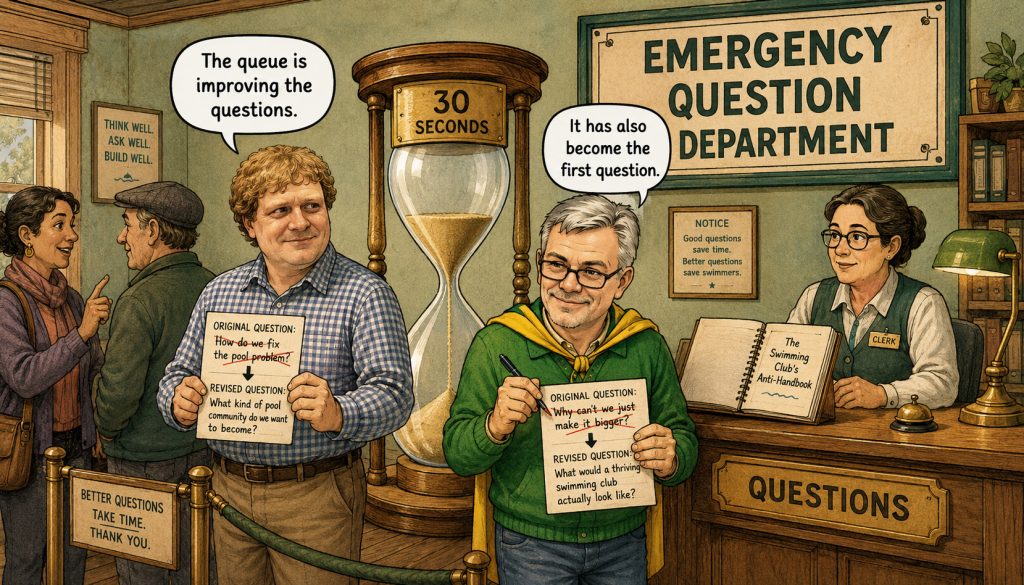
Imagine that the government creates an Emergency Question Department.
Before citizens may ask anything, they must prove that they have already thought about it for at least thirty seconds. I believe this could improve society. Unfortunately, the longer queues would become the first problem requiring an answer.
Standing in line might force us to think. Maybe. It might also force us to speak to the person in front of us or behind us. A conversation could begin. The people who have waited longest would have more time to prepare better questions, which means the Emergency Question Department itself would need to be extremely well prepared.
Whether it would be is another question.
Naturally, real emergencies involving life and death would receive priority. Nobody should have to spend thirty seconds developing a beautifully phrased question while the building is on fire.
For everything else, however, a small pause might not be such a bad idea.
Curiosity Needs Preparation
My recent travels reminded me that curiosity does not always begin when we arrive somewhere. Sometimes it begins earlier, with preparation.
I had always been curious about Edinburgh. Halifax was different. Until recently, the word Halifax made me think of the Canadian province, not the town in England. Then I saw pictures of the Piece Hall and thought: wow, that looks great.
In hindsight, I could have prepared more thoroughly and perhaps enjoyed the visit even more.
Something similar happened during a trip to Mainz on an extremely hot day. I wanted to know how the temperature would develop into the evening and night. It was still 28 degrees at midnight.
These were very different questions, but they taught me the same thing: preparation can create greater curiosity. Knowing something in advance does not necessarily spoil an experience. It can help us notice more when we are there.
An instant answer, therefore, is not automatically the enemy of curiosity. It depends on what we do with it.
The Machine That Knows Everything
I now use AI more and more instead of a traditional search engine.
Recently, I was looking for information about hydrangeas. Someone had published incorrect information on a website, while AI gave me the correct answer. In a situation like that, the machine is useful. It saves time and helps me solve a practical problem.
But I would not use it in exactly the same way for every subject.
When I want to understand people or historical developments, I may prefer to research in the old-fashioned way. I might go to a library—assuming libraries still exist by the time I arrive.
There is a difference between wanting a quick solution and wanting knowledge. If I need to repair something, I may be thankful for a direct answer because I do not have to think about the problem for hours. But if the advice turns out to be nonsense, I will later ask why anybody told me such rubbish.
The quick answer is convenient. The consequences may take longer.
The Missing Ingredient Is Doubt
Bad answers often lack doubt.
A person can make a genuine mistake. An AI system can make a mistake. A website can publish incorrect information. The dangerous moment comes when an answer is presented with complete confidence and no understanding that it might be wrong.
Public figures sometimes behave as though they have swallowed the truth whole, even while the facts disagree with them. Then we hear about “alternative facts,” which is a very elegant expression for something that is not a fact.
When I receive an answer from AI, the internet or another person, instinct remains an important quality-control department. If something sounds too good to be true, it probably is.
This may become increasingly difficult. Deepfakes created with AI are already convincing, and perhaps in ten years it will be almost impossible to distinguish fact from fiction.
At that point, the problem will not simply be that machines can produce false information. The problem will be that humans enjoy believing things, especially when those things confirm what they already wanted to believe.
People often ask questions and then seem surprised when you give them an actual answer containing your thoughts. They did not want your thoughts. They wanted quick confirmation.
You normally recognise this when you realise that the person you are speaking to lives in a parallel universe.
Your Brain Has Been Left Unattended
Every AI system should perhaps include a warning:
Your brain appears to have been left unattended. Would you like to reconnect it?
The warning should appear when the AI notices that I can no longer explain why I started the conversation.
The machine could then test whether my brain is working again. It could deliberately produce some nonsense or offer a few alternative facts. If I recognise them as nonsense, the connection has been restored.
This would be useful because AI is already training certain habits into us. The most obvious one is impatience.
We were impatient before AI, of course. The machine cannot take all the credit. But when AI fails to answer my question quickly, I am not very forgiving. I am more patient with people.
Perhaps that is because I know a person may need time to think, while I expect a machine to behave like an obedient oracle.
If AI began answering every lazy question with, “What do you think?” humanity would probably demand a refund within seconds.
There are also questions it should refuse to answer immediately. For example: What will the next winning lottery numbers be?
In that case, even an instant answer would arrive too late to be useful, especially if everybody received the same numbers.
The Defence of Instant Answers
I do not view AI entirely positively, but fearmongering is too simple.
Machines can take over mindless, repetitive work. Previous industrial revolutions were, in my view, a blessing because they made much hard and dangerous labour unnecessary.
This revolution may be even more far-reaching, and its consequences are harder to predict. But removing boring work can give people more time for ideas and creativity.
The question is what we do with that time.
We have already seen, even without AI, that convenience changes our relationship with knowledge and culture. Knowledge is available at any moment, which is practical, but it can also become fleeting.
Music provides a good example. It is now consumed through flat-rate services and, at best, paid for in that way. It is no longer always treated as something special to be enjoyed with devotion.
When everything is endlessly available, it can begin to feel almost worthless. It is like spilling a beer during an all-you-can-drink session. There is another one waiting, so nobody cares very much.
I sometimes choose a less convenient method precisely because the effort belongs to the experience.
I go to a record shop. I buy an album on vinyl or CD. Then I listen to it deliberately and with joy.
Travelling can be similar. So can cooking. The quickest route is not always the richest one. Preparation, effort and attention can make us more curious, not less.
The First Rule
This Anti-Handbook chapter could be called How to Receive an Instant Answer Without Becoming an Idiot.
My first rule would be simple:
Do not forget your instincts, and use your head.
Even someone as thick as me does not believe everything.
The rule is meant for humans, not machines. Hopefully, the machines will not need it.
Although, considering who trained them, perhaps they will.