
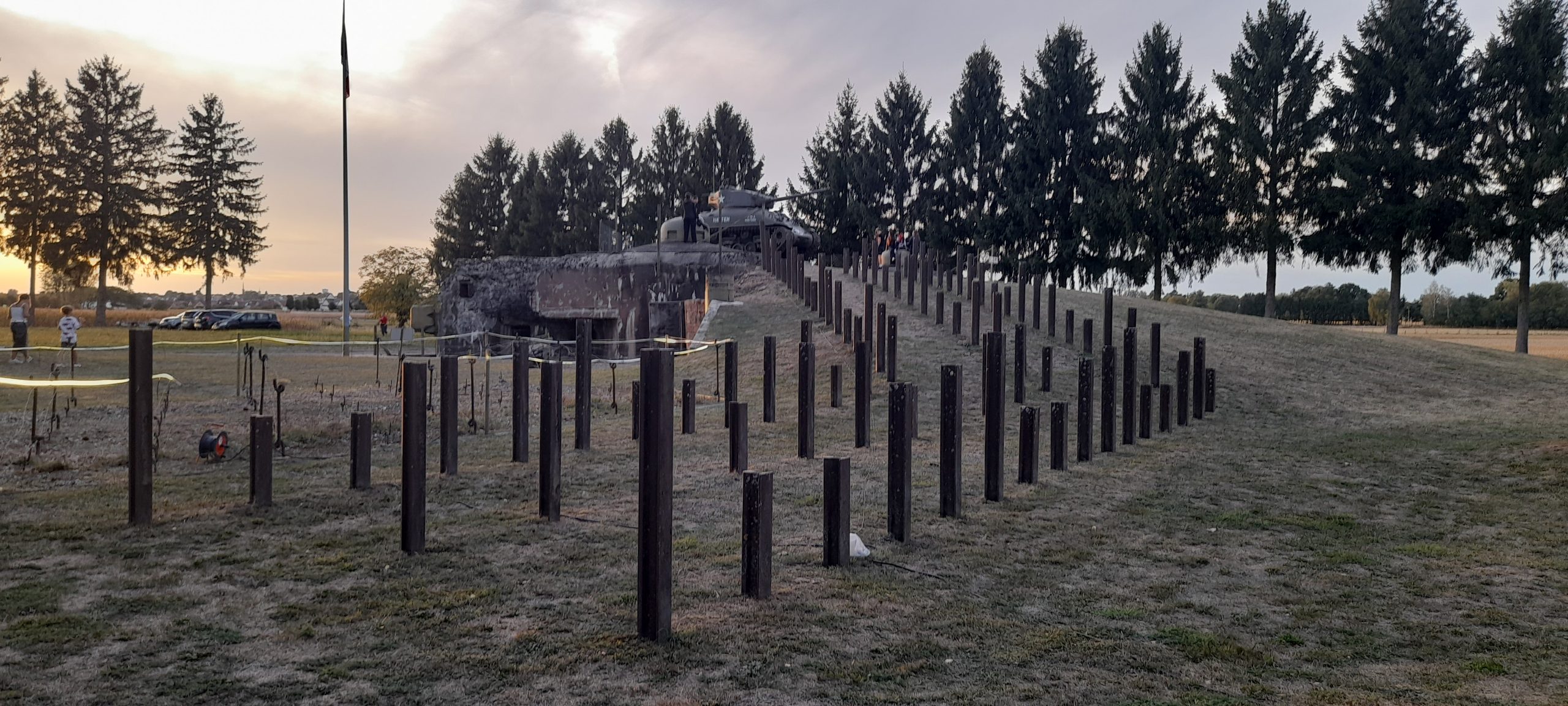
A Wild Boar, a Bunker and Breakfast Schnapps
By Fabrice
Janita asked me to explain two local traditions she had never heard of: a wild boar dinner among old military vehicles, and a 12-kilometre Marche Gourmande built around food, wine, music and friends.
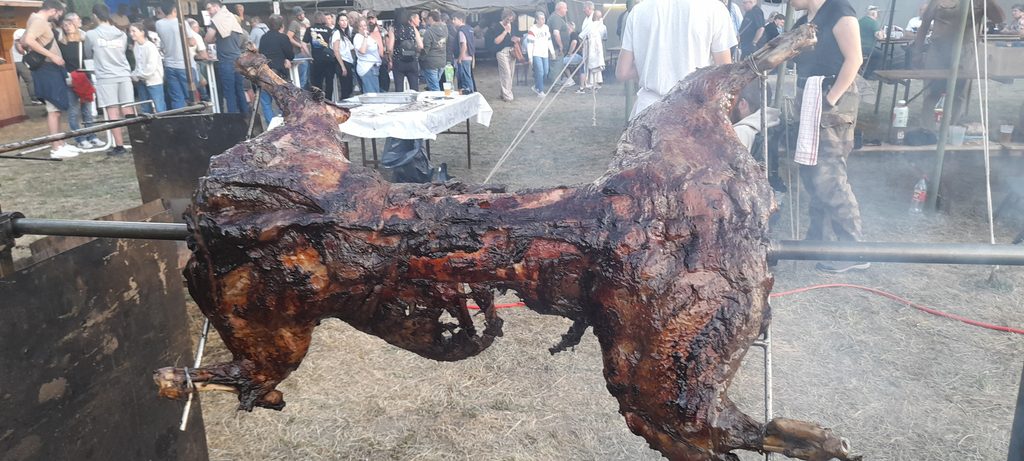
Janita looked at the photographs and said, “I know absolutely nothing about the wild boar dinner. Start at the beginning. What on earth is it?”
The beginning is probably not what she expected.
On Saturday afternoon, a whole wild boar is put over the fire. It cooks slowly for four or five hours, turning until it is ready for the evening. My understanding is that the animal is local, probably from within about 30 kilometres. There are different hunting groups and defined hunting areas around here, and wild boar are not difficult to find. They come into the fields and vineyards and can make a lot of damage.
Then, at around half past seven or eight, we eat.
That still sounds reasonably normal.
The location is where it becomes more interesting.
There is no restaurant.
The dinner is held at a Second World War bunker, with old military vehicles standing around it.
There are Jeeps and other restored vehicles, mostly American, and the next morning there is an exhibition. So if somebody told Janita, “Come to dinner,” and she imagined doing her hair, putting on a nice dress and arriving at a good restaurant with her husband properly dressed beside her, there would be a small problem.
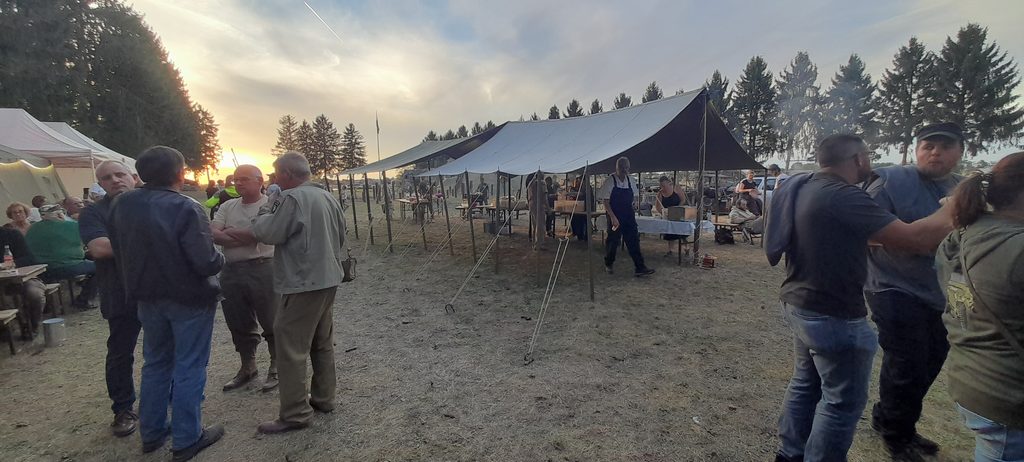
There is no restaurant.
There is a bunker.
There is a wild boar.
There are military vehicles.
And there are people eating, drinking and having a very good evening.
Janita wanted to know what she would see, hear and smell when she arrived. She was particularly confused by the vehicles.
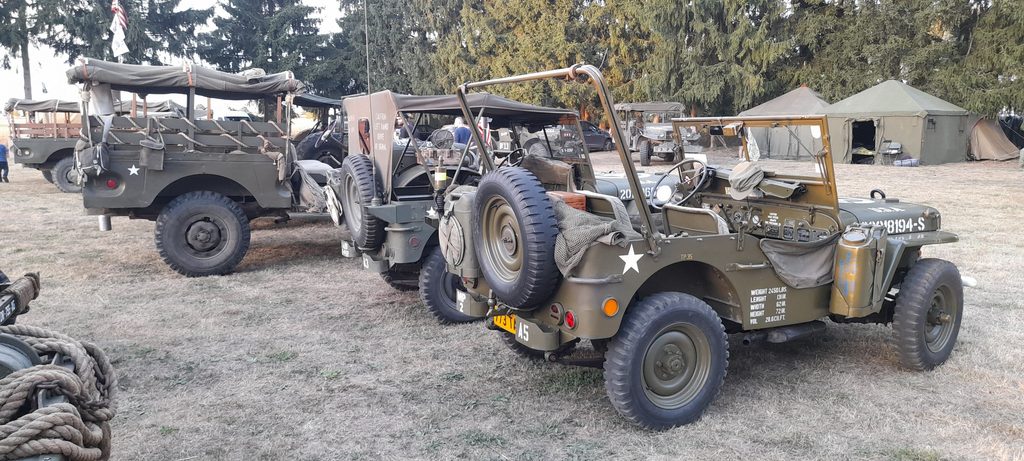
“Aren’t they supposed to be in a museum?” she asked.
Not necessarily.
I was one of nine people who founded the military-vehicle association about 20 or 25 years ago, and I still go to the event every year. The vehicles belong to enthusiasts who restore them, maintain them and, importantly, drive them.
For me, that last part is not particularly strange because I knew some of these machines when they were still working vehicles.
When I was in the French army in the mid-1980s, we were still using old American vehicles. I remember American soldiers visiting our regiment and seeing rows of GMCs and Jeeps. They thought we were making a film about the Second World War.
No. We were using them.
Some of those vehicles continued in service until the end of the 1980s. So when older people come to an event like this, they do not necessarily see museum pieces. Some remember the vehicles from military service. Others remember them from different periods of their lives. Children and grandchildren come too.
The machines carry their own stories.
But on Saturday evening, the important thing is not a history lesson. It is dinner.
There were around 30 people eating. The boar had been turning over the fire since the afternoon, and when it was ready, people could take another portion if they wanted one. One, two, three—it was not really a problem until your stomach told you to stop.
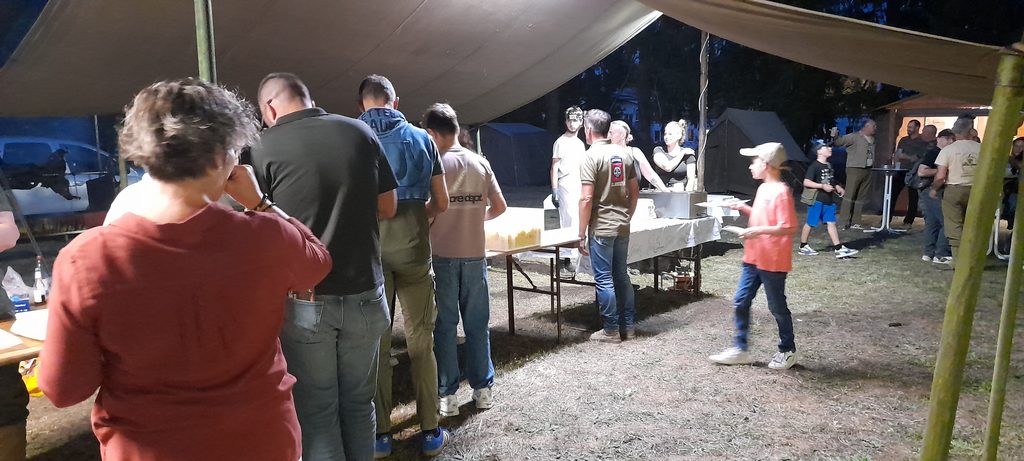
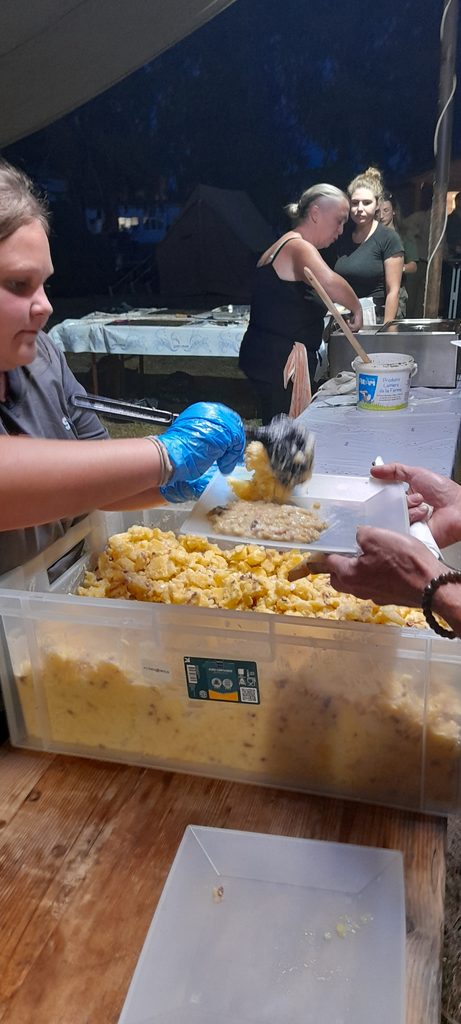
There were potatoes, salad, beans, bread, cheese and enormous éclairs. There was wine. There was beer. There was schnapps.
I had to drive, so there are limits.
This is sometimes an unfortunate responsibility.
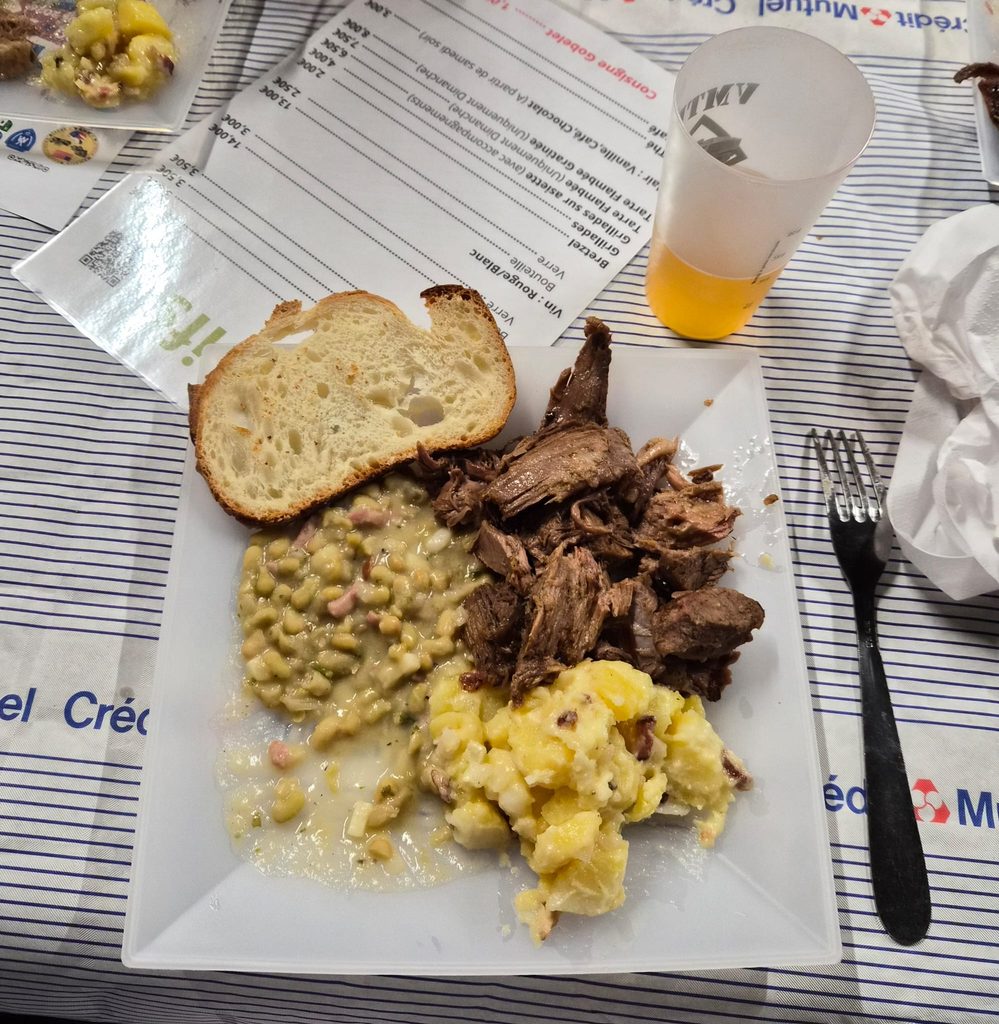
Then you go for a walk.
Janita had just survived my explanation of the wild boar dinner when she was introduced to another expression she had never heard before:
Marche Gourmande.
This required starting again.
A Marche Gourmande is a walk, but describing it only as a walk is not very useful. The one I did was about 12 kilometres, starting from the town hall. Along the route are different stations, and each station gives you another reason to stop.
We were a group of friends.
The official start was around nine in the morning, although with the queue we actually got going closer to quarter to ten or ten o’clock.
The first stop was breakfast.
There was bread, omelette, coffee and schnapps.
Janita accepted the bread and eggs. The schnapps required more explanation.
“Where’s the coffee?” she asked.
There was coffee too.
I had already eaten something at home, but this was the first proper station of the Marche, and a brass band was playing only a few metres away. You eat, you drink, you listen to the music, you talk, and eventually somebody remembers that this is supposed to be a walk.
So you start walking again.
A few kilometres later comes another station. There was pâté, salad and white wine. Then another stretch of walking. At another stop there were pretzels and drinks, and this time we stayed much longer—perhaps 45 minutes or an hour.
This is where the theoretical idea of a 12-kilometre walk begins to become flexible.
At another station there was fish and wine. There was goat’s cheese from a local producer. Later came meatballs with white sauce and a potato-based accompaniment, again with wine. Then cheese. At the final station there was coffee and a sponge-style tart.
There was music along the way too: a brass band at one place, a woman with a guitar at another, and later a man playing songs from the 1950s, 60s and 70s, French and American.
Nothing was rushed.
That is important.
At some stations we stayed only 15 or 20 minutes. Somewhere else we stayed nearly an hour. You meet people. You talk. Somebody has another drink. Somebody starts another conversation. Eventually the group moves again.
The ticket was €41 and included the food and drinks allocated at the different stations. If you wanted more, you could buy more.
This creates another mathematical problem when you are walking in a group of ten or eleven people.
You think: I will buy a round.
Then somebody else buys a round.
Then somebody else.
Very quickly, your one generous idea has become eight or nine generous ideas.
Fortunately, there is walking between the stations.
The point is not the 12 kilometres.
The Marche also gives local producers and caterers a chance to present what they make. You taste something at the event that you might never have ordered in a restaurant or bought for yourself, and suddenly you discover it.
But that is only part of it.
For me, the best part is being together with friends.
You walk ten or twelve kilometres, but nobody is trying to set a record. You stop. You eat. You have a glass of wine or beer. There is music. You meet people from other villages. The day keeps moving, but slowly.
The associations behind events like these matter because they are what allow people to keep organising things together. Somebody has to arrange the route, the food, the permissions, the stations, the musicians and all the small practical things that make the day work.
Then, when the day comes, it does not feel like organisation anymore.
It feels like everybody is simply there.
That was also what connected it, for me, with the wild boar dinner. One event involves a bunker, old military vehicles and a boar that has spent several hours above a fire. The other involves walking from one plate and glass to the next.
They look completely different.
But both are excuses for people to come together.
“Why not make one in South Africa?”
After all this explaining, I had a question for Janita.
Why not do something similar where she lives?
She said she would not even know where to start organising a Marche Gourmande.
It does not have to start with hundreds of people. I told her she could make a small version for family or friends: perhaps five or six kilometres, with three different stops. At one place there could be water and soft drinks for the children, beer or wine for the adults. Somewhere else, sandwiches. Somewhere else, coffee.
Friends could help at the different stations.
Then the idea became even smaller. Forget the long route. Take a local area, put some tables and chairs outside, light a few barbecues and invite the neighbours.
Janita thought about that.
“That’s not a bad idea,” she said.
Perhaps she will never think that breakfast schnapps is a good idea. She may continue to believe that Second World War vehicles belong safely inside museums. And if somebody invites her to dinner beside a bunker, I suspect she will now ask a few additional questions before choosing her dress.
But the rest is not so complicated.
You are outside. You have food. You have music. You have friends. You walk a little, stop a lot and keep meeting people.
As I told her, “It’s the moment when you are in a community with your friends. You make ten, twelve kilometres. It’s a very nice thing.”