

The Rather Nice Inconveniences
By Manfred & Martin, aka The Swimming Club, both in Germany.
At Swimming Club, a conversation about useless objects became an experiment in 1995 technology — and a question about what disappears when everything becomes easier.
Painful object divorces.
Martin does not need long to think about the things he owns but never uses.
There are, apparently, too many to count.
He lives in a small apartment and estimates that only about two square metres remain available for actually moving around. Other people might look at the accumulated objects and make the obvious suggestion: it can all go.
Martin has tried that.
He calls the experience “painful object divorces.”
Among the survivors is a drawing board that takes up a respectable amount of space despite not having been used for perhaps fifteen or twenty years. Its defence is magnificent in its simplicity: theoretically, it could also be used as a table.
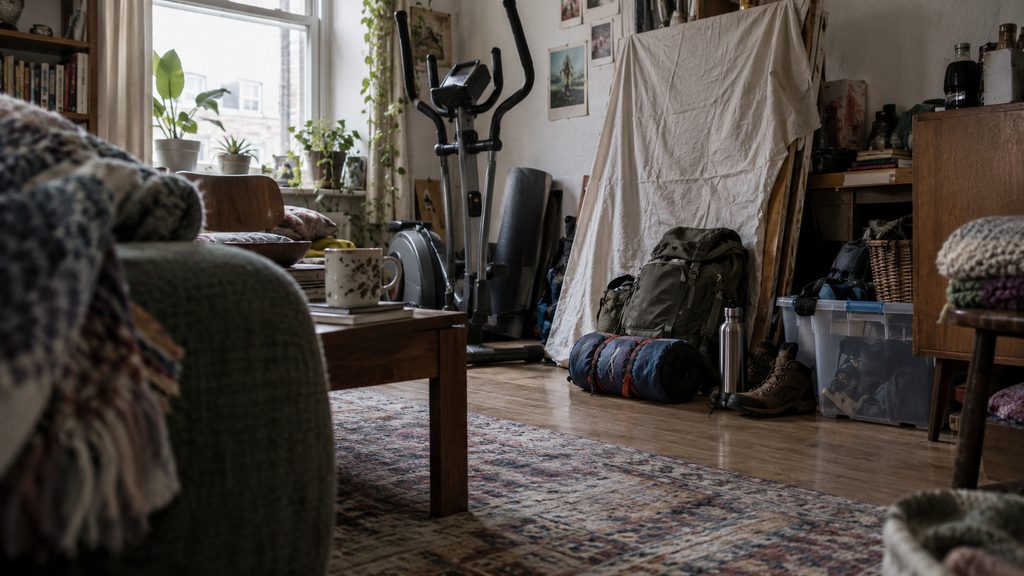
Manfred looks around his office and discovers a different archaeological site. In one corner stands a cross trainer, rather forlornly waiting for the day on which exercise may once again break out. There is camping equipment. There is a holder for socks. There are the ordinary remains of a life in which useful things have a habit of outliving their immediate usefulness.
“We are hunters and gatherers,” he says.
The only reliable restriction may be space.
Or not.
Manfred also has a caravan, which introduces a dangerous loophole into the entire system. It can function not merely as a holiday vehicle but, as he cheerfully admits, as the ultimate mobile junk storage area, travelling throughout Europe.
There is, however, a distinction. Some things are materials. Nails, screws, bits and pieces left over from old jobs: these can return to usefulness without warning. Manfred remembers his father, a bricklayer, keeping things recovered from demolition because they might be reused. Years later, Manfred sometimes finds exactly what he needs among those saved materials.
That is different from the cross trainer.
The screws are waiting for a job.
The cross trainer is waiting for Manfred.
And once an old object has unexpectedly proved useful, the damage is done. Throwing things away becomes even harder. The experience lodges itself in the brain: You see? I knew we would need that eventually.
It is an excellent argument for keeping almost anything forever.
But the conversation did not stay with cupboards for long.
The useless objects began to raise another question. What else have we discarded because it appeared obsolete — and what did we lose with it?
Back to 1995.
So Swimming Club conducted an experiment.
Tomorrow morning, the world returns to the technology of 1995.
What would we miss first?
Martin chose the mobile phone.
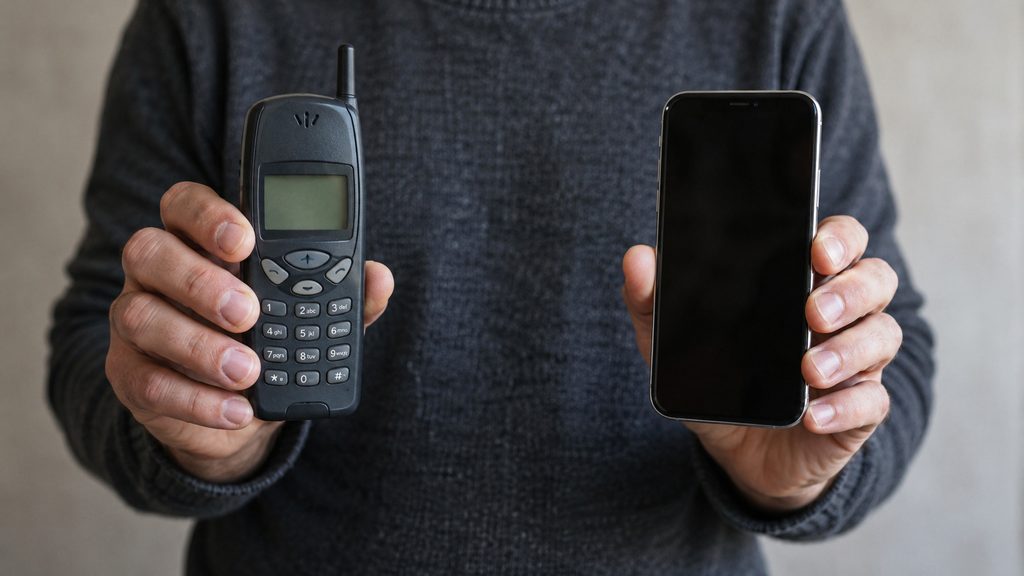
Manfred, with impeccable preparation for the collapse of civilisation, still has an old one. It can make telephone calls. For the purposes of 1995, that would seem to settle the matter.
Except it does not.
The modern phone is no longer really a telephone. It has become, as Manfred put it, a computer in the pocket. Without quite noticing how it happened, we have become remarkably comfortable with it — and remarkably dependent upon it.
Asked what piece of modern technology he would happily lose, Manfred had a quicker answer: the chatbots that now appear everywhere. He dislikes not knowing whether he is communicating with a human being or a machine.
Martin nominated the electronic ordering terminals in fast-food restaurants.
Even here, Manfred was unwilling to let the machine escape without investigating it properly. Technology, he argued, has to be examined closely enough to find where it can work in your favour. Somewhere inside the electronic McDonald’s menu, he has discovered the option to order a drink without ice.
This matters.
Because otherwise, in his experience, you risk receiving more ice than drink.
The great technological revolution has therefore brought us artificial intelligence, smartphones, global networks — and a hidden button that allows Manfred to defend his Coca-Cola against ice cubes.
Progress is complicated.
Martin faced another problem when asked to smuggle one modern invention back into 1995 and explain it without using vocabulary that did not yet make sense.
How would you explain Spotify?
You cannot say streaming. You cannot rely on the cloud. Even explaining the internet starts creating another explanation underneath the first explanation.
Eventually Martin abandoned explanation altogether.
Ask the person from 1995 for their favourite song, find it, press play.
The result is more convincing than the explanation.
Which may be true of much of modern technology.
No more friction.
Then the experiment became less funny.
Manfred imagined an ordinary part of life before so many processes moved onto screens: ordering a pizza. Today you can tap an app and wait for it to arrive. Previously, you went somewhere, spoke to somebody, ordered from a person and either ate there or carried the pizza home.
The modern process is easier.
Something has also disappeared.
“The process steps have become too easy,” was the thought that emerged around the table. There is less friction.
That sounds entirely positive until you ask what the friction contained.
Sometimes it contained waiting, inconvenience and inefficiency. But sometimes it contained another person.
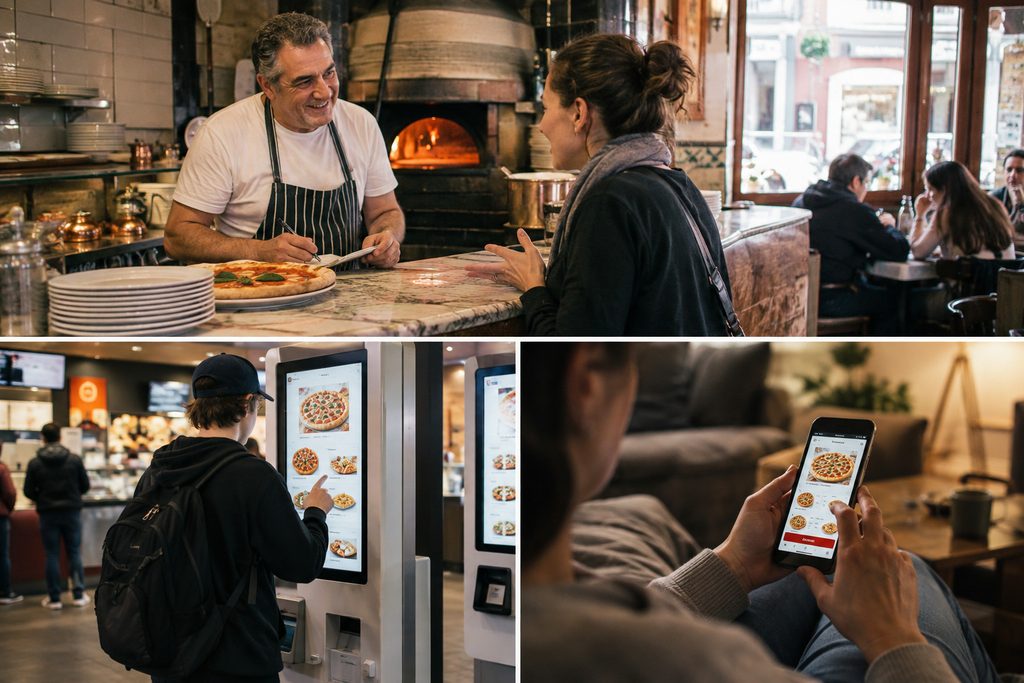
A telephone call. A short conversation. Someone who knew the system well enough to bend it slightly when real life did not fit the standard procedure.
The 1995 experiment now started running into reality. Banking. Train tickets. Medical appointments. Insurance. Security codes. Services that increasingly assume access to a digital system.
The Swimming Club was not arguing that the old way was universally better. Online banking, Martin pointed out, has real advantages. Manfred himself does plenty on his computer.
The tension was elsewhere.
We have embraced convenience very successfully. We may have been less careful about what was bundled up inside the inconveniences we removed.
Manfred described the difference through insurance. His brokers are local. When a friend had a problem with a car, the process involved providing pictures and proof through a more remote system. When Manfred faced a car problem of his own, he spoke to his local broker and the matter was dealt with.
His conclusion was practical rather than nostalgic: saving money in one place can produce difficulty somewhere else.
You can save at the wrong end.
The same concern appeared in banking. Martin still uses a bank with a branch in town. Manfred noted that his bank no longer has a machine for printing account statements. Paper itself can increasingly feel like an extra service rather than the normal way of receiving information.
The customer performs more of the administration.
The institution needs fewer people to perform it.
Convenience has winners.
And sometimes the person enjoying the convenience and the person benefiting most from the efficiency are not the same person.
The good old days were not necessarily good.
It would have been easy at this point to turn the conversation into a defence of the past.
Swimming Club did not.
Nobody seriously proposed giving up online banking, returning to paper for everything or rebuilding 1995 around the modern world. Some old inconveniences disappeared because they really were inconvenient. Some skills disappeared because there was simply no longer much need for them.
That is normal.
Manfred reached for the example of the Landauer carriage. Once, people needed the knowledge and craft required to build such things. Cars changed that. Skills disappeared because the world around them changed.
The interesting question is not whether everything old should be preserved.
It is whether we notice what we are removing before it has gone.
A shop once might not simply have sold bedding. It might also have offered the service of opening a duvet, cleaning it and replacing its feathers. That kind of repair and maintenance belongs to a different relationship with objects. Increasingly, Manfred suggested, we live in a world in which replacement can be easier than restoration.
Again, convenience wins.
But not without changing what people know how to do.
The question becomes more unsettling when the disappearing skill is not repairing a duvet or constructing a carriage.
What happens when the thing we use less is our own brain?
What becomes a luxury?
The final experiment looked twenty years ahead.
What ordinary thing that people can still do with their hands today might become a luxury by 2046?
It proved harder to answer than expected.
That may be the point. People living in 1995 would probably have struggled to predict which ordinary human interactions would be transferred to apps, which services would disappear behind websites and which objects would be absorbed into a single device carried in a pocket.
The next disappearance may be equally difficult to see from here.
Perhaps it will be another craft.
Perhaps a service.
Perhaps some part of healthcare will become increasingly robotic.
Perhaps it will be something less visible: remembering, navigating, calculating, composing, searching, deciding — small acts of thinking that gradually become unnecessary because a machine can perform them faster.
The conversation finally arrived at artificial intelligence, but not with a tidy answer. The technology is developing quickly enough that even some of the people working closest to it publicly acknowledge uncertainty about where it may lead.
That is a rather bigger mystery than the cross trainer in Manfred’s office.
Yet the two somehow belong in the same conversation.
We keep old objects because they might still be useful.
We adopt new technology because it certainly is useful.
Between those two instincts lies an uncomfortable question: how do we know what is safe to stop doing for ourselves?
Perhaps the most valuable old things are not the things gathering dust in cupboards.
Perhaps they are the habits, skills, conversations and minor human inconveniences we only notice after somebody has made them unnecessary.