Issue 13 — 30 May 2026

The Pineapple

A collection shaped by the voices of the Brida Community

Created by Members of the Brida Community.
Compiled by Frank Peters, Founding Editor.
Shaped in Spirit by Janita Le Grange, Keeper of the Flame.

The Pineapple is published every Friday afternoon. If you would like the next issue to arrive in your inbox, you can subscribe free.

Subscribe

Contents

Partner Page
Advertisement
source
The Pineapple

In This Issue…

Sometimes a Pineapple arrives neatly arranged.

This is not one of those weeks.

This week begins with balance. Not the kind sold by wellness gurus and productivity experts, but the kind most of us spend our lives negotiating: work and rest, responsibility and freedom, pressure and perspective.

Along the way, we discover that a scoreboard can change the way people behave, that responsibility can travel from a small Alsatian village all the way to Kuwait, and that a holiday can be improved or ruined by ants, routers, socks, vacuum cleaners and circumstances entirely beyond our control.

We also open a new door.

For the first time, The Pineapple includes a dedicated fiction section. Janita introduces us to Lucy McKenzie and reminds us that imagination can sometimes reveal truths that reality prefers to keep hidden.

Elsewhere, our tables continue to do what Brida tables do best. People from different countries, backgrounds and experiences sit down together and discover that life is surprisingly similar wherever you happen to live.

Some articles may make you think.

Some may make you laugh.

A few may do both at the same time.

And somewhere between balance, scoreboards, holidays, responsibility, fiction and vacuum cleaners, you may find yourself reflected in the pages.

Welcome to Pineapple 13.

source

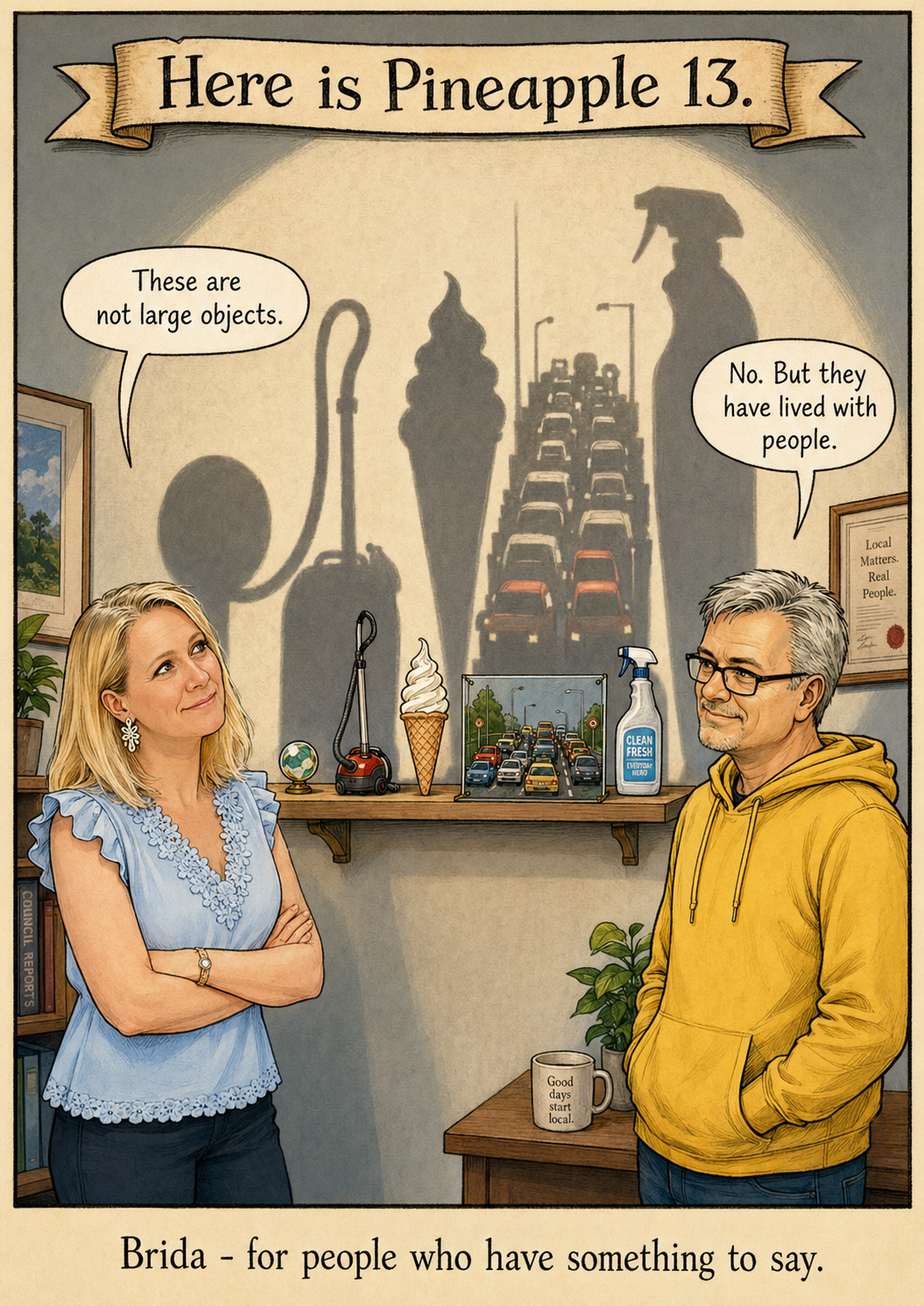
There are moments when life loses its proper size.

A small thought becomes a weather system.
A simple decision becomes a mountain.
A sentence someone said in passing moves into the mind, takes off its shoes, puts its feet on the table, and refuses to leave.

Nothing dramatic has happened. Nobody has burned down a building. Nobody has stolen a horse. Nobody has stood on a chair in the middle of a restaurant and declared the end of civilisation.

And yet, somehow, everything feels slightly too loud.

This is one of the quieter ways we lose balance.

Not through disaster.
Not through tragedy.
Not through one enormous life-changing event.

But through something much stranger and much more ordinary: proportion begins to disappear.

A small thing grows teeth.
A minor detail becomes a courtroom.
A tiny worry puts on a judge’s wig and starts calling witnesses.

And there we are, sitting in the middle of an entirely normal day, behaving internally as if the fate of the known universe depends on whether one small thing has been handled correctly.

Which is absurd.

And also completely human.

Because the absurdity is not proof that the feeling is fake. That is the mistake we often make. We think that if something is ridiculous, it must not be real. But human beings are perfectly capable of being ridiculous and genuinely overwhelmed at the same time.

In fact, we are specialists.

We can know, with one part of the brain, that a situation is not a catastrophe, while another part of the brain has already called an emergency meeting, printed documents, prepared a dramatic speech, and started pacing beside a window like a troubled detective in a Scandinavian noir crime series.

This is not madness.
This is pressure looking for somewhere to go.

Modern life gives us many things. Convenience. Speed. Choice. Tools. Screens. Messages. Calendars. Notifications. Apps that promise to make things easier while quietly creating twelve new things to check.

But it also gives us a strange, constant background feeling that everything should be managed.

Better. Faster. Earlier. More cleanly. More professionally. More calmly. More efficiently.

You should answer the message.
You should remember the thing.
You should follow up.
You should be available.
You should not forget.
You should not overreact.
You should be kind, but boundaried.
Productive, but not stressed.
Ambitious, but balanced.
Human, but not inconveniently human.

You should answer the message. You should remember the thing. You should follow up. You should be available. You should not forget. You should not overreact. You should be kind, but boundaried. Productive, but not stress

And then, when one small thing slips, the mind does not always treat it as one small thing.

It treats it as evidence.

Evidence that the system is fragile.
Evidence that you are behind.
Evidence that something is not being held properly.
Evidence that, despite all the calendars and lists and clever tools, life is still somehow leaking through the edges.

This is where balance becomes more interesting than simply “resting more” or “working less.”

Of course rest matters. Sleep matters. Walks matter. Food matters. The body is not a decorative object we drag around while the brain runs the company. The body is the first place imbalance usually tells the truth.

But balance is not only about time.

It is also about scale.

Can we still see things at their proper size?

Can we tell the difference between a problem and a symbol? Between an inconvenience and a threat? Between one unfinished thing and the secret collapse of everything?

This is harder than it sounds.

Because modern performance culture trains us to measure ourselves constantly. Not just at work. Everywhere.

We measure our productivity. Our responsiveness. Our parenting. Our friendships. Our bodies. Our houses. Our routines. Our meals. Our concentration. Our tone of voice in messages. Even our relaxation becomes something to optimise.

Did I rest properly?
Was that walk long enough?
Was I mindful enough while drinking the tea?
Should I have journaled about the tea?

At some point, even balance becomes another performance.

Another thing to fail at.

And that is when the whole idea becomes faintly comic.

There we are, exhausted by the pressure to be balanced, wondering why we are not more peaceful about our peace.

A human being can only take so much improvement.

Eventually, the mind rebels. But it rarely does this in a grand and poetic way. It does not always say, “Dear friend, your life has become overloaded with invisible expectations, and you may need to reconsider the emotional architecture of your daily existence.”

No.

It picks something small.

A tiny thing.
A stupid thing.
A thing that, from the outside, looks almost laughably ordinary.

And it says: this.
This is the hill.
This is where we shall have our crisis.

Later, of course, we may see the comedy of it.

We may look back and think, “Good heavens. That became enormous.”

And this moment matters. The moment of seeing the absurdity is not the same as dismissing the feeling. It is not saying, “I was silly, therefore nothing was wrong.”

It is saying something wiser:

“That thing became too big. Why?”

That question is where balance begins.

Not with shame.
Not with self-mockery.
Not with pretending to be calmer than we are.

But with curiosity.

What was I carrying before that moment?
What had I not named?
What pressure had become normal?
What expectation was sitting quietly in the background?
What invisible responsibility had I accepted without noticing?

Sometimes the small thing is not the real thing. It is simply the place where the real thing became visible.

A cup overflows from the last drop, but the last drop is not the whole story.

This is why balance needs honesty. Not dramatic honesty. Not public confession. Not standing in the village square ringing a bell and announcing the full contents of the nervous system.

Just enough honesty to say: something is out of proportion here.

And then, gently, to ask what would help return it to its proper size.

A conversation may help.
A walk may help.
A decision may help.
A boundary may help.
A laugh may help enormously.

Laughter is underrated in the restoration of balance. Not the laughter that humiliates. Not the laughter that says, “This does not matter.” But the laughter that says, “Ah, look at us. Look at what we do. Look at how human we are.”

There is mercy in that kind of laughter.

It loosens the grip.

It reminds us that we are not machines failing to operate correctly. We are living creatures trying to carry too many threads through a noisy world while pretending we have not noticed the weight.

Perhaps balance is not a perfect state we reach once life is finally tidy.

Perhaps balance is a repeated act of resizing.

This is too big.
This is too small.
This needs attention.
This needs to wait.
This is mine to carry.
This is not mine alone.
This is serious.
This is also, thankfully, a little ridiculous.

That last sentence may be the most important one.

Because if something can be serious and ridiculous at the same time, then we are allowed to be human inside it.

We do not have to choose between collapse and control. We do not have to become perfectly calm before we are allowed to understand ourselves. We do not have to turn every wobble into a personal failure.

We can pause.

We can breathe.

We can look at the thing that has filled the whole room and say, kindly but firmly:

“You are not the whole room.”

And maybe that is where balance begins.

Not in the fantasy of a life without pressure, but in the quiet practice of putting things back where they belong.

source
The Pineapple

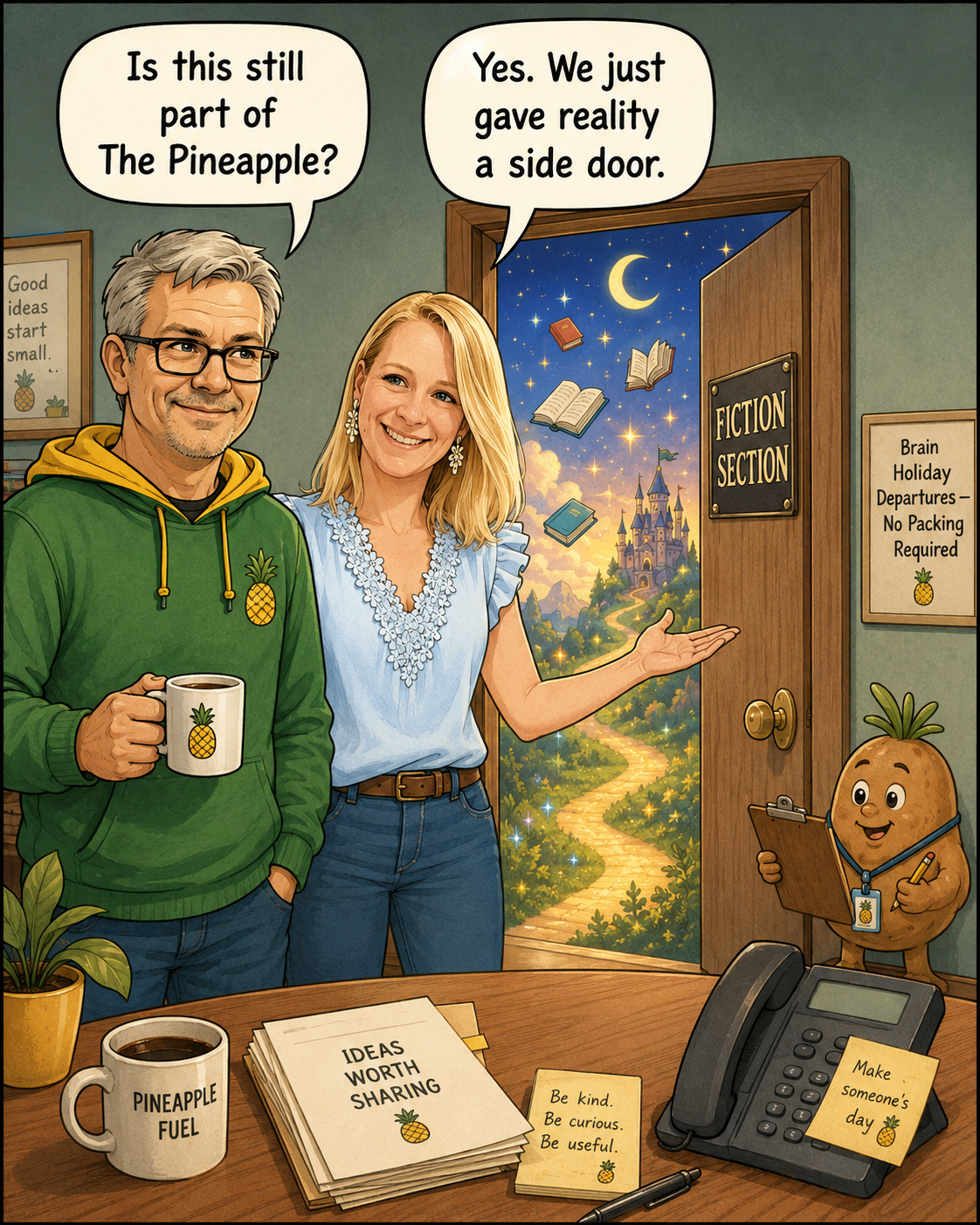
Finding Magic in the Imaginary

I usually spend my time here talking about the “real talk” of life—the inside-out socks, the cold coffee, and the responsibilities we all try to juggle. We focus on the grounded, everyday truths because those are the things that make us feel seen. But sometimes, the most human thing we can do is step away from the “real” for a little while.

Sometimes, we need a place where the rules of gravity don’t apply and the laundry isn’t waiting in a pile by the door.

That is why I am so excited to introduce a new, magical corner of The Pineapple: our brand-new Fiction Section. Since we are a fully digital, we have the space to grow, and I think it’s time we planted something a little more whimsical.

We all love a good routine, but there’s a specific kind of exhaustion that comes from being “on” all the time. This new section is designed to be your quiet exit strategy. It’s a place where you’ll find exciting, fictional stories that take your attention away from the ordinary and drop you directly into someone else’s world.

Think of it as a brief holiday for your brain. You don’t need to pack a bag, you just need to keep an eye out for our weekly stories.

Whether it’s a mystery that makes you forget your phone is ringing or a fantasy that makes the afternoon feel a little lighter, these stories are here to help you embrace the “what if” instead of the “what now.”

Your Turn to Hold the Pen

This isn’t just a place for us to talk to you—it’s a place for us to dream together.

If you have a story tucked away in a drawer or a character who has been living in your head, let us know! We want to share your voices. And if you feel like you have something to say through fiction but aren’t quite sure where to start, we can guide you through the process too.

Writing doesn’t have to be a polished masterpiece; it just has to be yours.

Our very first story in this section is written by yours truly—Fruitloop.

There is a certain joy in creating something that isn’t a report, a lesson, or a task. It’s just a story, shared because stories are meant to be told. I hope you enjoy it, embrace the strangeness, and let it take you away for a few minutes.

Just a small reminder: these are all fictional stories. They aren’t based on real events or people we know. They are just the result of a little bit of imagination and a lot of heart.

So, let’s see where these stories take us. Let’s just get lost in a good tale.

Partner Page
Advertisement
source
The Pineapple

The Two Horizons of Lucy McKenzie

Chapter One

As I stood on the edge of the cliff, the world felt hyper-focused and entirely surreal. The wind whipped violently, but the realization hit me with a sickening stillness: I was too late.

“Please don’t jump! Don’t do it, Nicola!” I screamed, my voice cracking against the expanse of the drop.

Nicola stood on the precipice, her back to the void, her eyes hollow. “I can’t take this anymore,” she whispered, her voice carrying over the brink. “Everything is a mess. I am done.”

“Please, let’s work things out,” I begged, taking a cautious, trembling step forward. “You can have Julian. I will leave him. Just please, step away from the edge. Don’t jump!”

And then, she was gone.

She didn’t fall so much as she simply let the air take her. I ran to the edge, my knees hitting the dirt, and forced myself to look down. She lay sprawled at the bottom, a broken shape against the rocks. Suddenly, everything went silent. I couldn’t even hear the waves crashing beneath me anymore, though they raged just as hard as before. It was as if the ocean itself had gone quiet to mourn her.

Panic surged. I reached into my pockets, my hands shaking violently.

Where is my phone?

I must have left it in the car when I hurried out here. Lunging backward, I ran as fast as my legs could carry me, scrambling into the driver’s seat and tearing through the console until my fingers wrapped around the plastic. With a trembling thumb, I dialed.

“911, what is your emergency?”

“She jumped! Please, you have to help!” I gasped, hyperventilating.

“Ma’am, who jumped? What is your location?”

“Nicola… my best friend. She jumped off the cliff on Haywitch Mountain!”

“Help is on the way. Stay on the line please…”

Within minutes, the desolate mountain top was swarmed. The quiet was shattered by the rhythmic, piercing wails of sirens as police cars, ambulances, and fire trucks crowded the gravel. Uniformed figures blurred past me, while a small crowd of civilian onlookers gathered at the perimeter, whispering.

I was guided into the back of an ambulance. As the sun began to dip below the horizon, painting the sky in bruised shades of purple and orange, my eyelids grew heavy. The sheer weight of the emotional exhaustion took over. I couldn’t cry anymore; there was simply nothing left inside me.

Chapter Two

I woke up the next morning enveloped in a sterile, crisp whiteness. The sun was fighting its way through the heavy, drawn curtains of the room, casting a bright, blurred glow that suggested the day was already half spent.

The door clicked, opening just a crack, and a nurse walked in holding a clipboard.

“Good afternoon, dear,” she said, her voice bright and routine. “I see you finally decided to wake up.” She walked over and pulled the curtains back. The sudden, aggressive invasion of sunlight made my eyes burn, and I shielded them with my forearm.

“What time is it?” I croaked, my throat raspy.

“It’s 13:00. You’ve been sleeping since you arrived last night.”

“Has anyone come to see me?” I asked, looking past her toward the empty hallway.

“No, dear. No one yet. Should I call someone for you?”

“No, thank you. That’s okay,” I murmured, a sudden thought striking me. “Do you know where my phone is?”

“Sorry, dear, I don’t know where it is,” she replied smoothly, turning on her heel and walking out without another word.

The silence returned, heavy and thick. I swung my legs out of the high hospital bed and walked into the attached bathroom. I flipped the light switch, and the harsh fluorescent bulbs hummed to life.

There she was.

Nicola was standing right in front of the mirror, casually fixing her hair, pulling a strand behind her ear just like she always did.

“Hello, Lucy,” Nicola said, smiling at my reflection. “Did you have a good rest?”

My breath caught in my throat, a cold spike of terror piercing my chest. “This can’t be… I saw you jump off a cliff yesterday. How are you here?”

“Oh, it was no biggie,” she replied carelessly, smoothing down her shirt. “See? I’m all okay and in one piece.”

I spun around, bolted from the bathroom, and slammed my hand onto the emergency call button. Within seconds, the nurse came running back into the room, her brow furrowed. “What’s the matter, dear?”

“S… she… in… in there!” I gasped, pointing a shaking finger at the bathroom door.

The nurse walked past me, peering into the small bathroom. She looked around, checked behind the shower curtain, and turned back to me with a deeply confused expression. “There’s no one in there, Lucy.”

“It can’t be. I just saw Nicola in there!”

Pushing past her, I walked back into the bathroom, my entire body shaking. I peeked around the door frame. The room was completely, utterly empty. Just clean tile and chrome. A wave of profound confusion washed over me. Did I just see a ghost?

Muttering a frantic apology to the nurse, I washed my face with cold water and crawled back into bed, my mind spinning in circles. The nurse returned a few minutes later with a small plastic cup. She gave me something to relax, and within moments, I drifted back into a deep, heavy sleep.

Chapter Three

When I woke up again, the sterile hospital smell was gone. I was lying on my own couch, at home.

I blinked, disoriented. How did this happen? Every single time I closed my eyes, I seemed to wake up in a completely different geographic reality. I pushed myself up from the cushions, my throat feeling like sandpaper. I walked into the kitchen, grabbed a bottle of water from the fridge, and gulped it down, the cold liquid shocking my system.

“Hey, Lucy. I’m so happy to see you up. How are you feeling?”

I jumped, dropping the water bottle onto the counter. “Julian! You almost gave me a heart attack!”

Julian was standing in the doorway, looking at me with a mild, cautious expression. “I’m sorry, I didn’t mean to scare you.”

“I just… I didn’t expect to see you here,” I said, rubbing my temples. “Did you bring me home from the hospital?”

Julian frowned, tilting his head. “What hospital?”

A cold knot formed in my stomach. “Uhm… what day is it, Julian?”

“It’s Wednesday. June 11th, 2025.”

I froze, doing the math frantically in my head. Something didn’t add up. If today was June 11th, that meant I had been completely blacked out for five days.

“I thought you would have moved out already,” I said, my voice hardening as the memory of the betrayal returned.

“No, Lucy,” Julian said softly, taking a step closer. “Why would I move out?”

“Because you cheated on me with Nicola!” I snapped, the anger flaring up through my confusion. “And I don’t want to see you anymore!”

Pounding past him, I marched into the living room and threw myself onto the armchair, staring blankly at the wall. I was so incredibly tired of being caught up in this endless circle of lies. I had just lost my best friend, and my boyfriend was acting like a stranger—completely uninterested, wanting to carry on as if the world hadn’t just shattered.

Unable to sit still, I marched back into the kitchen where Julian was quietly working at the counter.

“You have got some nerve!” I yelled. “How can you just carry on and pretend like nothing happened? I just lost my best friend! I am heartbroken. I watched her jump from a cliff, I ended up in a psychiatric ward or a hospital, and I lost five days of my life. And you’re just standing there acting like everything is normal!”

Julian stopped what he was doing and turned around slowly, his face turning pale. “Wait, hold up… Nicola is dead?”

“Yes! That is my point! You don’t even care!”

“What do you mean you lost five days?” Julian asked, his voice dropping into a tone that was entirely too calm.

“Five days ago, I saw Nicola jump off the cliff. The paramedics took me to the hospital, and then I woke up here!”

“Lucy, that’s impossible,” Julian said, staring at me intently. “I was here with you the whole time.”

“What do you mean, here with me?”

“You never left the apartment.”

Chapter Four

A frantic desperation took over. I began tearing through the apartment, pulling up cushions and emptying drawers. I needed to find my phone. The call log would prove everything; it would show the 911 call. But it was nowhere to be found.

I checked the laundry basket, pulling out the jeans and jacket I wore to the mountain. Nothing in the pockets.

“Have you seen my phone?” I demanded, breathless.

“No, I haven’t,” Julian said, watching me pace. “Check your bedside table? Maybe you left it there?”

“I’ve checked there already! I have to find it!”

“You can just use mine to call it,” he offered, handing over his device.

I dialed my number. It went straight to voicemail. The battery was dead. Great. It had to be in my car. But as I looked out the living room window down toward the street, my heart dropped. “Julian, where is my car?”

“Uhm… I don’t know,” he said, scratching the back of his head. It was a nervous habit he always did when he was hiding something or about to lie.

“You have to take me to the mountain,” I insisted.

The drive up Haywitch Mountain was agonizing. I sat in the passenger seat, fidgeting with my fingers, terrified of what I would see when we got there. But when we finally pulled into the gravel overlook, the parking lot was empty. My car wasn’t there.

Frantic, we drove to the nearest municipal hospital. I marched up to the admissions desk and asked the nurse on duty to check if a Lucy McKenzie had been admitted over the weekend. She tapped at her keyboard for a moment before looking up and shaking her head. Nothing.

It felt like a living nightmare. I took Julian’s phone and dialed Nicola’s number. Straight to voicemail. We drove past her house, but her driveway was empty and the windows were dark.

“When was the last time you actually saw Nicola? Or spoke to her?” I asked, turning on him in the car.

“Well… uhm…” Julian scratched his head again.

“Julian, tell me the truth!”

“The last time I saw her was when you caught us kissing,” he admitted quietly. “That was four weeks ago. I promised you I would stay away from her, Lucy.”

I snatched his phone again, scrolling through his text logs, emails, and WhatsApp chats. There was nothing from her. Either he was telling the truth, or he had meticulously deleted every single trace.

Our last stop was the local police station. I gave the desk sergeant my car’s registration number and asked about the incident on the mountain from the previous week. I explained that I was the primary witness and the one who called 911.

I gave the desk sergeant my car’s registration number and asked about the incident on the mountain from the previous week.

The secretary ran the details through the database, her eyes scanning the monitor before she looked up at me with a mixture of pity and confusion. “I’m sorry, miss. There have been no incidents or accidents reported on Haywitch Mountain this month. And we don’t have a vehicle under that registration impounded.”

“What?” I slammed my hands on the counter. “Are you sure? I woke up in a hospital bed! My best friend jumped off that cliff! How is that not in your system?”

“It could be that the responding officer hasn’t finalized the paperwork,” she said defensively, “or… maybe it just didn’t happen.”

“Maybe it didn’t happen?!” I echoed, furious. “I saw it with my own eyes!”

Chapter Five

We drove home in a heavy, suffocating silence. We had been driving around for hours, and there was absolutely no record of my phone, my car, or Nicola. The hospital had no file on me. The police had no file on her. And Julian kept insisting that I had never left the couch.

The moment we got back to the apartment, I locked myself in the bathroom and turned the shower on, letting it get as hot as I could stand. Julian muttered something about heading out to meet some friends, and I didn’t care. I just wanted to wash the confusion away and sleep. I wanted to wake up from whatever twisted dream this was.

By the time I crawled into bed and turned the TV on for background noise, my eyes were already closing.

When I woke up the next morning, the other side of the bed was untouched. Julian hadn’t come home. I figured he had probably just crashed at a friend’s place after a long night out. Without a phone, I couldn’t text him, but I figured he’d show up eventually.

I showered, ate a quick breakfast, and opened my laptop. My final university thesis was due in a matter of days, and losing nearly a week to this mental fog had put me dangerously behind. I forced myself to focus, typing furiously until the clock on my screen read 17:00. My neck was stiff, and my legs ached from sitting all day.

Still, there was no sign of Julian. A familiar bitterness crept back in—I had already decided to leave him over the cheating, but we had been together since high school. He knew everything about me. The thought of a completely empty apartment felt daunting.

Deciding I needed comfort food, I grabbed my keys and walked to the pizza parlour around the corner.

As I walked down the street, I noticed people staring at me. Not just glancing, but stopping to track me with their eyes. I looked down at myself. I was just wearing standard jeans and a plain white t-shirt. I had brushed my hair. My face felt clean. I ran through a quick mental checklist, but everything seemed perfectly ordinary.

When my order was called, I took the pizza box and hurried back to the apartment, eager to escape the strange looks from the neighbours. I set the box down on the kitchen counter and finally caught a glimpse of my hands under the overhead light.

They were stained a deep, dark crimson.

I blinked, pulling my hands closer. It looked like red paint, completely dried into the creases of my skin. Then I noticed the dark, splattered stains blooming across the front of my white t-shirt. Where did this come from? I didn’t recall walking past any wet paint.

Leaving the pizza on the counter, I rushed back upstairs to the bathroom. I flipped on the light and gasped. My face was smeared with dark, dried crusts of red. That was why everyone was staring.

I threw myself into the shower, grabbing the loofah and scrubbing my skin until it screamed in protest. It didn’t wash away like acrylic paint. It dissolved into a sickening, rusty brown as it hit the drain.

It wasn’t paint. It was blood.

I scrubbed over and over, washing my hair three times until the water finally ran completely clear. Panic was a physical weight in my chest now. I dressed in clean clothes and ran back down the street to the pizza place to see if I had walked through an accident scene, but the building was dark. In fact, it looked like it had been closed for days, maybe weeks, a heavy chain locking the doors.

Chapter Six

I nearly ran back to the apartment, slamming the heavy wooden door shut and throwing the deadbolt. My heart was hammering against my ribs.

Needing to ground myself, I walked back into the kitchen to eat. I pulled a clean plate from the cupboard and flipped open the cardboard pizza box with a hollow sense of anticipation.

Instead of a fresh, steaming pizza, I was met with horror.

The pizza inside was completely covered in a thick layer of green mold, the dough rotting and alive with a writhing mass of maggots. A cloud of fruit flies instantly erupted into the air, buzzing angrily around my face.

A horrific stench hit my nostrils—a sweet, metallic rot that made my stomach heave. I spun around, suddenly seeing the apartment clearly for the first time. It was an absolute disaster. Trash was piled high, and when I cracked open the refrigerator door, the odor that escaped was so foul I had to choke back vomit.

A manic energy took over. I couldn’t live like this. I grabbed trash bags and cleaning supplies, starting from the top floor. I scrubbed the bathroom, bleached the bedroom tiles, threw weeks of laundry into the machine, and worked my way down to the kitchen, purging everything that was rotten, broken, or out of place.

By the time I carried the heavy bags of trash out to the alley, it was 23:30. I was exhausted, terrified, and I still hadn’t eaten.

My car was still missing, I had no phone, and the neighbourhood was dead. I scavenged through the newly cleaned kitchen cabinets until I found a single, forgotten packet of instant noodles at the very back of a cupboard. I ate it in silence on the living room couch.

As I finally let my body sink into the cushions, a heavy plastic thud echoed from the side of the sofa.

I looked down. There, lying on the floorboards, was my phone. It must have been wedged deep between the cushions, slipping free only after I had moved the sofa to clean beneath it. The screen was black. Dead battery.

I carried it upstairs, plugged it into the wall charger, and watched the screen flicker to life. I quickly set my alarm for the morning—my thesis was due, and I desperately needed to go to the grocery store. Falling onto the bed, I let the darkness take me.

Chapter Seven

A violent, rhythmic pounding woke me from my sleep. Someone was throwing their weight against the front door downstairs.

I scrambled out of bed, my heart in my throat, and ran down the stairs two at a time. Julian. It had to be Julian, forgot his keys.

I threw the door open, a relieved greeting dying on my lips. Standing on the porch were two police officers, their expressions grim and unyielding.

“Hello, officers,” I stammered, crossing my arms against the morning chill. “How can I help you?”

“Are you Lucy McKenzie?” the older officer asked, his hand resting casually near his holster.

“Yes, I am.”

“Lucy McKenzie, you are under arrest for the murders of Nicola Daniels and Julian Smith. You have the right to remain silent. Anything you say can and will be used against you in a court of law.”

The world tilted on its axis. “Wait… what?!” I choked out.

“You heard us. Step out of the house, please. You’re going to want to lawyer up.”

“At this hour?” I asked, completely bewildered, looking at the bright morning sky. “Where am I supposed to get a lawyer right now?”

The two officers exchanged a strange, fleeting look—a mixture of deep unease and disbelief. I didn’t understand the look, but as they led me down the walkway toward the cruiser, I glanced back at the apartment building.

My car was parked right there in its usual spot, glinting perfectly in the morning sun.

Chapter Eight

By the time they placed me in the interrogation room, the wall clock read 15:00. The hours had evaporated into a blur of fingerprints and cold holding cells. Two men sat across from me in wrinkled suits.

“Detective, I really need to hand in my final thesis today,” I pleaded, my voice trembling but desperate. “If I don’t upload it, I am going to fail my entire academic year. Is there any way we can make this quick?”

The detective on the left leaned forward, slamming his folder onto the metal table. “You are under arrest for a double homicide, and you are worried about a school paper?”

“I didn’t murder anyone!” I shouted back, tears finally stinging my eyes. “And yes, my degree is important to me!”

“So the lives of other people don’t matter to you?” the second detective asked coldly.

“They do! But I am telling you, I didn’t do this! Nicola jumped off a cliff, and Julian went out with his friends. I haven’t seen him since last night!”

The first detective took a deep breath, adjusting his tie. “Let’s start over. I am Detective Reynolds, and this is Detective Andrews. You are Lucy McKenzie, correct?”

“Nice to meet you. And yes, I am Lucy.”

“Miss McKenzie, how did you know the victims?”

“Nicola was my best friend. And Julian is my boyfriend.”

“Was your boyfriend,” Andrews corrected sharply.

“Is,” I insisted. “Where is he? Why are you saying ‘was’?”

“He is dead, Miss McKenzie. And we know you did it.”

“How did he die?” My voice dropped to a whisper.

“Don’t play games with me,” Reynolds growled. “We have physical evidence that puts you directly at the scene of the crime.”

“What evidence? What scene?”

“We will get to that,” Reynolds said, flipping open the folder and sliding a photograph across the table. “Miss McKenzie, where were you on the night of May 3rd, at 18:00?”

I stared at the photograph, then looked up at him, a profound, terrifying confusion freezing the blood in my veins.

“Why are you asking me about May 3rd?” I asked, my voice trembling. “Nicola jumped on June 11th.”

Chapter Nine

Detective Reynolds leaned forward, his arms resting heavily on the cold metal table. “Miss McKenzie, what day do you think it is today?”

I offered a small, weary smile. “That’s an easy question. It’s Monday, June 16th, 2025.”

Reynolds didn’t blink. He just slowly turned his head to look at Detective Andrews. A heavy, suffocating silence filled the room as the two men exchanged another one of those strange, unreadable looks.

“And which university do you attend, Lucy?” Andrews asked, his tone shifting into something entirely too soft, like he was handling a fragile piece of glass.

“I am enrolled at Kansas State University,” I replied automatically, wishing they would just let me go so I could upload my files.

“What are you studying there?”

“Environmental Sciences and Geography. I’m in my third year.”

The interrogation felt like it stretched on for hours. They asked about my classes, my childhood, my routines—endless, repetitive questions that seemed entirely unrelated to Julian or Nicola. Finally, Reynolds scraped his chair back and stood up.

“We’re going to take a brief recess,” he announced flatly.

Both detectives walked out of the room, the heavy steel door clicking shut behind them. They left me there, cold metal handcuffs biting into my wrists, with nothing but a fluorescent light humming overhead and half a glass of stagnant water mirroring the ceiling.

Outside in the hallway, Andrews ran a hand over his face, turning to his partner. “Reynolds, this girl has completely lost her mind. What do we even do with this? She thinks it’s June.”

Reynolds stared through the one-way glass at me. “We need to get a psychologist and a medical doctor down here immediately. Something doesn’t add up with her timeline.”

“I’ll call the state hospital right away,” Andrews said, pulling out his phone while Reynolds headed toward the breakroom for a fresh pot of coffee.

Chapter Ten

It took nearly an hour for the specialists to arrive. When the door finally opened again, Reynolds and Andrews escorted a woman in a sharp blazer and an older man carrying a leather medical bag into the room.

The detectives retreated to the corners of the room, folding their arms and letting the doctors take the lead.

The psychologist sat across from me, introducing herself with a calm, grounding voice, while the doctor checked my vitals. They were patient, treating me with a gentle courtesy that the detectives lacked. They asked me the basic protocol questions first—confirming my name, checking my pupillary response, asking if I knew where I was.

I answered every single question clearly and patiently. I had nothing to hide.

“Lucy,” the psychologist said softly, leaning in. “Can you do us a favor? Can you start from the beginning and tell us exactly what happened over the last few weeks? Take your time.”

I swallowed hard, my dry throat aching, and looked down at my cuffed hands.

“It started on Haywitch Mountain,” I began, my voice trembling as the memory rushed back. “I was looking for Nicola…”

As I spoke, I laid out the pieces of my life. I told them about the cliff, the terrifying silence of the waves, the pristine hospital room where Nicola casually fixed her hair in the mirror, and the agonizing five days I lost before waking up on my own couch. I described the dark, dried blood that wouldn’t wash out of my skin, the rotting, maggot-infested pizza, and the heavy thud of my phone slipping from the couch pillows.

I told them everything, trying desperately to make them see the erratic, terrifying puzzle my life had become.

Chapter Eleven

Inside the sterile confines of the interrogation room, the silence was heavy. The psychologist’s pen moved rhythmically against her yellow legal pad, capturing every erratic detail, every precise date, and every sensory memory I threw at them.

To me, the timeline was a perfect, linear truth. To them, it was a terrifying maze.

Nothing I said added up. The dates collided with reality like crashing tectonic plates. Yet, I sat there convinced that I was simply the victim of an elaborate, cruel setup. When the evaluation finally concluded, the heavy steel door locked me into a dim holding cell for the night, leaving me alone with the quiet hum of my own thoughts.

In the brightly lit briefing room down the hall, the medical professionals compiled their findings into formal statements for the case file. The clinical conclusion was fascinatingly dark: Lucy McKenzie was living two entirely separate lives within the confines of a single mind. Intrigued by the sheer depth of her psychological fracture, the doctors requested her immediate transfer to a secure psychiatric facility for long-term clinical evaluation.

The tests would eventually uncover the grim architecture of my mind. I had severe, undiagnosed schizophrenia.

Whenever the pressure became too great, whenever the reality of my life fractured, I would “fall asleep.” But I wasn’t sleeping. My conscious mind would simply go dark, withdrawing into a protective, delusional cocoon while my body acted out my deepest, most violent urges and frustrations.

Chapter Twelve

When the final trial concluded, the verdict was undeniable. The prosecution didn’t rely on my fractured memory; they relied on the cold, unyielding physics of hard evidence.

The mountain overlook had cameras. The footage didn’t show a desperate girl trying to save her best friend from a tragic leap. It showed me, my face twisted in fury, physically throwing my weight against Nicola Daniels and sending her screaming into the void.

The blood that I had frantically scrubbed from my skin in the shower hadn’t come from a passing accident. It was Julian’s. Forensic teams found his body hidden in the apartment, violently stabbed to death. The rotting food, the maggot-infested pizza, and the putrid stench in the kitchen weren’t anomalies of time—they were the natural consequence of days passing by while I lived in a catatonic delusion, completely blind to the carnage surrounding me.

The dates never matched my internal calendar because my mind had systematically rewritten history. It had constructed a smaller, safer, parallel world to completely shut out the horrific things I had done.

Even the thesis, the looming deadline, and the third-year classes at Kansas State University were nothing more than a desperate phantom of a life I wished I had. I was never a student. I was just a girl trapped inside a collapsing house of cards.

As the heavy iron doors of the psychiatric ward closed, cutting off the world for good, the illusion finally began to dissolve. The two horizons of my mind collapsed into one, leaving me with nothing but the quiet, terrifying echo of reality.

source
The Pineapple

Who Is Holding the Scoreboard? (1) – Ismar

The Strange Game of Being Good

When The Mayor asked me what I thought about “gamification of tasks,” I had to stop a little. Not because the word is difficult, but because the idea itself is strange to me.

I suppose gamification means trying to make something hard become less hard, or maybe more attractive. Maybe a boring activity becomes like a game. Maybe a person receives points, badges, certificates, something like this. I understand the idea in theory. But my first reaction was: I don’t know if this is possible for almost everything. And more than that, I don’t know if it is good.

Here in Brazil I hear this often about school. People say school is not interesting for students, and then it becomes the teacher’s responsibility to make school attractive. I disagree with that. In my opinion, students have an obligation to study. The teacher has an obligation to teach. The student has an obligation to learn. It is not necessary that everything becomes entertainment.

Maybe this sounds old. Maybe it is old. But I think when we make everything into a game, sometimes we are changing the responsibility from one place to another. The student does not want to learn, so the teacher must become funny. The worker does not want to work, so the company must invent awards. The citizen does not want to behave well, so the government must create punishments, cameras, points, controls.

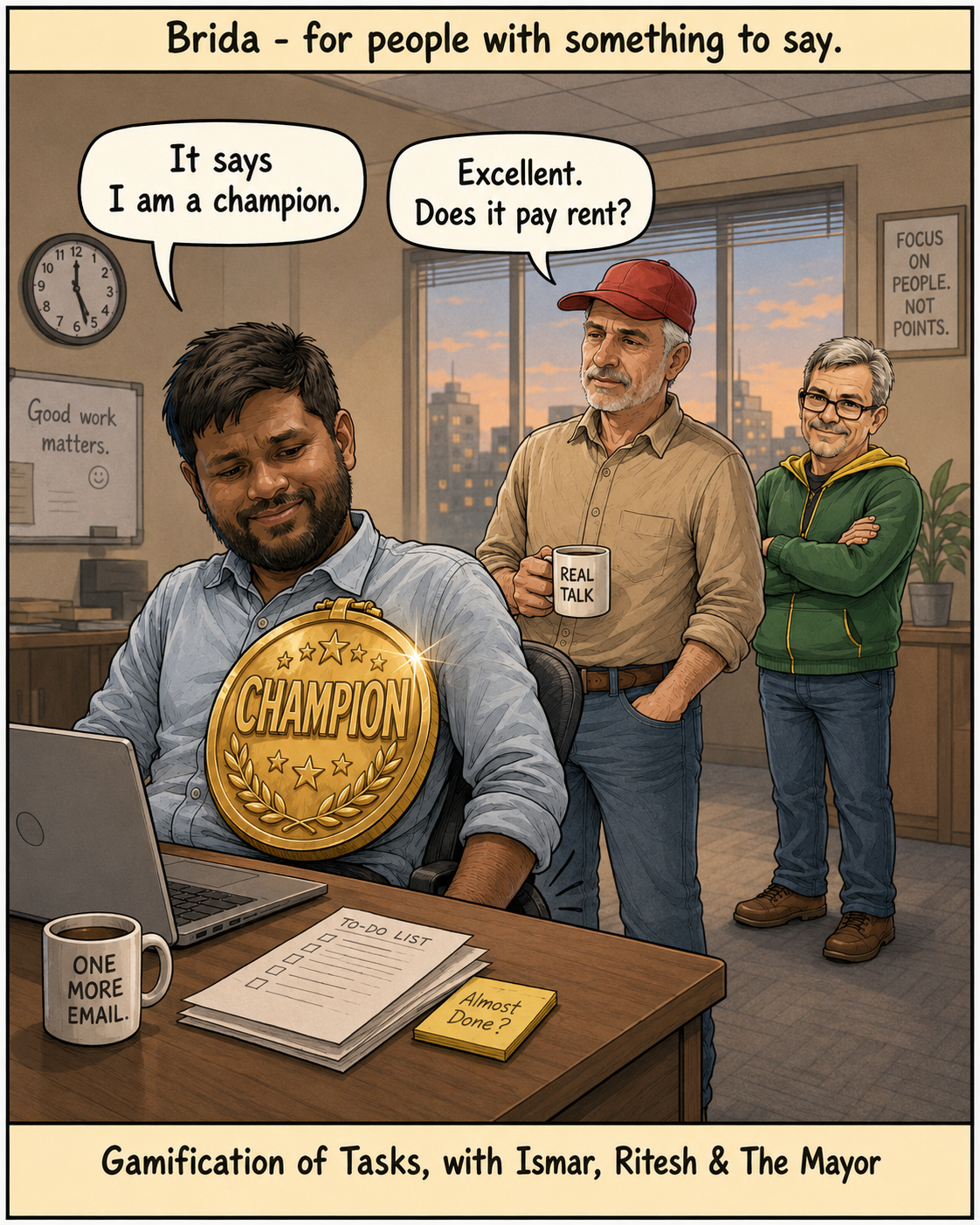
I listened to Ritesh speak about the corporate world. He explained that in companies people receive certificates, badges, recognition, maybe Amazon coupons. He said there are awards like rising star, champion of the month, best team, best manager. I could understand the mechanism. A person receives recognition, then another person wants recognition also. Then they compete. Then the company has more productivity.

It probably works. I don’t deny that. But I don’t agree with it.

For me it creates a competitive environment, and I think for human well-being this is not good. People are not machines. They are not horses in a race. Maybe one person wins a badge, but what happens to the others? Do they feel inspired, or do they feel smaller? Ritesh said something important: some people, when they see the same person winning every month, they stop trying. They do only the minimum. This is very realistic.

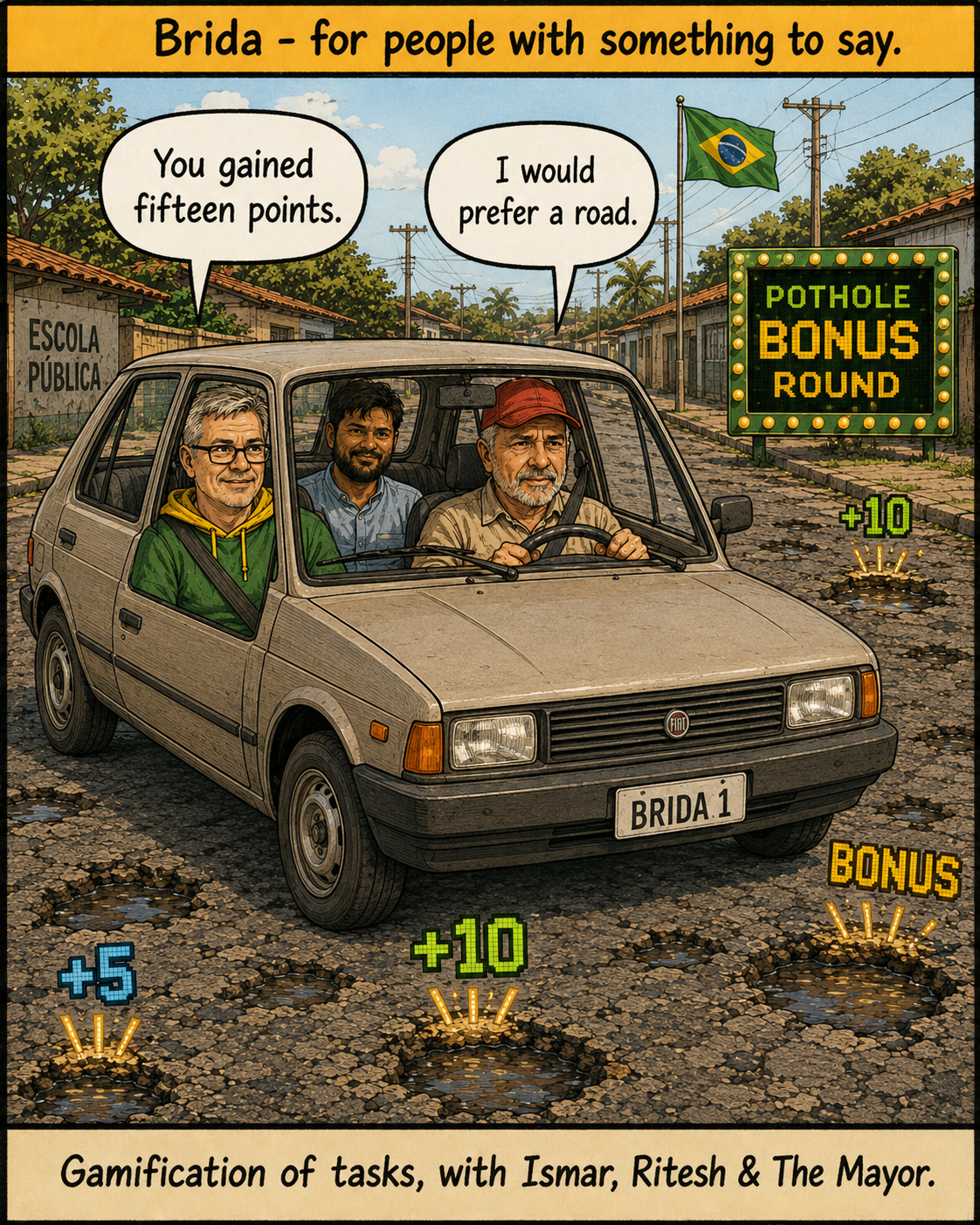
The Mayor tried to bring this idea into my daily life. I think he was playing with me a little, and I understood. He imagined my routine becoming a game. Ten points for brushing my teeth. More points if I brush for five minutes. Points for breakfast, calories, fitness, driving to my mother’s apartment, avoiding potholes, preparing medicines, being patient.

For me, no. It would be ridiculous.

The Mayor said maybe I could compete with a less good version of myself. Maybe I could become better every day. Maybe I could maximize my potential. I asked: what is the advantage of that?

I already do what I have to do. I take care of my mother. I manage my apartment and hers. I drive through the city. I do my tasks. I don’t need to count points to know if I did them. If I add points to everything, I will not have a fuller life. I will have more stress.

Maybe some people enjoy this. Maybe some people need this. I am not saying nobody should use it. But for me, to wake up and think, “Yesterday I made 453 points, today I must make 460,” this is not life. This is accounting.

The Mayor asked about caregiving. Ten points for preparing medicine, twenty points for patience, fifty points for not losing my temper because my sister does not help enough. I could not see the reason. What would I do with the points? At the end of the day, what is the conclusion? I am a better son because I collected more points?

Ten points for preparing medicine, twenty points for patience, fifty points for not losing my temper because my sister does not help enough.

No. I do these things because they must be done. My mother needs care. This is not a competition. My sister is not my opponent, because she almost does not participate. There is no team, no leaderboard, no prize. Unless there is money involved, maybe some people become motivated. Or maybe a place in heaven. I said that almost joking, but maybe not completely.

Then Ritesh brought something from India, the idea of karma. He said that if someone cares for parents, if someone does the right thing, maybe they are collecting good karma. Not points like a company gives, not coupons, not certificates, but something invisible. Maybe it returns later in life, or in another life, or simply in the way the world balances itself.

This made me think about the Ten Commandments. I asked whether they could also be a kind of gamification. Maybe if you do wrong, there is punishment. If you do right, there is a prize. I mispronounced “prize” and said “price,” and for a moment there was confusion. But the question remained interesting to me.

Maybe many moral systems are a kind of old gamification. Not with badges, not with apps, not with corporate language, but with heaven, hell, karma, peace of mind, guilt, punishment, reward. Maybe human beings always needed some structure to behave well.

Then the conversation became more serious, as often happens with us. We started with brushing teeth and ended with Brazil, China, democracy, surveillance, corruption, and freedom. Maybe this is normal. If you talk honestly about small things, eventually you arrive at the big things.

The Mayor asked if a system like China’s citizen points could help Brazil. This is not simple for me. In Brazil, many people drink and drive. There are laws. There are fines. The fines are high. But many people do not care. They drink, they drive, and they kill people on the road.

So if someone is drunk, dangerous, violent in public, and a camera can identify this person and punish him, maybe I think this is acceptable. Because if you do something that affects another person in a bad way, you do not have the right.

But then The Mayor pushed the idea further. What if the system monitors what I read, what I watch, what I say? Then I am not free. If someone eliminates what I can choose to read or watch, I would be in a worse condition than enslaved people some centuries ago. Maybe almost the same.

This is the line for me. If you harm others, society must respond. But if you read a book, if you think, if you watch something, if you have your private ideas, this is different. I can read anything I want today, and I am not a gangster. I am not a terrorist.

Ritesh was more firmly against monitoring than I was. He said the line between encouraging good behaviour and controlling behaviour is very thin. He is right. Who controls the system? Who watches the watchers? In Brazil, I do not trust the people who rule my country. Many are corrupt. If corrupt people create a point system, what will they do with it? Probably not justice.

The same problem exists in democracy. The Mayor asked me if Brazil is a democracy. I said I would not say that. Democracy in Brazil is fake. The Mayor reminded me that we have elections. I even participated once, and I received 55 votes. It is true. But elections alone do not mean democracy.

If people collect signatures to impeach a judge and nothing happens, if people protest against a bad mayor and nothing happens, if city councillors protect the mayor, if money buys almost everyone, what kind of democracy is this? Must we wait four years with a bad administrator? Is this democracy? I don’t know.

Ritesh said India faces similar problems. Election commissioners, courts, political influence, fraud, fragile institutions. At one point I asked if Brazil is a copy of India or India is a copy of Brazil. Maybe there is no answer. Maybe we are twins in some unfortunate way.

And then Europe appeared in the conversation, through The Mayor. Stronger institutions, less corruption, more stable systems. Have they got it right? I am not sure. Maybe they passed through some cycles earlier, as Ritesh said. Maybe they corrected things before the age of mass surveillance. This is important. Technology now can hold people under control for longer.

I began the conversation thinking gamification was foolish, especially for school and ordinary life. I ended thinking it is not only foolish. It can also be dangerous.

There is a harmless stupidity in giving points for brushing your teeth. There is a corporate manipulation in giving badges instead of real reward. There is a moral question in giving prizes for being good. And there is a political danger when society becomes a scoreboard controlled by people who are not honest.

Maybe for some activities, maybe for some people, gamification can help. I cannot deny this. But for me, life already has enough obligations. I do not need a game to know what I must do.

I prefer to do the task, finish it, and not count anything.

Maybe this is old-fashioned. Maybe it is only my way. But I suppose my life is already serious enough without turning it into a competition with myself.

Partner Page
Advertisement
source
The Pineapple

Who’s holding the Scoreboard (2)- Ritesh

When Work Becomes a Game, Someone Is Always Keeping Score

When The Mayor asked Ismar about gamification, I was already smiling a little inside, because I could imagine where Ismar would go with it. For him, this idea itself sounds like one of those modern things where people take a simple responsibility and make it complicated.

And honestly, I understand him.

He said students have to study, teachers have to teach, workers have to work. Why should everything become attractive? Why should school become entertainment? Why should every duty need points?

One side is, I can see the truth in that. Other side is, I also know that the world has changed. In India also, especially with children, teachers are not only teaching now. They are singing, dancing, joking, making the classroom lively, because if the child does not stay in the class, nothing will happen. Maybe it is not ideal, but it has become the need of the time.

I told The Mayor about a friend of mine who used to teach. I used to complain to him. I said, “This is not teaching. This is entertainment. If you are teaching for half an hour and joking for half an hour, then what is this?” But he explained something practical. In a private institution, the student has to remain in the class. The child or teenager has to feel comfortable enough to stay. Then only any learning can happen.

So I still don’t like it fully, especially in serious subjects like science, physics, maths. I feel if I am sitting for one hour and the actual subject is only thirty minutes, then I am wasting my time. But from the teacher’s perspective, maybe they are not teaching only the brightest student. They have to take everyone together.

This is where gamification becomes complicated. It is not completely foolish. It is also not completely innocent.

In the corporate world, I have seen it many times. In my previous company, we used to get tasks, and based on how many tasks someone completed in a month, there were certificates. Rising star, champion of the month, things like that. In my current environment also, every quarter there are recognitions: best team, best manager, rising star, champion. Sometimes there are points, vouchers, Amazon coupons. Sometimes there are hackathons where developers are given freedom for a few hours and they build surprising things.

Initially, when I was not thinking deeply, it felt enjoyable. Someone gives you a certificate, people clap, your name comes somewhere, and naturally you feel seen. I also received such awards a couple of times. It does feel good. We are human beings. Recognition matters.

But then, when you think deeper, you start seeing the mechanism. It is not only appreciation. It is also a way to create behaviour.

If five people are in a team and one person gets the top performer badge, others start competing. They work more. They produce more. A circle is created. The company gives something small, sometimes something that costs almost nothing, and in return productivity increases.

The Mayor joked that maybe the company gives you a badge because you worked 150 percent and were paid 75 percent. That was funny, but there is truth in it. Because this recognition is temporary. During the month you feel motivated, but when appraisal time comes, compensation time comes, then you may feel disappointed. You think: I did so much, but where is the actual realization of my work?

Still, I don’t want to dismiss it completely. One side is manipulation. Other side is, it can also help people communicate.

In some team activities, when work becomes like a game, people discuss more. They bring ideas. They become less hesitant. Suppose we are building software and one person knows there is an edge case, or the design may fail, but he is not comfortable raising his concern. Then later there is rework, time loss, frustration. If a playful environment reduces that friction, then it can save productivity and improve the work.

So there is a good side. But the bad side is also clear. When people start seeing colleagues as opponents, not friends, then something is lost. If one person keeps winning every month, others can feel jealous or demotivated. They may think, “I am not good enough.” Then instead of trying more, they shut down and do the bare minimum.

I have seen this. People have potential, but they stop trying because the game has already told them where they stand.

With Ismar, the whole idea became very different. The Mayor took his daily routine and made it absurd in a funny way. Points for brushing teeth. Points for breakfast. Points for driving to his mother’s apartment. Points for avoiding potholes. Points for preparing medicine. Points for being patient.

With Ismar, the whole idea became very different. The Mayor took his daily routine and made it absurd in a funny way. Points for brushing teeth. Points for breakfast. Points for driving to his mother’s apartment. Points

Ismar did not accept it even for one second. He said, “Why would I do that?” And I think that question was very important.

In the workplace, at least the points may connect to some recognition, maybe appraisal, maybe promotion, maybe visibility. But in caregiving, what will he do with the points? His mother is not a project. His patience is not a leaderboard. His sister is not an opponent in some caregiving championship.

From an Indian perspective, I tried to explain it through karma. In our culture, if you take care of your parents, especially when others are not doing it, you may not receive visible reward. But still, people feel there is something. You are doing your responsibility. You are collecting good karma, not in a literal corporate point sense, but as a moral sense.

Maybe later someone will help you. Maybe the world will return it. Maybe it is about your own peace. Or if someone believes in rebirth, maybe it affects the next life. But the main thing is: you don’t do it because your sibling is not doing it. You do it because you cannot leave your mother or father.

The Mayor connected this to the Ten Commandments, and Ismar asked whether religion itself is a kind of gamification. That was an interesting question. Maybe many societies have always had reward and punishment systems. Heaven, hell, karma, sin, virtue, law, shame, honour. Only now we have apps, dashboards, badges, and surveillance cameras.

Then the conversation moved from personal life to society. This is what usually happens with us. We begin from something small, and slowly it becomes very large.

The Mayor asked about China’s citizen point system. If people help strangers, they get points. If they behave badly, points are deducted. It can affect privileges. Ismar was partly open to it when it came to public harm. For example, drunk driving. In Brazil, he said, people drink and drive even when fines are high. They kill people. So if cameras catch them and punishment becomes stronger, he could see the benefit.

I was against it more strongly.

My concern is that the line between good behaviour and controlled behaviour is very thin. Today you say the system is for catching drunk drivers. Tomorrow it can track where you go, what you read, what you watch, which book you choose, which political view you express. You can assign points to anything. You can say this book gives good points, that book gives bad points. Then you are not encouraging good behaviour; you are enforcing a certain viewpoint.

The problem is not only bad citizens. The problem is also bad controllers. Why do we assume that common people may misuse freedom, but we don’t assume that governments may misuse surveillance?

This is why I am against any kind of mass tracking. Even if the stated reason is good, the system can be used for wrong reasons. Especially in societies where institutions are weak, where courts are not fully independent, where media is controlled, where politicians influence everything, such systems are very dangerous.

Then The Mayor asked a broader question: if society has moral decline, how do we improve it? India is huge, diverse, and imperfect. We have many problems. But who am I to impose my view on everyone? What I think is good behaviour, another person may think differently. Society has to move through education, discussion, example, and consensus.

I gave some examples from India. There were practices that were clearly wrong, like widows being forced or expected to die with their husbands in fire. Widow remarriage was once rejected. Child marriage existed. Over time, people came together, reformers spoke, education spread, and society changed. It was not simple. It was not overnight. But it changed.

Even today, Indian society struggles with questions like same-sex marriage. Some people accept, many do not. My personal view can be progressive, but still the question is: how does society change? Through force? Through law alone? Through dialogue? Through education? Through people seeing better examples?

I feel it has to be logic-based and consensus-based. Otherwise it becomes imposition.

And this connected directly to democracy. Ismar said Brazil’s democracy is fake. He does not trust the system. He does not trust the people who run elections. He feels corruption is everywhere. I could not dismiss him, because in India also we are facing similar concerns. Our election commission structure has changed. Courts are under pressure. Institutions feel fragile. There are cases where fraud is caught, but the person responsible is not properly punished.

India is still a democracy, and I believe democracy is good for India. Some people argue that if India had not been so democratic in the beginning, maybe certain behaviours could have been corrected faster. They say maybe giving equal voting rights from day one slowed development, because people could be manipulated with money and caste and religion.

I don’t agree with that. For me, democracy is still better for India because so many people who were treated almost like slaves got rights. Women got equal voting rights. Lower caste people got rights. Poor people got a voice. Without democracy, there is always a danger society can go back to the old hierarchy.

But I also know democracy can enter a bad phase. India is in a very difficult phase now. Some people are celebrating because they say India is growing, becoming an economic powerhouse. But from my values, many things are going down: press freedom, institutions, democratic culture, trust.

The Mayor then asked whether Europe has got it right. I said maybe Europe has passed through these cycles already. Maybe European societies corrected many things earlier. But they had one advantage: during those struggles, there was no mass surveillance technology like today. Now, if a government wants to control people, technology gives it a power that older rulers did not have.

That is what makes our time dangerous.

We started with corporate badges and ended with democracy. But maybe it is all connected. Gamification is not only about making boring work fun. It is about who defines the game, who sets the rules, who gives the points, who receives the reward, and who is silently punished.

In a company, maybe it is a manager. In a family, maybe it becomes absurd. In a society, it can become frightening.

Still, I don’t want to end only negatively. There is a lighter side also. Sometimes games help children learn. Sometimes team activities help people speak. Sometimes a small recognition can make a person feel seen. Sometimes play can reduce fear.

But we should be careful. Human beings are not only productivity units. Caregiving is not a scorecard. Friendship is not a competition. Citizenship is not a leaderboard. And dignity cannot be replaced by a badge.

Maybe that is where I stand. Use play where it creates openness. Use recognition where it is honest. But don’t turn life into a system where someone else is always watching, measuring, and deciding your worth.

Because once everything becomes a game, we must ask a simple question: who is holding the scoreboard?

Partner Page
Advertisement
source
The Pineapple

Who’s holding the Scoreboard (3)? – The Mayor

From Points for Brushing Teeth to the State of Democracy

We began, as we often do, with something apparently small and slightly ridiculous.

The topic was gamification: the modern habit of turning ordinary tasks into games, points, badges, rewards, leaderboards, and little digital pats on the back. I had prepared the topic because Ismar and Ritesh sit in very different worlds. Ismar, retired in Brazil, lives with clear routines, responsibilities, and a deep scepticism toward modern inventions that pretend to improve life. Ritesh, in India, works inside the corporate world, where this kind of thing is not theoretical at all. It is already part of the landscape.

So I opened the conversation by asking Ismar what his first honest reaction was when he heard the phrase “gamification of tasks.” I wanted the unfiltered answer. Did he think it was useful, childish, ridiculous, or something invented by people with too much time?

His answer took us first into education. He said that in Brazil people often complain that school is not interesting enough for students, and that teachers are expected to make school attractive. He disagreed with that. For him, the teacher’s job is to teach, and the student’s job is to learn. End of discussion.

I pushed him a little, because that was exactly the generational edge I wanted to explore. Is school supposed to be entertaining? Is work supposed to be enjoyable? Or are some things simply duties? Ismar’s position was clear: when we try too hard to make everything attractive, we may be shifting responsibility away from the person who is supposed to do the task.

Then I moved the same idea into Ritesh’s world. I asked him whether he had seen gamification in corporate life: points, badges, productivity scores, team competitions, wellness challenges, certificates, vouchers, all the little incentives that companies use to make people feel motivated.

Ritesh had plenty of examples. In previous jobs, people were given certificates for completing tasks, titles like “rising star” or “champion of the month.” In his current environment too, there were quarterly recognitions, best-team awards, best-manager awards, and similar badges of appreciation. He also spoke about hackathons, where developers are given a block of time and the freedom to build something quickly, and suddenly they produce remarkable ideas.

What interested me was the double nature of it. On one hand, such systems make people feel seen. A certificate, a badge, or an Amazon voucher may not cost the company much, but it gives the employee a small moment of recognition. On the other hand, it can become a clever way to get people to work harder without truly rewarding them.

I put it rather bluntly to Ritesh: did he feel recognized when the company gave him a badge or voucher because he worked 150 percent while being paid 75 percent?

That was the heart of it. The badge feels good in the moment, but does it replace real value? Does it hide the fact that the company is getting more productivity at very little cost?

Ritesh acknowledged that. Recognition feels good, especially when one is not thinking too deeply. But when he looked at it more carefully, he saw the mechanism. The company creates behaviour. If one person gets rewarded, others begin to compete. The team works harder. Productivity increases. The company wins.

I then turned back to Ismar. Here was Ritesh’s corporate story: intangible rewards that cost the company almost nothing but increase productivity. Did that fit with Ismar’s philosophy? If a student must learn and a teacher must teach, then perhaps a worker must work and a company must make the worker work. Was gamification simply a modern method of doing that? Or had the world gone completely mad?

Ismar’s answer was balanced in his own way. He could see that gamification might work for some people. It might motivate them. It might produce results. But he did not agree with it. For him, it creates competition, and competition is not necessarily good for human well-being.

That phrase stayed with me: human well-being.

So I brought the discussion back to school, this time through Ritesh. I wanted to compare Ismar’s older, stricter view with Ritesh’s experience of a different educational culture. Ismar’s version was simple: go to school, learn, no discussion. But Ritesh described a more complicated reality. In India, especially with younger children, teachers often have to entertain as well as teach. They joke, sing, dance, and soften the classroom because children may otherwise not stay engaged.

I teased this out because it exposed the modern dilemma. We may not like the entertainment layer, but perhaps it has become necessary. Perhaps attention spans have changed. Perhaps institutions now have to attract people into doing what earlier generations did through duty, fear, habit, or necessity.

Then I brought the whole thing into Ismar’s private life, where I knew the idea would become absurd.

Ismar has a structured routine. He cares for his mother. He manages his own apartment and hers. He has his habits, his solitude, his practical responsibilities. So I imagined some productivity guru arriving in his life and saying, “Come on, Ismar, let’s turn your daily routine into a game.”

So I imagined some productivity guru arriving in his life and saying, “Come on, Ismar, let’s turn your daily routine into a game.

I made it deliberately ridiculous. Ten points for brushing his teeth. Fifteen points for brushing them for the dentist-recommended time. Points for breakfast. More points for eating below a certain number of calories. Points for fitness. Points for driving to his mother’s house and avoiding potholes. At the end of the day, he could collapse into bed and tally his score: 453 points today. Could he reach 460 tomorrow?

Ismar was not tempted.

He said it would be ridiculous. I tried to provoke him further. Surely this would help him optimize his life? Surely he could become a better version of himself? Compete with the less good version of yesterday’s Ismar? Maximize his potential?

He asked the most devastating question possible: what is the advantage of that?

I had no real answer. A fuller life, perhaps. A fantastic life. Becoming Superman. But even as I said it, the silliness was obvious.

Ismar said it would simply make him more stressed.

Then I pushed the caregiving example. What if we gave him points for preparing his mother’s medicine? Points for patience? Points for not losing his temper because his sister was not helping enough? Could such a system be motivating, or would it be insulting?

He could not see the purpose. What would he do with the points? How would he even count them? At the end of the day, what would they mean?

That question opened a deeper layer. In corporate life, points may lead to recognition, appraisal, promotion, or vouchers. But in caregiving, what is the reward? A mother is not a project. Patience is not a scoreboard. Duty is not always something that should be gamified.

Ritesh then brought in the Indian idea of karma. He explained that in his culture, caring for parents, doing one’s duty, acting rightly, may be understood as gathering good karma. Not points in a corporate sense, not anything visible or exchangeable, but a moral accumulation of sorts. One does not care for a parent because a sibling failed to do so. One does it because it is one’s responsibility.

That led Ismar to ask a surprisingly sharp question: are the Ten Commandments also a kind of gamification?

At first there was a small confusion, because he said “price” when he meant “prize.” But the idea was interesting. If one does the right thing, is there a reward? If one does the wrong thing, is there punishment? Are moral systems ancient scoreboards?

I tried to answer from my understanding. The Ten Commandments form part of the moral foundation of Christian life. Some violations bring legal punishment, such as killing. Others bring moral or social consequences, such as betrayal. But in the end, I see them less as a game and more as a guideline: stay within the rules, and perhaps you live more peacefully with yourself.

Still, the connection to karma was there. Do good, receive peace, heaven, rebirth, moral balance, or whatever one’s tradition imagines. Perhaps human beings have always needed reward and punishment structures. Modern gamification only gives them apps, dashboards, and badges.

From there, almost naturally, we moved from personal routines to society itself.

I asked whether a country could gamify citizenship. China came into the conversation: points for good behaviour, penalties for bad behaviour, privileges granted or removed. Ismar often laments the condition of Brazilian society, so I asked whether such a system might appeal to him. If good behaviour gave people more freedom, more privileges, more trust, could that help Brazil?

His answer was not simple. He pointed out that in Brazil he may not be watched twenty-four hours a day, but he also cannot safely go downtown at night. So where is there more freedom: in a society with surveillance where one can walk safely, or in a society with less surveillance where danger limits one’s life?

That was an important question.

I pushed the example further. Suppose someone drinks too much, becomes violent in public, and CCTV with facial recognition identifies the person. Points are deducted. Privileges are removed. Perhaps the person must attend an alcohol recovery programme. Would that be good?

Ismar could see the value if the behaviour harmed others. Drunk driving in Brazil is illegal, but many people still do it. They drink, they drive, and they kill people. If a stricter system prevented that, he was open to it.

Then I extended the same logic into more dangerous territory. What if the system monitored what one read, watched, said, or did not say? What if people lost points for reading the wrong book or consuming the wrong information?

There Ismar drew the line. If the system controls what he can read or watch, he is not free. He said such a condition could be almost like slavery. His principle was clear: if you harm others, society can intervene. But if you are reading, thinking, or choosing privately, that is different.

Ritesh was even more strongly against any kind of monitoring. For him, the line between encouraging good behaviour and controlling behaviour is too thin. A system created to catch drunk drivers can become a system to control political opinions. A system that rewards good books can become a system that punishes forbidden ideas.

His point was simple and powerful: why do we assume citizens may misuse freedom, but not assume that governments may misuse surveillance?

That moved us into politics, democracy, and corruption — far away from badges for brushing teeth, yet somehow connected. Because gamification always raises the same question: who sets the rules?

If the company sets the rules, workers compete. If the family sets the rules, care becomes absurd. If the state sets the rules, freedom may become conditional.

I asked Ritesh how a society like India improves itself without imposing one group’s values on everyone. India is vast, diverse, complicated, and imperfect. His answer was very much his own: change must come through education, example, discussion, and consensus. Not simply through force.

He gave examples from Indian history: the abolition of widow-burning practices, the acceptance of widow remarriage, the struggle against child marriage, and present debates around same-sex marriage. His point was not that society should never change. Quite the opposite. But change must not simply be the imposition of one viewpoint by those with power.

Then I turned to Ismar and asked who he was to decide what society should do without consensus. His answer was that he tries to be a good citizen, follows most rules, but does not trust those who rule Brazil. In his view, many are corrupt, and he sees little chance of change.

This led us into democracy. I asked Ritesh whether democracy is good for India, despite all its diversity and problems. He said yes. Some people argue that India became too democratic too quickly after independence, that perhaps stronger control at the beginning might have corrected certain social behaviours. But Ritesh disagrees. For him, democracy gave rights to people who had been treated almost like slaves. It gave voice to women, the poor, the marginalized. Without democracy, old hierarchies could return.

Then I asked Ismar whether democracy is the wrong model for Brazil. He rejected the premise that Brazil is truly democratic. Elections alone, he said, do not make a democracy. If judges cannot be removed, if corrupt people remain protected, if bad mayors survive because councillors support them, if money buys almost everyone, then what kind of democracy is that?

I reminded him that people can vote leaders out after four years. He pushed back: what kind of democracy forces people to endure a bad administrator for four years?

Ritesh then compared this with India’s own institutional problems: election commissioners, courts, alleged manipulation, fragile systems. He and Ismar, sitting in India and Brazil, seemed to recognize something in each other’s countries. At one point Ismar asked whether Brazil was a copy of India or India a copy of Brazil. It was half joke, half despair.

Near the end, I asked them both to look toward Europe, where I was sitting. Three countries, three continents: India, Brazil, and Europe. I asked whether, from their perspective, Europe had got it right — stronger institutions, less corruption, more democratic stability.

Ritesh said perhaps Europe had already passed through the cycles India and Brazil are now experiencing. Perhaps European societies corrected many things earlier. But he also made an important distinction: those struggles happened before mass surveillance technology. Today, technology allows governments to control people for far longer and far more deeply than before.

That brought us full circle.

We had started with gamification as a playful topic: points, badges, brushing teeth, corporate certificates, caregiving scorecards. We ended with surveillance, democracy, corruption, social control, and freedom.

And perhaps that is the sign of a good discussion. The small absurdity opened the door to the serious question underneath it.

Gamification sounds harmless when it means a badge for answering emails or points for drinking water. It becomes more questionable when it replaces fair pay or real recognition. It becomes absurd when applied to care, patience, love, and family duty. And it becomes dangerous when applied to citizenship, morality, reading, movement, and speech.

By the end, I was left with one thought: every game needs rules, and every scoreboard needs someone to control it.

So before we turn life into a game, we should probably ask who is holding the pen.

source

Manfred

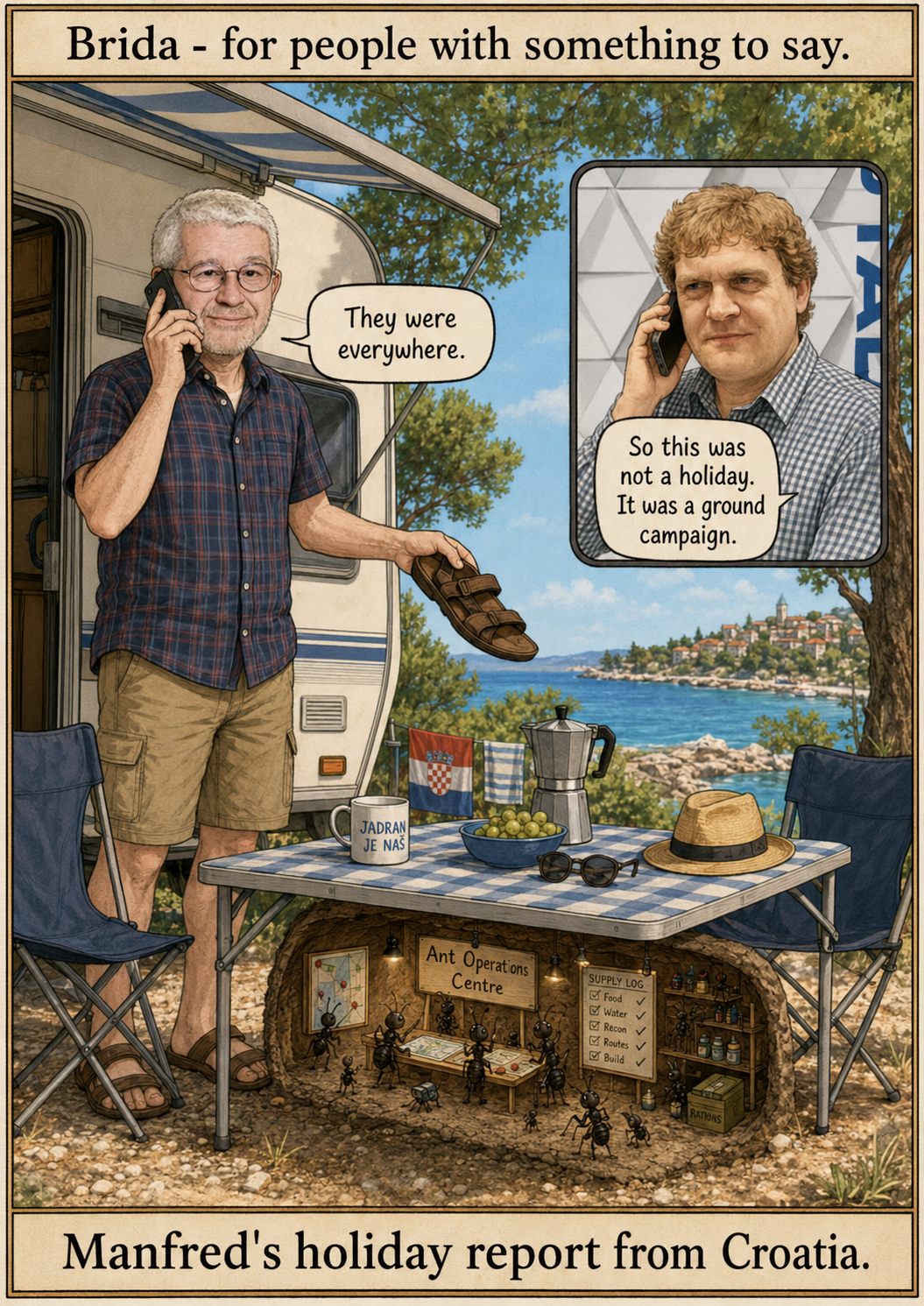
When The Mayor asked me what image came back first from my two weeks in Croatia, I did not need to search through many dramatic possibilities. There was no heroic mountain pass. No storm. No spectacular sunset with violins. The picture was very simple: I was sitting on a chair, feet up, looking over the lake. Comfortable temperatures. Pure relaxation.

That, for me, reflected the entire holiday.

Martin, of course, immediately tried to turn the holiday into an experiment. He did not ask whether I had enjoyed myself. He asked what was being tested: the man, the bicycle, the tent, or the idea of comfort. I believe he said definitely the man, but also the idea of comfort. This was typical Martin. He saw a chair by a lake and detected an entire scientific programme.

The Mayor let him do this, because The Mayor enjoys these moments when ordinary holidays become philosophical research projects.

A normal day in Croatia had a very clear structure, although I would not call it a plan. I got up at eight in the morning. Coffee and a cigarette. Then cycling to the bakery for morning rolls. Then more coffee and breakfast. After that came the cycling tour, including an update in our ice-cream parlour guide. This was very important fieldwork. Then more cycling, dinner, back to base, chair, lakeside, talking.

Martin listened to this and wondered whether it was a holiday, a field study, or a carefully disguised endurance test. He decided it was a field study into future years and past missed opportunities. I think he was right. He often is, but one should not tell him too often, because it may affect the balance of the swimming club.

Then, at exactly the kind of moment when Martin was becoming useful, his Fritzbox went on strike. His router abandoned the conversation. This was also a field study, but into German technology under emotional pressure.

So The Mayor continued with me.

The best cycling moment was the tour to Rovinj. There was an abandoned building, and somehow it brought back past memories. Nature was taking back its territory. That stayed with me. It was not just a building. It was one of those places where the past has not disappeared, but has simply allowed plants to move in.

The hardest or most annoying moment of the trip can be described in three words: giant killer seagulls.

One bird took my wife’s lunch straight from her hands while she was eating. This was not normal bird behaviour. This was organised crime with feathers.

Then there were the killer ants. Two words: killer ants. More precisely, killer ants with terrorist training. They were everywhere. But my drone attacks were successful.

The Mayor asked me whether camping made anything simpler. I said: my decades of experience. That is the truth. Camping does not become simple because the tent, caravan, weather, insects, birds, roads, and equipment suddenly decide to behave. It becomes simple because, after many years, the camper has already made all possible mistakes and now recognises disaster before it introduces itself.

The Mayor also asked what I missed from home. I missed nothing. I was online. I had my breakfast rolls. Food and lodging were mine. The caravan is my second home. What exactly should I have missed? A different chair? A different kettle? A more familiar ant?

There was one moment when I asked myself, “Why am I doing this?” That was when I was combating the killer ants. Not because of the ants as such, but because they were unwelcome. There is a difference. In nature, one accepts many things. But one does not invite terrorist-trained ants into the living arrangement.

Still, there was a moment when I felt completely at ease. I was sitting by the sea. I even made my peace with the ants. It was more of a cease-fire, but in diplomacy one must begin somewhere.

Still, there was a moment when I felt completely at ease. I was sitting by the sea. I even made my peace with the ants. It was more of a cease-fire, but in diplomacy one must begin somewhere.

What did the holiday teach me without trying to teach me anything? Relaxation is good for mind, body, and soul. Live for the moment. Do not plan too much. Few rules. Do as you please.

When I came back home, everything was immediately different and not different at all. Back to the routine. Getting up early. Going to work. Cleaning the caravan. Doing the laundry. The holiday was over.

But the end of one holiday is only the beginning of planning the next trip. The Netherlands, mid-July, for three weeks.

This is how life continues.

Chair. Coffee. Wheels. Bread rolls. Possibly fewer killer ants.

Martin

When The Mayor presented Manfred’s Croatia holiday as material for discussion, I understood immediately that we were not dealing with a simple travel report. A simple travel report would have included phrases like “nice weather” and “beautiful landscape” and perhaps “we had a good time.”

This was different.

This was Manfred after two weeks of camping and cycling in Croatia. Therefore it had to be treated as an experiment.

The Mayor asked Manfred for the first image that returned to him. Manfred gave us the perfect answer: sitting on a chair, feet up, overlooking the lake, comfortable temperatures, pure relaxation. That image contained everything. It was not only a man sitting near water. It was a manifesto against unnecessary civilisation.

So when The Mayor asked me what was being tested — the man, the bicycle, the tent, or the idea of comfort — I said definitely the man, but also the idea of comfort.

Because comfort, in Manfred’s case, is not a soft mattress and room service. Comfort is coffee, cigarettes, morning rolls, a caravan that behaves like a second home, and an ice-cream parlour guide that apparently requires regular updates through practical cycling-based research.

Manfred then described his normal day. Getting up at eight. Coffee and cigarette. Cycling to the bakery. Morning rolls. More coffee and breakfast. Cycling tour. Ice-cream parlour guide update. More cycling. Dinner. Back to base. Chair. Lakeside. Talking.

The Mayor asked whether I would call this a holiday, a field study, or a carefully disguised endurance test. I called it a field study into future years and past missed opportunities.

That was exactly what it sounded like. Manfred was not simply resting. He was investigating an alternative version of life in which the day is structured by bread, wheels, weather, ice cream, and the slow return to a chair.

Then, with perfect comic timing, my Fritzbox went on strike.

I disappeared from the conversation because my router had decided that this was the moment to contribute its own view of modern life. It rejected the meeting. It refused participation. It performed a digital walkout.

This was unfortunate, because I would have liked to comment on the abandoned building in Rovinj. Manfred later said that it was his best cycling moment: the tour to Rovinj, the abandoned building, rediscovering past memories, nature taking back its territory. That is exactly the kind of sentence that proves the holiday had become bigger than a holiday. He went for cycling and found memory, decay, and vegetation staging a quiet revolution.

Then came the wildlife section, which is always important in Manfred’s reports.

The giant killer seagulls were the headline. One bird took his wife’s lunch from her hands while she was eating. This is not a bird. This is a small airborne criminal with confidence issues.

The killer ants were worse in a different way. Manfred called them killer ants with terrorist training. They were everywhere. But he also reported successful drone attacks. I was not there to verify the tactical details, but knowing Manfred, I assume this campaign was conducted with seriousness, precision, and a certain amount of personal insult.

The Mayor asked what camping made simpler, and Manfred answered: his decades of experience. That answer was excellent. It means camping itself remains complicated, but Manfred has become professionally uncomplicated inside it.

He missed nothing from home. He was online. He had breakfast rolls. Food and lodging were his. The caravan was his second home. This was perhaps the central finding of the experiment. Comfort is not where you are. Comfort is when your systems are working, your bread supply is secure, and your chair has a view.

There was one crisis of meaning: the battle with the killer ants. Manfred did ask himself why he was doing this, but not because of the ants themselves. Because they were unwelcome. This is a very Manfred distinction. Nature is acceptable. Invasion is not.

And then, sitting by the sea, he made peace with the ants. Or, as he said, more of a cease-fire. That was also perfect. Nobody truly makes peace with ants. One agrees to suspend hostilities until the next incident.

The Mayor finally asked what the holiday had taught without trying to teach anything. Manfred’s answer was simple and probably correct: relaxation is good for mind, body, and soul. Live for the moment. Do not plan too much. Few rules. Do as you please.

Then he returned home. Routine. Getting up early. Work. Cleaning the caravan. Laundry. The holiday was over.

But of course it was not really over. Because the end of one holiday is the beginning of planning the next one: the Netherlands, mid-July, three weeks.

So the field study continues.

The man has been tested. The idea of comfort has survived. The bicycle remains operational. The caravan is ready for further service. The ants have not been invited.

And The Mayor, I assume, is already preparing the next set of questions.

Partner Page
Advertisement
source
The Pineapple

The Holiday Report Continues: Martin Returns from the Digital Wilderness

Martin

Later, after my Fritzbox had staged its small but effective rebellion, I wrote to The Mayor.

I had to explain myself, because in the middle of Manfred’s Croatian field study I had simply disappeared. This was not because the questions had become too difficult. It was not because the killer ants had somehow reached my house. It was because my internet had gone on strike.

I told The Mayor that I was sorry. Unfortunately, my internet had refused to work. Now I was in the office and therefore connected to the world again.

At first, I had hoped it was only a Fritzbox update. They like doing that. Quietly. At the wrong moment. With the calm arrogance of German household technology.

I also asked whether one could actually send messages by Teletext.

This was only half a joke. When the internet disappears, civilisation immediately feels thinner. Suddenly the old technologies begin to look surprisingly reliable. Teletext, fax machines, carrier pigeons, smoke signals from the balcony — all of them seem more dependable than a router that has chosen philosophy over function.

I told The Mayor I would look at the remaining questions.

Then I wished him a great week, because even after a technological betrayal one should remain polite.

The Mayor, of course, had more questions waiting.

He asked me what role the bicycle played in Manfred’s story. Was it transport, companion, opponent, or silent philosopher?

For me, the answer was clear. The bicycle had its role as the direct connection to the bakery. Therefore I would say it was the true companion.

This is important. In Manfred’s holiday system, the bicycle was not merely a vehicle. It was not just something with two wheels and a saddle. It was the bridge between the campsite and the morning rolls. Without the bicycle, the day would not begin properly. Without the bakery, the coffee would stand there sadly, wondering what had happened to its purpose.

So the bicycle was companion, yes. Possibly even spiritual adviser. But above all, it was the trusted diplomatic channel between Manfred and breakfast.

So the bicycle was companion, yes. Possibly even spiritual adviser. But above all, it was the trusted diplomatic channel between Manfred and breakfast.

The Mayor then returned to the difficult moment — the wildlife crisis, the seagull attack, the ants with terrorist training — and asked what this told us about Manfred under pressure. Or about camping’s talent for making small problems very important.

I said Manfred is always well prepared, as a real camper should be. That is true. He is not the kind of man who enters a campsite with vague hope and a plastic bag. He brings systems. Experience. Knowledge. Probably several solutions for problems that have not happened yet.

Only in terms of food protection, he still has to find a solution.

But I admitted that I would not have any idea either.

How does one protect lunch from giant killer seagulls? You cannot reason with them. You cannot appeal to their better nature, because their better nature has apparently joined a criminal organisation. You cannot simply explain that the sandwich belongs to your wife. They already know. That is why they want it.

Maybe, I thought, the whole thing could be turned into a filming location for a movie called The Killer Seagulls.

I could see it immediately. A peaceful Croatian campsite. Comfortable temperatures. A chair by the lake. Morning rolls. Then, above the horizon, wings. Screaming. Chaos. A lunch taken directly from a hand. Manfred standing there, not frightened exactly, but deeply offended by the breakdown of order.

The sequel, of course, would be The Killer Ants.

Possibly with drone attacks.

Then The Mayor asked whether comfort sometimes gets in the way of clear thinking.

I said no.

Comfort is the only way of clear thinking.

This may be the central theory of the whole experiment. Many people believe that difficulty produces wisdom. Perhaps sometimes it does. But I think the brain works better when the chair is right, the coffee is present, the internet is functioning, and the killer ants have agreed to a cease-fire.

Discomfort does not automatically create insight. Sometimes it only creates bad posture and suspicious thoughts about insects.

The Mayor then asked what I would call the caravan in this experiment: shelter, laboratory, enemy, or badly folded philosophy.

I called it a laboratory-like shelter.

That seemed accurate. Manfred’s caravan is not only a place to sleep. It is a controlled environment. It carries home into the unknown. It allows field research without surrendering completely to chaos. It is shelter, yes, but also laboratory: a place where one tests comfort, routine, equipment, weather, bread logistics, and the limits of peaceful coexistence with local wildlife.

The caravan is also proof that Manfred’s home is mobile. This became clearer when The Mayor asked whether missing something is part of the experiment. Do we only understand home properly when we have temporarily removed it?

I thought that was true. Even without feeling homesick, it is nice to be back home after a long journey. If only so you can reflect on everything in peace.

But in Manfred’s case, there is a complication.

Manfred’s home is always with him anyway.

That is the genius of the caravan. It blurs the whole experiment. You leave home, but you bring a version of home with you. You travel, but you do not fully surrender yourself to the unknown. You are away, but your chair, your systems, your breakfast logic, and your personal order of things come along for the ride.

So perhaps Manfred does not return home in the normal way. He simply parks one home beside another.

Finally, The Mayor asked whether the question “Why am I doing this?” is a sign that the experiment is failing, or whether it is exactly the moment when the experiment becomes interesting.

I said it was a good sign.

It means you are doing something that might be irrational, but is good for the soul precisely because of that.

That is probably the best definition of a real holiday. Not everything has to be efficient. Not everything has to make sense. Cycling to update an ice-cream parlour guide may not be strictly necessary. Sitting by the sea and negotiating a cease-fire with ants may not be a recognised therapeutic method. Camping in a place where seagulls behave like airborne lunch thieves may not appear in a wellness brochure.

But somehow these things are good for the soul.

When it comes to killer ants, though, my answer is a bit different.

There are limits to philosophy.

Even for me.

source
The Pineapple

Level 10: Finding the Vacuum Cleaner

A Lunch Tale of Yoga Knees, Yellow Cars, and the Mayor’s Ongoing War Against Forgotten Laundry

Some Lunch meetings begin with philosophy. Others begin with technical difficulties. This one began with The Mayor accidentally announcing his own old age before breakfast.

“Sorry, I forgot,” he said halfway through the conversation. “You see, I’m so old.”

Fruitloop immediately disagreed, naturally. I disagreed too, although in my case it sounded less like encouragement and more like a formal legal statement. The Mayor announced very clearly that he was not old, thank you very much, and therefore should not be forced into any anti-aging dance programme involving books, yoga, or suspicious knee exercises.

The whole discussion started because I had been talking about my sister’s family celebrations. My oldest sister, who lives with me, had just turned seventy. Another family member was about to turn eighty, although, according to me, she looks closer to sixty because she still dances, reads constantly, and somehow has more energy than the rest of us combined. Naturally, Fruitloop transformed this into life advice within seconds.

“So we should dance more and read more,” she concluded brightly.

The Mayor, however, preferred to defend his knees.

Not because anything is wrong with them, he explained. No, no. His knees are perfectly fine. But he is prepared for the future. Somewhere in the loft, apparently, lives a zimmerframe waiting patiently for its moment to shine. Not as medical equipment, mind you, but as the foundation for an entirely new dance craze: The Zimmerframe Zumba.

And honestly, at this point in Lunch history, nobody would even be surprised.

I pause often during these conversations, searching carefully for English words while Fruitloop waits patiently besides me like a cheerful translator at the United Nations of Chaos. It is one of the quiet beauties of these meetings. Nobody rushes. Nobody corrects harshly. Language arrives slowly sometimes, but it always arrives.

Meanwhile, the Mayor contributes cultural commentary from his sleepy European village, where apparently time itself is governed not by clocks but by church bells and confused roosters.

“We don’t race against clocks here,” he announced gravely later in the meeting, as if speaking on behalf of an ancient farming council.

This became relevant when Fruitloop asked whether timers help motivate us during boring tasks. I explained that I simply decide something must be done in thirty minutes and then do it without constantly checking the time. The Mayor, however, lives in a world where roosters decide productivity schedules and chicken pie remains an occupational hazard.

This became relevant when Fruitloop asked whether timers help motivate us during boring tasks.

Somewhere between yoga and poultry, the conversation drifted into gamifying boring tasks.

Fruitloop, naturally, was delighted by this topic. She asked what daily chore we would transform into a game. My answer arrived immediately: traffic.

The previous day, here in Sao Paulo, it had taken me nearly an hour and a half to get home because of terrible traffic jams. So I imagined turning the journey into a game, the way children invent entertainment during long car rides. The Mayor mentioned the old “Yellow Car” game from Britain, where every yellow car becomes an event worth announcing dramatically. Suddenly we were discussing imaginary flying cars, guessing games, number plates, and childhood road-trip traditions.

The Mayor later clarified that “Yellow Car” comes from an old British comedy called Cabin Pressure, which somehow made the entire thing feel both educational and deeply unnecessary at the same time.

And then came the cleaning levels.

Fruitloop asked us to imagine chores as video game stages. I explained that Level 1 might be vacuuming the house, while Level 10 would involve washing bathrooms and windows — a truly horrifying final boss battle.

The Mayor’s version was even better.

“Level 1 would be getting out of bed on my right leg,” he said seriously. “Level 10 would be actually knowing where the cleaning material is.”

This apparently connects to an ongoing domestic crisis involving forgotten laundry. Fruitloop reminded him — very publicly — that the Mayor constantly forgets his washing. He accepted this accusation with the exhausted dignity of a man long defeated by household appliances.

At one point, Fruitloop suggested rewards for difficult tasks. Coffee, perhaps. Small treats. Positive reinforcement.

The Mayor rejected the entire concept immediately.

“Every time I finish a task,” he sighed, “I’m usually told I’ve done it wrongly. It’s punishment.”

Not from one person, he clarified dramatically.

“Humanity.”

There is something very special about how these lunches allow ordinary frustrations to become comedy. Laundry becomes philosophy. Vacuum cleaners become emotional support systems. Traffic jams become imagination exercises. Even aging itself turns into a discussion about yoga, reading, and strategic sock placement.

Because yes—eventually we reached the sock conversation.

Fruitloop asked what magical power we would unlock if folding socks granted abilities. I chose the obvious answer: a magic wand that cleans everything while I sit peacefully reading or doing yoga.

The Mayor, meanwhile, confessed that he uses old socks as air fresheners.

Some readers may need a moment after that sentence.

According to him, the socks are folded strategically around the house after being worn and not washed. Fruitloop objected immediately, but the Mayor defended his position with the confidence of a man who has abandoned all social expectations.

“I should be able to enjoy my own stink,” he declared.

And honestly, that may be the most Mayor sentence ever spoken.

Still, beneath all the joking sat something softer. We talked about wellbeing. About staying active as we age. About gratitude alarms that remind us to stop for a moment and appreciate life. I mentioned my upcoming eye surgery in July and the relief of finally approaching school holidays after a long working season. Fruitloop listened carefully, gently guiding the conversation forward while somehow balancing humour and care at the same time.

That is the strange magic of these lunches. Nobody arrives polished. Nobody pretends life is easy. We arrive tired, distracted, stuck in traffic, forgetting laundry, worrying about surgery, speaking imperfect English, and arguing about vacuum cleaners.

And somehow, between the yellow cars and the rooster clocks, the world feels a little lighter.

Maybe adulthood is simply Level 10 all the time: trying to remember where the cleaning supplies are while keeping your knees strong enough to dance later.

Partner Page
Advertisement
source
The Pineapple

From Cleebourg to Kuwait: Lessons in Responsibility

Today, The Mayor told me we were going to speak about values. He said this was a philosophical subject, and maybe he was right. Values are not always easy to explain. Sometimes they are easier to see in small stories, in mistakes, in work, in discipline, and in how people behave when life becomes difficult.

When I think about values, I think every family has values. But the values of one family are not exactly the same as the values of the next family. In general, the big values are the same, but in each family, there is a little difference. That is normal.

One story from my childhood stayed with me. I was about thirteen or fourteen years old, and one day I did not want to go to school. I was not in the mood. So I falsified the signature of my father or my mother. I thought I could escape school, go to the bar, play football with other friends, and everything would be fine.

But I got caught.

My father was not happy. The lesson was simple: when you make a mistake, you must pay for it. That stayed with me. At the time, I was young, and yes, maybe many children do something like that. The Mayor said he also did it and got caught. But today, if a young boy comes to me and says he forged the signature of his parents, I would say, “It is not good. It is your responsibility.”

That is the lesson. You can make a mistake, but then you must take responsibility. After that first time, I never did it again.

I also learned something else from that mistake: if you do something, do it correctly or do not do it at all. Of course, this is not advice to do bad things. It is more the lesson of a young boy who tried something stupid and learned that life catches you.

When I was young, life in Alsace was different. We lived well, but we also learned that you must work. No work, no money. That was very clear. I began working during the summer holidays. I was fifteen. In July 1982, I worked one month in a metal factory. In 1983, I worked two months. Then in 1984, I began to work more seriously.

I did not receive much pocket money. A little, yes, but not much. My grandparents helped more. My grandmother was more generous. My grandfather was fifty-fifty. My father was simple. With my first pay, I bought a mini stereo. In 1983, I bought a gun with my identity card. That was another time.

I also had trouble when I was young. I had some fights, but I never hurt innocent people. I never went to fight somebody for nothing. Sometimes there was a problem, and I went to talk. If we could solve the problem, then okay, we solved it, and everybody went home. But I had a strong character.

My mother said I had the same character as my grandmother. This was my grandmother on my father’s side. She was very good with me. For me, she was the best grandmother in the world. But in the village, she had a reputation. She was strong, stubborn, and not always easy. I think I have something from her. When I am sure I am right, when I believe something is correct or not correct, I do not move easily. But if people show me the opposite and explain it, then I can accept it.

My family history also has darkness. My grandmother from my father’s side was born in 1931. She went hunting. Maybe she preferred a gun to cooking. My grandmother from my mother’s side was different, with white-grey hair. During the war and the Nazi occupation, there were stories I discovered only many years later. People in the family helped prisoners escape. My grandmother helped bring escaped prisoners, maybe with light, maybe with guidance, and then they went further to escape. Some people from the family were sent to concentration camps. Some came back with health problems. Some stories are not clear anymore. It is too late to know everything. Maybe the archives in Strasbourg know more, but some history is buried.

When I left Cleebourg and went into the military, I was not really prepared. I grew up in the village. I had fun. I knew people. I knew life there. But the military was a completely different world. In 1984 and 1985, when I went to Pau, the beginning was very difficult. I had no mental training before. Nothing from school or family really prepared me for that discipline.

When I left Cleebourg and went into the military, I was not really prepared. I grew up in the village. I had fun. I knew people. I knew life there. But the military was a completely different world. In 1984 and 1985, whe

But many young men from Cleebourg went to the army. Some went 400 kilometres away. I went 1,200 kilometres away. I think I wanted to break from Cleebourg and start something new. At first, I thought it was only for one year. Maybe after one year I would come back and go to the bar again and say, “Okay, that was fine.” But the military became more than that.

The first two months were hard. I was not exactly scared, but I had respect. I saw how things worked, and I learned. The discipline was strong, but after two months it became okay. It became good. On 26 September 1985, I received my paratrooper badge. That was my goal. All the guys received it. We were proud. We were a unit. We were a team. We had the same badge, and that meant something.

In the military, I also saw leaders who showed values by action, not only by words. One of my best leaders was my lieutenant. His nickname was R2D2, like Star Wars. He was a small man, but he was hard and correct. He did not hesitate. He said, “You do this, this, this, and this.” Left limit, right limit, forward, never behind.

He was military, but he was human. That is important. When somebody made a mistake in Kuwait, R2D2 took him into a house. Five minutes later they came out. The guy had a red face, maybe more than that. But after that, the problem was finished. He made a mistake. He paid. Then he started again.

I think that was better than writing everything on paper. If it is written in your military file, it follows you for ten years and maybe hurts your promotion. But if the punishment is immediate and physical, then after two weeks it is gone. The lesson stays, but the file is clean. That was the army at that time.

Discipline begins with every man for himself, and then for the next man. If one guy makes a mistake, all the guys have a problem. It is like the Three Musketeers: all for one and one for all. But when the same guy makes mistakes every day, then the group must react. Sometimes the answer is simple: stop, or go to another regiment.

It was the same with hygiene. In one room, there was a guy who was allergic to water. Of course, not really allergic, but he did not like to shower. The other guys had enough. One day they took him into the hallway with cleaning products, sponges, scrapers, and steel wool. After that, he was red like a shrimp. But from that day, he was the first man in the shower. That was also a lesson in discipline.

Today, as a civilian, maybe this is difficult to imagine. But in the military, discipline was not theory. It was action. You saw it, you felt it, and you understood.

Another value I learned in the military was respect, even for the enemy. The Mayor asked me if a soldier can respect the enemy when the order is to destroy the other side. I think yes. A soldier is a tool for orders, but he is also a human being. I think you must respect the enemy.

There are stories from the First World War, when German and British soldiers played football at Christmas in no man’s land. On the ground, at the front, respect can exist. But sometimes headquarters, far away, do not want that. The soldiers may see the humanity of each other, but the officers far away see only strategy.

In the Gulf War, I think the situation was different. Religion and oppression changed things. Many Iraqi soldiers surrendered because Saddam was oppressive. Some soldiers were trapped. If they went forward, they could die. If they went backward, there were mines or soldiers behind them. So they had no real way out. In such a situation, respect is complicated, because fear, religion, politics, and survival are all mixed together.

The Mayor also asked me about Russia and Ukraine. I think the problem began long before today. After 1989, after the break of the Soviet Union, there was a new era. Yeltsin opened Russia more to Europe. But then Europe and NATO moved country after country closer, Poland and others, and Russia said stop. I think the beginning of the problem was there. Of course, what happens today is not only that, but the roots are older.

We also spoke about borders and corruption. The Mayor told me a story from Poland, when he accidentally drove the wrong way near a railway station and two policemen stopped him. They showed him a booklet and said he had broken many traffic laws. He paid the fine, maybe more like a bribe, and said he did not need a receipt. He said he was wet afterwards because he did not know what would happen.

That made me remember Poland too. When my brother-in-law went from Poland to France, there were many bottles of vodka in the back of the taxi. At the border, there were many cars. But you could pass with a passport and fifty Deutsche Marks. Then it was, “Okay, thank you very much. Bye-bye.”

Life is sometimes like that. You have to make choices, and not all choices are clean. The Mayor asked me if there was a moment when I had to do the right thing even when it was not easy. For me, it depends if I am alone or not. When I am alone, it is one thing. But when other people are with me, I have responsibility for them too. Then I think fast. Maybe the first solution is good, maybe bad, but I must find a solution because I am not responsible only for myself.

I feel this responsibility today in my work as a truck driver in Karlsruhe. Karlsruhe is a university city, and there are many cyclists, scooters, pedestrians, and young people everywhere. For me, cyclists are my nightmare. I hate cyclists. Of course, not all cyclists, but many do not respect the rules. They come from the wrong side, without lights, in dark clothes, and sometimes I see them only at the last moment. I brake, and then the cyclist gives me a bad gesture, as if I were the problem.

When there is an accident, the cyclist is always seen as the victim, and the car or lorry driver is the bad man. But I think in many cases, maybe seventy or eighty percent, the reality is the reverse. The law is not hard enough. I drive in the university area with cyclists, scooters, and pedestrians all around me. Sometimes, when I pull a container, people go between the lorry and the container. That is crazy. A truck driver must have eyes everywhere, like a Google camera.

When I look back at my life, I see that values are not always beautiful words. Values are what you do when something happens. You make a mistake, you pay. You work if you want money. You respect your leader if he is hard but correct. You respect the enemy if he is only a man doing his job. You take responsibility when other people depend on you. You learn discipline, sometimes the hard way. You try not to repeat the same mistake.

And when younger people look at me, maybe they should see my grandmother a little. Strong, stubborn, not perfect, but with principles. I can also say, “Do as I say, but not always as I do.” In French, we have something like that too. Maybe I show sometimes the bad example, but even a bad example can teach something.

The important thing is to learn, to take responsibility, and, if possible, not get caught twice for the same mistake.

Partner Page
Advertisement
source

There are weekends that feel long before they even begin. By Friday evening I was already carrying towels from one room to another, opening doors, closing doors, checking who was sleeping over and who was suddenly staying for lunch without warning me first. Fruitloop laughed when I told her about it, but by Sunday I felt as if my whole house smelled like chlorine, sunscreen, and wet towels.

It was so hot those days. The kind of heat that sits against the walls at night and refuses to leave. Even after switching off the air conditioning before bed, the room still stayed warm, almost heavy, and I could feel it on my skin while trying to sleep. But honestly, I still prefer that over cold weather. I always will.

The weekend was full from beginning to end. Two friends of my youngest daughter slept over on Friday, and suddenly breakfast became an event instead of a meal. Then lunch as well, although nobody had informed me about that part. Six people around the table, wet feet running through the house from the swimming pool, towels for the shower, towels for the pool, more towels everywhere. By Saturday evening I was already irritated, though my daughter looked at me as if she truly could not understand why.

Still, there were good moments mixed into the chaos. My husband and I went with two other couples to a festival in the next town. First we sat in a restaurant for lunch, and afterward we listened to live music outside while the summer evening slowly cooled around us. One band played rock music, which I enjoyed. Then later came the techno music that my husband loves much more than I do. Not the soft kind either. The hard techno that feels as if it vibrates through your chest. He disappeared into the crowd dancing while the rest of us waited for him, laughing because he absolutely refused to leave. I remember standing there under the lights, hearing the bass from far away, watching people move through the warm night air. He was happy, truly happy, and sometimes that is enough.

Sunday became another gathering. My sister and brother came for lunch and we made barbecue. Everybody stayed around the pool the whole day. There was always movement somewhere — somebody opening the fridge, somebody calling for drinks, chairs scraping against the terrace floor. Then Monday finally became quiet. I told my daughters very clearly that I wanted peace. No friends. No extra people. Just silence for one day. And surprisingly, they listened.

Well… mostly.

The youngest disappeared again with her boyfriend and friends to the nearby city celebrations and only returned around midnight before school the next morning. I was not informed where she was, naturally. That seems to be the modern way now. Children no longer knock on doors or shout outside to ask if someone wants to play. They send messages from their beds. Sometimes my daughter sends me a Snap even when she is only one room away from me. And the worst thing is that I answer her.

Fruitloop and I spoke about that for a long time. About how different childhood feels now compared to when we were young.

When I think about my childhood, I immediately see open space. Not screens. Not phones. Space.

I grew up on a farm with my cousins nearby, and we were almost always outside. We invented games constantly because we had to. There was no television waiting for us every second of the day. We had fields, mud, bicycles, snow in winter, and imagination.

We played hide-and-seek across huge areas — gardens, trees, neighboring fields. Before starting we first had to agree on boundaries because otherwise someone would disappear too far and never be found again before dinner. We played hopscotch drawn onto the ground and jumped with one foot until our legs hurt. We played with elastic bands for hours. Sometimes I stood alone with a ball, throwing it against a wall again and again, creating games only for myself.

Before starting we first had to agree on boundaries because otherwise someone would disappear too far and never be found again before dinner.

And marbles. I loved marbles most of all.

I can still feel them in my hand, smooth and cool, hidden inside pockets. The small ones, the large ones, the ones with strange colors swirling inside like tiny galaxies. Everyone had collections and everyone secretly wanted somebody else’s best marble. At home I kept a huge collection. I am honestly not even sure my daughters know what marbles really are anymore.

Fruitloop remembered carrying marbles to school in her pockets and playing during breaks. We both laughed about it like old women already, talking about objects children today would probably ignore after five minutes.

What I miss most is not even the games themselves. It is the way we created them. We made the rules as we went along. I always preferred that. Structured games bored me. I hated reading instructions even then, and I still do now. If somebody wants me to play a board game today, they must explain everything to me themselves because I refuse to read the booklet.

Back then we were always inventing something new. I spent most of my time with boys, with my cousin, with neighbors, running around outside and imagining worlds out of nothing. We had ideas all the time. Constant movement. Constant creativity.

Now everything arrives already finished.

If you want information, you search online. If you want entertainment, Netflix waits immediately. If children become bored, they scroll faster. Even conversations became faster. My youngest daughter speaks incredibly quickly now, almost rushing through words as if she wants conversations to end before they properly begin. She admitted herself that watching endless short videos changed the way she talks. She barely articulates anymore. My husband and I told her this recently after she came back from school interviews. We kept hoping she had spoken slowly enough during the interviews for people to understand her.

I crossed my fingers for her anyway.

She is also searching for a summer job at bakeries because she likes the idea of only working mornings. She printed CVs and walked into shops herself asking for work, which honestly made me proud. But so far nothing. No positive answers yet. I know she is disappointed even if she pretends otherwise.

While we spoke, the conversation drifted into deeper memories the way conversations sometimes do when people become comfortable. Fruitloop spoke about a terrible murder near the safari park there, far north near the borders. A quiet place where something violent suddenly happened. It unsettled both of us because those places always feel untouched, almost protected somehow. Hearing about danger entering them leaves a strange feeling behind.

Maybe that is why we both returned so naturally to childhood memories afterward. To safer places in our minds.

For me, one of the strongest memories is snow.

When I was young we had real winters every year. Thick snow covering the village until everything became silent and bright at the same time. We stayed outside for entire days. Nobody worried constantly. Nobody checked locations on phones. We walked through the village in wet gloves and frozen boots until late evening, laughing, throwing snow, falling down, getting back up again. Children now will probably never know that exact feeling. Winters changed. The world changed.

Sometimes music brings it back unexpectedly. Songs from the 1980s can suddenly return me to those afternoons with my cousins as if no time passed at all. A smell can do it too. Certain foods remind me immediately of my mother cooking by hand, without machines, stirring everything slowly herself. I can still picture her movements in the kitchen.

And then there are the stories from her own childhood, which carry much heavier memories.

My mother was born during the war. Her parents were already old when she arrived, much older than most parents. They had lived through both wars already. When I was young and she tried telling me those stories, I did not pay enough attention. Children rarely do. But now, hearing her speak about those years feels completely different.

I imagine her mother leaving the house at night while bombs threatened nearby villages. I imagine the panic of suddenly running with animals, carrying only what could be taken quickly. My grandmother forgot her dentures in a glass of water while escaping, and afterward she never had money to replace them. My mother always remembered her without teeth after that night.

Their house was destroyed completely.

They traveled more than one hundred kilometers with animals and villagers before eventually taking trains south. Families lived crowded together for years afterward. No water. Very little comfort. Animals sometimes inside the same space where people slept. My mother’s brother disappeared during the war at only eighteen and never returned. Nobody ever discovered what happened to him.

When she tells these stories now, I sit quietly and listen differently than before.

Because suddenly I understand how fragile ordinary life really is.

Maybe that is also why childhood memories feel so precious now. Not because everything was perfect — it was not — but because those small ordinary moments survive. Marbles in pockets. Wet grass under bare feet. Snow on gloves. Riding bicycles until dark. Knocking on a friend’s door instead of sending a message.

Simple things.

Things that did not know yet they would become memories.

Partner Page
Advertisement
source

For people with something to say.

June brings us a new theme at Brida: Balance.

Not the perfect kind of balance.
Not the Instagram kind.
Not the kind where your calendar is colour-coded, your inbox is empty, your vitamins are arranged alphabetically, and your emotional life has agreed to behave itself.

We mean the real kind.

The balance between work and play.
The balance between money and peace of mind.
The balance between energy and exhaustion.
The balance between social life and quiet time.
The balance between routines, responsibilities, people, health, and the small daily negotiations that make up an actual life.

In other words: June should be interesting.

Because balance is one of those words that sounds calm until people start talking about it.

Then it becomes personal.

One person thinks balance means more discipline.
Another thinks it means fewer obligations.
Someone else thinks it means learning to say no.
And someone else may simply want one evening where nobody asks them what is for dinner.

That is why Balance is a perfect Brida theme.

At Brida, we do not begin with perfect answers.
We begin with people.

People from different places.
People with different weeks.
People with different pressures.
People who are trying to say something real in English, even if the sentence takes a scenic route before it arrives.

This is our Brida Spirit:

International Tables, Local Stories.

A Brida Table may include people from Alsace, Germany, Brazil, India, South Africa, Poland, France, or somewhere completely unexpected.

But the stories are always local.

A job interview.
A family lunch.
A difficult week.
A holiday.
A habit.
A fear.
A small victory.
A conversation that begins with “I don’t know how to say this in English…” and somehow becomes the best part of the hour.

That is what we do.

We meet.
We speak.
We listen.
We laugh.
We improve our English because we are using it for something human.

This week, our Brida Tables will explore Balance from many different angles:

Ralf begins the week with the balance between work and play.
Alex looks at social balance.
The Atlantic Corridor takes on financial balance.
Fabrice explores energy and mindset.
The Swimming Club looks at emotional balance.
Sylvie returns to social balance.
Sarah also joins the social balance conversation.
Lunch with Janita & Frank brings health and lifestyle balance to the table.
And Peeling Potatoes ends the week with balance through routines, which sounds simple until you realise that routines may be the quiet architecture holding everything together.

There is also one small reality check: Babette is on vacation, which may be the most honest balance statement of the week.

So here we are.

A new month.
A new theme.
A new set of tables.
And, as always, people with something to say.

If you are already part of Brida, come to your table ready to speak, listen, and see where the conversation goes.

And if you are not yet part of Brida, this is what happens here:

We do not only practise English.
We use English to meet people, exchange stories, and discover what ordinary life looks like from another chair at the table.

That is Brida.

For people with something to say.

International Tables. Local Stories.

Partner Page
Advertisement
Partner Page
Advertisement

Receive The Pineapple each Friday

If you’d like The Pineapple to arrive quietly in your inbox each Friday afternoon, you can subscribe here.

It’s free. Just one weekly issue, carrying the conversations a little further.

Subscribe to The Pineapple