Issue 12 — 22 May 2026

The Pineapple

A collection shaped by the voices of the Brida Community

Created by Members of the Brida Community.
Compiled by Frank Peters, Founding Editor.
Shaped in Spirit by Janita Le Grange, Keeper of the Flame.

The Pineapple is published every Friday afternoon. If you would like the next issue to arrive in your inbox, you can subscribe free.

Subscribe

Contents

Partner Page
Advertisement
source
The Pineapple

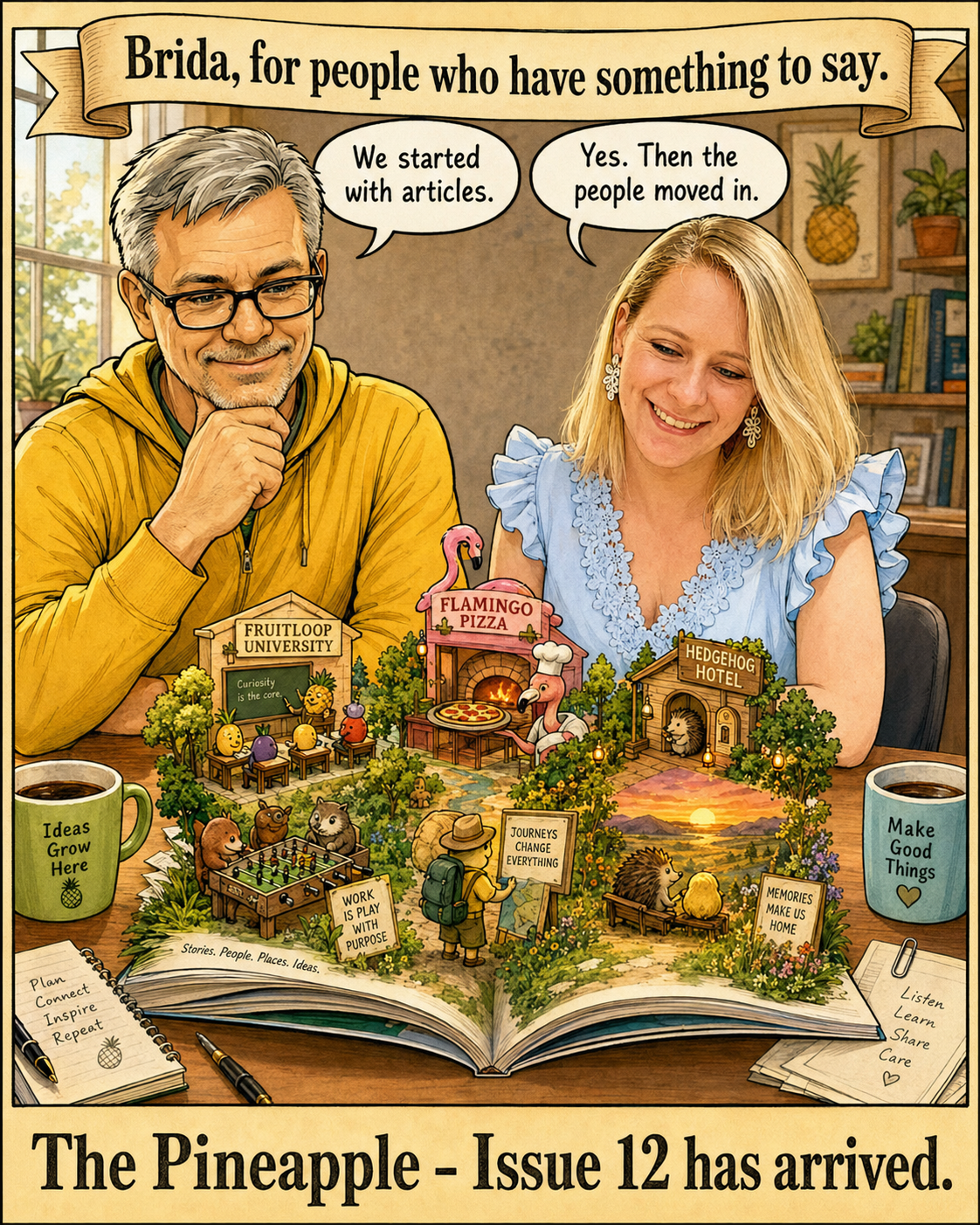
When the Archive Starts Speaking

Brida — a space for people who have something to say

Sometimes you only understand what you have built when you stop looking at the individual pieces and begin to see the pattern.

This happened to me recently when I looked at the Pineapple archive.

There are now more than 300 articles in it. And every month, about 40 more are added. Stories, impressions, memories, reflections, jokes, photographs, questions, little pieces of life. At first, you see numbers. You see articles. You see a growing archive.

But then, when you look at it long enough, something changes.

It starts to speak to you.

This is not a new lesson for me. I learned something similar about 30 years ago, at what is now Daimler Trucks. Back then, I learned about Kaizen. Continuous improvement. But Kaizen, at least as I understood it, was never only about improvement. It was also about attention. About looking carefully. About not rushing away too quickly. About staying with something long enough until it begins to show you what it really is.

And when I look at the Pineapple archive like that, I see something very clearly.

People have something to say.

Not sometimes. Not only when they are confident. Not only when their English is perfect. Not only when they have a big story, a dramatic story, or a professional story.

People have something to say in the ordinary moments.

In the small stories.
In the memories.
In the jokes.
In the strange little observations.
In the things they noticed on a walk, in a city, in a kitchen, in a classroom, in a family, in a moment of doubt, love, humour, or surprise.

And I think this is what has surprised me most.

The so-called mundane stories are not really mundane at all.

A small memory can open a whole world. A funny incident can show character. A simple impression can reveal a person’s way of seeing. A story about work can become a story about dignity. A story about food can become a story about family. A story about a journey can become a story about belonging. A story about nothing much can suddenly become a story about everything.

This is what I see now.

The Pineapple is not just an archive of English texts. It is not a collection of language exercises. It is not a place where people simply show that they can speak.

It is much more human than that.

It is a place where people appear.

Of course, English matters. We use English because it is the bridge. It allows people from different countries, cultures, histories, and everyday lives to meet each other. It gives us a shared space.

But English is not the final point.

The voice is the point.

This is something Fruitloop and I see again and again. People often come with a story, but they do not always know that it is a story. They may think it is too small. Too personal. Too ordinary. Too simple. They may think, “Who would want to read this?” Or they may know exactly what they want to say in their own language, but in English it becomes smaller, flatter, less alive.

They may think, “Who would want to read this?” Or they may know exactly what they want to say in their own language, but in English it becomes smaller, flatter, less alive.

That is where the help matters.

Not the kind of help that takes the person out of the text. Not the kind of help that makes every voice sound the same. Not the kind of help that polishes everything until it becomes correct but lifeless.

The real work we do is different.

We listen for the person inside the language.

We ask: Is this really what you mean? Is this your voice? Can we help the reader feel what you are trying to say? Can we keep the humour? Can we keep the warmth? Can we keep the human detail? Can we help the English carry the person, not replace the person?

That, for me, is becoming the heart of Brida.

For a long time, we have used the normal words around English. Confidence. Fluency. Communication skills. Practice. Conversation. Improvement. These words are not wrong. They are all true.

But they are not big enough.

They describe the surface.

They describe what people think they need.

But underneath that, there is something deeper.

People want to feel like themselves in English.

They want their ideas to survive. Their humour. Their memories. Their intelligence. Their kindness. Their doubts. Their work. Their questions. Their way of looking at the world.

They do not only want to speak better English.

They want to bring more of themselves into English.

And this is why the new sentence feels so important to me.

Brida is a space for people who have something to say.

I do not feel that we invented this sentence. I feel that we discovered it. The archive showed it to us. The members showed it to us. The stories showed it to us. The Pineapple showed it to us.

Because after more than 300 articles, it becomes difficult to ignore the evidence.

People are not empty.
People are not only learners.
People are not only mistakes waiting to be corrected.
People are not only vocabulary gaps and grammar problems.

People carry stories. They carry humour. They carry love. They carry memory. They carry pain, questions, wisdom, and wonderful small details from real life.

Sometimes they only need a theme.
Sometimes they need a table.
Sometimes they need a listener.
Sometimes they need a little courage.
Sometimes they need someone to say, “Yes, that is worth saying.”

And then something happens.

The English becomes more than English.

It becomes participation.

This, I think, is what Brida has been building quietly from the beginning. A place where people do not have to perform. A place where English is not a test. A place where the small story is welcome. A place where humour is welcome. A place where people can arrive with what they have, and slowly discover that what they have is enough to begin.

The Pineapple is the public window into this.

Every issue says: look, these are real voices. These are real people. These are not perfect texts produced by perfect English speakers. These are human beings using English to share something of themselves.

And that matters.

Because in a world where so much communication has become fast, loud, angry, polished, artificial, or empty, there is something quietly powerful about people telling real stories in their own voices.

A birthday.
A journey.
A childhood memory.
A strange observation.
A moment of humour.
A photograph from a campsite.
A question that stays in the mind.
A potato, because even a potato can become philosophy if you look at it long enough.

That is the Pineapple.

And that is Brida.

English is the bridge.

But the voice is the point.

So perhaps the best invitation is not complicated.

Start by reading.

Meet the voices already here. Notice the people behind the stories. Notice the humour, the humanity, the love, the small details that are not small at all.

And when the moment comes when you feel, “I have something to say too,” then there will be a place for you.

At the table.

In the conversation.

In Brida.

source

There are business lunches. There are strategy meetings. And then there are the strange little intellectual expeditions that happen when Professor Fruitloop decides to open the doors of “Fruitloop University” and drag me through higher education whether I consent or not. Which, apparently, I did not.

The lunch began innocently enough. Just the two of us at the table. Nathalie was still somewhere beyond the edges of civilization, Rosie had vanished into a two-day training course she probably remembered five minutes before it started, and suddenly I found myself alone with Fruitloop and a virtual pizza menu. That should have been my first warning sign.

While I was still trying to decide between olives and mushrooms on a pizza, Professor Fruitloop was already preparing psychological warfare disguised as “gamification.” She called it a discussion topic. The Mayor called it an ambush.

Naturally, lunch immediately descended into snails.

He defended French cuisine with alarming enthusiasm, speaking warmly about garlic butter and innocent little snails floating happily in sauce, while I maintained my perfectly reasonable position that no civilized lunch should involve creatures normally found on garden walls. He accused me of being a chicken. Which, considering the context, felt deeply ironic.

So there I was: pizza ordered, beer mentally poured, weather forecasts discussed, and suddenly enrolled in an educational institution the Mayor never applied to.

“Welcome to Fruitloop University,” I announced with entirely too much joy.

He knew then the afternoon was doomed.

The strange thing is that beneath the chaos, the conversation wandered into something unexpectedly thoughtful. We started discussing gamification of work — reward systems, points, achievements, motivational nonsense dressed up with colourful badges and cheerful jingles. Normally, this sort of thing makes every corporate instinct inside him recoil slightly.

After all, he had spent years inside the machinery of companies like Mercedes-Benz and Bombardier Transportation, where efficiency wasn’t a buzzword. It was religion. We were building half a million truck engines a year, orchestrating factories spread across countries, moving locomotives, trams, engines, and entire industrial ecosystems with precision. In those environments, “gamification” sounds like somebody from Pluto arriving with a ukulele and suggesting stickers might improve logistics.

And yet… somewhere along the way, Brida has become its own strange creature.

We are not Mercedes-Benz. We are a weird pineapple-and-potato-powered startup that somehow functions through equal parts process engineering, optimism, improvisation, and mild panic. On the surface, we look delightfully quirky. Underneath, there’s actually a surprisingly sophisticated engine quietly humming away behind the scenes. Or at least there is when certain people remember to follow the processes.

I noticed that remark immediately.

“I get the hint,” I said.

The Mayor knows, Professor Fruitloop misses absolutely nothing.

The discussion spiraled from there into experience points, reward systems, and the fantasy of fully automated processes that would allow him to sit in a garden drinking champagne while systems magically ran themselves. It remains, tragically, unrealistic.

The discussion spiraled from there into experience points, reward systems, and the fantasy of fully automated processes that would allow him to sit in a garden drinking champagne while systems magically ran themselves.

Still, there is a tiny form of gamification already hiding inside our work. Our beloved spud list. There’s a ridiculous amount of satisfaction in ticking off completed tasks one after another. He guards that feeling fiercely. He always wants me to have the joy of writing “success” beside a completed item. And honestly, he may be right.

Somewhere between discussing process optimization and redesigning websites, we arrived at the real obsession currently consuming my existence: advertising campaigns.

Ah yes. Facebook.

Or, as we now call it, The Seventh Circle of Bureaucratic Hell.

For weeks we’ve been trying to lure people toward our beloved Pineapple — this curious, thoughtful little publication we genuinely believe has something beautiful to offer. The systems are there. The pages are there. The campaigns exist. But convincing people to actually subscribe? That final stone in the road has become maddeningly difficult.

At one point, while trying to configure a Facebook campaign form, he became so frustrated he started inventing entirely new English vocabulary. None of it suitable for publication.

The “Fruitbowl”, meanwhile, sat patiently on the other side of his screen receiving increasingly distressed screenshots from him every thirty seconds.

“This isn’t working.”

“Now what?”

“Why does Zuckerberg hate me personally?”

To the Fruitbowl’s credit, it kept calmly replying with things like:
“Okay, now click there.”

Meanwhile he was spiritually deteriorating.

And yet somewhere inside the madness, there was still laughter. There always is.

The conversation drifted from digital advertising to domestic chores, which somehow became equally philosophical. We discussed reward systems for laundry mountains, dishes, homework, and surviving family life without emotionally relocating to another continent.

He told me an old story from my hotel days at the Gatwick Hilton near London. Back then, he introduced a tiny reward system for reception staff: whoever secured the most express checkouts during a shift won a humble £1.25 box of After Eight chocolates.

You would have thought he’d announced a million-pound lottery.

That was the lesson: rewards aren’t always about value. Sometimes they’re about recognition. About feeling seen.

I admitted my own domestic reward system mostly involves hiding chocolate from myself and then forgetting where I put it. Which feels deeply symbolic somehow.

My son, meanwhile, has apparently started discovering the sacred art of process optimization by doing Thursday’s homework on Wednesday so he can enjoy two homework-free afternoons. I nearly applauded. This, the Mayor informed her, was operational efficiency at its finest.

Rome, after all, was not built in a day.

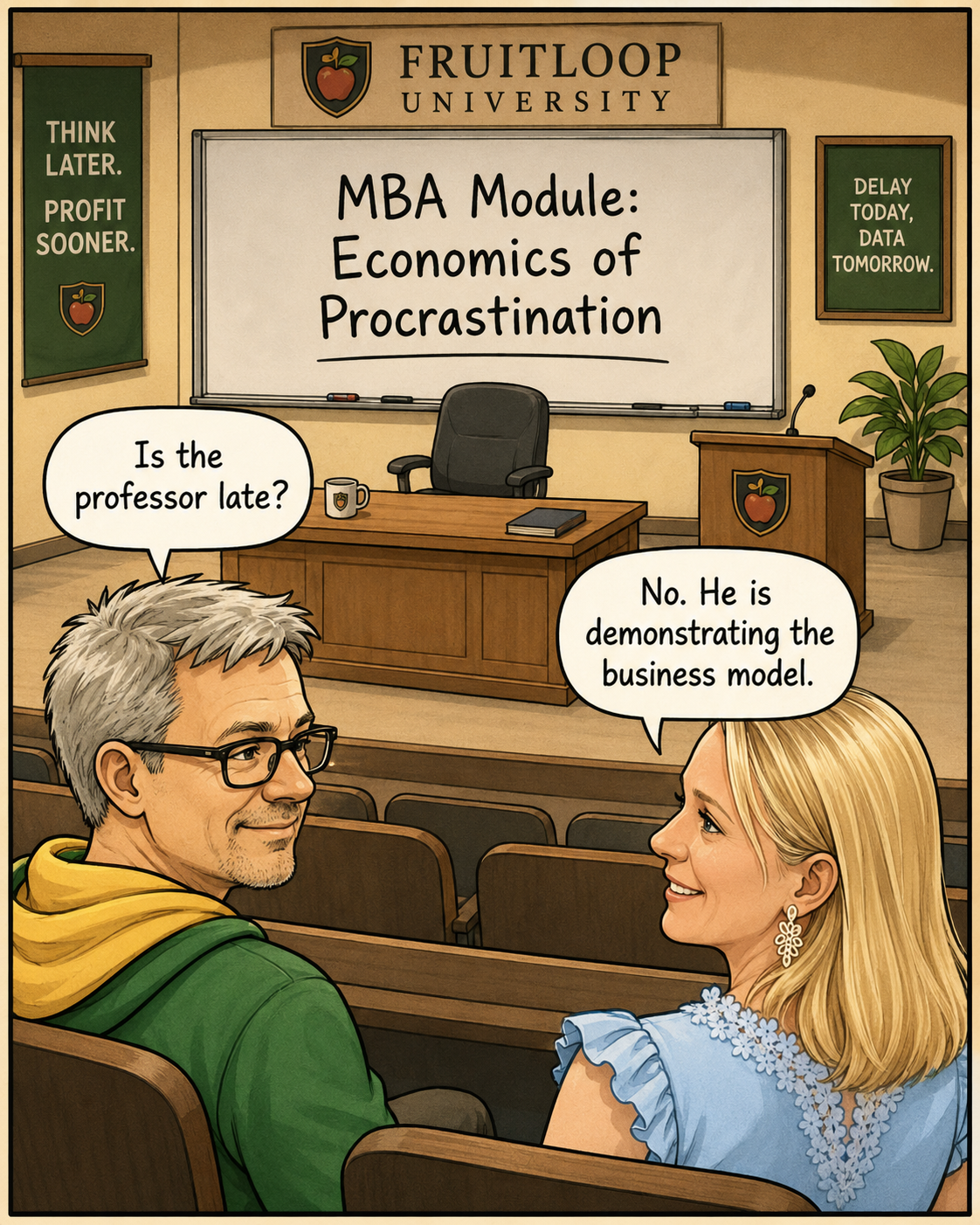
Naturally, the conversation eventually collapsed into French revolutionary tactics, household strikes, hiding in cupboards with chocolate reserves, and the economic theory of procrastination.

At this point, I asked what subject procrastination would teach if it became a professor at Fruitloop University.

Easy.

Economics.

Specifically: The Economics of Procrastination.

An MBA-level course on making money while successfully avoiding all responsibility. We even discussed writing a future bestseller together: Zen and the Art of Procrastination.

Admittedly, neither of us are likely to finish it anytime soon.

By the end of lunch, deadlines had somehow acquired Queen soundtracks, Beethoven became a stress mechanism, opera singers were weaponized into productivity tools, and I was threatening to study French history so I could launch domestic revolutions properly.

Which, frankly, feels like a natural progression for this project.

And somewhere in the middle of all this chaos — between pizza toppings, Facebook meltdowns, reward chocolates, and imaginary universities — something quietly meaningful emerged again.

Maybe that’s what Lunch has always been about.

Not perfection. Not polished answers. Not productivity gurus with expensive microphones.

Just two people sitting at a virtual table trying to figure life out one ridiculous conversation at a time.

And perhaps that’s the real lesson from Fruitloop University:
Sometimes the best systems aren’t the perfectly optimized ones.

Sometimes they’re simply the ones that leave enough room for laughter, unfinished homework, hidden chocolate, and a pineapple stubbornly waiting for the world to discover it.

Partner Page
Advertisement
source
The Pineapple

The Secret of the Sun-Spot Zen

Some days, I sit and wonder: what exactly am I missing? Why does today feel calm and relaxed, while others are a frantic rush backed up with mountains of work, impossible schedules, laundry peaks, and a complete lack of dinner ideas? I’ve checked, and even Google doesn’t have the answer to that one.

I think, personally, it depends on my mood. Some days I care a little more than others; some days I worry a little more. There are times I don’t mind the chaos and the explosions happening right beside me, and other times I just keep my head down and push through it all.

So, when you ask me, “How are you?”, I never really have complaints. I’m just dealing with the household madness in my own little creative way. Of course, that “way” occasionally involves contemplating running away to a deserted house far away in the mountains—preferably one with plenty of heat and warmth.

It’s no secret that I don’t like the cold winter months, and they have been creeping in more and more every day. We missed autumn entirely this year and jumped straight into the deep end. Although the temperatures are technically still bearable, the wind is icy and leaves your bones chilled from the inside out. Some days, I feel like I can never truly find the heat or warm up.

Even my husband, who usually hates the warm weather and lives for the winter, said this morning, “It’s a bit chilly.” Mmmm. I thought you preferred the cold? If the winter-lover is feeling the bite, what hope is there for the rest of us?

Have you noticed how some days just disappear into thin air? This whole week has been a ghost. Tomorrow is already Friday, and I feel like I haven’t done much, even though I know I have. Yes, I worked; yes, I cooked; yes, I cleaned—but it’s all just a blur.

And don’t even get me started on May! Where did the whole month go? We are hurtling toward the middle of the year at a speed that feels slightly illegal.

So, while I sit here sipping on my hot chocolate and finishing up my tasks for the day, I’m thinking the perfect solution to all problems is to just let it go. Even if, on the inside, I am squirming at the sight of an unfinished “potato list,” I have to choose peace.

I do have to wonder: where can I order a box full of those new robots? Can they help with the chores while I enjoy my coffee—warm, for once—somewhere in a sun-spot? That is the dream. A little mechanical help to manage the laundry mountain while I focus on being a Fruitloop.

And please, if the universe is listening, let our Wi-Fi connection stay on for this weekend! I am officially done with the digital disappearing act. It seems like every weekend we are left with no internet. At least we have electricity (knock on wood). Maybe I should just appreciate the positives and embrace my enemy: the “No Wi-Fi” zone.

It’s forced meditation, right?

I will try again next week. But tonight, I’m sticking with the hot chocolate and the sun-spots tomorrow.

source
The Pineapple

Coffee, Card Games, and Controlled Chaos: A Day in My Life

Some mornings feel like a race before the starting whistle even blows. When Janita called me for our English meeting, my husband was busy leaving, I was tired from too much work, and honestly, I still felt half asleep. The night before had been busy because I had training in the evening and only went to bed very late. For me, “very late” means after midnight — and then waking up again at 5:40 in the morning. She almost felt tired for me.

Still, the sun was shining after several rainy days, and suddenly life felt a little bit lighter. We talked about my upcoming holiday, and she reminded me that we would only see each other again in three weeks. Three weeks! She was already excited about all the stories I would probably bring back after the holiday. I told her maybe. She immediately corrected me: “Definitely.”

That is one thing about Janita — she always sounds very sure about these things.

Before the meeting really started, she explained the topics for our next meetings. Apparently, June would be all about “balance.” Social balance. Emotional balance. Health balance. Digital balance. Financial balance — absolutely not, thank you very much. The moment she mentioned finances, I almost wanted to hide under the table. Eventually, I chose relationship balance, social balance, and work-and-play balance. Fruitloop seemed very happy with my choices, although I still suspect she enjoys making me discuss difficult topics.

Then she asked whether I liked the funny cartoon reminders she sends every Thursday. I admitted they always make me smile. They usually describe everyday situations so perfectly that it feels almost dangerous. This week’s cartoon was about adults turning ordinary life into little survival games — like trying to drink one hot cup of coffee before the children interrupt you.

Honestly? That one felt personal.

Every morning after preparing school lunches, I sit down with breakfast and my coffee for exactly a few peaceful minutes. Those moments are sacred. Sometimes I only have thirty minutes before the entire house explodes into movement again. My daughter needs to wake up. My son needs to get ready. I still need to get myself ready. My coffee is not just coffee — it is emotional support in a cup.

Fruitloop asked if I ever turn mornings into competitions. Actually, yes. My son is usually the fastest one getting ready, although my daughter wins on certain days because she leaves the house earlier for school. Apparently even school mornings become Olympic events in our home.

Cleaning bedrooms, however, is another story entirely.

Fruitloop asked whether I motivate the children with rewards like chocolate. Absolutely not. If my daughter cleans her room, I mostly arrive with a trash bag because that usually becomes necessary. I admitted that years ago, when my son was still very little, I once packed toys into garbage bags and removed them completely. Sometimes motherhood requires dramatic measures.

At this exact moment during the lesson, my daughter interrupted because she was hungry and needed food immediately. Suddenly, I found myself giving microwave instructions in the middle of my English conversation:
“Turn the dial. Press the triangle button. One minute thirty.”

At this exact moment during the lesson, my daughter interrupted because she was hungry and needed food immediately.

Meanwhile, Fruitloop sat patiently through the chaos as if this were completely normal.

Eventually, the conversation moved to games. Our family loves card games, especially Uno and Skip-Bo. Recently we also bought a game called Quickstop at a trade show in October. The game involves questions, letters, and trying to answer under pressure before your brain completely stops functioning. Honestly, that description also works for parenting.

We do not play as many games lately because school life has become busy. Homework seems endless. My daughter often plays alone downstairs with her Schleich horses, creating entire little districts with stables, transporters, and houses. She leaves everything exactly where it is so she can continue building the next day. It is actually very impressive.

When it rains, though, things become difficult because inviting friends over suddenly requires people driving through terrible weather. Germany and rain — not always the best combination.

Then Fruitloop asked what kind of silly game I would choose for a work fun day. That question nearly broke my brain. I eventually settled on card games because at least everyone understands them. She also asked whether adults should play more games in general.

I honestly do not know.

Children naturally play more than adults. Adults have work, hobbies, responsibilities, gardens that need vegetables planted, and husbands who mysteriously find plenty of time for video games on the computer. Apparently, gaming becomes much easier when someone else reminds you to build bedrooms or clean the garden.

Still, I admitted that if Fruitloop and I ever played a game together, I would choose Quickstop or Uno. Trying to explain Quickstop to her during the lesson almost turned into another game itself. There were cards, letters, categories, dice, and somehow a lot of confusion. At one point I even fetched another game called Das Neinhorn to explain it properly, which only made things more chaotic.

Fruitloop listened bravely while I attempted to describe animals swapping words like “No,” “Why,” and “So what?” Honestly, I am still not sure if she understood me completely. But she smiled politely, which counts.

Then came the truly terrible suggestion: “The Floor Is Lava.”

My children had apparently seen this on television already. Fruitloop thought it sounded hilarious. I informed her immediately that anyone attempting this inside my house would probably be called stupid. She asked what would happen if my husband actually enjoyed it.

Simple.

If he cleans up afterward, he may jump across furniture all he wants.

That feels fair.

The conversation became even sillier when she asked whether I sing in the car. I do, I have full karaoke concerts alone while driving to work. I admitted that yes, I sing. At the moment, my favorite songs are “Golden,” some K-pop music, and songs from Pocahontas. Not the Disney version, though — another version by AnnenMayKantereit.

By then, my daughter was once again moving through the house, preparing for another appointment, half listening and half ignoring our entire conversation. At one point Fruitloop joked that children somehow answer questions without ever truly listening.

She is not wrong.

Before ending the meeting, Fruitloop asked one final question: water balloon fights or dance games?

Easy answer.

In summer, we absolutely play water balloon games. They are fun, chaotic, and apparently excellent for removing stress and frustration. Fruitloop even suggested water guns for the weekend. Honestly, not a bad idea.

Especially if someone else cleans afterward.

Partner Page
Advertisement
source
The Pineapple

Hailstorms, and the Illusion of Routine

The weather had been behaving strangely for weeks, and everybody seemed to have a different opinion about it. One application promised sunshine, another storms, another wind. Even Fruitloop laughed about it because she remembered I’d been checking the forecast almost obsessively before the flea market. We only finished preparing the car at nine in the evening the Wednesday before because we still didn’t know if we would even go. The boxes stood in the hallway for days already, clothes folded carefully, small things wrapped in newspaper, everything waiting for a decision nobody could really make.

In the end we woke up at five in the morning anyway.

That early hour always feels strange to me. The house still dark, the air cold enough that your hands stay stiff for a while, the sound of the coffee machine much louder than normal. My husband loaded the last things into the car while I stood there holding my warm cup with both hands. I remember thinking maybe the weather would surprise us and become beautiful after all.

It was actually fine until around eleven.

Then suddenly hail.

Not even a little bit. Real hail. Loud on the roof of the car, bouncing everywhere, people running with plastic sheets and blankets trying to save their things. But my husband had prepared everything very well. We had protection ready for the clothes and boxes, so we covered everything quickly and sat inside the car waiting for it to pass. The windows fogged a little from our breathing. Afterward the weather kept changing every few minutes — a little sun, then wind, then rain again. One of those days where you never fully relax because you keep watching the sky.

Still, for the weather we had, I was satisfied. I sold enough. Maybe not extraordinary, but enough that I came home feeling it had been worth waking up at five.

And yes, I got my sausage.

That part made me happy because normally this flea market is extremely popular and the queue for food is endless. But because the weather scared people away, I waited less than five minutes. No champagne this year though. Only warm coffee and cappuccino because honestly it was too cold for anything festive. Maybe next year.

Although there probably will not be another flea market before next year anyway. I only do one every year. The places are limited, and people react immediately when invitations open. It becomes almost competitive.

Now suddenly the weather is going in the opposite direction. Twenty-four degrees, then twenty-nine, and next week they already announce thirty-five. It feels like we no longer have a real spring. You move directly from autumn into summer without any gentle middle.

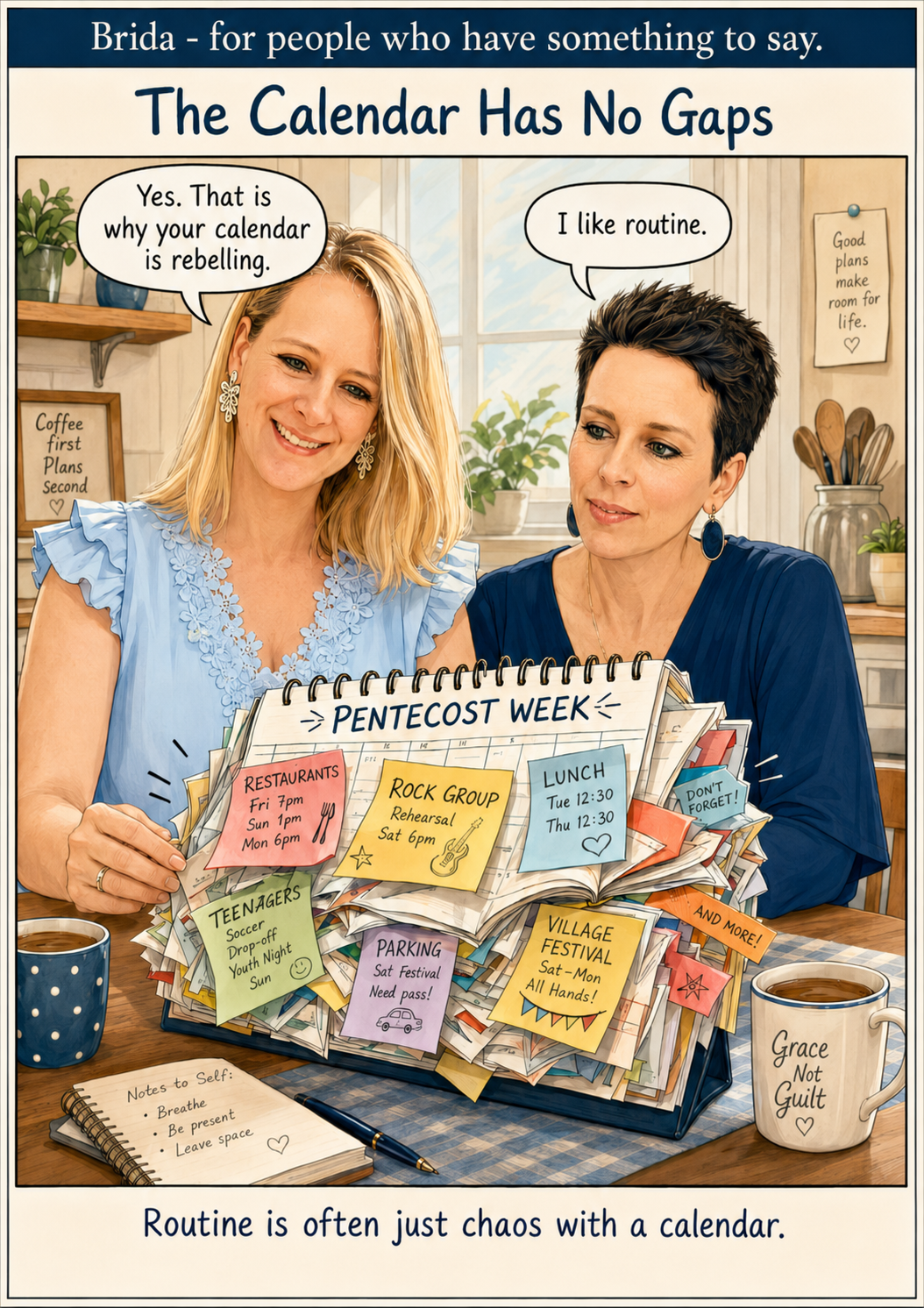
Fruitloop said it was similar there too, except they had rain first and now cooler weather again. Meanwhile my calendar is becoming fuller because Pentecost is coming, and in the city next to our village they have one of the most famous celebrations in the region. Every year the streets fill with music groups playing outside, people eating at long tables, teenagers everywhere around the carousels, tourists arriving from Germany, and families walking slowly through town in traditional costumes. The whole place smells like grilled food and beer and warm pavement after sunset.

I already have plans almost every evening.

On Friday I’ll go to a restaurant with my sister-in-law. After that we considered going to a party with a DJ, but I’m not completely convinced because my daughters will probably be there too, and I can already imagine their faces if they see me dancing somewhere. Fruitloop joked we should pretend not to know each other if that happens. Honestly, maybe that is the best solution.

Saturday evening we’ll go again for a rock group, Sunday there are guests for lunch, and afterward we return to the celebration in the evening. It’s only about ten kilometers away, but still too far to walk. Luckily we know some places where parking is possible because otherwise it becomes impossible during the festival.

I was already tired just describing the weekend.

At the same time, I like routines. Fruitloop started talking about breaking routines through playfulness, making ordinary things feel lighter somehow, but I realized while we spoke that I am somebody who likes structure very much. I like knowing what comes next. Breakfast, work, lunch, dinner. There’s comfort in repetition.

Fruitloop started talking about breaking routines through playfulness, making ordinary things feel lighter somehow, but I realized while we spoke that I am somebody who likes structure very much.

But when you have teenagers, routine is mostly an illusion anyway.

My youngest daughter is preparing for her Baccalaureate exams now. They stopped classes for a few days so the students can prepare oral exams, and naturally I thought maybe she could help a little at home. But according to her, she has absolutely no time. This after arriving home at one in the morning and spending half the next day in bed scrolling on her phone.

Sometimes I look at her and feel exhausted before we even start talking.

She wants a summer job at a bakery because the hours are from six in the morning until eleven, leaving the whole afternoon free. Honestly, I had to laugh a little because she loves staying awake late at night. She has no idea yet what waking up before sunrise every day actually feels like.

Still, I understand her logic. Fruitloop said she was smart for choosing that schedule, and perhaps she is.

Since getting her car she drives everywhere constantly. I pay the insurance, she pays for fuel. Every second weekend she works at a local restaurant, but now she wants to leave because the boss is unfriendly. The funny thing is that outside the house she’s always smiling, always laughing with friends, always charming. Then at home I ask one small thing and suddenly I become the problem.

My husband keeps telling me to let her solve her own issues. He says if I stay quiet, eventually she will learn. But I worry too much. I know that already.

In September she will move into her own apartment in a neighbouring town.

Even saying that aloud still feels strange.

Part of me thinks it will be good for her. She may become more mature living alone. She’s confident in ways I never was at her age. I saw that already in Egypt when the shops only opened in the evenings. I hated walking through those streets because the sellers were so aggressive, always trying to force you to buy something. I never felt comfortable there. But she walked into shops alone without fear and bought whatever she wanted.

I admire that confidence even when it terrifies me.

At home, though, I prefer knowing where she is. There are areas that are not very safe, and once she leaves, the house will suddenly become quieter. Too quiet maybe.

Luckily my older daughter still comes home almost every weekend. Never the opposite. She actually likes being home. Especially now because my husband is preparing the pool for summer. The girls have a very strong complicity together. The older one often tells the younger one to be kinder with us. She’s become an example somehow — fashion, manners, little things. The younger copies her constantly even when pretending she does not.

Their music is another story completely.

I still love music from the eighties, and sometimes the younger one likes it too, but usually the car becomes filled with loud rap or R&B shaking the windows while we argue about the volume. It’s impossible to win.

Fruitloop asked me if there was something silly from childhood I would still do today. I admitted I actually used a jumping rope two years ago for training, but a hula hoop? Absolutely not. I cannot imagine doing that while my husband or daughters watch me. Some dignity must remain.

Though apparently not too much dignity, because in August we already decided to attend a “Charlie 2000” party with music from the nineties and early 2000s. So perhaps I am becoming playful after all.

But only a little.

Mostly my days stay predictable. I eat almost the same breakfast and lunch every day. During the week I eat at exactly the same times. If I run in the morning, I eat half a banana before leaving and the other half when I come back. Yesterday I ran eight kilometers, and tonight I might do a smaller run again if I still have energy after work.

Lately in the evenings I sit alone watching Younger You on Netflix because my husband is often not home. It’s become another routine without me noticing.

Fruitloop asked if small changes could alter how a day feels. Brushing teeth with the opposite hand, wearing funny socks, changing breakfast locations. I had to laugh because being left-handed already confused enough people when I was young. My father tried repeatedly to force me to write with my right hand. It never worked. Even now if I try brushing my teeth with the other hand, I have to focus so hard that it feels ridiculous.

Maybe that’s the point.

Still, I’m not changing my breakfast routine. I already lose enough time every morning.

And honestly, comfort matters more now than style anyway. Years ago I wore dresses much more often. Now I wear jeans and sneakers because I want to feel comfortable. My daughters and I have the same clothing size, so technically we can exchange clothes, but they never want mine. And I certainly will not wear their tiny crop tops. Some things are simply not meant for my age.

By the end of our conversation I was already thinking again about work waiting for me. So many emails. Too many unfinished things. I’m still covering another person’s work until next Tuesday, and I can feel the pressure in my shoulders all day long.

Outside it was only nineteen degrees according to my computer, though it felt colder. The mornings are still around three or four degrees, which feels unfair considering next week promises extreme heat again.

Life feels full lately. Loud music, teenagers, weather warnings, unfinished emails, bakery dreams, village festivals, and mothers worrying quietly while pretending everything is fine.

Maybe routines are not as fixed as I imagine after all.

Partner Page
Advertisement
source

When Fruitloop called me for the lesson, I was already prepared for chaos. Not bad chaos. Just the normal kind. The funny kind. The kind where we start speaking about balance in life and somehow finish with flamingos making shrimp pizza. Honestly, with Fruitloop, this is very normal.

First, she told me we had to choose the topics for next month. The main theme was “balance,” which already sounded very serious and philosophical and adult. Fruitloop started reading all the choices like social balance, emotional balance, health and lifestyle balance, financial balance, relationship balance, digital balance, work and play balance, all these things. I had to choose four topics, but my brain was doing loading screen noises.

So I picked social balance, emotional balance, relationship balance, and work-and-play balance because honestly this one sounded the most fun. Health and lifestyle was maybe too much responsibility for one afternoon. Fruitloop accepted my choices like a proud administrative manager of my future emotions.

Fruitloop introduced the lesson topic: creative play in daily life. At first, I thought it just meant imagination and random creativity during normal activities. Like making life less boring. Like adding little experiments into everyday things. Apparently, that was exactly the point. So for once, my brain was functioning correctly.

When she asked what makes me lose track of time, I immediately said reading, films, series, and painting. Homework? Absolutely not. Homework makes time stand completely still. During homework, every five minutes I become a clock investigator. “What time is it now?” “How is it only three minutes later?” It is suffering.

Then Fruitloop asked if I ever doodle to solve problems or focus better, and I showed her my notebook with all my classroom drawings. There was even a princess in a castle with a horse. Fruitloop looked genuinely impressed, which made me happy because I actually love drawing during class. It helps me concentrate. I know it sounds backwards, but it works.

Unfortunately, one teacher once grabbed my notebook during a lesson about presidential campaigns and showed my drawing to the entire class like it was some political masterpiece. Suddenly everybody was laughing because Sarah apparently designed a medieval kingdom instead of a campaign poster. But honestly? I was proud of the drawing. The castle was beautiful. So it was okay.

Then we spoke about computers and creativity. I explained to Fruitloop that I love editing videos more than using the computer for school. I adore cutting clips, adding sounds, making everything aesthetic and dramatic. Recently I made a German video explaining why I wanted to work at Europa Park, and editing it was honestly the best part. Adding sounds makes me feel like a movie director with zero budget and too much imagination.

Then suddenly Fruitloop remembered my tests.

And this was my moment.

I proudly announced that I got 16.5 on my English grammar exam. My best grammar grade of the year. I was so proud of me. The funny thing was that the grade was optional to include in the average, and Fruitloop joked that maybe I would refuse it. Absolutely not. I practically begged the teacher to count it. “Please take it. Please.”

The funny thing was that the grade was optional to include in the average, and Fruitloop joked that maybe I would refuse it.

The Spanish test also went well, even if the teacher gave us approximately one million vocabulary words to study. He corrects papers with the speed of a sleepy turtle, so I still didn’t know the final grade.

After that, Fruitloop shared an Einstein quote: “Creativity is intelligence having fun.”

And honestly? I really liked it.

I tried explaining that creativity is not only school intelligence. It is emotional intelligence too. Like paintings on a canvas — some people only see flowers, but the artist sees memories, emotions, reasons, hidden meanings. I also started talking about my brother and his ADHD, how he constantly draws because his brain is full of thoughts and energy. Sometimes people need creativity just to let their minds breathe.

Fruitloop then started speaking about Leonardo da Vinci like she personally knew him. Apparently, he wasn’t only an artist but also an inventor and anatomy expert. Basically the overachiever final boss of humanity.

Then the meeting became completely fruitloopy.

Fruitloop asked how creativity could be added into cooking, and immediately I invented a witch potion recipe with dragon eggs, butterfly blood, and unicorn poop. Obviously the potion was green because green is superior. The potion’s purpose? Intelligence. Naturally.

After that, the silly questions arrived one after another like a parade of nonsense.

If cats became teachers, I decided everyone would just sleep during class because cat teachers would only organize nap time. Honestly? Dream education system.

If I could slide instead of walking everywhere, I would travel through every country because I didn’t want any country to become jealous.

Then came one of the most important confessions of my life: my emotional relationship with my fridge.

Fruitloop asked what songs my fridge would sing, and I imagined mermaid siren songs trying to attract me toward snacks and meat shelves. Fruiitloop also asked if I felt emotionally attached to my fridge.

The answer was yes.

Very yes.

If hugging a fridge was socially acceptable, I probably already would have done it. The relationship happened naturally. You cannot explain true love.

Then we created the greatest superhero in history: the Super Sweet Hero. A sweet potato superhero spreading positivity around the world. His powers were saying kind things, giving smiles, and making people feel loved. I even explained that maybe if bad people started their mornings with encouragement and kindness, they would become nicer. Okay, maybe it is unrealistic, but dreams are free.

Later, Fruitloop asked where my bed would travel if it could move. My brain immediately chose Rome, specifically behind the famous fountain where everybody throws coins and makes wishes. I don’t even know why. My brain simply downloaded the image directly into my soul.

Then we spoke about phones giving life advice, which honestly sounded terrifying. Imagine opening TikTok and hearing: “Sarah, do your homework.” Absolutely not. I would switch my phone off immediately. My phone already hears too much.

The final section of the lesson became an international animal restaurant competition.

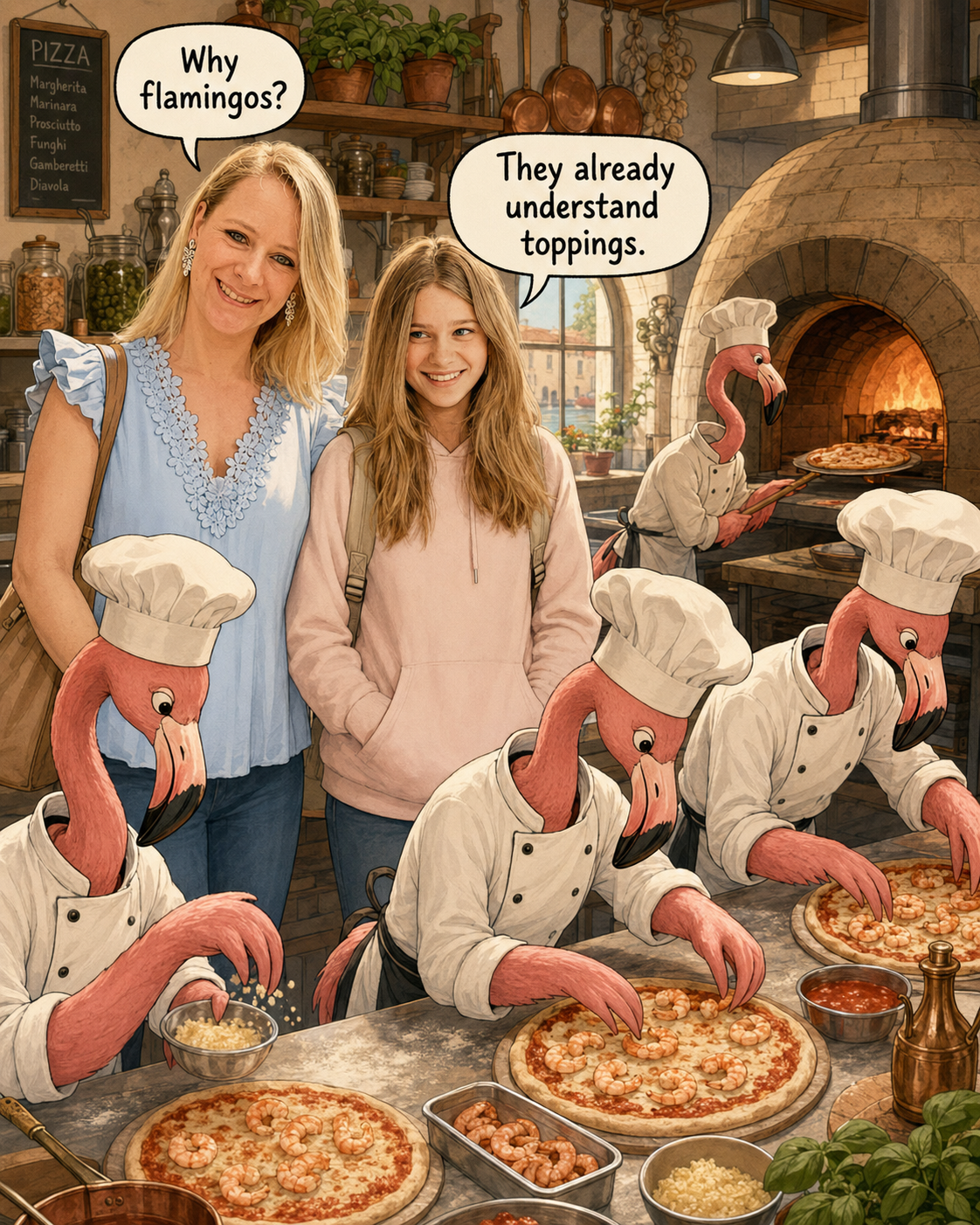
Fruitloop asked which animal would make the best pizza if animals owned restaurants. At first I panicked because I couldn’t think of “Italian animals.” Fruitloop literally Googled animals in Italy while I sat there like a confused documentary narrator.

Finally, I chose flamingos because they are pink and iconic. Also, they could cut pizza using their giant legs. Their pizza toppings would obviously include shrimp because flamingos eat tiny sea creatures. Then I shared my flamingo fun fact: flamingos are pink because of what they eat. Otherwise they would be white or pale pink.

This led to another important scientific question: if humans eat enough carrots, can we become orange?

I honestly think yes.

Fruitloop tried giving me logical explanations about beta carotene and tanning, but personally I still believe I can achieve legendary summer tan status through carrot dedication and sunshine.

At the end of the meeting, we both looked slightly exhausted from our own imagination. Fruitloop told me to enjoy my weekend with the fun fair and traditional dances, and I promised I would tell her everything next Thursday.

Then we said goodbye.

And honestly, after talking about magical soup, fridge romance, superhero vegetables, and flamingo pizza chefs , my brain felt strangely peaceful.

Maybe creativity really is intelligence having fun.

Partner Page
Advertisement
source
The Pineapple

The Bridge That Danced Like a Boat

I was really, really tired when I spoke with Fruitloop, but also very happy because my weekend was completely crazy in the best way possible. I had just come back from Austria, and honestly it felt like I was inside one Disney movie mixed with mountains, snow, beer, bridges, and a little bit of panic.

The trip started because of my father’s music group. One person from the group organized everything, so we went with a lot of people together. It was from Thursday morning until Sunday night, and after that I had exams immediately. Very evil timing, please. I thought I only had an economics exam, but surprise — I also had physics, and physics is usually one of my best subjects. The problem was that I completely forgot to study for it because my brain was still somewhere in Austria on a mountain. So the exam was… not amazing. Not catastrophic. But not amazing.

The mountains in Austria were honestly unbelievable. We walked on this enormous bridge between two mountains, and when Fruitloop asked me about it, I tried to explain that it looked completely safe from far away. But when you stepped onto it, the whole thing moved like a boat. I was trying to act brave, but inside my brain was screaming, “Oh my god.” There was snow on top of the mountains, which made everything look magical and terrifying at the same time. Very impressive. Also very scary. Perfect combination.

We ate a lot during the trip too. Like… a lot a lot. My parents also drank Austrian beer because apparently Austrian beer is “really good,” according to my father, who suddenly became a beer philosopher during the vacation. We also visited the castle that inspired Disney’s Sleeping Beauty castle. The outside looked exactly like the movie, and inside it reminded me of Beauty and the Beast. There were giant chandeliers and huge staircases, and I could completely imagine a princess dramatically running down the stairs into a ballroom while dramatic music played in the background. Fruitloop taught me the English word “chandelier,” which is almost the same as French, so I felt very intelligent for approximately three seconds.

One of my favorite things was the traditional music festival near the mountains and the lake. There was music, people everywhere, and this beautiful scenery that looked fake because it was too pretty to be real. Sometimes Europe is honestly showing off.

When we finished speaking about Austria, Fruitloop suddenly changed the subject and asked me about “playful thinking.” At first I thought she said “painful thinking,” which honestly also exists during exams. But then she explained that playful thinking means solving problems with imagination, spontaneity, curiosity, and creativity instead of being serious all the time.

Fruitloop told me about her son stuffing food into his mouth because she asked him to eat faster, which is technically creative but also maybe dangerous. Then she explained how she turns boring things into games, like timing herself while washing dishes. The whole idea was basically making life less heavy by turning things into little challenges.

Fruitloop told me about her son stuffing food into his mouth because she asked him to eat faster, which is technically creative but also maybe dangerous.

That conversation made me realize I already do this all the time.

I confessed something extremely weird to Fruitloop: when I clean my room or study or organize things, I pretend I am filming YouTube videos for imaginary followers. I literally explain everything like, “Hello everyone, today I will show you how to clean your room effectively.” Then I continue talking to invisible subscribers while doing chores. Apparently I have been doing this since I was little because my mother found old videos of me introducing my house like a tiny chaotic influencer. “This is my bedroom, this is my bathroom, welcome to my house.” Honestly, future Sarah might become a famous YouTuber accidentally.

Fruitloop loved this idea so much that she said she wanted to try it herself. I told her, her entire family would probably start doing it in one month. Imagine everybody in the house speaking to invisible followers while washing dishes. Completely normal behavior, obviously.

We also spoke about procrastination, which is unfortunately one of my talents. I explained how I sometimes get so stressed about exams that my brain simply decides, “No problem. Future Sarah will deal with this.” Then Future Sarah becomes stressed too, and the cycle continues forever. Fruitloop admitted she used to do exactly the same thing in school, so at least I felt less alone in my academic chaos.

The funniest part was probably when we started imagining ridiculous situations. Fruitloop asked what I would do if I couldn’t use my hands to write. I immediately said I would use my toes because I already know how to pick things up with my feet sometimes. Apparently this is not considered normal behavior by society, but honestly people are missing out.

We also spoke about scouts and how time limits actually help people become more creative and organized. In scouts we have schedules for everything: tents, meals, sleeping, waking up. Each team has a leader who keeps everybody on time. Without limits, I think everyone would just wander around eating snacks and forgetting reality.

At one point, Fruitloop asked me what playful thinking would be if it were a plant. I chose a cactus, which sounded completely ridiculous at first, but then I became strangely philosophical. I explained that cactuses look strict and scary outside, but inside they are fresh and useful, like aloe juice. Imagination can seem strange or scary to strict people too, but actually it can help you relax and solve problems. Fruitloop looked genuinely impressed, and honestly I was impressed with myself too because I completely improvised that answer.

Then we imagined playful thinking as fashion rules. My answer was easy: no black and white clothes allowed. Only colorful rainbow outfits. Black and white are “too simple,” according to my artistic expertise from school. I told Fruitloop that black and white, was not in the vibe of my fashion code. Very serious fashion business, please.

Near the end of the meeting, Fruitloop asked what I would do if I had a magic wand that could solve problems playfully. At first I said I would delete school completely, which Fruitloop immediately criticized because apparently doctors still need education. Very annoying detail. So then I said I would make myself a genius and also know every language in the world. I think it would be incredible to speak with people everywhere — from New York to tiny villages in India surrounded by elephants and jungle.

Then, obviously, I also decided I would become rich and adopt a lion.

Not a dangerous lion. A vegetarian lion.

That is important.

I promised Fruitloop she could visit my future house and go on safari in my garden with my vegetarian lion best friend. She said I needed to train it first so it would not eat people, which honestly is fair criticism.

By the end of the conversation, my brain felt lighter somehow. I was still tired. I still had exams. I still had too many things to do in May with parades, traditional dances, festivals, and helping my mother sell flammekueche at night. But after talking with Fruitloop, everything felt more manageable.

Maybe that is the real point of playful thinking.

Life is still stressful. Bridges still move like boats. Exams still exist. But sometimes if you imagine yourself talking to invisible YouTube followers while cleaning your room, suddenly the world feels a little less heavy.

Partner Page
Advertisement
source
The Pineapple

Questions from Under the Hedge

Monday morning, the 18th of May, The Mayor called me Mr. Brand, and I said, yes, here I am. I was ready for hedgehog. In our garden, we have five hedgehogs now, and somehow they had become the important people of the house. The Mayor said they had questions for me, because hedgehogs want to understand humans. I thought, okay, this will be funny. But also, I tell you, it was not so easy. Hedgehog logic is small, but very sharp.

Our hedgehogs are happy. They have a nice house now, because we used wood boxes from the apple gardener. I made holes with the saw, from the back and from the front, so the hedgehogs can go inside. But we have a problem in our town. We have these big black birds, crows, and also a magpie, nesting in a tree on our street. They come into the garden and eat the hedgehog food. So now we put the food out only late in the evening, but still the birds are clever. They fly in, look around, and think, aha, restaurant is open.

So we bought proper little doors, swing doors, for the food boxes. The first evening my wife was lying in the garden, watching and watching. The first hedgehog came. One round, two rounds, three rounds around the box. He could smell the food, but he did not understand where it was. Then he found the little door and pushed inside. After that the others learned it too. Now it is fine to watch because the new food box has a window, and we can look inside while the hedgehogs are eating.

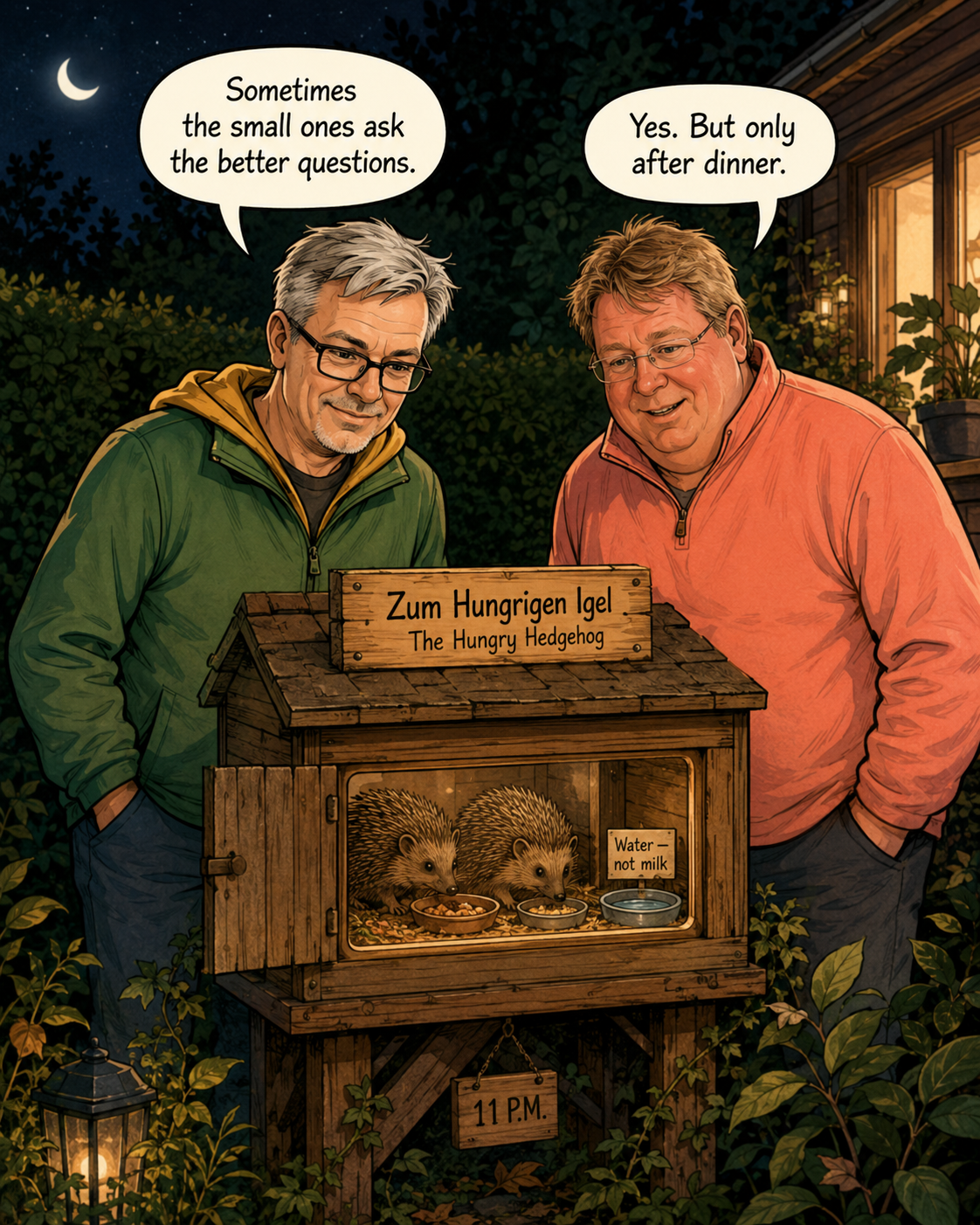
At the weekend we had a friend visiting. We went to a restaurant, and afterwards, around 11 p.m., the hedgehogs were already there. Four grown-up people standing and watching hedgehogs eating. That is our nightlife now. The Mayor said we could make it a tourist attraction: visit Ralf’s hedgehogs when they eat. I said, yes, a new restaurant: Zum Hungrigen Igel — The Hungry Hedgehog.

The Mayor said the five hedgehogs had sat down and made questions for humans. The first thing they wanted to know was why humans build such big houses but then sit mostly in one small kitchen. I had to say, no, we are not normal people. We do not sit in the kitchen. In our kitchen there is only my place. We eat in the winter garden, the conservatory. Our kitchen has no sitting place. But I dream of a new kitchen, with a cooking island in the middle of the room. That would be nice.

The hedgehog house is much simpler. It has a small floor and a door where rats cannot go inside. Then comes a kind of labyrinth. Only hedgehogs understand it. They go inside, eat in the big room, and there are bowls. In one bowl is dry food, meal worms, and soldier beetle larvae. Maybe three hedgehogs can eat in one room, but they do not sleep there. They sleep outside, in their own houses, somewhere in the garden. Hedgehog logic is easy: one room for food, one garden for life.

But we humans need more rooms. One room where I can talk with The Mayor and with the company. One room for sleeping. One kitchen. One bathroom for showering and brushing teeth. One big room to meet friends. A hedgehog would probably say, why? But for humans, this is normal.

Then the hedgehogs asked why I drink hot brown water every morning before I can speak nicely. That is easy. When you are sleepy, you drink hot brown water and then you are happy. You are not sleepy anymore. You are crazy, and you can make action. Coffee is brown water for humans. But not for hedgehogs. The Mayor asked if maybe we could give the hedgehogs a bowl of this brown water when they are awake at 11 p.m. I said no, no, they are already awake twenty-four hours. That is not good for small hedgehogs. Hedgehogs get water. Not milk. Never milk. Only water.

Then came the question about cutting the grass. Why do humans cut the grass exactly when the hedgehogs have made it comfortable? I had to think about the mower, the robotic lawn mower. We do not let it drive at night because then you cannot see where it goes, and that is dangerous for the animals. Our neighbour is a little bit different. When everybody says the earth is dry and there is no water in the garden, he puts the sprinkler on and makes his garden green like a golf place. But our garden is not a golf place. We do everything for the animals.

We have a Totholzhecke, a dead wood hedge. We cut the grass only every three weeks. We leave little places with clover and flowers so the bees have something to do. Near the terrace, where the hedgehogs eat, chives come up through the stones. Schnittlauch. We do not cut them because they start blossoming, and then the big bumblebees come. They push themselves into the flowers. I like that. I said to my wife, if a friend comes and does not like the garden like this, then it is his problem, not our problem. We do everything for the animals. We have birds, we have hedgehogs, we do something for nature.

The Mayor said the hedgehogs noticed that we say the garden is quiet, while they are having a very busy night. I thought, yes, but maybe they say, look, Ralf and his wife are sleeping, so we don’t wake them up. They are kind hedgehogs. They go through the garden, they eat, they look, but they keep the night soft. No loud party. Only small feet and noses in the dark.

The Mayor said the hedgehogs noticed that we say the garden is quiet, while they are having a very busy night.

There is one hedgehog who is a bit crazy. He must look under everything. Under the table, under the plate, under the things near our sleeping room window. Sometimes you hear klam-badam, klam-bam, klam-bam. Then I know somebody is investigating again. Maybe it is his hobby. Maybe he is the engineer among the hedgehogs.

Then the hedgehogs wanted to know why humans wear shoes outside, but hedgehogs have to walk barefoot with excellent spikes. I said, because hedgehogs are a little bit dirty. In the front they are eating, in the back they put their business outside. One hedgehog even made his business in the plate. But this is how they are. Garbage in, garbage out. They do not think, oh, I must be neat now. They have a small brain, and in that moment they are not thinking about good manners. If there is a little poo near the plate, maybe humans think it is a thank-you note. But no. It is only hedgehog life.

The Mayor asked about little lights in the garden. Why do humans put lights outside and then act surprised when hedgehogs inspect them? I said, I do not like lights in the garden. My wife has some LED lights, but for me they are too bright for the hedgehogs. Hedgehogs have small eyes. The lights are too high and too brightful. So when she switches them on, I go outside and switch them off. She has four little dog-foot lamps, solar battery, nice ones, but still I do not like lights in the garden. The Mayor laughed and said this is maybe reality TV for the hedgehogs: watching husband and wife debate about lights.

Then came the leaves. Why do humans collect leaves in bags when leaves are clearly perfect blankets? Again I had to say, we are not normal. We leave the leaves in the garden, because under the leaves are small animals, and other animals can eat them. One time my wife wanted to use the rake, and I said, okay, this is the first time, but the next layer stays on the ground. The next leaves remain. No wonder the hedgehogs like our garden. It is hedgehog-friendly.

Then they asked why we wash food before eating it, but then burn sausages on fire and call it barbecue. That made me smile because this is easy. Food can be dirty, so we wash it. But sausage is better when it is brown, or maybe a little bit black. It smells better. The feeling to eat it is better. A sausage from the fire, with a little bit of colour, this is not dirty. This is barbecue. That is culture.

The hedgehogs also wanted to know why humans talk to plants, cars, grills, and coffee machines, but then pretend animals are the strange ones. I said, I do not talk to coffee machines. I talk to hedgehogs. We have another feeding station in front of our house near the front door, because hedgehogs from our neighbour cross the street and come into our garden. There is a box where the birds cannot go inside. Sometimes when we come home late, a little hedgehog is sitting in there, and we say, oh, no problem, we go inside. We are the Brands here, but you can finish your dinner. The hedgehog waits, we go inside, and then everything is okay. Sometimes these are better conversations than with humans. But I am not crazy. Normally.

The hedgehogs asked why humans open the door, look into the dark garden, and whisper, “Is somebody there?” Of course somebody is there. I know this. We whisper because if we talk loud, they go away. If we are quiet, they wait. When we go back inside and it is dark again, they return to the food house. This is respect. You do not shout in a restaurant when the guests are nervous.

Then came the morning question. Why do humans hurry in the morning and then say they want a peaceful life? I said, I can tell the hedgehogs that I am not hurry in the morning. My wife is hurry. She works today at six o’clock, and then she drives to work and is there at 5:45. I say, why so crazy? You need maybe a quarter hour to drive to work. If you go five minutes later out of the house, it is not a problem. But this is her way. The Mayor asked how I explain this to a hedgehog, and I said I have a special phone to them. A little hedgehog iPhone. I ring them and say, I have no problem. My wife has a problem. The Mayor said maybe hedgehogs have an H-phone. Yes, exactly. Hedgehog technology.

Then they asked why I have so many tools when a hedgehog only needs a nose, four feet, and patience. I said, I have so many tools because the hedgehogs want new houses. They are lazy. They found somebody stupid enough to build houses, cut holes, make food stations, prepare the Totholzhecke, and look after them. But maybe they are not stupid. Maybe they are very intelligent. They found us. They found the restaurant. They found the sleeping places. Only with the eating and the business outside, nobody is perfect.

The hedgehogs wanted to understand holidays. Why do humans drive far away when adventure is already under the hedge? I said we cannot look at hedgehogs every day only. We need a change of wallpaper. Also, we go on holiday when the hedgehogs are sleeping, from October to April. For smaller holidays we have a nice neighbour who gives the hedgehogs food. So we do not forget them. We just go away when they are in their winter time, and then the neighbour keeps the Hungry Hedgehog Restaurant open.

Then came rain. Why do humans think rain is bad weather, when rain means worms are coming upstairs? First, I said, we do not like worms. And we do not like rain because the grass is wet, and the little hedgehogs get cold feet. We humans have umbrellas for rainy days, but not the hedgehogs. Then I thought, maybe I must buy small umbrellas for them. Hedgehog cocktail umbrellas. Maybe from Alibaba in China. A marketing opportunity. Not too small, maybe bigger than cocktail size.

The hedgehogs asked why we call the garden a mess when it is full of interesting smells, tunnels, leaves, and secret roads. I said, it is not a mess. I have no problem with the garden. My wife has accepted it too — maybe with a little grumbling, but accepted. The garden is alive. It is not a showroom. It is a place where somebody is always doing something, even if we cannot see it.

Then they asked why humans put food in bowls for cats and dogs and then complain when everybody comes to the restaurant. I said, difficult. I do not like cats. But I like dogs. Humans put food in bowls because they do not want food on the ground in the house. Animals come with their feet inside, and it is better to have bowls. For us humans, it is also nice to go to a restaurant sometimes. Not every day, but one or two days in the week. You see friends there, you have fun, and it is good for the inner peace. You eat somewhere else, and your soul says, ah, good.

Then the hedgehogs asked why humans say good night and then keep staring into bright little boxes. At first I did not understand. Bright little boxes? Then The Mayor explained it must mean the television, or the phone. I said yes, because we need the bright little boxes for sleeping. When we go to bed and say good night, we do not sleep immediately. We look into the little bright boxes, and we hear and watch something. That is also not logical, but many human things are not logical.

Then came the rules. Why do humans make rules for everything — shoes here, cups there, tools in the right drawer — and then lose the car keys? I said, not normally. I do not lose my car key. It is always on the right side of my trousers, in the small pocket, the little pocket where maybe in old times a clock on a chain was. That is where my key goes. My wife does not lose her key either. She comes inside and puts it on the, the key hanger. When she goes outside, she takes it from the key hanger. Easy. A good system is important.

Then the hedgehogs asked why humans become soft and quiet when they see a small animal, even if they were grumpy five minutes before. This I understood very well. Little animals ground me and my wife. Not in a bad way, but calm. They bring everything quiet inside. They are so nice and sweet. I look at them and think, what does this little animal think? Then I come down and ask myself, why should I be grumpy? Where is the reason? You see a hedgehog, small nose, small feet, eating in the night, and the world is nice and good again. There is no reason to be grumpy.

The last question was maybe the biggest one. Why do humans need stories to remember that the world is alive? I said, we do not need stories, because the world is nice and good already. When we see our hedgehogs, we know it. Not all people, but many people are happy to see them, to make food for them, to give them something to drink when it is dry. Hedgehogs are on the red list, endangered animals, and that means we must look after them. For me this is normal. This is how you know the world is alive. You do not need a big theory. You only need to stand in the garden at night and see a little hedgehog pushing through the swing door to eat dinner.

The Mayor said that I had answered the Hedgehog Quiz very well. I said it was very difficult. But I understood what he was doing. He wanted to make the thinking playful. Instead of asking me serious questions about nature, humans, gardens, animals, and responsibility, he let the hedgehogs ask. That was clever. It pushed me, but in a good way.

And maybe that is the best way. Sometimes a small animal can ask a better question than a big person. Sometimes a hedgehog with a nose, four feet, and patience understands more than we do. And sometimes, when four grown-up people stand in the dark at 11 p.m. watching hedgehogs eat through a little window, you know: yes, the world is alive, and also a little bit funny.

Partner Page
Advertisement
source
The Pineapple

What My Son Teaches Me About Work

I knew before we started that this would be difficult.

Some topics are easy for me. When we speak about customers, meetings, football, discipline, trust, preparation, I can find my way. These are things from my daily life. I know them. I live them. I can explain them with stories.

But playful thinking? That was not my comfort zone.

For me, play is not the first word I use when I think about myself. I am a useful person. I like things that have a reason. I like preparation. I like responsibility. I like doing things properly. I do not play video games. I do not play games on my smartphone. When I have free time, I am often happy when I can relax. I am a Kopfmensch, a head person. I think a lot.

So when The Mayor came with these questions, I felt very quickly: this will be a hard hour.

But he did something clever. He did not ask me, “Alexander, are you playful?” That question would have been finished in ten seconds. I would have said, “No, not really.” Instead, he made the questions come from the voice of my two-year-old son.

That changed something.

When a child asks, the question becomes softer. It is still serious, but not heavy. And maybe this is already the first lesson. Sometimes the angle changes the answer.

The first question was simple: “Papa, when you drive to a customer, do you ever play a little game in your head to make the long drive easier?”

My first answer was no.

I do not play games in my head when I drive. I listen to the radio, to podcasts, or I call colleagues. Sometimes I call old colleagues from Homel Hercules. For me, long-distance driving is not boring. I know many people would say it is dead time, but for me it is not. I can listen. I can think. I can speak with people. I can be alone in a good way.

At first, I thought: no game.

But then The Mayor continued, and I noticed something.

Before every meeting, I have a plan. When I am driving, I think about the appointments of the day. I think about the customer. I think about the contact person. I ask myself what the best way is to get the right information. First, I want to understand the person. Then I want to understand the company. Then I want to understand if they are interested in working stronger together, and what is most important for them.

Maybe this is my game.

Not a game like children play. Not something without purpose. But a tactic. A plan. Like football before the match starts.

In football, you do not just run. You need to understand the opponent. You need to know your position. You need to see where the space is. You need to react. And in sales, it is not so different. Before I go into a meeting, I try to create my tactic. I want to reach my goal, but I also want to understand the other person honestly.

When my son asks, “Papa, is your work sometimes like football, where you need a tactic before the game starts?” I can say yes. That is true.

And when someone says no to me, I do not think the match is finished.

If a customer says no and I say, “Okay, that’s fine, you don’t need help,” and then I go to the next one, I think I do a bad job. When my contact person says no, the match is still open. Maybe it is only the first half.

Then my job is to understand why he says no. I do not stop before I know the real reason. Sometimes the first no is only protection. Sometimes the customer has no time. Sometimes he has too many suppliers. Sometimes he does not yet trust me. Sometimes he does not yet see the problem clearly himself.

If I stop too early, I learn nothing.

This is also why preparation is important for me. The Mayor asked if preparing my notes before a meeting is like packing my football bag before training. I said: a little bit.

In football, I have my standard things in the bag. In work, I also have my standard toolbox. I prepare a presentation for the customer, and the topics are mostly the same, but I change the fine things, the details. It is important whether I already know the customer or whether it is a new customer. With a new customer, the most important thing is to understand the company and to understand him. I ask different questions. With a good existing customer, I look at my notes from the last meeting.

I prepare a presentation for the customer, and the topics are mostly the same, but I change the fine things, the details.

Sometimes the notes are not only business notes.

I have one customer who is a football trainer for kids. He is very happy when he speaks about this. He talks a lot. So I write it down in my laptop. Not because I want to manipulate him, but because it is part of who he is. When I meet him again, I can follow the conversation. I can ask him about it. I can show him that I listened.

For me, this is not fake interest. It has to be real. This is very important. If stories and jokes are not real, the other person can feel it. Then there is danger. They may feel I am not honest. They may feel I am not to be trusted. And trust is everything.

This is maybe where work can be serious and still fun.

My goal in every meeting is that the customer and I have a good feeling together. Maybe we have a little fun. Maybe a lot of fun. When the customer has a good mood with me in the conversation, I have a better chance that he thinks, “This is an interesting person. I want to speak more with him.”

But there is a line.

If a customer is in a bad mood, I need a lot of sensitivity. I can try one or two times to make the situation lighter. But when I feel there is nothing to do, then I stop. If I push the customer too far, it can be a problem. He may feel that I do not respect his mood. He may think I am only a clown. That is the last thing I want.

Playfulness without respect is not good. It becomes noise. It becomes too much.

There are also days that are simply difficult. Sometimes I have only one real meeting in a day, and then I visit small EDE or Northwest distributors. This is a big challenge for me because in the last one and a half years I have had almost no success in these meetings. I try to challenge myself to get the first positive conversation, to get my foot in the door.

A few weeks ago, I had a good conversation with a customer like this. We talked for twenty or twenty-five minutes. The mood was good. But he said he had so many chemical suppliers already that it was not interesting for him. I think 80 percent of these conversations end like this.

That is frustrating.

And honestly, I do not yet find the right way. My colleagues cannot really help me, because I think they are on the same level with this. Not successful. Still, it is only the first half. I have to keep learning.

This is where my work becomes like being a detective. Or maybe like a lawyer. I once watched a series for two months called Lincoln Lawyer, and I liked that idea. In my job, I have to find the problem at the customer. When I know the problem, I can use the right tools. If I do not find the problem, I can only guess what the problem could be.

And guessing is not the best way to be successful.

The Mayor then changed the direction. He asked what helps me become Papa again when I come home tired, and not only work-Alexander.

That question was easier, because I know this moment.

The good thing in my job is that most times I have a long drive home. On this drive, I have time to relax and recharge my battery. That helps me to be on point when I arrive at home, open the door, and meet my son.

But even there, play is not always simple.

When I come home and my son wants to build his train, most times I sit with him on the floor — and then I get tired. For me, it is better when we go outside. He rides his bike, and I walk or run behind him. Now we have the perfect time for it. In winter it is not so easy, but now we can go into the garden, ride the bike, move, breathe.

Outside is better than inside.

Football is also my way of playing. And my way of thinking better. Both.

On the one hand, I can speak with my friends and my trainer and get a free head. On the other hand, I have a game where I can run and be active. I can forget the stress. Training three times a week is fun and discipline together. Sometimes I am very motivated to go to training or to the match. Sometimes I am not so motivated, but I go because of discipline and because of the team. At the moment, I think fun is more in focus, but discipline is always there.

Maybe this is why I understand play better when it has commitment inside it.

A game is not only fun. A good game has rules. A team. Responsibility. You show up.

When something goes wrong at work, I do not always laugh about it. I still have situations in my head where I lost a big deal or a big customer. These things stay with me for years. But I think you have to learn from these stories, from these problems, and do it better next time.

I try to remember one sentence: when you have a problem, and you know that in one year it will no longer be a problem, then maybe it is not such an important problem.

This is not easy. In the moment, the problem can feel very big. But the sentence helps a little.

The question that stayed with me most was about children asking questions.

My last boss once told me a very funny story about his kids and the job as a salesman. When children are small, adults say, “Don’t ask so many questions.” But when you are an adult and you are a salesman, your job is to ask as many questions as you can.

Not only the funny questions. Sometimes you have to ask the hard questions to get the real information from your customer.

I compare this with my son. He can ask ten times if he can eat chocolate, and ten times I say, “No, don’t eat chocolate now.” And maybe later, when he is older, I will tell him: you have to be interested in the person in front of you. You have to ask questions. You have to understand the situation.

So maybe children already know something that adults forget.

They ask. They try again. They are curious. They do not stop after the first no.

At the end, The Mayor asked if, when my son plays and learns things, I also play a little when I work so I can learn things.

And I think yes.

For example, I work with AI now. I see it a little bit like a game. I try to find new ways to work better, with better performance. Finding out new ways is, for me, like a game.

That surprised me.

Because at the beginning I thought: no, I do not play. I am not that person. I am useful. I am serious. I am responsible.

But maybe playful thinking does not mean wasting time. Maybe it means staying open. Trying a new way. Asking one more question. Seeing the meeting like a match that is still open. Turning a long drive into preparation. Turning a problem into a story. Turning work into something with energy, not only pressure.

This hour was very hard for me. The questions were difficult. The English was difficult. The psychology behind it was difficult. Everything in this hour felt difficult.

But I survived it.

And maybe I became one percent better.

Maybe that is enough. Maybe playful thinking starts there — not with laughing all the time, not with becoming someone else, but with finding a little more movement inside serious things.

A little more space.

A little more curiosity.

A little more possibility that the match is not finished yet.

Partner Page
Advertisement
source
The Pineapple

English Is a Completely Un-necessary Invention

I think, unfortunately, it is not possible to have a time machine.

But I wish for that.

That is maybe the first thing The Mayor should understand. When I said the words time machine, he immediately became interested. For him it was already a door opening into the Plaza, probably with a cartoon cave, a question mark, and somebody doing something completely unnecessary with great seriousness.

But for me, it was not only a joke.

I would like to have one.

Not for the future. The future makes me scared. If I had one choice, I would take the backward function. I would go back. At least to the time when my sister was still alive. Not to the last two years, because they were difficult and important, but difficult. Before that. Late 1990s, early 2000s. That was a good period. We were optimistic. There was no social media. There were good things. Enough technology, but not yet this feeling that every useful thing must update itself until it has forgotten why it existed.

Inside my time machine there would be rules.

The Mayor offered some possibilities. No touching buttons. If it still works, leave it alone. No unnecessary progress.

For me it is clear.

No unnecessary progress.

Some progress is only progress for the sake of progress. New software. New style. New version. And then suddenly there is no new function. Worse, many functions are gone. Then I ask: what was this progress for?

This is where I become maybe very Martin.

I remember old systems. Windows 95. Word. Excel. PowerPoint. Lotus 1-2-3. Lotus was better than Excel, by the way. We should not forget this. I remember MS-DOS, pen and paper, Total Commander, split screens, folders where you could actually see what you were doing. Things worked because somebody had understood the person sitting in front of the machine.

Today they reinvent the wheel and behave as if they invented the wheel.

But the wheel itself? Yes. That was necessary progress. I would have been impressed by the wheel. I am not against progress. I am against progress that walks into the room wearing a shiny jacket and removes the useful button.

If my time machine went too far back and landed in the Stone Age, I would first take coffee.

Then teletext.

The Mayor liked this too much, of course. He imagined teletext on a stone plate in a cave. Page number three. Weather: klink, klink, klink. This is exactly how it would work. Like The Flintstones. They had very good technology there. Birds as machines. Cars you push with your feet. Very good for fitness.

The Mayor liked this too much, of course. He imagined teletext on a stone plate in a cave. Page number three. Weather: klink, klink, klink. This is exactly how it would work. Like The Flintstones. They had very good tech

And then there was the English problem.

In the cartoon, I am sitting in a cave thinking: what if somebody invented a language called English?

This is a good Martin thought, because I like the English language. Especially when it is sung by Garbage. Then it is a beautiful language. At work, maybe less beautiful. But German at work is also not always beautiful. Maybe uglier.

If I had to explain English to a caveman, I would not start with “hello” or “food.” I would teach him:

“This is completely unnecessary.”

Because it is a full sentence. A difficult sentence. A proper task.

So there I am, sitting in my cave, and I have invented English.

This is already a problem, because nobody has asked for it.

The Mayor comes into the cave, still speaking fluent caveman, which is mostly “grun grun” with confidence. I stand up and try to explain that I have made a necessary invention.

But how do I explain English before English exists?

I point at myself.

I point at the wall.

I draw symbols.

I draw arrows.

I draw a question mark, which is the most important part.

Then I say my first official English sentence:

“English is a completely necessary invention.”

The Mayor looks at me.

He says something like: “Grun?”

And then I realise the problem. To explain my invention, I already need my invention. To teach him English, I first have to explain why he must learn English, but I can only explain that in a language he does not yet speak.

So I draw more arrows.

Then more question marks.

Then maybe a small pineapple, because at this point I think The Mayor understands pineapples better than grammar.

Still he looks at me like: Martin, this is completely unnecessary.

Which, of course, means the lesson is working.

The most important symbol in all of this is the question mark. The Mayor asked me if the symbols, arrows and question marks in the cartoon are how my brain works when I solve a problem. I said yes. The question mark is the most important. I do not know who invented the question mark, but it was a very good invention.

If I travelled into the future and met future people, the first thing I would ask them is:

Are you happy?

Not: do you have flying cars? Not: do you still work? Not even: do you still have proper buttons, although this is also important.

First I would ask if they are happy.

And if they showed me some amazing new machine, I would be curious how it works. But I would still ask: is the old one actually broken?

If the old machine still does good work, I would keep using it. The new machine can stand beside it. Ready to jump in if needed.

This is a very good system.

A caveman brought into a modern office would be shocked. Security pass. Coffee machine. Screens. People staring into boxes. No fire. Funny food. Microwave. No animals to hunt. No tools, no weapons.

But if I serve him good coffee, maybe it is okay.

When someone new comes into our office, the first machine I explain is always the coffee machine. It is the most important thing in the complete office.

Coffee rules the world.

I also still like proper calculators. Yes, I have a calculator on the PC and on the smartphone. But old calculators worked. Keyboards worked. Touchscreens are not always progress. In modern cars there is too much touch. Touch, touch, touch. And then it does not work properly. A keyboard is still better.

This is not nostalgia only. I do not think the past was better in every way. Society-wise, it is better to live in modern times. There are many achievements. Human rights and so on. In this case I am not conservative.

But teletext still.

Maybe the best way is to take the best from the past, the best from now, and the best from the future, and build your own package.

Everybody packs this package differently.

Mine has coffee, proper buttons, no unnecessary progress, English sung by Garbage, the backward function, teletext protected by German law if possible, and one very serious rule:

If it still works, please do not make it worse.

Partner Page
Advertisement
source
The Pineapple

Before Sunset, Everything Was Possible

Ismar: I Think We Had More Interesting Childhoods

When The Mayor asked about the games we loved to play as children, I did not think first about something very special. I thought about soccer.

Maybe this is normal in Brazil. Maybe not only in Brazil. The first memory is not always the most important one, but the one that appears first. For me it was soccer, marbles, hide-and-seek, and that game where one child runs behind another until he touches him. The Mayor called it tag. Yes, tag. We had that. Later, when I was a little bigger, I played chess and dominoes, also.

At that time, soccer was the most interesting for me. Today, if I have to choose, soccer would not be on the top of the list. This is one of the strange things about childhood. What is very important for us at ten or eleven becomes something ordinary later. But in that time, the ball had power.

In my case, sometimes the ball had even more power because I was the owner of the ball. This changed everything. If I owned the ball, I was the first to choose my team. If I was not the owner of the ball, maybe I was one of the last ones chosen, because I was not a very good football player. Ritesh said something very true: the person who holds the bat or the ball plays first. There is no written rule, but it is stronger than many written rules.

The Mayor asked if, as a child, I jumped into games or first analysed the rules, the people, and the risks. I suppose when we are children, we do not analyse much. Someone invites us, and we take part. Maybe the adult remembers himself as more complicated than he was. As a child, I think I was more direct. If there was a game, I played it. If there was no game, I would go home.

School in Brazil at that time was only four hours a day. Sometimes I studied from seven to eleven in the morning. Sometimes from one to five in the afternoon. Later, in high school, I studied at night, because in Brazil many poor people worked during the day and studied at night. I don’t know if this is normal in other countries. The Mayor said it was not normal in his country. For me, it was just part of the system.

Most of the time I lived near school. Once maybe I had to walk one kilometre. But I usually went straight home. I was never a person very connected to groups. Maybe only in adolescence, from thirteen to fifteen, for two or three years. Except this period, I was almost alone. I don’t say this as a tragedy. It was just like this.

When Ritesh described his school in India, it was very different. His primary school was in his village, only about five hundred metres from home. He went from nine in the morning to four in the afternoon. He even went early, waiting for the teacher to come and open the one room. At lunch he went home and came back. Sometimes the teacher sent children to bring other children who were crying and refusing to come to school. I imagined this scene: children pulling other children to school. It is funny, but also serious. In Brazil, at least in my memory, I did not hear much about children not going to school. School was obligatory, maybe until fourteen in my time, now more. We had around forty students in one class.

Ritesh spoke about Kabaddi. I did not know this game. He explained that there are two teams, and one person goes to the other side, repeating “kabaddi, kabaddi,” without breaking the rhythm or taking breath, and he must touch someone and return before being caught. There was also a version in his area with a prisoner in a box and others trying to free him. It sounded physical, but also full of rules invented by children. He spoke also about cricket, but I confess I understood cricket as a variation of baseball. The Mayor said this was only very loosely true. Ritesh tried to explain in less than sixty seconds: two batsmen, one bowler, fielders, a boundary, maximum six. I understood some pieces, not the whole thing.

Cricket seems to me a very long game. The Mayor said one form can last three to five days. Ritesh explained that now there is a shorter version, twenty overs, six balls in one over, and that in India many millions of people watch IPL in the evening. These numbers were difficult for me. In Brazil we have football numbers, but India numbers are another kind of reality.

Some games were more universal. The Mayor noticed this. A child in Brazil and a child in India, without knowing each other, may invent almost the same game. I remembered a game only for boys, where one boy put out his hands or fingers and the other tried to hit them very hard. If he missed, the turn changed. It was a terrible game, painful, but we played. Ritesh knew this immediately. He described the same thing. It seems children everywhere create small tests of courage and pain.

I did not remember inventing games with sticks or stones. Maybe we did, but I don’t remember. Ritesh remembered many things. Bicycle tyres rolled with wooden sticks. Metal rings rolled along narrow village paths. Homemade wooden bats. Mud bricks. Matchbox labels torn off and used in small collecting games. For him, many things became toys because there were not many toys. For me, it was a little different. My family was not rich, but I had enough toys: trucks, military uniform, and, yes, a gun.

When I said gun, Ritesh thought I meant a plastic gun. But I meant a real one. When I was nine, my father let me use a revolver, maybe a .38. When I was ten, I received something like a rifle. I still have a scar on my thigh because it was difficult to close the gun, and I pressed it against my leg and hurt myself. I know this sounds strange to other people. The Mayor said I may be the only person he knows who owned a gun as a child. But on the farm, at that time, this existed.

School uniforms also existed. I wore dark blue trousers and a white shirt until the end of school. Today the government provides uniforms for public school students, but in my time my parents had to buy them. Of course the uniform did not stay clean. We ran a lot. My shirt became sweaty. Once I came home very dirty because a bigger and stronger boy threw me on the ground in the street, where there was asphalt and reddish sand. He was aggressive and fought with almost everyone. After that, we had three days away from school, like a punishment.

I was not usually a child who caused problems to my parents. But once I stayed playing soccer until six in the evening, and my mother and sister went looking for me. My mother reprehended me a lot that day. I remember this because when I played soccer, I lost the sense of time.

There were duties too. On the farm we had a wood stove, and I had to clean it every day when I was eight or nine. Later, in the city, I had to keep the front and back yard free of weeds. I also had to wash my socks and underwear when I was thirteen or fourteen. It was not dramatic. It was just what I had to do.

On the farm we had a wood stove, and I had to clean it every day when I was eight or nine.

When The Mayor asked what game I would teach a child from India, I chose a game that maybe Brazilians do not play so much anymore. We can call it burning. There are two squares, maybe five metres by three or four metres. Each team has three, four, or five people. You throw a soccer ball at the other team. If the ball hits someone and he does not catch it, he is out. You continue until you eliminate the other team. It is simple, but interesting. Maybe good for someone who wants to become a goalkeeper, because you must catch the ball.

At the end, The Mayor asked if I miss those days. I said that although we had other kinds of difficulties, I suppose childhood in my time was more interesting than today. In general, children now play video games or surf the internet. I think we had a more interesting and healthier childhood.

Maybe this is not completely fair. Every generation says something like this. But I still think there was something good in running, sweating, losing the time, being dirty, being angry because the team lost, accepting it anyway, and going home before someone came looking for you.

I don’t know exactly if it was better. But it was real. And maybe that is what I miss.

Ritesh: Before Sunset, Everything Was Possible

When The Mayor asked us about childhood games, I first thought of Kabaddi.

For us, in school, especially primary school, Kabaddi was the game. I don’t know if everyone outside India knows it, so I will explain it in a simple way. There are two teams. One person goes to the other side and keeps saying “kabaddi, kabaddi,” without breaking the rhythm. He has to touch someone and come back to his own side before they catch him. It is not only strength. One side is physical, yes. Other side is breath, timing, team coordination, and also some courage.

In our area we had another version also. There was a prisoner kind of person inside a marked box, and the other team had to stop him from coming back home. One person from his team would enter, keep saying “kabaddi,” and try to touch people so that the prisoner could come out. It was not official Kabaddi, but it was our version. In childhood, this happens. You have the official rule somewhere, but on the ground you make your own constitution.

Ismar spoke first about soccer, marbles, tag, hide and seek, chess, and dominoes. I liked that because it showed that some games are very far geographically but very near in childhood. A Brazilian child and an Indian child may never meet, but still they run, hide, chase, argue, and make rules almost in the same way.

I also played marbles, but I was not good at all. And my uncle was very strict. Whenever he saw me playing marbles, he would send me back. I was afraid of him. So Kabaddi was the official safe thing in primary school. Later, in middle school, cricket came. We started forming teams, bunking classes sometimes, and going to play. I was not good at bowling or batting. Or I can say I was thinking I was good, but people were not giving me a chance. They used to say, “You field,” or “You bat seventh down, eighth down.” Sometimes I was not even a proper wicketkeeper, more like a sleeper.

Still, cricket was everywhere. The Mayor asked me to explain cricket to Ismar in less than sixty seconds. This is almost impossible. I said there are fielders, one person bowls, two batsmen stand opposite, the bowler throws the ball, the batters try to score, and if the ball is caught without dropping, the batter is out. Maximum score on one ball is six. I don’t think my explanation was good. Ismar understood it as a variation of baseball. In a very loose sense, The Mayor said, yes, but really they are very different.

Then I explained how cricket changed. Earlier test cricket took five days. One-day cricket was fifty overs. Now twenty-over cricket is very popular. One over has six balls. IPL is going on, and in India so many people watch it every evening. I tried to explain crores and millions also. Indian numbers are another game by themselves.

But the real cricket of childhood was not stadium cricket. It was gali cricket, street cricket. Officially you need eleven players on each side. But what if you have only four or five people? Then you create rules. In our village, we made a boundary ourselves. If you missed three balls continuously, you were out. If the ball bounced once and someone caught it with one hand, you were out. If there were not enough fielders, you adjusted. Now people call it gali cricket, and even advertisements show big players playing with children where children say, “This is not your rule, this is our rule.” I like that. It means something we did out of necessity became a culture.

My primary school was in my village, about five hundred metres from home, on the main road corner. There was one room only then and open land on both sides. School was from nine to four. We went early, maybe fifteen or thirty minutes before, and waited for the teacher to come and open the lock. At lunch we went home and came back. In the evening, our teacher, who was from our village, used to walk back with us. She wanted to make sure we reached home. Sometimes we sneaked out to play.

My mother made my school bag herself, stitching it at home. I wrote on a slate with chalk. Earlier the slate was like a black mud or earthen board. Later we got cardboard slates with plastic corners. Even that became a toy. We would throw it and see who could throw highest. Children don’t need many things. They need time, other children, and some object that adults think is useless.

In primary school, there were maybe one hundred twenty children in the whole school. Sometimes the teacher sent us to someone’s house to bring a child who was crying and refusing to come. We pulled first-standard or second-standard children to school. Today maybe it sounds funny or harsh. At that time it was normal.

After fifth grade I left my village for middle school and high school. Middle school was around one kilometre from home, high school around one and a half. In middle school we still came home for lunch. In high school we carried tiffin boxes. Then tuition started: morning tuition, evening tuition. From middle school to the second year of college, life became school, study, tuition, and scoring marks. So when I remember real games, most of them are from primary school.

We had other games too. There was one where five or six flat items were stacked on each other. One person threw something to break the stack, and others had to rebuild it while someone tried to hit them. We called it PTO. There was also the running-in-a-circle game, where one person touched you and you ran to touch someone else. It was not about achieving anything. It was just fun.

We rolled bicycle tyres with wooden sticks. We rolled metal rings with a holder. The game was to see who could roll longest, sometimes on narrow village paths. I wanted to play those games very much, but I did not always get the chance because I did not get a tyre or ring at home. Some children asked their fathers to go to a builder and make a round metal ring. For us, this was excitement.

We made bats at home from wood. Younger children collected money to buy a bat from a shop, but many of us made it ourselves. We collected mud and made small bricks and played selling things to each other. We took matchboxes, tore off the printed sides, collected them, and played games where if your picture matched mine, everything became yours. There were not many plastic toys. Maybe I had five or six toys in my childhood. Sometimes a small car, sometimes a truck, sometimes a plastic gun from the fair. When Ismar said gun, I thought he meant this kind of plastic gun with small gunpowder caps that only made sound. But he meant a real gun. That surprised me.

The Mayor asked about uniforms. In primary school, we wore our own clothes. Later the government gave money for school dress. In middle school, a uniform became mandatory: sky blue shirt and navy blue pants. In middle school I wore half-pants. In high school I got full pants. Ismar wore dark blue trousers and a white shirt. His parents had to buy it. In my case, later the government helped.

Uniforms did not remain clean. Near our primary school there was a kind of water flow during the rainy season, not exactly a canal, but water came there. Behind the hall there was a brick wall, maybe five feet. We used to climb and cross it, and the wall colour came on our shirts. Many times I tore my pants. Then I had to go home. I was afraid because my mother had Indian-style punishment ready. I tried to find my grandfather or grandmother first and stick to them, because then my mother could not hit me. Timing was important.

The biggest crime was coming home after sunset. Before sunset, somehow there was freedom. After sunset, everything changed. I had to come home, clean the kerosene lamp, and study. We used kerosene lamps. Cleaning the lamp was routine. My father also polished his own shoes and sandals. In India, traditionally some jobs were connected to caste, and there were people who did shoe work, but from childhood I saw my father doing these things himself. Later, in middle and high school, I cleaned my own black shoes. In primary school my mother did everything. When I went to middle school, my grandmother came with us and cooked and cleaned. We just had to study.

There were some games parents opposed strongly. Gilli-danda, for example. It has two sticks. You hit the smaller stick with the bigger one and send it flying. Many children got hurt in the eyes, so if someone in the village saw us playing and told my mother or uncle, they became very angry. My uncle was also strict about cards. Even if children played only for fun, not money, he was against it.

I compare this with my younger brothers and sisters. I feel I did not get the same freedom they got. The older child absorbs more discipline. The good side is that you become responsible. The bad side is sometimes you feel you carried the punishment for everyone.

When The Mayor asked whether I was a good loser, I thought of cricket and Kabaddi. In cricket, because I batted seventh or eighth down, losing was understandable. Sometimes there were only a few balls left, and I could not score. I remember only two games where I scored and my team won because of me. In Kabaddi, we fought more because strength was involved. If one person crossed the line and the other team was losing, they would say, “No, he broke the rhythm,” or something like that. Then arguments happened.

In school, I was not much of a fighter. In primary school I was good at studying and playing both, maybe that helped. In high school some teachers knew my father, and even boys who bullied others were friendly with me. One cousin was in that group, so maybe because of him also. I saw fights, even gunfire once, on the high school grounds because some people wanted to dominate. But I was not the person fighting.

If I had to teach one Indian game to a Brazilian child, I first thought of cricket, obviously. But other than cricket, I would teach Kabaddi. Because it has team coordination, breath control, strength, and mental focus. You have to integrate with others. You have to understand when to attack, when to hold, and when to return. It is a game, but it teaches something without becoming a lecture.

At the end, The Mayor asked whether I miss those days. Definitely I miss them. During the conversation, I started remembering primary school again. Most of the good playful things in my life happened there. After primary, life became progress but also pressure. Study, scoring, tuition, exams. In college, only from the second or third year, I again became connected to friends and explored things.

I even told my father, through my brother, that my younger brothers should go to a school where there are activities, not only studies. Because I felt I did not get that full student life from middle school to college.

Primary school was different. Nothing very wrong happened in that time. There was no pressure. Studying was also fun. Playing was fun. Going early to school was fun. Sneaking out was fun. Even being afraid of going home with torn pants is now a funny memory.

One side is that we cannot go back. The other side is that remembering itself gives something. It shows that before marks, before jobs, before all the seriousness, there was a time when a tyre, a stick, a slate, a muddy shirt, and five minutes before sunset were enough to make a whole world.

Partner Page
Advertisement
source
The Pineapple

The Paratrooper’s Roadmap: Exploring the World

I grew up in Cleebourg, a small village in Alsace. Maybe there were 700 people. For some people, this is very small. For me, it was home.

But when I was already five, six, seven years old, I had something in my head. I wanted to see the world.

At school, my favourite subjects were history and geography. I liked to learn about old times, about villages, about the Renaissance, about industry, about the 1800s, the 1900s, and the twentieth century. In geography, we learned about France, Europe, and the different continents. I had a very good teacher. A good teacher can motivate you. I think this is important.

I still think I have my old history book from school.

When I was young, I already had this dream: go to the army and explore the world.

The Mayor asked me when I first wanted to leave Cleebourg. I said it was very early. I liked my village, but I wanted adventure. I wanted to see other countries. I wanted to be outside. I wanted to do something with a team, in many different situations.

I left school at seventeen. For one year, I worked near Wissembourg, in a factory that made exhaust pipes for cars and trucks. It was on the road going to Lauterbourg, before the forest. In those years, maybe 150 or 200 people worked there. There were three teams.

I worked on a machine.

It was not bad work, but it was not for me. I had regular hours and money, but I felt like I was in a prison. I did not like being inside a building all day. I wanted to be outside. I wanted movement. I wanted freedom.

So when I was seventeen, I went to the mayor’s office. I said I wanted to go to the army at eighteen. Normally, military service was later, at twenty, but I wanted to ask to go earlier.

The secretary gave me papers. I filled them in.

There was one problem. Because I was not eighteen yet, I needed permission from my parents. My mother was not a problem. But my father did not want to sign. He did not sign.

So I waited.

When I became eighteen, it was my decision.

I went for my three days of selection. They asked me if I wanted to go to the army. I said yes. They looked at me and asked if I was sporty. I was not. Before the army, the only sport I did was in public school. But they said okay.

Later, I received a letter. I was on holiday with my friends in the Vosges. I called home, and my mother said, “Your letter from the army is here. You go next month.”

I came home, and the letter was on the table in the living room. I opened it. I had to go to Pamiers, near the Pyrenees. I left by train on 5 August 1985. On 6 August, I arrived at the barracks.

The Mayor smiled when I told him this date, because he also started a new life in August 1985. He went from Germany to London to work in a hotel. I went from Cleebourg to the army. Same month, different roads.

My father was not very enthusiastic, especially because I wanted to go to a parachute regiment. My mother was okay. My sister was about fifteen. For me, it was my choice. In the village, it was normal that many young men went to the army. Some of my friends went before me because they were older. Others went later.

At the beginning, the money was not much. I think it was about 405 francs. Later, after my parachute jumps, it was more. Maybe 1,500 francs. But we had food, clothes, and a bed, so it was pocket money.

Pamiers was very different from Alsace. Here in Alsace, we have hills and villages. There, you have the Pyrenees, big mountains, and you are not so far from the Atlantic or from Andorra. For an eighteen-year-old, it felt like freedom.

But the first two months were very hard.

I arrived in August. It was very hot. The first sport test was on Friday morning. We had to run for twelve minutes. I was not ready. After twelve minutes, I was exhausted. I felt dizzy. Someone spoke to me and asked if I was okay. I was not good.

But I told myself: now, I can only do better.

The next two months were drill, sport, marching, and training in the mountains. It was hard, but I do not regret it. For me, it was a very good school for life.

The Mayor asked me what made me continue. I think it was perseverance. Maybe stubbornness too. In the army, you must use your arms, but also your brain.

I also had a problem with height. When I was a child, I had vertigo. My grandfather smiled every day when I went up a ladder, because I was afraid. And later, I wanted to become a paratrooper. The Mayor asked me if I was crazy.

Maybe a little.

But I wanted to do it.

In my group, only a few people left. Some were not allowed to jump. Some had injuries. Some could not continue mentally. It was a selection. The sergeants were hard, sometimes brutal, but there was also a method. The first two months were not only training. They were also selection.

In my group, only a few people left. Some were not allowed to jump. Some had injuries. Some could not continue mentally. It was a selection. The sergeants were hard, sometimes brutal, but there was also a method. The fir

But there was also camaraderie.

When one guy had a problem, the others helped him. If he could not carry his bag, someone carried it. If he fell, the others picked him up. Everybody could have a problem one day. So everybody helped.

After two months of instruction, I went into a command company. I wanted to go into a fighting company, but first I spent eight months in a service company. Then, in June 1986, I went into the first company, a fighting company.

Around that time, the regiment said it was going to Lebanon and they needed volunteers. I volunteered. I signed to stay longer than the normal one year.

From June to December 1986, I was in Lebanon.

Lebanon was not peaceful. I was part of the United Nations force in South Lebanon. We had the blue helmet. We were not there to attack. We could defend ourselves, but we were neutral.

A normal day was work, patrols, going to other companies, going to headquarters, checking points, controlling vehicles, and looking for weapons, ammunition, or explosives. Sometimes we controlled people and vehicles with big loads.

I was in Naqoura, near the headquarters. One evening, I saw two Israeli ships. Some minutes later, I saw combat helicopters. Then, after a little time, I saw fire coming from the sky and an attack. That was real combat.

The Mayor said most people see this on television while eating their dinner. For them, it is abstract. But when you are there, it is different.

For me, at that age, it was exciting. I was young. I saw the world differently from today. In the army, we trained for combat from morning to evening, so when something happened, it was almost normal. But most of the time in the army, you are waiting. You train, you prepare, you wait for days, weeks, months. Then one special moment comes.

This is army life. You wait, but you must stay mentally ready and physically ready.

In Lebanon, I also learned that the military reality, the political reality, and the media reality are not the same. We were in South Lebanon, but many orders did not come from Paris. They came from New York. That is very far from the ground.

I came home from Lebanon on 18 December 1986.

Before I left, an officer from another regiment came and said he was looking for people for a new section. I listened to his speech. I thought, okay, why not? I went back to my old regiment on 31 January 1987, and in March I moved to the new regiment, near Toulouse.

In 1987 and 1988, I also went to Berlin for training. This was before the Wall came down. We crossed Checkpoint Charlie in uniform and went to the Russian side, to East Berlin. We went to Alexanderplatz.

I had a lot of East German marks, maybe 800 Ostmark. I went with my friends. We wanted to buy things, maybe vodka, maybe other things. But restaurants were not easy. I remember we found red wine.

We were twenty years old, and sometimes people came to speak with us. One man came with his wife and said he had a daughter of twenty years old. Our officers warned us: be careful. If you have a friendship with a woman there, it can become a diplomatic problem.

I spoke German, so I understood very well what they meant.

Those were interesting times.

In October 1989, I went to French Guiana. This was different again. French Guiana is France, but it is also South America. It is French territory, but you are next to Brazil and Suriname. You have French infrastructure, French shops, French newspapers, and also the jungle, heat, humidity, insects, and the Maroni River.

At that time, there was a problem in Suriname, a civil war. We were near the border, around Saint-Laurent, Apatou, and the Maroni area. We checked the border. We brought chiefs to discussions with the government of Suriname. We helped with refugee camps.

This was another side of the military. It was not like Lebanon. It was more peacekeeping and control, but not with the United Nations. It was the French army.

A normal day could be patrols, checking the river area, cleaning the camp, helping around the refugee camp, and bringing people to the city so they could do shopping or take care of practical things.

Sometimes we went into the forest. We hunted. We caught butterflies. We lived outside.

It sounds maybe like a holiday, but it was hot and humid. There were many insects. Small wounds could become infected very fast. You had to be careful.

After Guiana, I later went to Kuwait during Desert Storm.

In Kuwait, we arrived during the war period. First, we slept in the French embassy. After that, we slept in the English tower. Kuwait was divided into different sectors: American, French, British, and others.

Our job was demining. We cleared mines on the beach and in other areas. For some people, when they hear “mine clearing,” they think only danger. Of course, it was dangerous. But when you are trained, you do the job. It was not routine exactly, but it was very interesting work.

I was there from February to May.

I remember the oil terminals and the petrol fires. The oil was burning. When you went into the cloud, it became dark. At three o’clock in the afternoon, it could look like night. The smell was strong. The sky was black.

But I have good memories of Kuwait because it was an interesting job. It was real work, and we knew why we were there.

There was also Djibouti and Ethiopia.

One time, we were on a ship. After three days, in the evening, we had an assembly. The captain told us we were not going back to France. We had to go to Djibouti because there was a problem in Ethiopia.

We arrived in Djibouti. The first evening, we slept in a hangar. The next morning, we waited. We thought maybe we could go to town, find a bar, drink a beer, and relax. After a few hours, they told us we were going to the airport.

We took a small plane and landed in the desert, in the north. Then we took buses.

In Ethiopia, there was a civil war, and the army had left many weapons and ammunition behind. Our job was to collect everything, from small pistols to tanks. There was ammunition everywhere. We took it for destruction.

You cannot keep this ammunition. It is too dangerous. It can be old. It can be Russian, Chinese, Jordanian, or from somewhere else. You cannot trust it. So you destroy it.

At one point, we had maybe 120 tons of ammunition together, ready for destruction.

Later, in 2007, I also went to Ivory Coast as a reservist. That was another experience. When you are older, you see things differently from when you are eighteen or twenty. You still do the work, but your eyes are different.

In Africa, I learned a lot about people.

People adapt to circumstances. Sometimes, this is good. Sometimes, it is terrible.

I saw boys of maybe twelve years old with weapons. For them, it was normal. But for me, it is not normal. A child should be a child, not a soldier.

I also learned that when you are European in Africa, people think you have money. Sometimes there are two prices: one price for local people and one price for white people. This is part of reality too.

The Mayor asked me what I learned from all these countries and all these experiences.

I think I learned that people are different, but also the same. Everywhere, people want to live. They want food, safety, family, friendship. But circumstances change people. War changes people. Poverty changes people. Fear changes people.

I saw Lebanon, French Guiana, Kuwait, Djibouti, Ethiopia, Ivory Coast. I met soldiers, civilians, refugees, children, officers, local people, and people in very difficult situations. These experiences stay in you.

But Cleebourg stayed in me too.

When I came back home, it was not difficult to come back, because this is my home. I like home. But I also like going out. This has not changed. Even today, I like to go away for work or for missions. Last month, I was one month in Bavaria. I was comfortable there. Maybe one day I go to Ukraine. Maybe South America. I do not know. I am open.

The Mayor asked me about war today, especially Ukraine, drones, missiles, and technology. Today, war has changed. There are drones, missiles, 3D printing, small mines, and new systems every day. Drones are low cost. Technology is very important.

But I think one thing does not change. The last combat is always infantry. In the end, soldiers are still there on the ground.

I follow the war in Ukraine. I see pictures of what Ukraine uses and what Russia uses. I see the trend. But I do not see a good side.

Since 1989, many countries in Europe believed Russia was finished as a problem. Germany, France, and others reduced their armies. We closed units. We reduced soldiers. Today, we have a problem. We do not have the same forces as before. There are fewer volunteers. It is the same in France.

Since 1945, we hoped the big war was finished. But today, maybe that time is finished.

I do not say this with pleasure. I say it because I saw some things. I saw how peace and war can live near each other. I saw how people wait, prepare, and then suddenly everything changes.

I came from a small village of 700 people. I began with history and geography books in school. I wanted to see the world. The army gave me that road.

It was not always easy. It was not always beautiful. But it shaped me.

I learned discipline. I learned perseverance. I learned camaraderie. I learned that sometimes you are afraid, but you continue. I learned that freedom is important. I learned that home is important too.

I left Cleebourg to see the world.

But Cleebourg was always the place I came back to.

Partner Page
Advertisement
source
The Pineapple

Peeling Potatoes 48: Fruitloop University and the Martian Potato

1. Fruitloop: The Questions from Fruitloop University

I came into this thinking experiment with my own plan. I had questions from Froot Loop University, and as usual, they looked playful on the surface but carried little traps underneath. That is the point. A good Fruitloop question must sound ridiculous enough to make The Mayor laugh, but serious enough to make him accidentally tell the truth.

My first question was whether The Mayor would rather know every truth about the world or stay happy and confused.

The Mayor did not choose one cleanly, because The Mayor rarely walks in a straight line when he can take a scenic route through a philosophical hedge. He said that when it comes to the big picture, he is drifting away from wanting to know everything. The world is too depressing. Newspapers make him want to throw up. The powerful people, the money, the trillionaires, the spaceships, the one-way tickets to Mars — all of that feels too heavy, too abstract, too far away from where ordinary people actually live.

But when it comes to everyday things, he wants to know. He wants the small truths. The laundry mountain. The mundane details. The things people usually overlook because they are too busy looking at important things. He said those small, ordinary things are more practical, more useful, more fun, and more relatable.

That was a very Mayor answer. He looked away from world power and landed in the washing basket. But that is also where he found the human thing.

Then I asked him: if a robot perfectly copied his personality, which one would be the real him?

The Mayor said the real one would be the bon vivant. The one who enjoys life, likes a good time, asks silly questions, has good conversations, drinks good wine, eats good food, and tries not to worry too much. He said people would know the real Mayor because he would be the biggest clown in the room. Also probably the laziest, because at heart he is a very lazy person and if he can procrastinate, he will.

But then he admitted the other side too. Sometimes something bites him on the bum, and then he becomes serious, focused, horrible, and unpleasant because he wants something to happen. That is also The Mayor. The clown and the old goat with a mission. The one who wants to sit around and be merry, until something matters enough to make him dangerous.

Then came the sneezing question.

If The Mayor could pause time, but only while sneezing, how would he use the power?

He worked it out carefully, because apparently even nonsense must be properly administered. He sneezes several times in a row, so he might gain about a minute of paused time. And what would he do with this magical power?

He would have an espresso.

Not save the world. Not become rich. Not fix humanity. Just pause time long enough to make a small coffee, drink it quickly, and not sneeze into it because that would spray espresso over everyone nearby.

This was also very Mayor. Give him a supernatural gift and he will turn it into a tiny civilised break.

Then I asked whether life would lose meaning if happiness could be guaranteed artificially.

The Mayor said yes. Definitely. He said happiness needs its opposite. Sadness, anger, frustration, arguments — they all give happiness its shape. He even mentioned that the best part of an argument can be kissing and making up afterwards, although he immediately clarified that this depends very much on who the argument is with. A partner, maybe. A boss or business colleague, probably not. That might create more problems than it solves.

He said artificial intelligence may be useful if we use it properly, for knowledge, data, facts, figures, and processing. But the human being should remain natural. Let humans stay human. Let feeling stay feeling. Let happiness mean something because it was not manufactured in a happiness factory with a warranty and customer support.

My last question was about dreams.

What if dreams were actually previews of alternate universes?

The Mayor said it would be scary, especially because I had just had the privilege of speaking to a Martian. He asked whether this conversation had been weird. I said yes. He asked whether it was positive weird or horrible weird. I said positive weird.

The Mayor said it would be scary, especially because I had just had the privilege of speaking to a Martian.

And that became the answer.

Maybe dreams are previews. Maybe they are trial versions. Maybe somewhere there is a streaming service for dreams, and you can choose which one to watch, which one to avoid, and which unfinished dream you want to return to because you still need to know how it ends.

I said I would like to watch the dreams I remember but never finished. I want to know what my crazy little mind thought up.

The Mayor said it is not that crazy, and certainly not little.

That was the soft landing of Fruitloop University. The questions were absurd, but they did what they were supposed to do. They opened little doors. Behind one was truth. Behind another was identity. Behind another was time, happiness, dreams, and espresso.

A proper university, in other words.

Just with better nonsense.

2. The Mayor: The Martian Potato Experiment

I had my own thinking experiment, and I arrived with two potatoes.

The plan was simple: The Mayor would become a Martian who had no idea what a potato was. Not only that, this Martian would not understand food, cooking, eating, hunger, tiredness, anger, life, or death. A small problem, then. Just the entire human condition, placed on the table in vegetable form.

I held up the potato and asked Fruitloop what it was.

Fruitloop said it was a potato. A vegetable. Food. Something you cook and eat.

This was immediately a problem because the Martian did not know what food was. He did not know what cooking was. He did not know what eating was. On Mars, apparently, they do not need to eat. They just exist, and they get energy differently. So Fruitloop had to explain Earth from the beginning.

She explained that food can be plants or animals. Fruit and vegetables. Cows, pigs, sheep, chickens, fish. Some things are hunted, killed, slaughtered, cut into pieces, and cooked. Potatoes must be washed. They can be peeled or boiled whole. They can be fried, smashed, cut, boiled, spiced with salt, pepper, or barbecue spice. When they are soft enough for a fork to go in without struggling, they can be eaten.

Then she explained eating.

You put the food in your mouth. You chew. You swallow. It goes to your stomach.

The Martian needed time to process this.

Then I asked whether eating makes the potato disappear.

Fruitloop said yes.

So I asked what the potato says about that.

Fruitloop said the potato wants to be a potato. It was born and bred for this. “Eat me. That is why I am here.”

This was a remarkable statement. The potato had become a willing participant in its own disappearance. A heroic little lump. A root vegetable with purpose.

Then I asked whether the potato had feelings.

This was because the Martian had observed that humans have feelings. Sometimes the mouth moves upward, opens, and happy sounds come out. Sometimes liquid comes out of the eyes, which seems to be less good. If humans have feelings, perhaps potatoes have feelings too.

Fruitloop said she did not think potatoes have feelings.

The Martian asked whether that was normal.

Yes. Apparently this is normal.

Useful information for the committee on Mars.

Then I asked why humans eat.

Fruitloop said humans eat for energy, so they do not die, and because they get hungry.

Energy made sense to the Martian. Martians get energy from the sun. They go outside and recharge. Since Earth is closer to the sun than Mars, the Martian briefly considered whether Earth might be a good place for Martians. Colonisation was noted as a possible future agenda item.

But then came the difficult words.

Die.

Life.

Hungry.

Fruitloop explained that dying is when life leaves the body. Life is moving, talking, doing things. If those things stop, you are dead. The Martian realised that if he was moving and talking, he might be experiencing what humans call life.

This was quite a discovery for a creature who had only asked about a potato.

Then Fruitloop explained hunger. Hunger is when the body tells you it needs energy. It is like a feeling. Sometimes hunger makes people angry or tired.

So I asked about angry.

Fruitloop said anger is common among humans. She has experienced it many times. The Martian wanted to know whether he should take anger back to Mars.

Fruitloop said no.

She tried to explain it as sadness crossing a line, or irritation, or annoyance. When that did not work, she explained the signs: facial expressions, body changes, hands in hair, grunting sounds, and signals that someone may want to punch or smack someone.

The Martian decided anger should not be exported to Mars. The future consequences would not be good.

Then I asked about tired.

Fruitloop explained that humans cannot just keep going. When they run out of energy, they need to find a soft place, lie down, close their eyes, and sleep.

The Martian found this counterproductive.

Fruitloop agreed, but said it is inevitable. Humans can push themselves for a little while, but they cannot stop tiredness forever.

So tiredness also went on the list of things Mars should probably not import.

Then came the question of whether the potato should travel back to Mars.

If Martians do not eat, Fruitloop said, then they do not need potatoes. But the Martian could take one as an example for the committee. The problem was survival. For the Martian, the journey to Mars is instantaneous. For humans, with their strange thing called time, it takes about nine months.

Fruitloop said the potato would not survive nine months.

Unless, of course, it travelled like the Martian and arrived instantly.

That was the risk.

Take it on an adventure, she said. One day, The Mayor could return and tell her what happened to the potato.

The Martian also invited Fruitloop to Mars.

She declined.

Not because of Mars, but because her whole house would fall apart without her. She has people on Earth who care about her. She did, however, offer to handpick a few other people for the Martian to take instead, but she could not name names.

Very diplomatic.

The Martian asked how he should send a message from Mars. Martians send messages from head to head, but Fruitloop said that would not work for her. She offered WhatsApp or email. The Martian suspected Mars might still have that primitive technology somewhere. Possibly even fax machines.

And so the potato experiment ended where all good experiments should end: with more questions than answers, a possible interplanetary communication problem, and one potato facing an uncertain future.

Partner Page
Advertisement
source
The Pineapple

Upcoming Brida Tables

Join the conversation; come as you are.

In May, our Theme of the Month is Play.

Not just games or laughter, though we welcome both. Play is also curiosity, freedom, creativity, risk, imagination, and the small moments when language becomes less about being correct and more about being alive.

Our Brida Tables are online conversation sessions where people come together to explore the monthly theme in English. They are warm, human, and discussion-led — a place to practise communication through real ideas, shared stories, and meaningful questions.

Each table is hosted by Frank — The Mayor, joining from France, Janita — Fruitloop, joining from South Africa, or sometimes both of them together.

Most tables follow our Theme of the Month. Other themes can also be arranged on request for schools, teams, groups, or communities.

The times below are listed in CEST and UTC, so please check your own local time before joining or booking. If none of the listed times work for you, message us — we’ll happily open another table when possible.

Pull up a chair. There is always a warm place for you at the table.

Our Tables for the week starting May 18, 2026

Monday 25 May

Time: 15:00 CEST / 13:00 UTC
Topic Gamification of Tasks
Host: Frank — The Mayor
Format: Online

Tuesday 26 May

Time: 8:00 CEST / 6:00 UTC
Theme: Creative Play in Daily Life
Host: Frank—Mayor
Format: Online

Time: 17:00 CEST / 15:00 UTC
Theme: Rediscovering Core Values
Host: Frank—Mayor & Janita—Fruitloop
Format: Online

Wednesday 27 May

Time: 8:00 CEST / 6:00 UTC
Theme: Desiging a thinking experiment.
Host: Frank—Mayor
Format: Online

Time: 15:00 CEST / 13:00 UTC
Theme: Games we loved to play as kids
Host: Janita—Fruitloop
Format: Online

Thursday 28 May

Time: 11:30 CEST / 9:00 UTC
Theme: Embracing the What if.
Host: Janita – Fruitloop & Frank—Mayor
Format: Online

Want to join a Brida Table?

Want to pull up a chair? Message us on WhatsApp and we’ll help you find the Brida Table where you’ll feel most at home.

Where the conversations are going next

Each month, Brida Tables gather around a new theme. Here is the path we are following through the end of 2026.

When June comes, we’ll begin opening the door into 2027.

June 2026 Balance July 2026 Rest August 2026 Curiosity September 2026 Money October 2026 Boundaries November 2026 Gratitude December 2026 Integration
Partner Page
Advertisement

Receive The Pineapple each Friday

If you’d like The Pineapple to arrive quietly in your inbox each Friday afternoon, you can subscribe here.

It’s free. Just one weekly issue, carrying the conversations a little further.

Subscribe to The Pineapple