
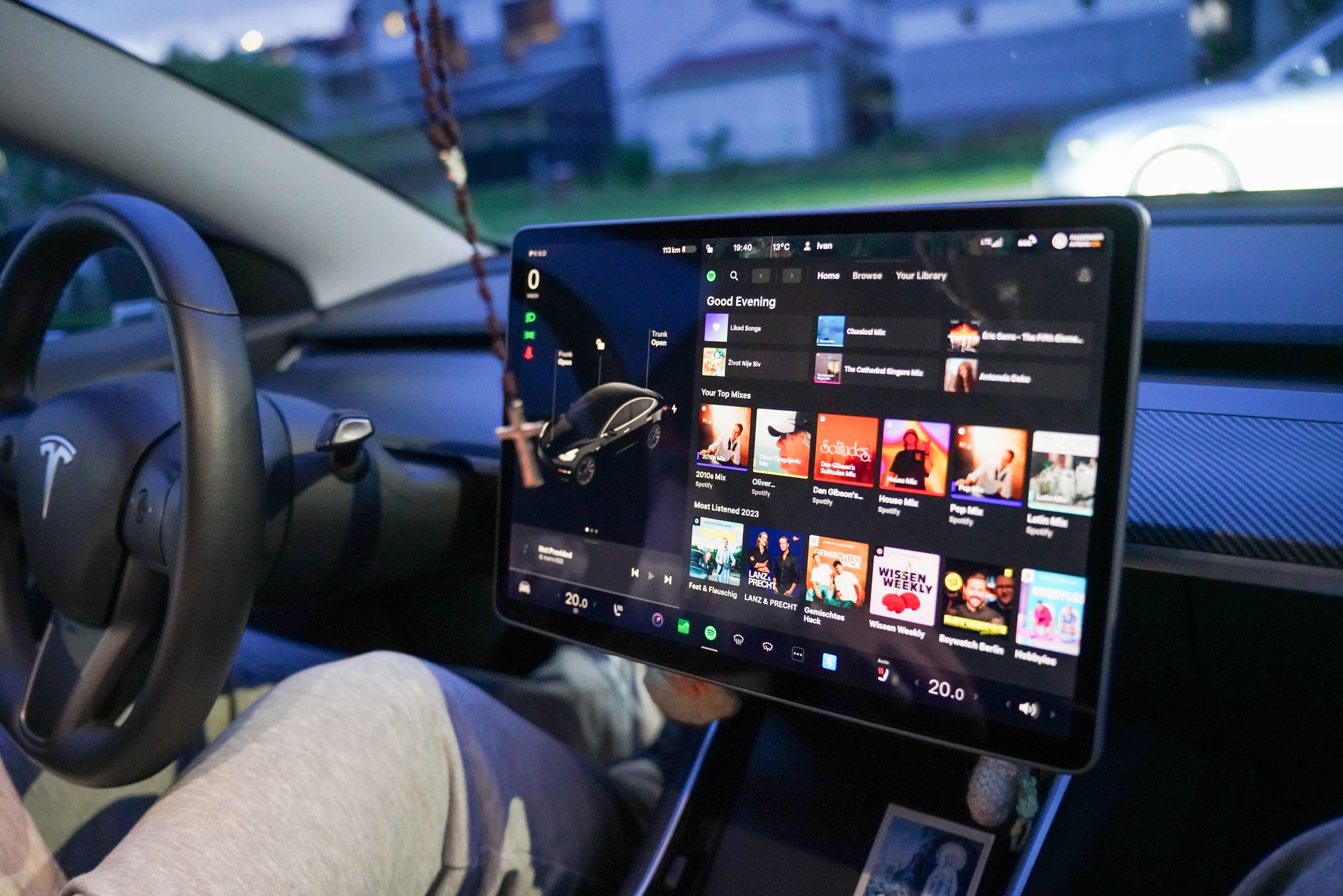
The Spaceship With One Cupholder
A Swimming Club conversation about new cars, old instincts, digital rest, and the strange moment when technology promises comfort but asks you to go to university first.
The Car Is No Longer Just a Car
This began as a conversation about Digital Rest.
Not meditation apps.
Not screen-time graphs.
Not a clean theory about modern life.
It began with a phone, a car, a caravan chair, and Manfred discovering that buying a new car in 2026 might require a small degree in technology.
Ralf had recently received his new Skoda.
It had screens, sensors, Apple CarPlay, speed-limit recognition, automatic braking, mobile-phone connections, software updates, warnings, and enough features to make a normal driver feel both impressed and slightly supervised.
Manfred, meanwhile, was thinking about replacing his 2007 car.
His first hope was modest.
“I hope the car still has a steering wheel and brakes,” he said, “because those things I still know.”
This is where Digital Rest became real.
Not as a question of whether technology is good or bad, but as a question of whether modern technology still allows a human being to feel calm, curious, and in control.
Handy Handy
When the table heard the words “Digital Rest,” Martin immediately thought of the phone.
“The phone,” he said, “because it is always handy. The handy handy.”
He is pro-phone, he said. But it can be too much.
Ralf had two answers: his mobile phone and his car.
They are now connected. He drives with Apple CarPlay. His route appears on a big screen. If he asks himself where his mobile phone is, the answer is usually simple.
It is in the car.
Luckily, he added, they live in a very safe area. There are no thieves.
Manfred’s version of Digital Rest was shorter.
“Handy off, laptop off, camping chair out, sit in front of caravan. End of discussion.”
This may be the clearest definition of Digital Rest ever produced at Swimming Club.
A Spaceship With Cupholders
Ralf’s new Skoda did not feel completely like a normal car.
“It is a spaceship with cupholders,” he said.
Then he corrected the statement.
Actually, there is only one cupholder, for his coffee pot.
And then there is a big hole, which he does not know what it is for.
Manfred listened from the other side of automotive history.
“My car is a perfectly normal car.”
Martin added his own simple position.
“My car is just a car.”
There it was.
Three stages of modern driving.
A car that is just a car.
A perfectly normal car.
And a spaceship with one cupholder and a mystery hole.
When the Car Helps
Modern cars do have their arguments.
Ralf explained that his Skoda reads speed-limit signs. It can brake automatically, slow down for roundabouts, and accelerate again afterwards.
“It is police proof,” he said.
Martin named cruise control. His old Mercedes E240 from 2003 already had it.
Manfred’s car, by comparison, still expects him to participate fully.
“My car has nothing. Just an accelerator and brakes. I still have to do everything myself, even look at the road signs.”
Then, for once, the whole table agreed on a modern feature without difficulty.
Air conditioning.
Some technology does not need a philosophy.
Some technology is simply civilisation.
When the Car Talks Too Much
But useful technology can also become restless technology.
Ralf had connected both his private phone and his company phone. The car was supposed to read only the private phone, but it had registered everything from the company phone.
To swap phones, he had to stop, open the door, put one phone on airplane mode, connect the other phone, close the door, and start the engine again.
This is not exactly restful.
There was a software update available, but he was not allowed to install it yet.
Maybe next week.
Or the week after.
Martin’s car has solved this problem differently.
“My car doesn’t talk with me,” he said. “It doesn’t like me. As simple as that.”
Manfred could not think of much that talks in his car.
There is cruise control.
There is air conditioning.
Mechanically, it is basic.
And there is a certain peace in basic.
Can One Switch It Off?
If Ralf were Manfred’s car-buying interpreter, Manfred had one serious question.
“Can one switch off all these new helpers?”
Ralf’s answer was not completely reassuring.
Some, yes.
Others, no.
For example, when the car stops at traffic lights, the engine switches off. When the driver accelerates, it starts again. Ralf wanted this function switched off, but it was not permitted.
Then there is the warning sound when he exceeds the speed limit.
Ping.
Ping.
Ping.
“But I always drive ten kilometres per hour faster,” Ralf said.
His solution is simple.
He turns up the radio.
It is not an optional extra, he explained.
It is a mandatory extra.
This is one of the strange truths of modern life.
The feature is there for your benefit. You did not ask for it. You cannot fully remove it. So now your solution is louder music.
Old Arithmetic
Ralf also gave Manfred advice about buying a modern car.
What should Manfred ignore?
“The price.”
The Skoda has many features. It costs €66,000. It is a company car. Privately, Ralf would never pay that amount.
He still thinks in Deutsche Mark.
€66,000 becomes 132,000 DM.
That was a lot of money for his parents. With that money, they would have been rich.
Now, for a car, this has somehow become normal.
A car can have software updates, radar warnings, automatic systems, and one mysterious hole beside the coffee pot.
But €66,000 is still €66,000.
Help or Attention?
The table then arrived at the real question.
Where is the line between “this helps me rest” and “this wants my attention again”?
Ralf described the distance regulator on the highway. It creates a safe distance between his car and the car in front.
But then another driver sees the space, overtakes him, and moves into it.
The car brakes.
Ralf loses the setting.
He has to reset it.
After a while, he switches it off.
Technology has planned for safety.
Human traffic has planned for opportunity.
Manfred had a more old-school caravan solution.
When he has his caravan in tow, he tailgates a truck. Then there is no motivation for others to drive between him and the truck.
This may not appear in the official manual.
But it is, in its own way, a system.
Learning, or Being Forced to Learn
Martin made an important distinction.
Learning new technology is fine.
Being forced to learn it is different.
Some things are enjoyable. Others are downright stupid.
Ralf’s experience was more positive. Before the Skoda, he had driven different rental cars for nine months. Volvo, Tiguan, Mercedes, each with different functions.
Those months became training.
By the time he received the Skoda, he had already learned many of the systems.
“I can drive and phone at the same time,” he said, “and the car drives by itself. That is cool.”
Manfred’s situation is different.
“This applies to me. From zero to one hundred kilometres in one step.”
His goal, he joked, is to read the newspaper in the passenger seat while driving.
But then he said the real thing.
He hopes that learning the new technology will be greater than having to learn it.
He wants the experience to be positive.
He wants to start the car without having to go to university first.
That sentence contains a lot.
It is not resistance to learning.
It is resistance to unnecessary pressure.
Curiosity can be restful.
Forced adaptation is not.
Is It Still a Car or a Relationship?
At some point, the table had to ask the obvious question.
If a car now has software updates, settings, profiles, apps, and passwords, is it still a car?
Or is it a relationship?
Ralf gave the best possible evidence.
His wife has a problem with an app called Blitzer.de. It warns drivers about mobile or stationary radar traps.
When it starts, a female voice says:
“Your favourite passenger is now activated.”
This is not just a technical feature.
This is domestic theatre.
Still, Ralf defended the machine.
It is only a car.
But it is a nice car.
And if someone has a caravan or trailer, some systems really do help. For people who know the pain of reversing with a trailer, this is not decoration.
This is genuine usefulness.
The table was not anti-technology.
It was anti-nonsense.
There is a difference.
The Pleasure of Driving
What would a truly restful digital car do less of?
Ralf’s answer was immediate.
It should not take away the pleasure of driving.
A driverless car might be okay, but he still wants to drive his car. He wants to be able to interfere at any moment.
“I don’t want to relinquish control.”
Manfred agreed.
He does not need a car that takes over too much. He wants control over driving.
Driving should be fun.
Sometimes, he said, you have to fight the settings because a real situation forces you to do something different from what the settings think you should do.
Martin agreed with both of them.
This was one of the clearest shared points of the conversation.
Digital Rest does not mean doing nothing.
It does not mean giving up control.
It means not being forced into a fight with your own machine.
The Brrmm Matters
There are old car habits that modern cars should not destroy.
For Martin, it is the driving experience, the character, and the design of the car.
And the sound.
The brrmm of an engine is important.
Manfred agreed. He wants the feeling of controlling the car independently, not being controlled. He wants to enjoy driving without always adjusting settings.
And yes, the sound matters.
The brrmm matters.
For Ralf, it was also the smell.
The smell of petrol.
He was once a car electrician, from 1980 to 1983. He worked with cars that smelled of petrol and diesel.
One day, maybe, he would like to buy a Mercedes-Benz 280 SL, the R107.
He worked on that car.
The ignition.
The smell.
The whole experience.
“It is unbelievably great.”
An electric car is not the same.
The six-cylinder engine, he said, sounds like a sewing machine.
This was not nostalgia as decoration.
It was memory through the senses.
Petrol.
Diesel.
Ignition.
Sound.
Machinery.
Youth.
Work.
Skill.
Some old things remain inside the body.
Advice Without Becoming the Expert
At the end, the table tried to give advice for buying modern technology without losing peace.
Ralf’s first advice was direct.
“Don’t buy a car from the VW Group.”
He had driven other brands where the functions worked. With the Skoda, there was always some sort of problem.
“It is a new car,” he said. “It cost so much money. Why can’t this thing work properly?”
Martin’s advice was more general.
Do not exaggerate comfort and user simplicity, because it can become nerve-wracking.
Manfred’s advice was calmer.
There has been a huge development in technology. Take it one step at a time.
No stress.
He finds it frustrating that cars used to have more or less the same features. Now each car is full of electronics.
In one situation, he could not even find the handbrake.
Then he learned the car no longer had one.
This is modern progress in one small scene.
A man looking for a handbrake that has disappeared into an electronic system.
Dream On
So what is Digital Rest, after all?
For Ralf, it is good music, empty streets, electronic functions that work properly, and driving on the highway while looking at nature to the right and left.
Then he added the correct technical assessment.
“Dream on!”
For Martin, Digital Rest means driving without noticing it.
For Manfred, the sentence began with the right ingredients.
Fun and curiosity should be more…
The transcript stops there, but maybe the table had already said enough.
Digital Rest is not the absence of technology.
It is the hope that technology does not steal the pleasure, the humour, the control, the sound, the smell, the road, the coffee pot, the camping chair, or the ordinary human right to start the car without first attending university.