
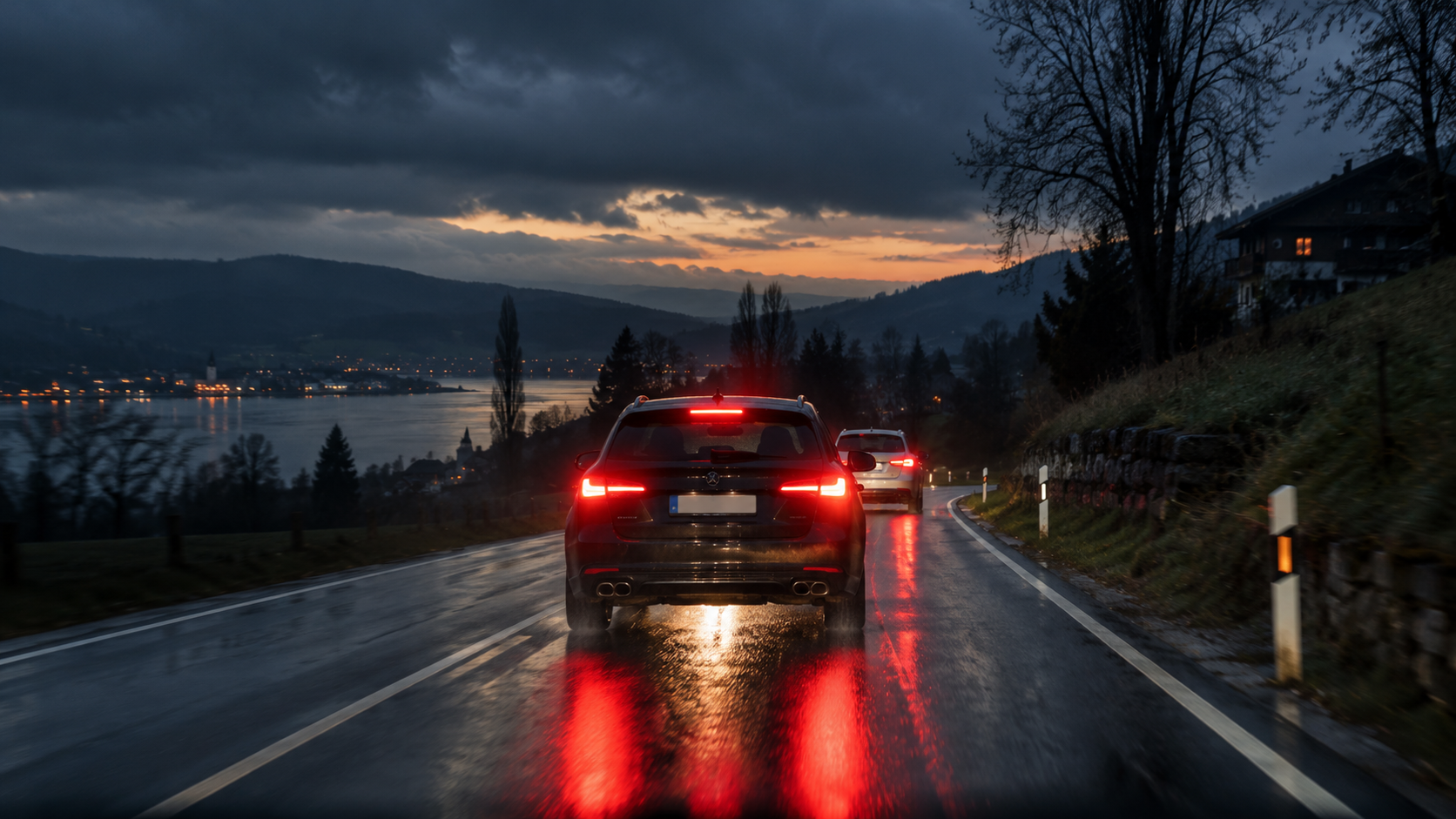
When the Headlights Disappear.
On the road, distance is measured in metres. Manfred and Martin discovered that the more interesting distance is the one between caution and aggression, rules and instinct, and what a driver does and what everybody else thinks they are doing.
By Manfred and Martin, in the Swimming Club, Germany.
There is a moment when the car behind you stops being merely close.
Manfred knows exactly where it is.
“When you can’t see their headlights any more,” he says, “then it becomes really critical.”
Martin has a different solution. He would prefer to deport the rear-view mirror altogether, so that he no longer has to watch whatever the driver behind him is doing.
The problem, though, is not simply distance. It is interpretation. A car appears in the mirror and comes closer. Perhaps the headlights flash. Suddenly a completely ordinary journey has acquired characters, intentions and possibly a villain. Nobody has spoken a word, yet an entire conversation has begun.
And, as the Swimming Club quickly discovered, driving is full of conversations like that.
What is that idiot doing?
Put a very slow driver on a perfectly normal road and the first reaction is almost automatic.
“What problem has he got?” says Manfred.
His second reaction is more useful: keep your distance and watch. Perhaps the driver is about to stop. Perhaps something is wrong. Perhaps he is looking for a house number.
Martin has developed his own modern theory. Years ago, a car wandering strangely across the road might have suggested a driver who had been drinking. Today he assumes something else.
“He’s probably fiddling with his phone. Maybe he suddenly remembered he still has to post his breakfast on Facebook.”
That is the trouble with driving. The road gives us very little information, so the brain supplies the rest. A brake light, a hesitation, a slightly strange line through a bend, and the missing paragraphs begin writing themselves.
Manfred once noticed the same thing with a horn. A driver behind him honks and the instinctive reaction is immediate: What have I done wrong? Is he honking at me?
Manfred refuses to accept the premise.
“Why on earth should I always assume he means me?”
Perhaps the other driver is greeting somebody. Perhaps he is testing his horn. Perhaps, as Martin suggests, it has been gathering dust and simply needs a good blast to clear it out.
This does not mean Manfred fails to recognise bad driving. When somebody is genuinely dangerous, he notices. He is simply reluctant to begin with the assumption that the other person is an idiot.
That becomes considerably harder when the headlights disappear.
Tailgating changes the atmosphere immediately. Martin responds with a stream of private commentary that, he says, he hopes nobody ever hears. Manfred sometimes taps the brake lightly enough to illuminate the brake lights — a small message saying, in effect: There is another car here.
Except even that message may not arrive as intended. The driver behind may see a warning. Or a provocation. He may overtake, pull in front and brake in return.
A tiny misunderstanding becomes road rage.
Two people. Two cars. Plenty of communication. No conversation at all.
The strange wisdom of slowing down.
Manfred has spent enough time towing a caravan to notice that it has changed the way he drives even when the caravan is not there.
“I hardly ever do more than 120 on the motorway now,” he says. “Maybe 130 at most.”
With the caravan he travels more slowly still, but years of towing have altered his normal rhythm. The revelation is almost disappointingly simple.
“You arrive at the destination with 100 as well. Surprisingly.”
Martin agrees. However heroic your plans for the average speed may be, traffic jams, lorries and everybody else on the motorway usually have their own ideas.
Manfred remembers being very different. As a young man in the 1980s, he once drove towards Frankfurt with his foot firmly down and, as he remembers it, barely took it off again until he arrived. The result was not triumph.
“I was completely stressed. Completely exhausted.”
Driving fast demanded constant concentration. Every gap, every approach and every small movement by another vehicle required attention. Slowing down did more than alter the number on the speedometer. It changed the journey itself.
These days, when Manfred wants to move into the faster lane, he often waits for a larger gap than he once would have.
“Other people go across much earlier. Sometimes I ask myself: why are you waiting so long?”
He is not sure whether the answer is age, experience or simply a different sense of risk.
Probably all three.
Italy works. Somehow.
The Swimming Club does not believe every European country drives in quite the same language.
Germany is heavily signposted, heavily regulated and, in Manfred’s view, occasionally so fond of road signs that the signs themselves become confusing.
Italy is different.
With some exaggeration and affection, Manfred describes Italian traffic signs as recommendations rather than commandments. Yet the great surprise is not the apparent chaos. The great surprise is that it works.
Martin enjoys driving there for precisely that reason. His theory is that Italian drivers cannot simply assume everybody else will obey every rule exactly as expected, so they have to pay more attention to one another.
“They think with you,” he says.
For Manfred, the difference becomes clearest when changing lanes. In Germany, he tends to wait for a clearly visible opening. In Italy, the opening may never appear in the German sense. You indicate that you want to move across, you begin moving across, and the traffic reacts.
“They think: just come over, you’ll get your space,” Manfred says. “But unfortunately the German doesn’t think like that.”
Add a twelve-metre car-and-caravan combination and the cultural experiment becomes considerably more exciting.
Spain offers another version. Scooters emerge from unexpected directions, roundabouts demand attention everywhere at once and Martin suggests that what you really need is a 360-degree eye.
Again, Manfred comes back to the same thing.
“It works. But you have to have the same way of seeing it.”
Perhaps that is the largest unwritten rule of all. A traffic system is not only made from laws, markings and signs. It also depends on a collection of expectations shared by the people moving through it. The visitor therefore has to learn more than the official rules.
He has to learn what everybody else thinks those rules mean.
The road is talking to you.
For Manfred, the Netherlands offers perhaps the clearest example of a road communicating before anybody has done anything.
He admires the way Dutch road design gives cyclists visible space. Different colours immediately tell the driver that something has changed.
“You see that different colour and something works in your brain. There’s something special there. You have to pay attention.”
For him, that is more effective than painting a few lines along the side of a German road and declaring the bicycle problem solved.
Martin sees the difficulty every day in Kassel. Cyclists arrive from different directions, e-scooters have joined them and pedestrians make their own decisions.
“You have to watch like a hawk,” he says.
Not because he wants cyclists removed from the road. Quite the opposite. Nobody wants the moment when a misunderstanding becomes an accident. The question is whether the road itself helps people understand what everybody else is likely to do.
A coloured bicycle lane says something. So does a brake light, a flashing headlight or a horn.
Unfortunately, nobody can be completely certain what.
The Mayor imagines a world in which words disappear and human beings are allowed to communicate only with indicators, headlights and hand gestures.
Manfred refuses immediately.
“I would refuse to learn this new foreign language.”
Martin identifies another difficulty. He would first have to explain that an extended middle finger can occasionally be intended in a friendly way. Manfred adds that scratching your head should not automatically be interpreted as telling somebody they are crazy.
Within minutes, the new universal language has collapsed.
Which is rather the point. Even on the road, where communication has been reduced to a small collection of supposedly standard signals, human beings still manage to add uncertainty, emotion and interpretation.
The passenger has a different windscreen.
The strangest distance in a car may not be between two vehicles at all. It may be the fifty centimetres between the driver and the passenger beside him.
Manfred knows this from travelling with his wife.
He may approach a junction believing he has judged the speed, the distance and the caravan perfectly. From the passenger seat, she sees the same situation from another angle and suddenly reacts.
“Watch out!”
For the driver, that warning can create exactly the uncertainty it is trying to prevent. Manfred knows what is ahead and has already planned his movement. Then the passenger panics and a new thought arrives immediately: Has she seen something I haven’t?
Now he is looking for another danger.
Martin admits that he is not an especially relaxed passenger either. He has sat beside drivers whose style made him deeply uncomfortable, only to discover later that the same people considered his driving dangerous.
Apparently everybody is the sensible driver when sitting in their own seat.
The perfect car may have a problem.
Eventually the conversation arrives at the perfectly obedient self-driving car.
Imagine it travelling through Kassel and following every official rule exactly. What would it make of the unofficial part?
Martin thinks the machine will need clairvoyance. It will have to anticipate cyclists, pedestrians, scooters and all the small movements through which people reveal what they are probably about to do.
Manfred is less interested in solving the problem.
He simply does not want the car.
“If I want to be driven, I’ll take the train.”
Martin improves this immediately.
“If I want to be driven, I’ll call my chauffeur.”
For Manfred, the objection is partly about control. Modern assistance systems already occasionally disagree with the driver. A lane-keeping system sees a line and interprets it according to its programming. The human being sees the traffic situation around him and may have a different idea.
Then comes the absurd little battle between person and machine.
I want to go there.
You should not go there.
I am the boss.
For all the imperfections of human driving, something is happening that is difficult to reduce to a set of rules. Drivers are constantly reading one another: guessing, anticipating, forgiving, complaining, making space, refusing space and sometimes inventing motives that were never there.
Perhaps that is why the important distance between strangers cannot be measured only in metres between two bumpers.
It is also the distance between seeing something and deciding what it means.
Between a warning and a provocation.
Between noticing that another person is behaving strangely and deciding that he must be an idiot.
Sometimes the safest thing on the road may be a little more space.
And occasionally the wisdom to remember that the horn might not have been about you at all.