What Are We Going to Do About It?
AI can widen our choices, sharpen our questions and help us see connections. The harder question is what we choose to do with them.
By Bruce Lloyd, London with Frank Peters, Cleebourg.
Near the end of a conversation that had ranged across AI, trust, money, language, power, politics and the odd detour into history, I found myself making a slightly uncomfortable admission.
I have spent a lot of my life writing about issues and talking about them. I have spent rather less time going out and actually doing something about them. I have never been a great one for joining demonstrations or becoming deeply involved in politics. I might pretend that I am a thinker, I said, but perhaps I also have to admit that I am not really a doer.
Frank immediately challenged me.
If I had done nothing, he pointed out, I would not have become a professor. I would not have been involved in industry, research and all the other things that have filled my working life. Perhaps, then, the distinction is not really between thinking and doing.
The more interesting question may be what happens to our thinking once we have done it.
And who notices.
The problem with power.
We had arrived there by a rather circuitous route, which is not unusual in our conversations. We begin somewhere, throw ideas backwards and forwards, and occasionally discover afterwards that there was a thread running through the whole thing.
This time, one of those threads was power.
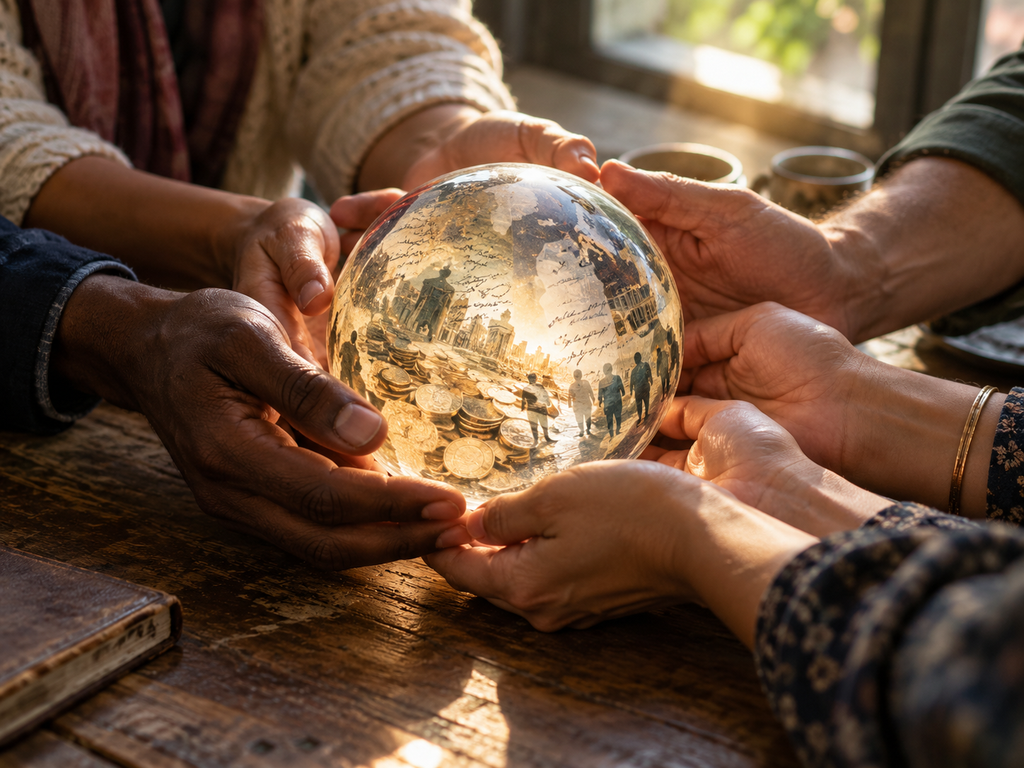
Frank had been playing with three expressions: the power of language, the power of money and the power of people. Put them into a Venn diagram, he suggested, and the word sitting in the middle would simply be power.
That reminded me of something I had written about many years ago: power is the ability to make things happen. Responsibility asks a different question — in whose interest do you make them happen?
I have a shelf full of books about power. Many are concerned with how you acquire it and how you prevent other people taking it away from you. What has always interested me is how rarely responsibility appears alongside it. At the other end of the bookshelf are books about corporate social responsibility which, in turn, often seem curiously reluctant to talk about power.
Yet surely the two belong together. Power without responsibility can become very self-focused. Once responsibility enters the equation, we are forced to look beyond ourselves. Who benefits? Who pays? Who is heard, and who is ignored? What are the consequences of the thing we are trying to make happen?
That takes us rather quickly into technology.
There is enormous uneasiness around AI, and some of it is perfectly understandable. But it is often difficult to separate mistrust of the technology from mistrust of the people and organisations behind it. They are not necessarily the same thing.
Frank wondered whether AI has become a convenient scapegoat. Perhaps some of our anxiety comes from the fact that it exposes how much we do not know. Blaming the computer can be easier than examining the quality of our own thinking and questioning.
My concern is slightly different. Technology does not exist separately from human motivation. However sophisticated the systems become, they are created, funded and operated inside organisations with their own pressures and interests.
We have seen something similar with social media. Platforms may speak about connection, openness and freedom of speech while operating within commercial systems that reward attention, growth and profit. The media itself faces comparable pressures. Controversy attracts attention. Polarisation attracts attention. Extremes attract attention.
Then we wonder why trust is declining.
There is a curious circle here. The more trust there is in a society, the less regulation people feel they need. As trust falls, we create more rules to control those operating at the limits of acceptable behaviour. More regulation brings more frustration, more lawyers and more attempts to find ways around the rules. Measures intended to restore confidence can end up reinforcing the feeling that nobody can be trusted.
There is no easy way out of that.
More choices, less focus.
AI introduces another paradox. It is enormously increasing the number of choices available to us.
At first sight, that sounds entirely positive: more information, more possibilities, more perspectives, more ways of approaching a problem. We can ask another question, investigate another angle, generate another alternative and compare another interpretation.
But doing something requires focus.
Human beings still have a finite amount of time. At some point we have to stop exploring and decide what matters. If the number of possibilities keeps growing, we may need considerably more discipline simply to decide where to put our attention.
That brought us back to priorities.
How do we know what is important? What matters to me may not matter to somebody else. Something that looks urgent may not be significant at all, while something happening quietly in the background may matter enormously. The thing making the greatest amount of noise is not necessarily the thing deserving the greatest amount of attention.
AI can help us examine those choices. I do not think it removes our responsibility for making them.
It may actually increase it.

A rather accidental career.
From there, the conversation became more personal. Frank asked whether I had considered myself ambitious during my career.
My answer was no, although I probably had what I called a kind of naive ambition. What I did not have was a particularly disciplined sense of direction. I was fortunate to find myself in the academic world almost by accident, and once I was there all sorts of things happened, many of them outside my control.
I was lucky enough to be in the right place at the right time.
That is rather different from the conventional story of success. We tend to admire people with a clearly defined focus. They know where they are going, set their goals and pursue them relentlessly. Often they are very successful.
But there may be a danger in defining success quite so narrowly. If the destination around which you have built your life suddenly becomes irrelevant or unobtainable, an extraordinary degree of focus can become a weakness.
Life is rarely entirely the result of one person’s plan anyway.
Careers develop through other people. Somebody sees something in you that they need. You see something in them. Opportunities emerge. Things are given and taken. Chance intervenes.
People intervene.
Frank and I did not know one another existed until an online platform happened to put us together. An algorithm created an introduction. A conversation followed, and then another.
Technology made the connection possible.
It did not decide what we would do with it.
The freedom of not having to do.
There is another dimension to the relationship between thinking and doing that becomes particularly interesting later in life.
For most of our working lives, earning a living forces us to be doers. We do things partly because somebody else needs them done. Our actions serve an organisation, a customer, a market or a profession.
Retirement changes that relationship. Suddenly you do not have to be driven by quite the same forces.
That creates freedom, but it can create frustration too. You may have more opportunity to think creatively and fewer structures compelling you to turn those thoughts into action. Meanwhile, somebody still working inside an organisation may experience the opposite problem: constant activity, yet a feeling that what they do is scarcely noticed or appreciated.
Neither condition is automatically satisfying.
Perhaps the important question is not whether we describe ourselves as thinkers or doers, but whether there is some relationship between the two.
Thinking without doing can become sterile. Doing without thinking can become dangerous.
The same is true of power. Power makes things happen. Responsibility asks why they should happen, and for whom.
Did we achieve anything?
Eventually we arrived at the slightly awkward question behind conversations such as ours.
Have we contributed anything useful?
Or are we simply two men sitting, metaphorically at least, on a Greek island drinking coffee and enjoying a conversation?
I am not sure we can know.
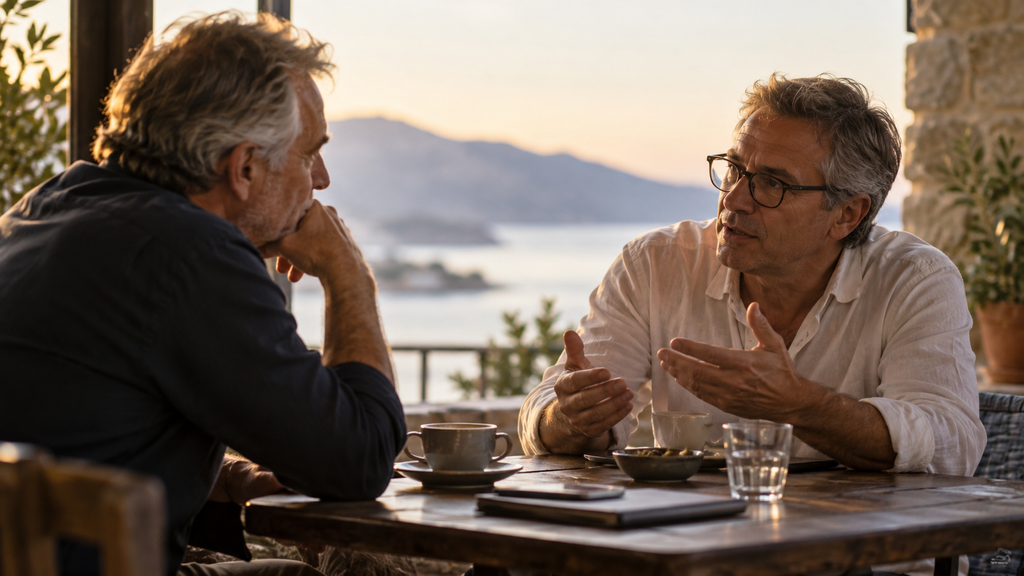
We certainly did something. We talked. We questioned each other. We occasionally disagreed. We followed ideas down unexpected paths and ended up in places neither of us had intended to visit when we began.
Whether that amounts to achieving something may not be entirely for us to decide.
Something we discuss may be read by somebody else and connect with another thought. It may alter a question they were asking or lead them to do something differently. We may never hear about it. That is one of our human limitations: we often do not know the effect of what we do because people do not tell us.
So I suggested a smaller test.
Had either of us left the conversation with an idea we did not have before?
The answer was yes.
That does not amount to changing the world. It does not even mean that either of us will behave differently tomorrow. But perhaps that is where the movement from thinking to doing begins.
And perhaps this is also where AI becomes most interesting. Not as the thing that gives us the answer, and certainly not as somewhere we can transfer responsibility, but as another participant in the movement between thought and action.
A human thought goes into the system. Another human questions it. AI helps organise, challenge or extend it. Something emerges on the other side and travels onwards.
What happens after that is much harder to