In This Issue.
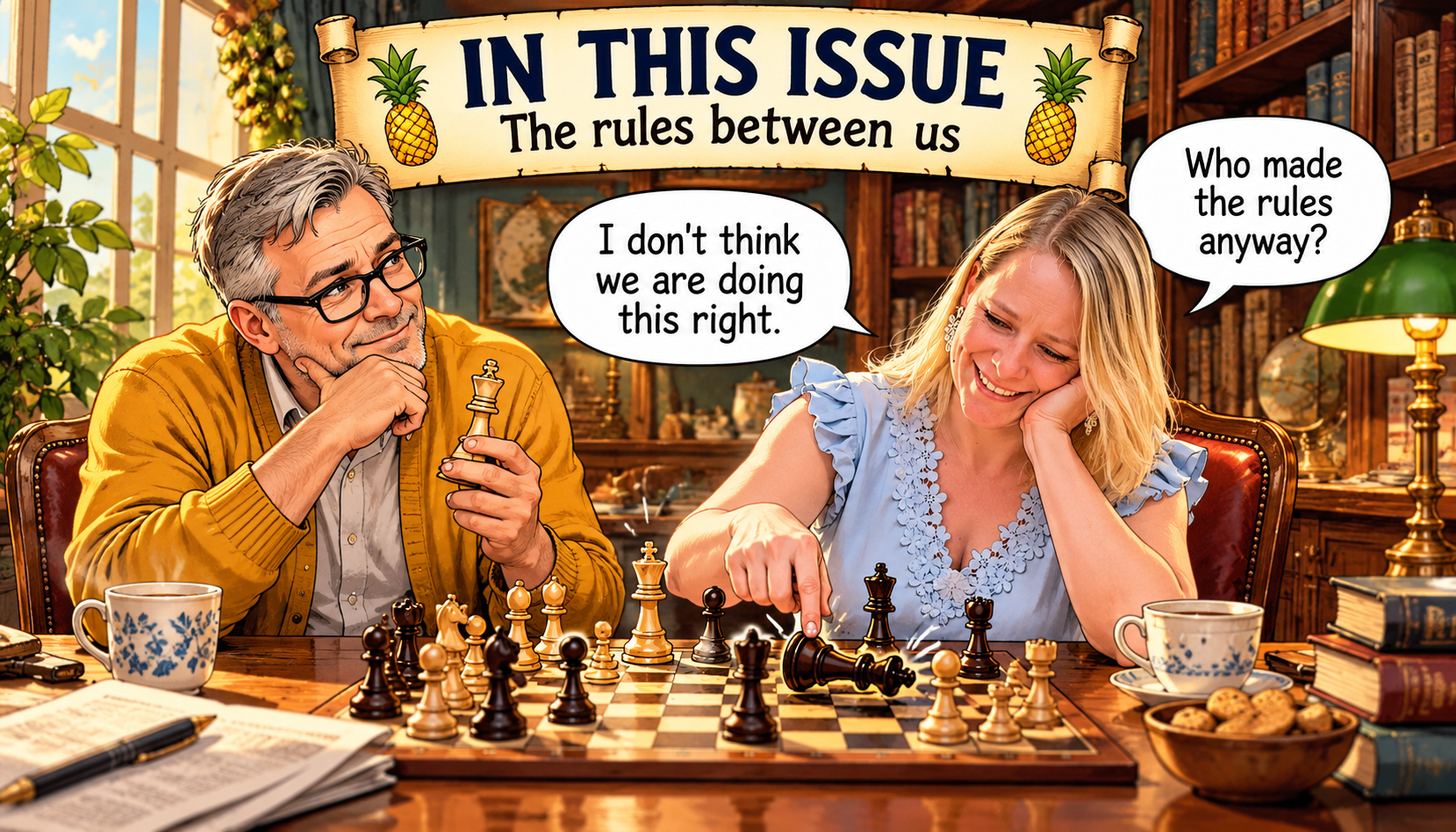
Life is a bit like a chessboard, filled with little pieces and strictly defined moves. When you learn how to play for the first time, it can feel like the rules are being made up as you go along. Sometimes we forget a rule, our queen gets taken, and we lose. Some days we end up stuck in checkmate because we made a wrong move—and we lose again. But other times, we play the pieces right, follow the rules, and win the game.
Those chess rules are written down black on white. But the rules we share with the people closest to us are entirely different. They aren’t written down in contracts, handbooks, or lists; we simply understand them, absorb them, and follow them. They live in quiet understandings, unspoken boundaries, and the occasional household explosion when a line is crossed.
In this issue, we take a closer look at these invisible agreements that govern our relationships with partners, children, friends, and colleagues. But what happens when we realize we aren’t always playing by the exact same rulebook?
In her editorial, The Rules Between Us, Janita explores the little rules that shape everyday life, from household expectations to the things we assume everybody else already knows. But what happens when two people have completely different ideas about what is normal?
From the rules we live with at home, we head out into the wider world, where familiar behaviour can suddenly look very different.
In The Trip I Still Think About Every Week, Alexander looks back on a family trip to California that left him with unforgettable memories. From friendly strangers and spectacular scenery to the shocking poverty he encountered in Los Angeles and Las Vegas, he discovers an America full of contrasts — a journey he still thinks about almost every week.
Monica’s Postcards, Koalas Around the World, take us to Melbourne, where a collection of wonderfully dressed koalas represents countries and famous characters from around the world. Can you recognise them from their costumes and accessories? There are fourteen to identify, so get ready to test your international knowledge!
After travelling across the world, we return to the smaller exchanges of everyday life, where money, generosity and effort do not always add up in quite the way we expect.
In The Bill Tells Only Half the Story, Ralf knows that an expensive meal can be worth every cent — or leave a bad taste. From a disappointing restaurant visit in Gran Canaria to an old friend helping repair his car, a €2.50 coffee-machine repair and three helpings of a delicious salad, he explores why the real value of something cannot always be measured in money.
In Two Hundred Kilos of Mussels and a Week of Possibilities, Sylvie has a busy week ahead in France, starting with 200 kilograms of mussels to prepare for a tennis club feast. Between her daughter’s flower-selling challenge, holiday plans that may or may not happen, safari stories and conversations about life in France and South Africa, she wonders whether her week off will leave any time to relax.
Fabrice reflects on the difference between authority and respect in Respect Is Not a Rank, drawing on his experiences of work, responsibility and military life. Following the rules is one thing, but deciding who deserves respect is not always quite so straightforward.
Of course, even when everyone has the best intentions, agreeing on the right thing to do can become surprisingly complicated.
In Ladies First, Age Before Beauty, or Rock-Paper-Scissors?, what happens when everyone is trying to be polite, but nobody agrees who should go first? Join Rosii, Monica, Fruitloop and the Mayor for a wonderfully chaotic Lunch involving stubborn doorways, birthday privileges, an inflatable duck, a missing cat and a spaceship to Mars with one seat too few. Good manners have never been quite so complicated!
In Atlantic Corridor’s Good Manners Travel Well, what would happen if Ismar and Ritesh visited each other’s homes in Brazil and India? From airport collections and restaurant bills to shoes, food and unexpected house rules, the two discover that hospitality is sometimes less about knowing the customs than understanding the people.
And perhaps, underneath all these customs and expectations, there is something simpler about how we make room for each other.
In The Human Bit, the Mayor invites us to slow down, put aside the need to prove ourselves, and consider how we make room for one another. Two trees sharing the light offer a simple image of living alongside others without asking them to move out of the way.
In Was That Friendly, or Was I Just Insulted?, Manfred and Martin take us on a wonderfully entertaining tour of North Hesse, where stubborn locals, suspicious friendliness, apple wine and unexpected coffee etiquette are all part of the experience. From polite English drivers to German television habits and holes in socks, they discover that good manners may have less to do with where people come from than with the people themselves.
From the peculiarities of human behaviour, we move to a bigger question: what happens when understanding the world is no longer the same as knowing what to do about it?
In What Are We Going to Do About It?, Bruce and the Mayor explore the relationship between thinking and doing, from power and responsibility to trust, technology and artificial intelligence. As AI gives us more information and choices than ever before, they wonder whether the real challenge is finding answers — or deciding what matters, taking responsibility and doing something with what we learn.
After all that thinking, it is time for something considerably more practical — and rather delicious.
In Ralf’s Kitchen, Ralf’s Three-Helping Chickpea and Quinoa Salad, Ralf arrives at a barbecue expecting to enjoy the meat, but it is Petra’s chickpea and quinoa salad that steals the show. Three helpings later, he has a new favourite recipe to share, complete with feta, rocket and a delicious homemade dressing.
And finally, just when we think we have worked out how people ought to behave, Fruitloop University reminds us that things could always be much more complicated.
In Who Goes First at the Monster Café?, our latest Peeling Potatoes adventure, even deciding who should go first can become a complicated business. Join the familiar characters of Fruitloop University for another wonderfully ridiculous encounter with the rules of everyday life.
And in The Next Issue — Whose Rules Are These Anyway?, we turn our attention to the people who make the rules in the first place. From family traditions and workplace expectations to the customs we follow without questioning, who decided how things should be done — and do we really have to listen?
Curious? Grab a beverage, settle down and read or listen to Pineapple 34.