

Until It Stops Working
By The Swimming Club, aka Martin & Manfred, both in Germany.
Music, caravans and the invisible machinery underneath an ordinary good day.
Martin likes to listen to music properly. Not as something floating around in the background while he does three other things. He sits on the couch and listens. Sometimes he streams a concert from his mobile phone to the television. Sometimes it is a DVD. The VCR is still connected too, although videos do not get much work these days. CDs remain in service. So do vinyl records.
And because Martin likes music at something close to the volume at which it was meant to be played, there are headphones. Wired or Bluetooth, but mostly wired.
It all sounds perfectly normal.
Which is exactly the problem.
Take one thing away.
Remove the CD and Martin simply reaches for the vinyl record. Remove streaming and things become less convenient, but the music survives. In the car, you can keep travelling backwards through technology until you reach the cassette.
Then remove the headphones.
Now the neighbours are involved.
Martin has sound-sensitive neighbours. They once noticed the squeak of his doors, something he himself had stopped registering. The doors had not become quieter. He had simply become used to them.
It is a small thing, but it points towards something much larger. Things that remain unchanged for long enough eventually disappear from our attention.
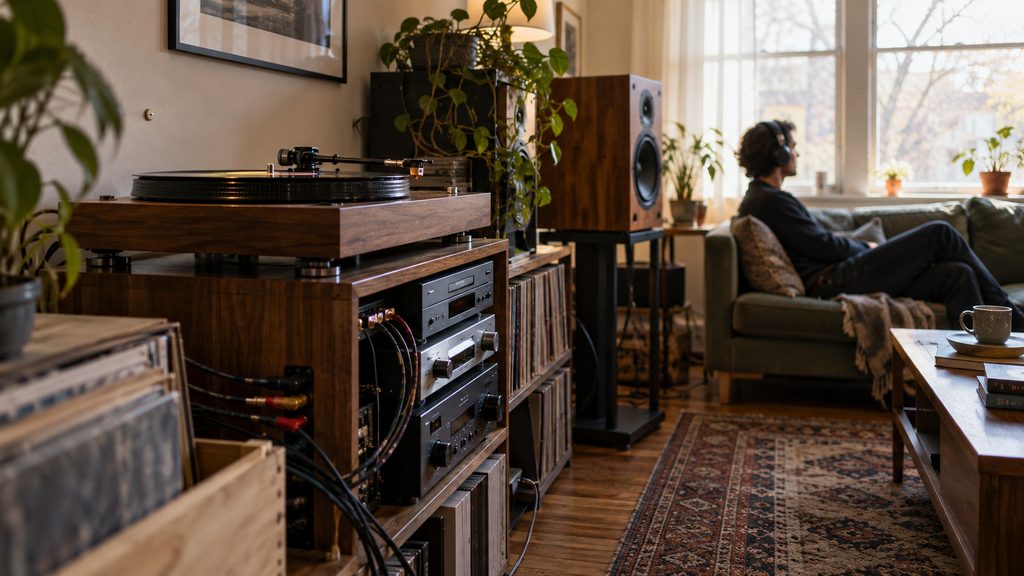
So we started dismantling Martin’s music.
Headphones. Loudspeakers. Amplifier. Turntable. Cassette deck. CD player. Television. Mobile phone. Electrical socket. Plug. Wires. Electricity itself.
“Oh wow,” was Martin’s reaction as the list grew.
The three or four minutes of a song suddenly contained an extraordinary amount of human ingenuity.
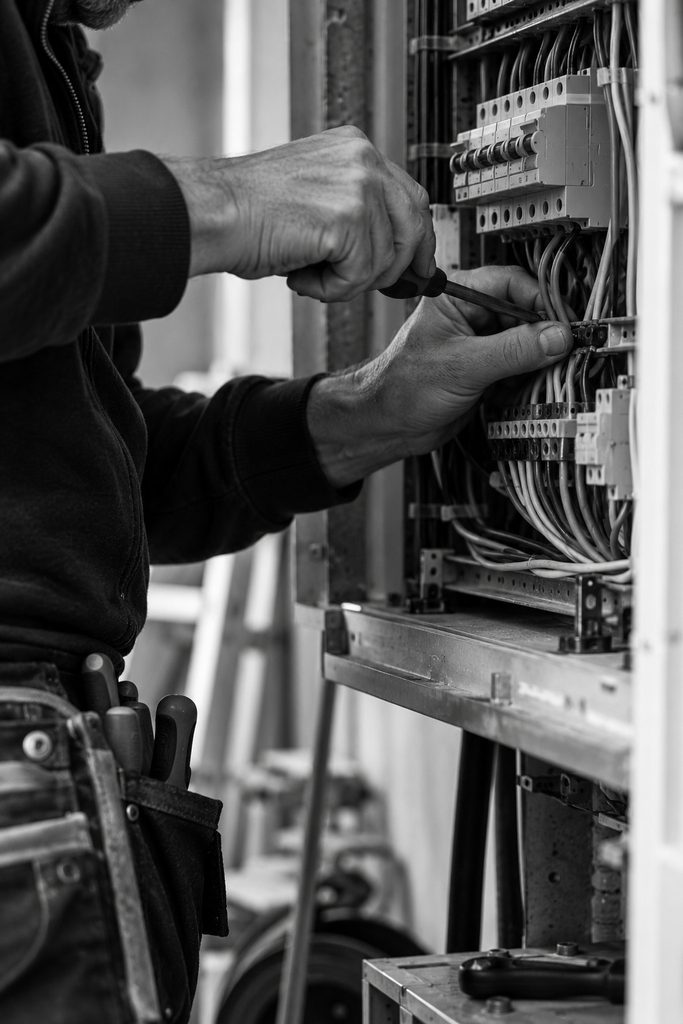
Without electricity, of course, most of it stops. Manfred, an electrician, had an appropriate version of history ready.
“When God said, let there be light, we had already laid the cables.”
In Manfred’s telling, electricians have been around for a very long time.
Yet when Martin sits on his couch and presses play, he does not think about cables. He listens to the music. Nor does he particularly want to hear the construction of the guitar, the manufacture of the amplifier or every process that brought the sound into his room.
That would probably destroy the experience rather than improve it.
The machinery needs to disappear.
Until it doesn’t work.
Take away the road signs.
Manfred’s caravan offered another experiment.
What does he need before leaving on holiday?
“A destination. The car has to be roadworthy, the caravan, both through the MOT. I need vacation and my wife.”
A strong start.
Then we removed the SatNav.
No great problem. Manfred belongs to the generation that can still read a paper map. He knows that north is at the top, and losing the electronic voice on the dashboard would not stop him setting off. He knows the general direction. He can reach the German border.
So we removed the road signs too.
“That could get interesting.”
Without signs, the landscape itself begins to matter. Head south for long enough and large mountains ought eventually to appear. Those would be the Alps. Continue further and, sooner or later, there should be a sea. Go north and another sea waits at the end.
East is more troublesome.
And even on a familiar journey, knowing roughly where Würzburg lies is not quite the same as knowing which road will take you there. Suddenly memory matters. Previous journeys matter. Geography matters. Natural barriers matter. Borders and legal restrictions matter.
A journey that appeared to belong entirely to the traveller starts revealing how many other people have already prepared the way.
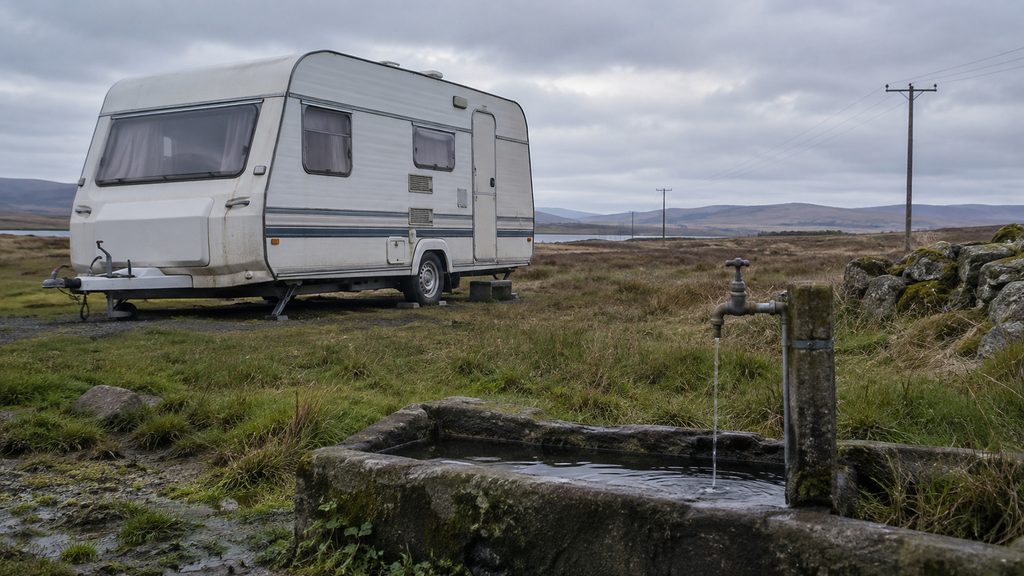
Then we took away the campsite.
Manfred could have a field. He could park the caravan. If he started carefully, the battery might last five days. Food could be bought. Nature provides certain possibilities when toilets disappear, although those possibilities come with complications. Washing depends on finding water. The caravan itself needs electricity for systems that normally require no thought at all.
Could he manage?
Probably.
For perhaps a week.
“Somehow it would work, but it wouldn’t be a holiday.”
That was the point at which the caravan stopped being simply a self-contained symbol of freedom.
Manfred does not need luxury. A field and a water point will take him surprisingly far. But even his version of independence rests on infrastructure.
“The freedom stops when the infrastructure is non-existent.”
The invisible bit underneath.
Once we started looking, the same pattern appeared everywhere.
At work, there are tools and technical systems. The internet has become so fundamental that, as Manfred put it, sad as it may be, almost nothing works without it.
At the end of the month, money appears in an account. We call it being paid. It feels automatic.
It isn’t.
Somewhere there is a system, and somewhere a person has to make that system do what it is supposed to do.
A train door opens. A train door closes. The passenger thinks about getting off at the right station. Almost nobody thinks about the people whose work made that ordinary little movement possible.
And that is probably as it should be.
If every time a train door opened we had to contemplate the engineering, manufacturing, maintenance, software, electricity and human labour behind it, we would never get anywhere.
Successful systems become invisible.
Perhaps that is part of the definition of success.
The unusual becomes ordinary remarkably quickly.
Water comes from the tap.
Electricity comes from the socket.
Really?
Just that?
We know perfectly well that the answer is no. But in daily life, that is exactly how we behave. The water comes from the tap because that is what water does.
Until one morning it doesn’t.
The part that cannot be manufactured.
Martin and Manfred had begun with equipment, but the conversation did not stay there.
Martin had recently celebrated his birthday. There had been good conversations, two excellent cakes and, later, some good concerts to close the day. One of the cakes even travelled home with him.
The technology could deliver the concert. It could not manufacture the good day.
The same is true of music itself.
Suppose every technical component works perfectly. The amplifier works, the headphones work, the electricity flows, the correct signal reaches the correct machine—and the music gives Martin no pleasure.
What has failed?
“Probably me, because I selected the wrong music for the moment.”
Or, he added, perhaps he had put the wrong record into the wrong sleeve.
There are songs, though, where the opposite happens. Martin described Garbage’s The Trick Is to Keep Breathing as a “soul healer”. For him, its message reaches beyond the equipment carrying the sound. In a difficult moment, breathing, relaxing and simply continuing can become the important part.
The equipment delivers the song.
The song does something else.
Manfred found the same distinction in travel. A holiday can contain a flat battery, stress and an unwanted detour. He remembered needing a new battery in the South of France. At the time, the problem was real. Later, it became part of the experience, while the positive memory of the journey remained stronger.
Perhaps that too is something we quietly do all the time. We do not merely remember systems functioning. We remember what they allowed us to feel.
Pleasure.
Relief.
Freedom.
A good conversation.
The feeling that somebody is interested in what we know.
The optimism that can appear when another person seems genuinely willing to move something forward.
Manfred put it simply: the personal attitude of one person can move mountains.
No plug, cable, road sign or SatNav can produce that on command.
What happens when that becomes normal?
A broken SatNav announces itself immediately.
So does a failed internet connection. A silent loudspeaker. A power cut. No water from the tap.
But freedom rarely flashes an error message.
Friendship does not display a warning symbol when we stop noticing it.
Pleasure does not make an alarm sound when it has become routine.
Manfred thought taking those things for granted was not particularly good. There are moments when we stop and recognise that something went well, that a goal was achieved, or that other people helped us get there. But those moments may be rarer than they should be.
Perhaps greater awareness raises the value of the experience.
That does not mean sitting on the couch listening to a song while solemnly thanking the electrical socket, the cable manufacturer and the person who designed the plug. Martin was probably right: if we heard the whole system while listening to the music, we might ruin the music.
Some things need to disappear so that we can enjoy what they make possible.
But perhaps they should not disappear completely.
Because underneath an ordinary song is an astonishing chain of things that work.
Underneath a caravan holiday is an extraordinary network that quietly makes freedom possible.
And underneath both of them is something even easier to overlook.
The fact that we are able to enjoy them at all.