
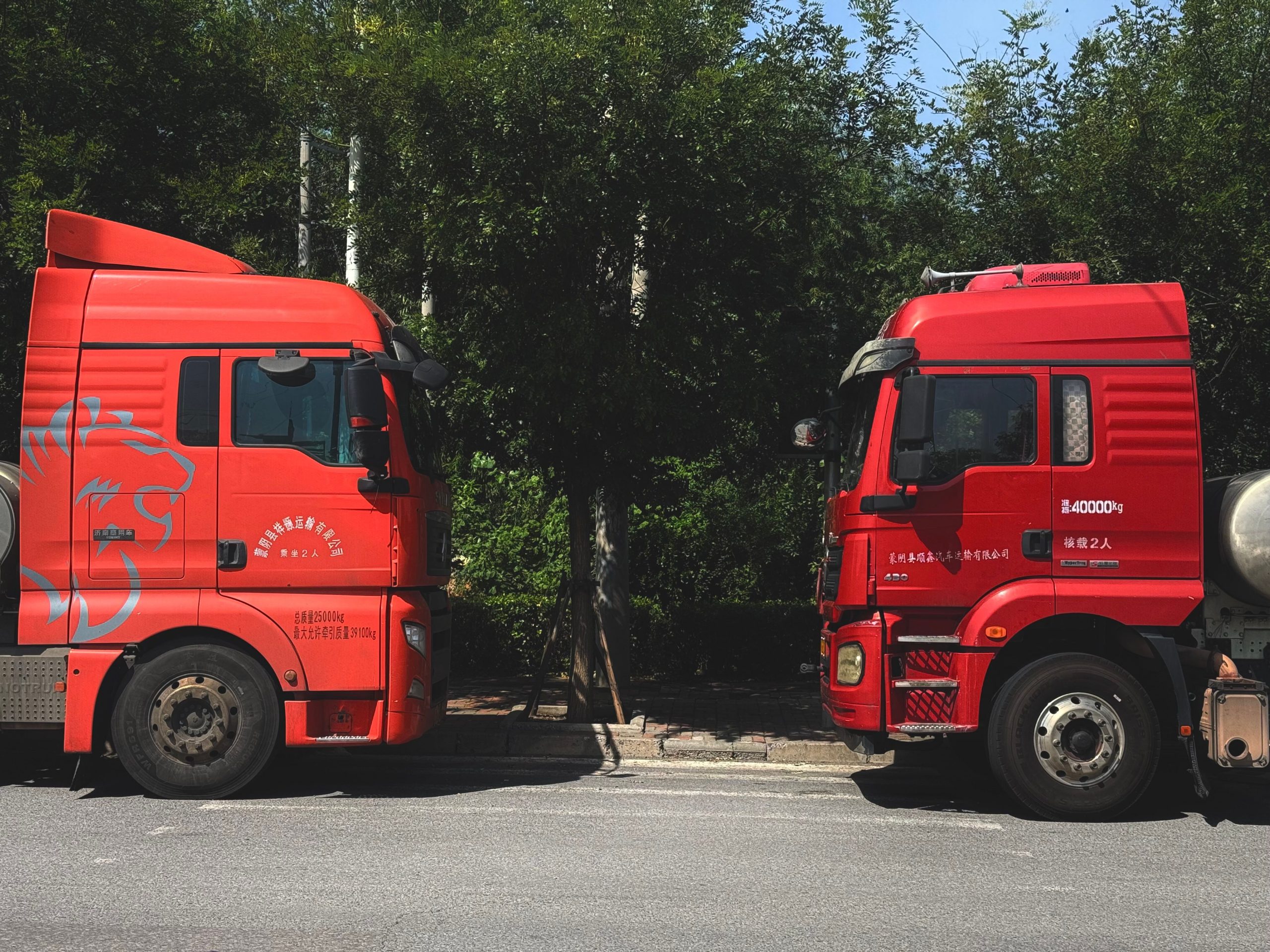
Two Metres Above the Road
From the cab of a 26-ton truck, Fabrice sees ordinary streets from a different height. The view is better. The responsibility is heavier. And what looks easy from outside is often anything but.
A Different View.
Janita asked me what would surprise her first if she climbed into my truck tomorrow morning.
She has been in a five-ton, maybe ten-ton truck before.
“That is a baby truck,” I told her.
Mine is around 26 tons.
The first surprise would probably be the position. Then the width. Then the length.
When you have never been inside a large truck, you know it is big, of course. But knowing that from the outside and sitting inside it are two very different things.
You are also sitting roughly two metres above the ground.
And that changes what you see.
The World Is Already Awake.
I begin work at six in the morning. By then, I am certainly not the first person working.
In the industrial areas, people have already started. There are bakeries, recycling businesses, factories, dispatchers, other drivers, and all the people who make these places function before much of the city has properly begun its day.
It is a different view of the morning.
Janita thought perhaps I would talk about sunrises, forests, or beautiful landscapes from high up in the cab.
Not really.
I work mainly in the city.
I see buildings, cars, companies, containers, and people.
But being higher does mean I sometimes see things that the person in the car in front of me cannot see.
At a crossroads, for example, I might be behind another vehicle and see a bicycle approaching from the right.
The driver in front may not be able to see it yet.
I can.
Then I use the horn to warn them.
That is one advantage of the truck.
I do not see everything.
I just see a little bit more.
The Space That Isn’t There.
One thing people often misunderstand is how much space a truck really needs.
A car driver looks at a street and thinks there is plenty of room.
I look at the same street with a truck and container that may be twelve or fourteen metres long, and I see something completely different.
People sometimes tell me, “Yes, you can go there.”
I say, “No, I cannot.”
They look again.
Of course you can.
No.
The dimensions decide.
It is not only the length.
When you turn, the back of the truck moves differently from a car.
A small street, with parked cars on both sides, can suddenly become a completely different problem when you are driving something this size.
Sometimes there may be only ten or twenty centimetres to work with.
And sometimes you discover the problem only when you are already inside the street.
Then there is one solution.
Reverse.
I once had to reverse about 200 metres through a very tight street.
Janita said that sounded difficult.
I told her that after 200 metres, I had lost about two litres of water.
Very interesting.
Very, very interesting.
Sometimes the Answer Has to Be No.
The misunderstanding becomes more serious when people ask a truck driver to carry something that should not be carried.
Someone sees a container and thinks: it fits, so the truck can take it.
That is not how it works.
I have had people tell me to take a container when I knew it was overloaded.
“Yes, you can.”
“No, I cannot.”
“Yes, you can.”
No.
If something goes wrong on the road, the person who told me to take it is not sitting behind the steering wheel.
I am.
I remember one container filled with gravel.
Just looking at it, I knew there was a problem.
Gravel becomes very heavy, very quickly.
When I tried to lift the container, it was obvious that this was not a normal load.
Again, somebody may look from outside and say it should be possible.
For me, the question is different.
Can I transport it safely?
If the answer is no, then the answer is no.
That is part of the responsibility people do not always see when they look at a truck driver.
The truck is big, so perhaps they imagine it can simply do anything.
It cannot.
And the driver cannot simply say yes to everything.
And Then There Are Cyclists.
Of course, sooner or later, we arrived at cyclists.
This was probably inevitable.
I can become frustrated when somebody is difficult to see or behaves unpredictably in traffic.
Early in the morning, particularly in winter, visibility can be poor.
If someone is wearing dark clothing and has poor lights, I may see them only at the last moment.
With a large vehicle, that matters.
But there is also one cyclist I see regularly on my way into the city.
I see him in summer.
I see him in autumn.
I see him in winter.
Rain, wind, sunshine. He is there, going to work on his bicycle.
And I respect him.
Why?
Because I can see him.
He has good lights. He makes himself visible.
From a distance, I know he is there.
That is completely different.
And I have to be consistent myself.
I cannot complain that cyclists should make themselves visible, and then go cycling wearing clothes nobody can see.
When I am on my bicycle, I also have to make myself visible.
You have to be consistent.
Sometimes You Get Out and Help.
After years of driving, you also become used to watching people trying to solve small problems on the road.
Someone cannot reverse.
Someone gets stuck.
Someone blocks the street.
The cars begin waiting.
Then the horns begin.
Sometimes I get out.
I stop the traffic and help the person.
I remember a woman with a small car and a little trailer.
She only needed to reverse a couple of metres, but she could not manage it.
And in that moment, everything becomes blocked.
So I helped her.
For me, reversing two metres with a trailer is not a big thing.
For somebody who hardly ever does it, it can be a very big thing.
The people waiting behind may not be happy.
They can wait.
Solve the problem first.
Then everybody can continue.
What Still Surprises Me.
At the end of our conversation, Janita asked me something I had to think about.
After all these years on the road, what am I still curious about?
The vehicles?
The machines?
The places?
No.
The people.
Every day you see people doing something, and you think, “That is not possible.”
But it is possible.
Every day.