
There Might Be Some Use in Future.
By Ismar in Campo Grande, Brazil and Ritesh, Bengaluru, India.
Between a kitchen cabinet in Bangalore, a sparse apartment in Campo Grande and three old phones that nobody quite knows what to do with, a conversation about clutter became a story about repair, necessity and lives lived in transition.
Every home seems to have a place for things that have temporarily escaped a decision.
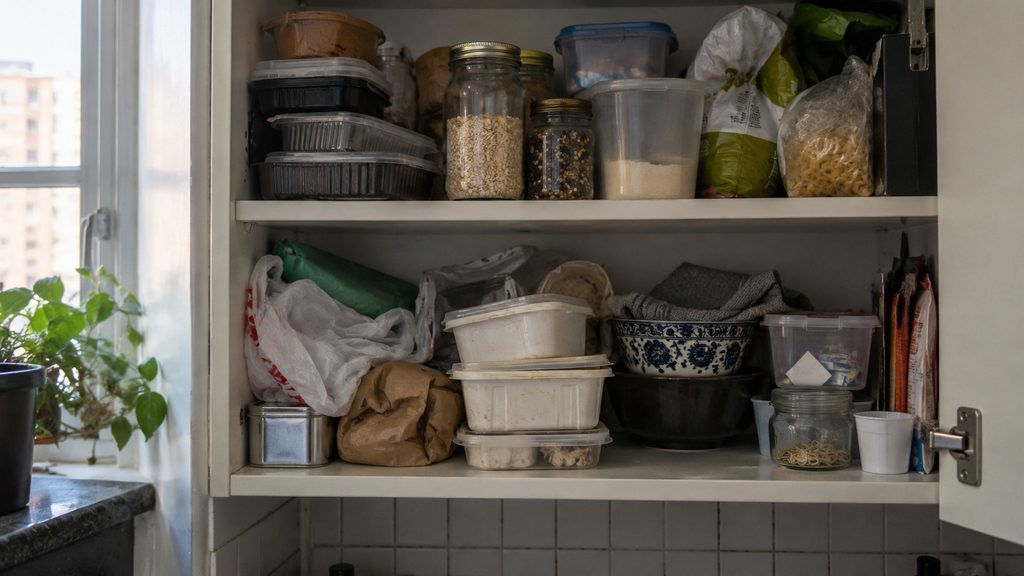
In Ritesh’s apartment in Bangalore, it is not quite the famous junk drawer. It is a kitchen cabinet. Plastic bags go there, along with containers that arrived with takeaway food, packaging from deliveries and all those small objects that are not useful today but might, under circumstances nobody can yet describe, become useful tomorrow.
“There might be some use in future,” Ritesh said.
That sentence could probably justify half the contents of cupboards, sheds, garages and spare rooms around the world.
Ismar does not have such a place. At least, not officially. If he went carefully through his apartment in Campo Grande, he admitted, he would probably find old clothes he no longer wears. But there is no designated territory for the unnecessary. His home is sparse enough that he does not own a television because he does not watch one, nor a conventional sofa. In six years, he reckons, perhaps three people have visited him.
He does have enough chairs.
“More than people that have visited me in six years,” he pointed out.
So already the mystery was becoming more complicated. One of us keeps containers because they might become useful. Another owns almost nothing he does not need. And yet both grew up in households where throwing something away was very different from what it is today.
Before recycling had a name.
When something broke in Ismar’s childhood home, his father repaired it.
A table leg, a chair, a saddle: these were not automatically objects at the end of their lives. His father could work with the leather from cowhide and make or repair the equipment needed around a farm. He could deal with problems on a tractor. Ismar remembers him as someone who had learned from the environment around him, probably by watching other people and then doing the work himself.
Ritesh recognised the same world immediately.
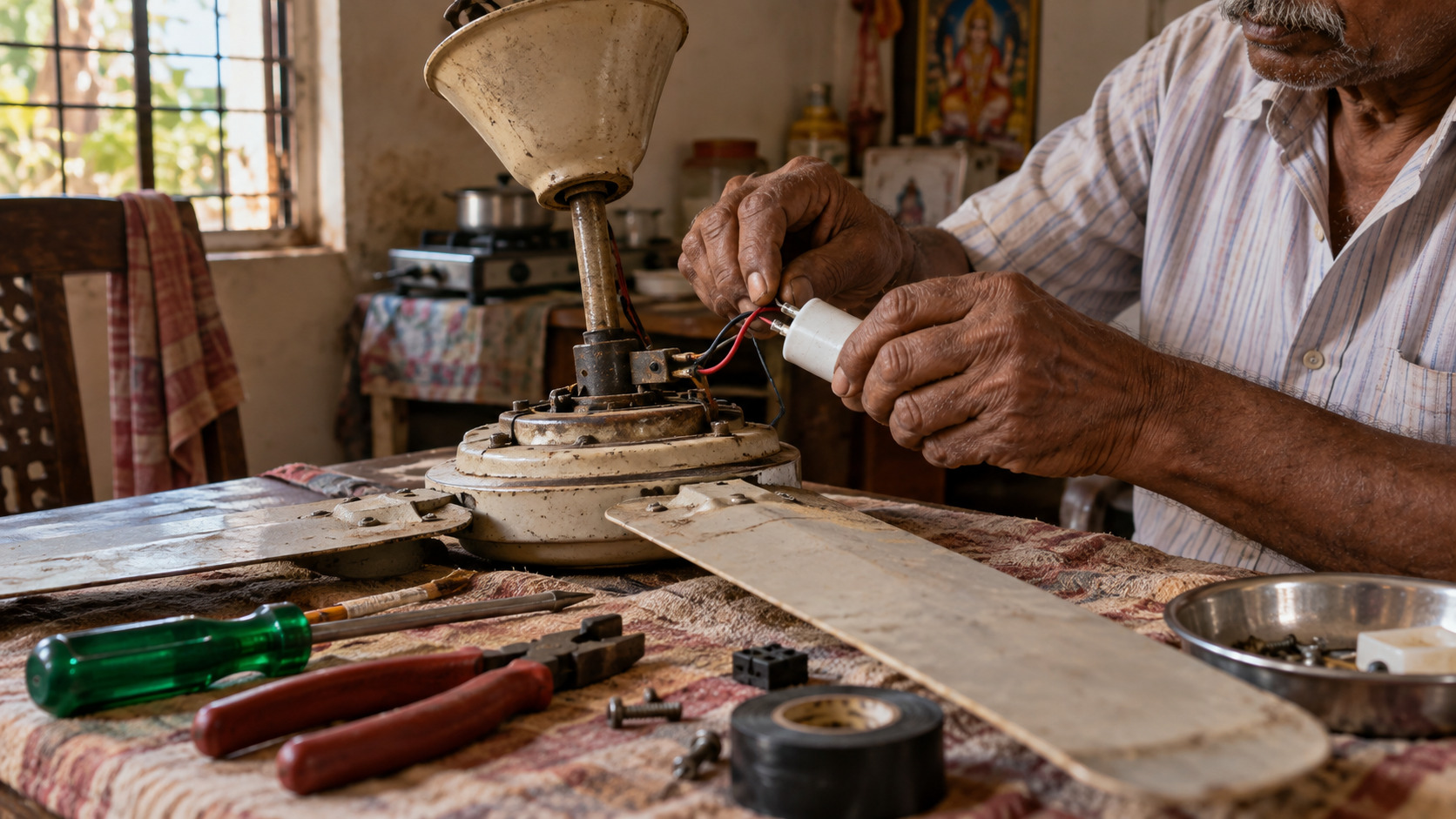
Growing up in India, he remembers his father and uncle repairing almost everything themselves. Calling someone from outside was not the automatic response. Machinery, tractors and ordinary household problems were dealt with at home when possible. Specialist help existed, but it belonged to the problems that really required it.
The interesting part, to Ritesh, is that the men doing all this had not necessarily been formally trained. They learned because something needed to be done.
He remembers the same attitude towards driving. When a tractor arrived, nobody first disappeared to a driving school. They began in the field, practised and learned. Later, when a car entered the picture, a licence became necessary, but learning still began with doing.
Ritesh sees a difference in himself. In his professional life, he researches first. He learns about a subject and then begins. The previous generation, as he remembers it, often began because there was no alternative.
Some of that knowledge nevertheless travelled with him to Bangalore. When a ceiling fan slows down, for example, he knows that the problem may be a component that can be replaced. He has watched other people call an electrician for work that he remembers being done at home.
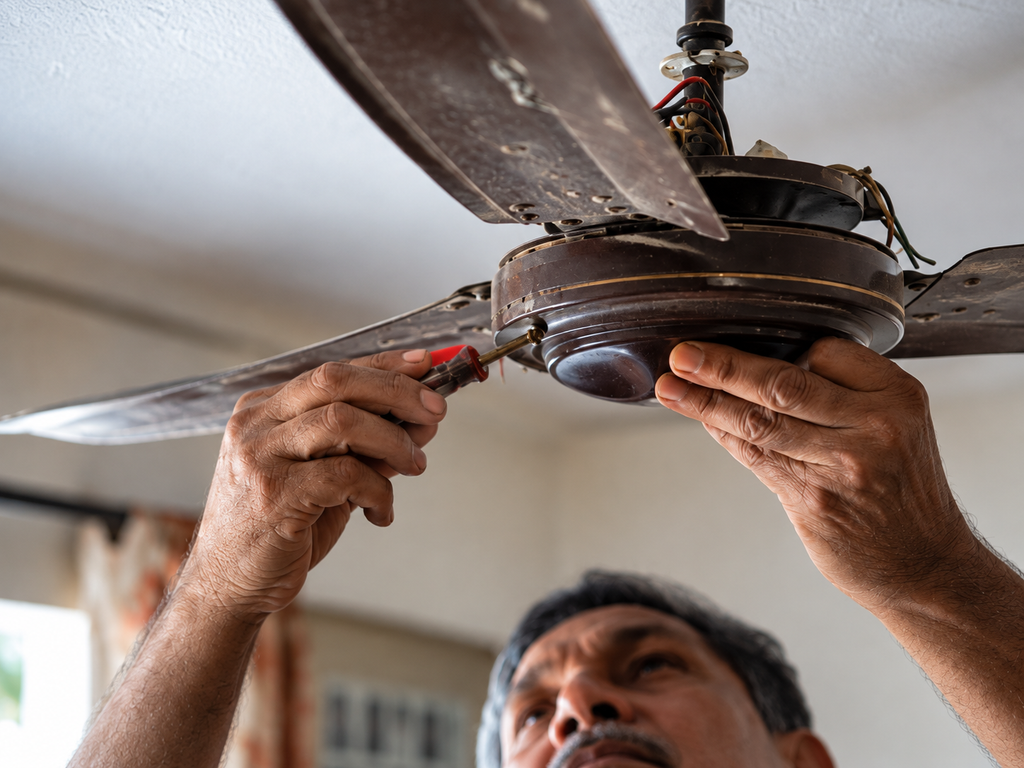
For him, this is not simply nostalgia. He wonders whether convenience has weakened the curiosity to ask what has actually gone wrong.
Ismar has encountered the other side of the same change. He once paid roughly half the price of a replacement phone to have his old one repaired. The repair did not last, and eventually he bought another phone anyway. Now his stereo system will no longer play the CDs he likes. He would repair it if he could, but he has struggled to find somebody who will do the work.
The desire to repair has survived. The machinery around that desire has changed.
And perhaps that explains some of the things we keep. A broken object once represented materials, parts and possibilities. Today it can become an awkward object caught between two worlds: too sophisticated for us to repair ourselves, too cheap to justify professional repair, yet somehow too valuable to throw away without hesitation.
When necessity becomes habit.
Ritesh’s childhood gives the phrase “recycling” a rather grand modern sound.
Clothes did not necessarily finish their lives when their first owner outgrew them. Ritesh was the oldest child, so usable clothes could pass down to younger children. When a piece of clothing finally became too worn to wear, it could become a cloth for cleaning the house.
Things moved from one purpose to another.
Fertiliser arrived on the farm in plastic sacks. The sacks themselves could then be stitched together to make something large enough to sit on in the field. Threads removed from them could become rope. That rope could be used around animals or woven into the traditional cot used at home.
Nothing in this required a sustainability campaign.
“I think this habit got developed because of necessity,” Ritesh said.
Money mattered. If something could still be used, using it meant not having to buy something else. But once repeated often enough, necessity became habit. Keeping, repairing and repurposing became normal behaviour rather than an environmental statement.
Some traces remain. At his family home there is still a room into which old things disappear. Ritesh describes needing a torch to investigate it properly. Broken shoes may be there even when nobody could reasonably wear them again.
That is where he draws a distinction. Reuse makes sense to him. Keeping something that cannot realistically be used does not.
Yet the line between those two categories is strangely difficult to locate.
His mother may see one more possible life in an object. Ritesh may see rubbish.
Neither judgement is really about the object itself. It is about what each person has learned an object might still become.
The luxury of throwing something away.
The conversation eventually moved from what we keep to the systems waiting for us when we finally decide not to keep it.
At the Mayor’s home, throwing something away can involve deciding whether it belongs with recycling, food waste or general waste. Even the recycling bin had recently been inspected before collection, with a marker left behind to show that the household was sorting correctly. Larger unwanted objects involve another journey and another sequence of categories.
Ismar’s experience in Campo Grande is very different. He separates recyclable material himself and takes it elsewhere because, as he described it, his apartment complex still does not have the recycling system he believes it should have. He sees recyclable material mixed with ordinary rubbish and contrasts that with more organised collection he has experienced elsewhere in Brazil.
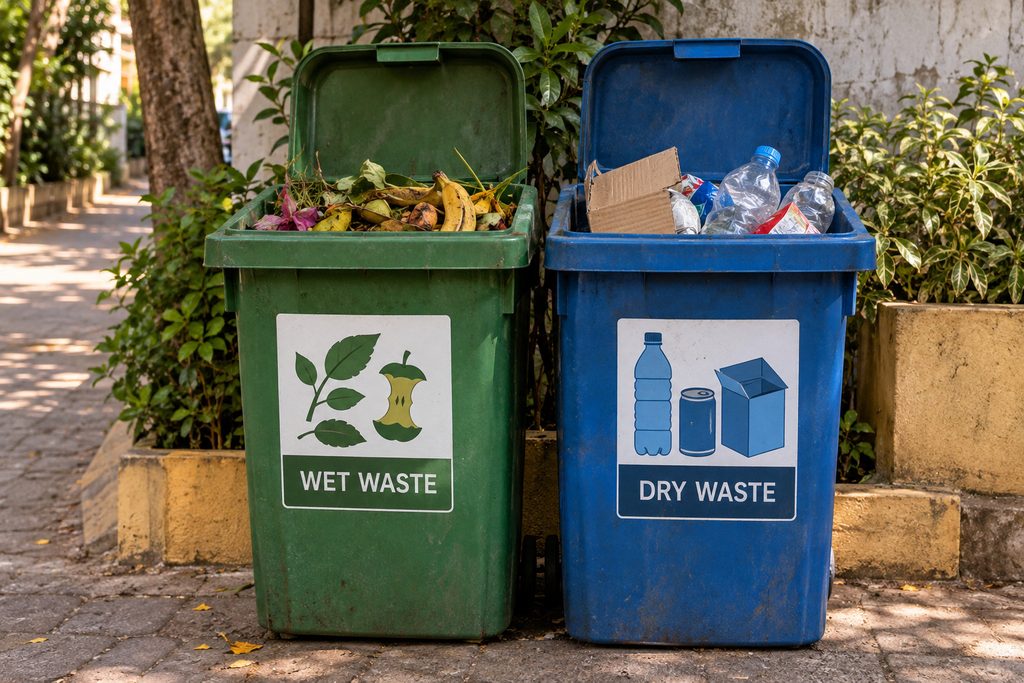
Ritesh described another mixture of systems. In Bangalore, he separates wet and dry waste and sees organised collection around him, although practices vary. Back in his native area, food leftovers may go to animals, while other rubbish may be dealt with very differently. What looks like one national problem from a distance becomes many local realities when seen from the ground.
Perhaps throwing things away is partly a privilege of infrastructure. It is easier to decide that something has reached the end of its life when there is a reliable place for it to go.
Without that, the old instinct returns: keep it. Burn it. Feed it to an animal. Turn it into something else. Put it in the room and decide later.
Living as if you might leave.
Then another explanation for accumulation appeared almost accidentally.
Ritesh and his wife have been building their Bangalore apartment slowly. They have a mattress but have not bought a bed frame. They have chairs but not yet a table. A sofa that could also become a guest bed may come later.
For the moment, they are comfortable.
The apartment feels spacious precisely because it is not full.
Money was part of the original decision, but something else matters too.
“This is not our home,” Ritesh said, meaning not the permanent home they intend to build around themselves over a lifetime. Tomorrow, circumstances may change. They may move. So before buying something, they ask whether they actually need it rather than whether it would make the apartment look more impressive to somebody visiting for a few hours.
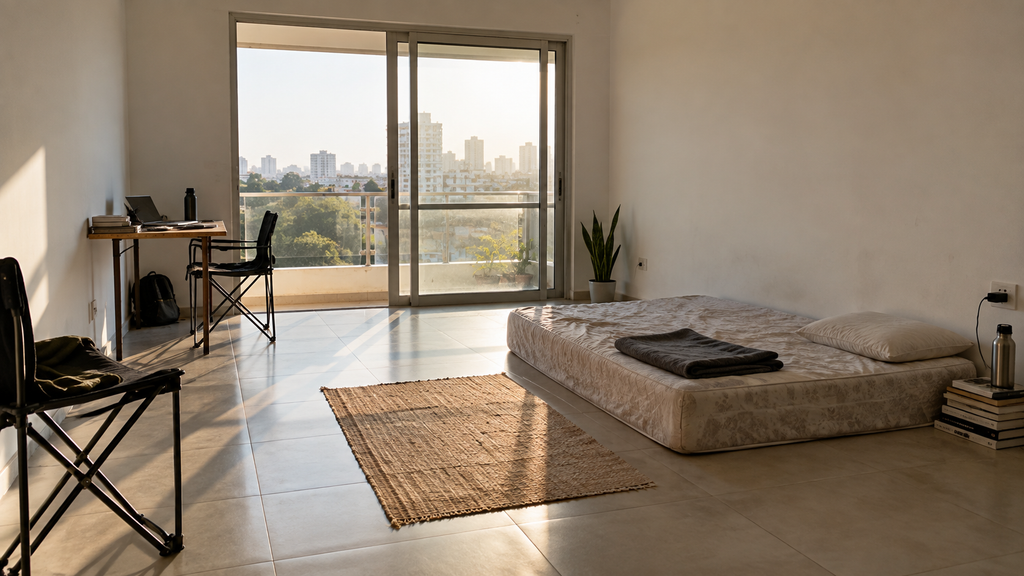
Ismar arrived at much the same place through a completely different life.
He has repeatedly moved somewhere expecting the stay to be temporary. He went to Manaus expecting two years and stayed nine. He went to São Paulo expecting two years and stayed sixteen. He expected five years in Curitiba and stayed twelve.
His supposedly temporary homes have a habit of lasting.
Yet the temporary feeling remains.
“I try not to accumulate things,” he said, before immediately correcting the picture a little. He knows he still owns things he could live without.
That may be the most interesting answer to the original mystery.
We keep things because the future is uncertain. Ritesh’s family kept a broken part because one day it might fit another machine. His mother keeps shoes because perhaps an object does not feel completely finished merely because its present purpose is gone.
But uncertainty can work in the opposite direction too. Ritesh and his wife do not want to fill a temporary apartment with possessions they may later have to move. Ismar has spent decades arriving in cities without knowing how long they will remain his home, so accumulation makes little sense.
One kind of uncertainty says: keep it, because you may need it later.
The other says: do not buy it, because you may have to carry it later.
And then there were the Mayor’s three phones.
One works perfectly well, although he does not particularly like it. One is old, cracked and held together by its cover, but still serves occasionally as a small tablet. The third no longer works at all.
Ismar’s solution was admirably clean: remove the personal information, recycle what no longer works and keep the functioning phone.
Ritesh approached the same small mountain of technology differently. Repair what can reasonably be repaired. Use what still meets the need. Trade in or sell what has value. Even a dead phone may contain parts useful to somebody repairing another one.
The Mayor, meanwhile, still had three phones sitting in front of him.
Which may be why the mystery survives.
Sometimes we keep things because we remember a time when objects were difficult to replace. Sometimes because our parents taught us that waste was foolish. Sometimes because an old container, cable, shirt or telephone still appears to have one final useful life hidden inside it.
And sometimes, apparently, we simply put it somewhere and promise ourselves that the decision can wait.