

The Trouble with Being Polite.
From German handshakes and French formalities to South African aunties and an imaginary royal emergency, the Lunch table discovers that good manners are not always as simple as they seem.
By Monica in Adelaide, Australia, Nathalie in Accra, Ghana, Fruitloop (Janita) in South Africa and The Mayor, Uncle Frank (Frank) in Cleebourg, France. Rosii in Sao Paulo, Brazil sent her apologies.
What makes someone polite? Is it a friendly smile, a warm greeting, a firm handshake, or simply knowing when to say excuse me? And if you travel to another country, do the same rules still apply?
That was the question waiting for everyone at Lunch this week, where Fruitloop, the Mayor, Nathalie and Monica gathered from different corners of the world to explore the strange and sometimes confusing rules of politeness.
It sounded like a perfectly respectable conversation. Naturally, it wasn’t long before the Mayor was being threatened with the title Uncle Frank, someone was refusing to board a homemade aeroplane, and a king was in danger of having his dinner interrupted by an urgent visit to the toilet.
But underneath the laughter was a surprisingly interesting question. Who actually decides what is polite, and what happens when the manners we were taught no longer fit the world around us?
A Smile Is Not Always the Answer.
Fruitloop began with something simple. When we meet somebody for the first time, what makes us think they are polite?
Nathalie, who had recently moved to Ghana after living in Asia, offered an interesting perspective. She explained that we often judge politeness according to our own upbringing. When somebody behaves in a familiar way, we recognise that behaviour as polite. But familiar does not necessarily mean correct, and our personal expectations are not universal rules.
Different countries, cultures and generations have different ideas about good manners. What feels respectful to one person might seem strange, distant or even rude to another.
Nathalie had already noticed some interesting differences while shopping in Accra. She described seeing people dancing while working in shops, something that had surprised her after her experiences in Asia. She had also noticed different attitudes towards resting during quieter moments at work.
The Mayor immediately announced that he might try dancing while waiting at the supermarket checkout.
He suspected somebody might lock him up.
Yet Nathalie’s observations raised another question. She had encountered people who did not smile or greet customers as warmly as she might have expected, but she still considered them polite and well-behaved.
For the Mayor, a smile, eye contact and genuine warmth were important parts of a first impression. He spoke about the feeling of being comfortable with somebody, even when you hardly know them. He also recognised that these impressions come from our own experiences and values.
Fruitloop brought the discussion closer to everyday life in South Africa. At school, when collecting her son, she often encounters parents who politely ask to pass if somebody is standing in their way. In a supermarket, however, someone might accidentally bump into you and then look at you as though you were responsible for the collision.
And traffic, she suggested, was an entirely different story.
The Mayor knew exactly what she meant. He recalled driving to a busy restaurant on a beautiful Sunday when two women were standing in the middle of a roundabout, apparently enjoying a conversation while vehicles tried to navigate around them.
He sounded his horn.
The women, according to his account, were not particularly impressed.
From their perspective, perhaps he had interrupted a perfectly pleasant conversation. From his, they were standing in the middle of a road full of cars, motorbikes and buses.
Sometimes, he suggested, you have to be impolite.
Nathalie added another possibility. Perhaps our behaviour depends just as much on our mood as on our manners. The same person might respond kindly one day and impatiently the next, even in exactly the same situation.
The Mayor readily admitted that he had occasionally been so rude that his wife had preferred to distance herself from him.
Good manners, it seemed, could disappear remarkably quickly when somebody was having a bad day.
The Complicated Business of Saying Hello.
The conversation soon travelled to Germany, where Monica had noticed a greeting tradition that still surprised her.
People shake hands. Not necessarily because they are meeting for the first time or conducting business, but because that is simply how they greet one another.
Coming from Australia, Monica found the formality unusual, especially among people who already knew each other well.
The Mayor remembered something rather different from his Scottish country dancing days. He had spent about two years learning the dances in preparation for a wedding in Scotland. After one Christmas break, the first class of the new year became an enormous greeting ceremony.
Around twenty people had not seen each other for several weeks. Naturally, everybody needed to kiss, greet and catch up with everybody else.
The process took approximately half an hour.
Their German dance teacher, who was waiting to begin the lesson, was apparently less enthusiastic about the extended social occasion.
One person’s friendly reunion was another person’s lost dancing time.
But greetings were not merely a question of handshakes and kisses. Nathalie remembered being expected, as a child, to kiss adults she hardly knew because her parents considered it polite.
Monica had similar memories. Adults would hug and kiss children whether the children wanted it or not. She particularly remembered an older relative who tickled her, something she strongly disliked.
Today, Monica approaches children differently. Rather than automatically hugging them, she gives them space and allows them to decide whether they want that physical affection.
Fruitloop recognised the same change in herself. As a child, she was expected to greet adults with kisses and hugs, including people she was meeting for the first time. These days, she prefers to stand back, offer a friendly greeting or shake hands.
The Mayor suddenly realised that meeting Fruitloop in person might require careful preparation.
What exactly was he supposed to do?
Fruitloop offered a practical solution.
“I think a handshake is safe.”
The Mayor was relieved. At least he now knew the rules.
You, “Vous”, “Du”, and the Dangerous Uncle Frank.
If greetings were complicated, the words used to address people were even more interesting.
In French and German, choosing between formal and informal ways of saying you can carry considerable social meaning.
Nathalie explained that she had grown up using the formal French “vous” when addressing strangers and older people. It was a sign of respect, something taught through childhood and reinforced by education.
Yet within some international expatriate communities, she had discovered almost the opposite expectation. Using “vous” could make people uncomfortable because it created a sense of distance.
She recalled meeting a Swedish woman and addressing her formally in French. The woman jokingly suggested that “vous” was something to reserve for royalty.
Nathalie enjoyed that idea so much that she was tempted to adopt it herself.
The Mayor had his own complicated history with the German “du” and “Sie”.
He remembered once suggesting to a younger professional acquaintance that they could use the informal “du” with each other. She preferred to remain with the formal “Sie”.
He found the refusal surprisingly painful. To him, the informal form had been an invitation to a more comfortable relationship. To her, maintaining formality was evidently preferable.
Monica had noticed that German communication was becoming more casual in some situations. Hotels had begun addressing her informally, even when she was a complete stranger. Yet she still used the formal form with relatives by marriage whom she had known for decades.
The Mayor admitted that his own preferences were changing with age. Where he might once have welcomed casual familiarity, he now sometimes preferred the respect he associated with a more formal greeting.
Then Fruitloop introduced the South African solution.
In Afrikaans, she explained, younger people often address older adults as “Oom” and “Tannie”, meaning uncle and aunt, even when they are not related.
So, technically, the Mayor could become Uncle Frank.
This suggestion was not warmly received.
The Mayor made it very clear that Fruitloop should think carefully before ever addressing him that way again.
Unfortunately for him, Fruitloop rather liked it.
“It has a nice ring to it. Uncle Frank.”
Monica was amused too, and the possibility of Uncle Mayor was soon floating around the table.
The Mayor’s dignity was under serious threat.
Meanwhile, Nathalie had discovered another interesting form of address in Ghana, where people sometimes called her Mommy, despite her not having children.
Fruitloop recognised the practice from South Africa, where she had also heard older women or mothers addressed that way. Neither was entirely certain of its origins, but both recognised it as part of the social language they had encountered.
By this stage, the table had travelled through several countries without leaving its chairs, and the simple English word “you” was beginning to look wonderfully uncomplicated.

When Being Honest Feels Impolite.
Fruitloop then presented a situation almost everybody could recognise.
Someone invites you to dinner, but you really do not want to go. Is it more polite to tell the truth or invent a beautiful excuse?
Nathalie preferred honesty, although she admitted it was not always easy.
She and her husband do not particularly enjoy large evening gatherings, especially when they involve many people they do not know. Sometimes they accept invitations out of politeness, even though the occasion is not something they are looking forward to.
They have also tried explaining their preferences honestly, but that can be delicate. Some people understand. Others may feel rejected.
Monica admired Nathalie’s approach. If somebody told her they disliked large evening gatherings, she would happily suggest lunch or another arrangement instead.
For her, honesty was not necessarily an insult. It could simply help two people find a better way to spend time together.
But then Monica remembered a situation where telling the truth was considerably more difficult.
A friend had built his own four-seater aeroplane and had repeatedly invited her to go flying.
Monica had repeatedly found reasons not to go.
The problem was not that she disliked her friend. She simply had no intention of climbing into his homemade aircraft.
“I’ve still got a lot of living I want to do,” she explained.
Her friend, unfortunately, was persistent.
The Mayor immediately offered an ingenious solution. Perhaps The Pineapple could publish the story, Monica could send the article to her friend, and he could discover her true feelings without her having to say them directly.
If he became offended, they could blame the media.
The Mayor was particularly pleased with this arrangement because, as publisher, he could distance himself from the editorial decision and leave Fruitloop to deal with the consequences.
Fruitloop had somehow become responsible for international diplomacy involving a homemade aeroplane.
It was turning into quite a morning.
The Mayor admitted that he generally relied on the familiar excuse of being busy, although even that did not always work. He recalled an encounter in a fashionable German restaurant where a woman questioned why she had never seen him there before. When he explained that he was usually busy, she promptly informed him that her son was also very busy but still found time to visit.
Some people, it seemed, were remarkably difficult to discourage.
The Invitations That Never Arrive.
The conversation about invitations led Fruitloop to a rather different experience.
She mentioned that she had not been invited to her cousin’s wedding, although several other members of her family had received invitations.
She did not know why.
At first, she had wondered whether her invitation might still arrive. But as time passed and other relatives began discussing the wedding, it became clear that she had not received one.
The Mayor was astonished. Monica tried to find a practical advantage: at least Fruitloop would not have to buy a wedding outfit.
Fruitloop agreed that she had saved herself the expense of a dress.
Nathalie wondered whether there might have been a postal problem. She remembered invitations in her own family that had never reached their destinations.
But Fruitloop explained that the invitations had been sent digitally through WhatsApp.
So the mystery remained.
Monica recalled similar experiences of being left out of family celebrations. She had learned to take such things in her stride, although the conversation made clear that an invitation can mean more than simply a place at a table.
Being included matters. So does knowing where one stands.
Fruitloop did not claim to know why the decision had been made, and the table could offer no answer. The discussion eventually returned to humour, as it so often does at Lunch.
After all, there was still one very important question waiting.
And this one involved royalty.
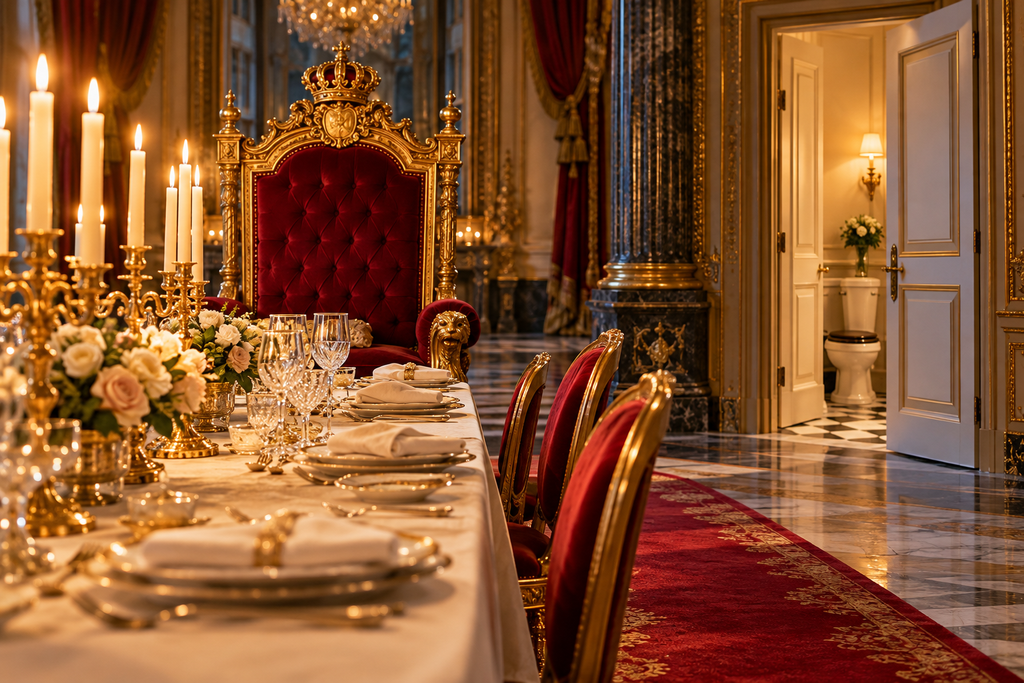
Excuse Me, Your Majesty, but I Really Must Go.
Fruitloop’s final question was gloriously ridiculous.
Imagine you are having dinner with a king. Unfortunately, you desperately need the toilet, and His Majesty is telling the longest story in the history of royal dining.
Do you interrupt him, quietly disappear, or risk an international incident?
Monica immediately wanted to know which king they were talking about.
Apparently, that made a difference.
The conversation briefly wandered into royal families, republics and Monica’s memories of seeing public expressions of respect for a monarch in Norway.
The Mayor then transported Nathalie to an imaginary banquet at Versailles, where a French king was delivering a magnificent speech and nature was making increasingly urgent demands.
Nathalie approached the problem diplomatically.
She thought modern monarchs might be more understanding about an unavoidable interruption than kings of earlier centuries. Nevertheless, she would try to find somebody to take her place in the conversation so that the king would not suddenly be left alone.
Even in a fictional royal emergency, Nathalie was thinking about good manners.
The Mayor had a different plan.
He would arrange to sit beside Dame Edna Everage, the famous Australian comic character created by Barry Humphries. Dame Edna, he felt certain, would understand the situation and smoothly rescue the conversation while he made his escape.
No diplomatic incident necessary.
Finally, Fruitloop gave her answer.
If the dinner involved many guests, she would quietly disappear without interrupting the king. But if it were just the two of them, she would simply explain that she needed to leave for a moment.
“Hold your story.”
And then, with the perfect dramatic timing of a woman who had spent the morning discussing manners across continents, she added:
“I’ll be back.”
The table immediately recognised Arnold Schwarzenegger’s famous line from The Terminator.
The Mayor wondered whether that was a promise or a threat.
Fruitloop assured him it was a promise, although she admitted that it might depend on what happened in the bathroom.
And with that, royal protocol had officially surrendered to Fruitloop.
Perhaps the Rules Are Still Being Written.
By the end of Lunch, nobody had produced a universal rulebook for politeness.
Nathalie had shown how much our expectations depend on culture and upbringing. Monica had reminded everyone that old customs, especially around personal space, can change for good reasons. Fruitloop had brought the conversation back to everyday encounters, where a simple apology or a thoughtful greeting can make a difference. And the Mayor had demonstrated that even a person who values good manners can become wonderfully impatient in a roundabout.
There were contradictions everywhere. A formal greeting could express respect or create distance. An honest refusal could be considerate or hurtful. A hug could feel welcoming to one person and uncomfortable to another.
Perhaps that is why the unwritten rules are so difficult. We learn them long before we begin questioning them, and then spend much of our lives discovering that other people learned something different.
The Lunch table did not settle those differences, but it certainly enjoyed exploring them.
And should Fruitloop and the Mayor finally meet face-to-face, at least one international protocol has already been agreed upon.
A handshake will do.
Whether Uncle Frank can survive the occasion remains another question entirely.