
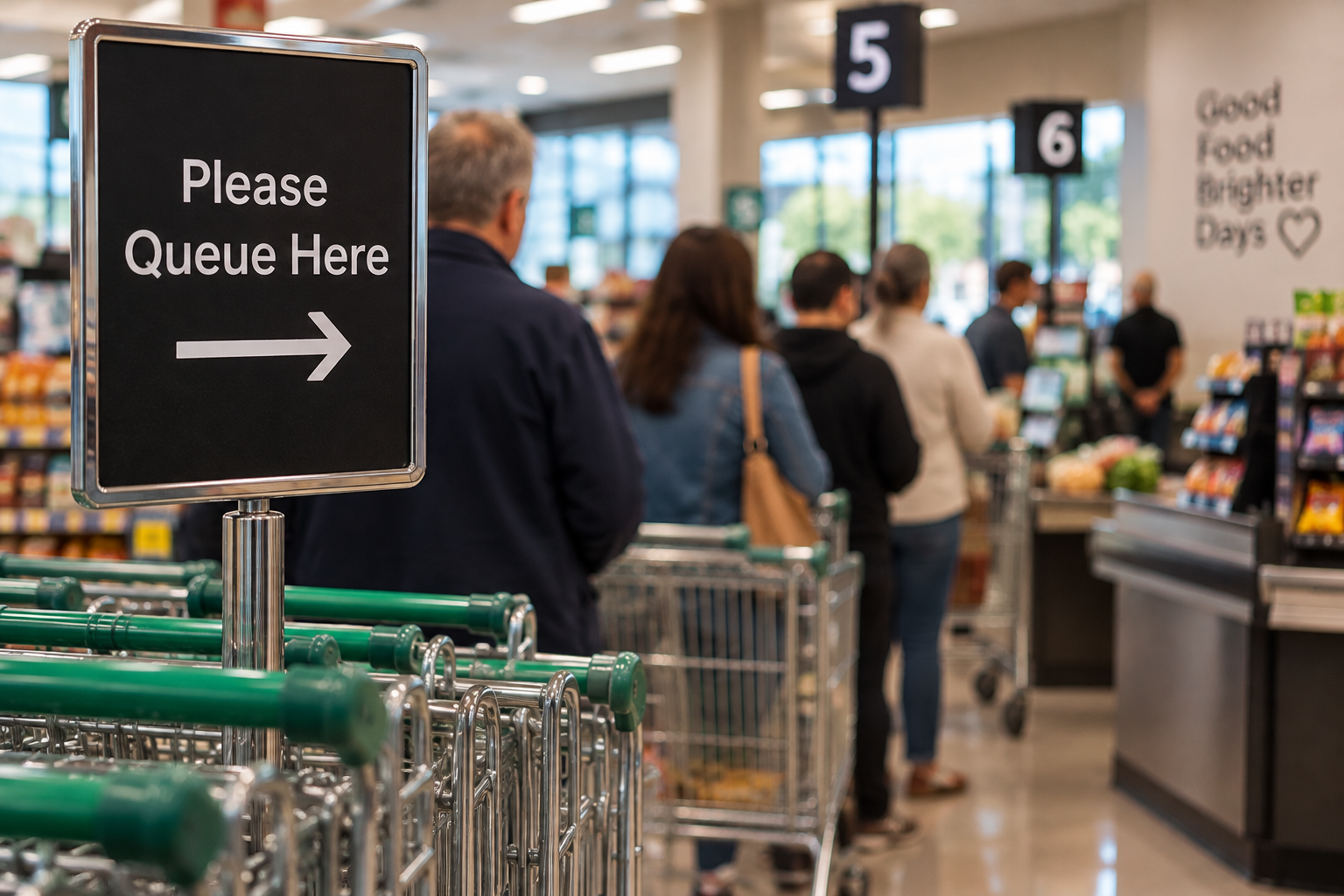
The Queue Is Never Just a Queue.
By Ritesh in Bangalore, Ismar in Campo Grande, Brazil.
From supermarket trolleys in Brazil to temple lines in India and government offices in South Africa, waiting reveals something surprisingly human: our rules matter most when we are tempted to break them.
By Atlantic Corridor
A queue looks simple. One person stands behind another. Everybody waits their turn. Eventually, everybody gets where they are going.
Yet put that same queue in a supermarket, a bus station, an airport or a traffic jam, and suddenly it becomes a small experiment in human behaviour.
For Ismar in Brazil, a queue is “something boring,” but also something necessary and civilised. He would rather wait in an orderly line than become part of a disorganised crowd.
For Ritesh in India, the word that comes first is order. A queue means sequence, rules and enough patience to accept that your turn will come.
And in South Africa, Janita sees much the same thing. At supermarkets, pharmacies, cinemas and schools, people generally understand the system. They wait.
Until, of course, somebody decides not to.
Choosing the line.
Perhaps nowhere do we become more amateur mathematicians than at the supermarket checkout.
Imagine two queues. One has four people. The other has six.
Which do you choose?
Ismar immediately looks beyond the numbers. How many items are in the trolleys? Who is standing there? Six people carrying only a few things might move faster than four people with heavily loaded carts.
Ritesh makes the same calculations in Bangalore. A trolley piled high can mean 15 or 20 minutes at the till. Someone holding only a few items may disappear quickly. Then there are families with children, because the contents of a trolley are not necessarily final until the transaction is actually over.
You study the evidence. You make your decision.
And then Murphy’s Law arrives.
Ismar has learned not to change queues unless the difference is substantial. The moment you abandon your line, the one you left seems to accelerate.
Ritesh knows the feeling from the Bangalore Metro. You spot another line with fewer people and move towards it. Before you reach it, several other people have had exactly the same brilliant idea.
Now you are behind them.
The great queue mystery has struck again.
There are other ways to pass the time. Ismar reads on his phone, but supermarket queues offer another entertainment: studying what other people are buying. He notices the large bottles of soft drink, the packets of snacks and the things he considers a waste of money.
Ritesh used to watch people too. These days, he says, that can feel awkward, so out comes the phone: news, X, Instagram, scrolling.
The queue has not disappeared. We have simply found somewhere else to look while standing in it.
When the rules stop working.
The conversation travelled easily between Brazil, India and South Africa because each country seemed to have its own version of the same contradiction: people generally understand queues perfectly well, yet certain places make the rules strangely fragile.
In Brazil, Ismar finds queues at supermarkets and banks reasonably orderly. Getting onto a bus can be different. Someone sees an opportunity to enter first, takes the shortcut, and the line begins losing its meaning. Concert entrances can become sufficiently chaotic that he prefers to avoid them.
In Bangalore, Ritesh sees another version in the daily rush around public transport. People squeeze forward, jump lines and compete to get ahead. Yet at security checkpoints in shopping malls, behaviour changes. There is a clear process, staff control the entrance, and suddenly everybody becomes attentive.
South Africa has its own queue geography. Janita says ordinary queues generally work. Government departments can be another matter.
At Home Affairs, she once went through the expected process to collect an official marriage certificate: paperwork, payment, a number, then waiting for that number to be called. Except the system did not quite follow itself. The official who had helped her earlier simply called her over when the certificate was ready.
A visit that might have taken an hour or two was finished in about 20 minutes.
There was a queue. There was a number. There was a system.
And then somebody used common sense.
Perhaps that is part of the mystery. Sometimes breaking the apparent sequence makes things worse. Sometimes it makes things work.
The person who needs to go first.
Ritesh discovered the difference at an airport.
After a death in his family, he needed to travel home. In the rush to book a flight, he realised only after paying that departure was frighteningly close. The airport was about 45 kilometres away.
He and his wife took a taxi and raced there. At the airport there was a large queue.
This time Ritesh became the person trying to get ahead.
But he did not simply push through. He explained. Again and again, he told people that his flight was about to leave and asked if they would let him pass.
They did.
By the time they reached the gate, the frantic running turned out to have been unnecessary. The flight was delayed.
But something from that experience remained with him.
He is still annoyed by people who simply cut a line. Everybody has somewhere to go; everybody has priorities. Yet now, when he sees someone rushing for a lift or trying desperately to catch the Metro, he allows for another possibility.
“There might be some genuine reason.”
The difference, for him, is courtesy.
Ask.
Explain.
Give the other people in the queue the opportunity to make room for you.
That turns jumping the queue into something else entirely: strangers briefly agreeing that somebody else’s need matters more than their place in the sequence.
When being right is not worth it.
Ismar learned a different lesson.
Until he was about 30, he says, if somebody took his place in a queue he would complain. Then, while waiting at a transport department to update his car documents, a bigger man behind him managed to get his paperwork processed first.
Ismar objected.
An argument followed until the cashier warned them to stop or security would be called.
Not long afterwards, Ismar remembers hearing a television report about an argument in an ATM queue in Rio de Janeiro that ended in a killing.
That changed his calculation.
Today, if someone pushes ahead, Ismar may tell them, “The end of the queue is there.”
If they insist, he leaves it.
“It’s not me that will teach people to respect one another,” he says.
For somebody who believes queues are part of civilised behaviour, this is not approval of the person breaking the rule. It is a decision about which rule matters more.
Waiting a few extra minutes is one thing.
Personal safety is another.
Ritesh has reached something close to the same position. Queue-jumping irritates him, but he does not want an argument with somebody who may become aggressive.
The queue, then, has an unwritten rule beneath all the written ones: sometimes surrendering your place is wiser than defending it.
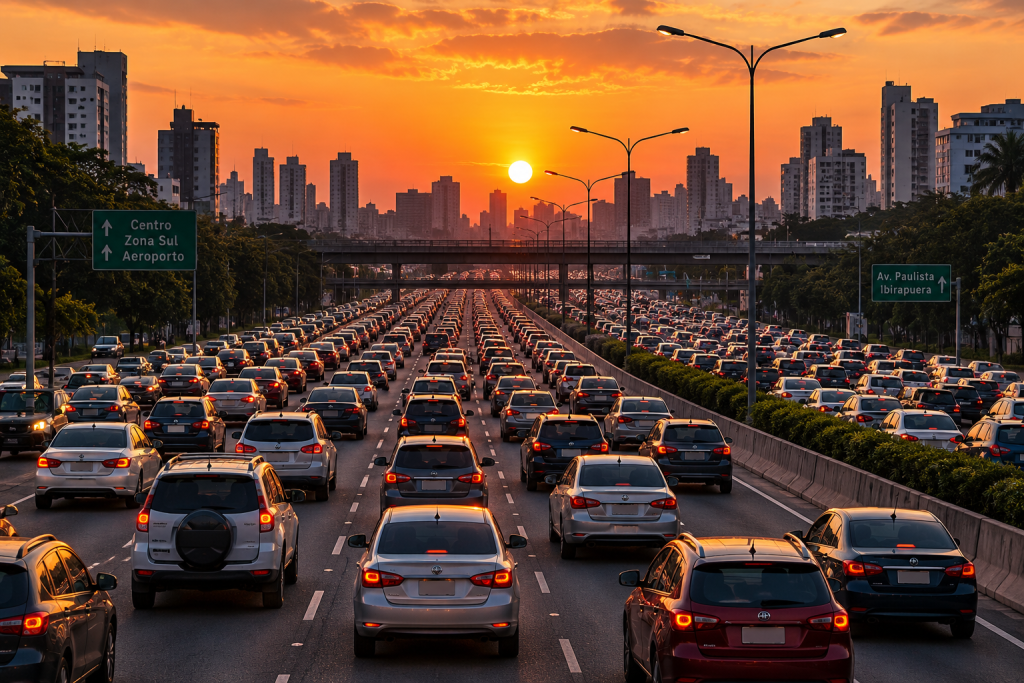
India, Brazil and South Africa in slow motion.
Long waits produce their own stories.
Around New Year’s Eve in the 1990s, Ismar remembers travelling towards the beach with friends and their families. A journey of less than 100 kilometres took about six hours.
On another occasion, a journey of roughly 130 kilometres also stretched to six hours. They had expected the trip to take around an hour and a half, so there was no food or water in the car. By the time traffic finally moved enough for them to reach a restaurant, hunger had become part of the journey.
Ritesh can compete.
On a trip with his wife, they decided to visit a famous temple. The queue looked manageable until they entered it and discovered the zigzags hidden inside. What they expected to take perhaps half an hour or an hour took three. Their plans for the rest of the day disappeared.
At India’s busiest temples, he says, people may simply set aside the entire day.
His more extraordinary wait came after starting a new job in Bangalore. He was still living in his old accommodation while trying to save money before moving closer to work. One evening he left the office around 6.30.
He reached home at 1.30 in the morning.
The distance was only about 16 kilometres.
The following day, he and his friend took leave from work, found somewhere nearer and moved.
South Africa supplied its own version. Janita once set out for work on a journey of about 30 kilometres and encountered a major accident on the freeway. Traffic stopped.
She was supposed to arrive at eight.
She arrived at noon.
Four hours for 30 kilometres.
Across three countries, the details change, but the experience is immediately recognisable. You keep expecting movement. You hesitate to abandon the route because perhaps, in another five minutes, it will start moving again.
Waiting is partly about time. It is also about uncertainty.
The queue you don’t have to stand in.
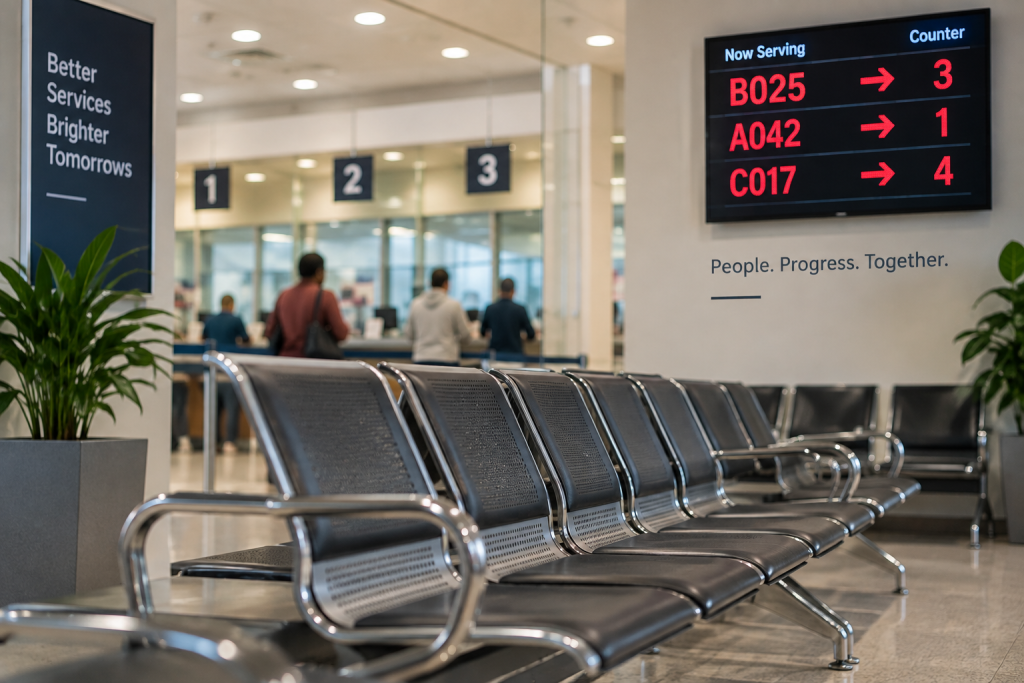
That may explain why all three were attracted to a simple invention: the number.
Take a ticket and suddenly your body no longer has to represent your place.
Ritesh remembers this from college fee payments. Students could receive a token and wait, talk or sit on the stairs until their number came. He sees the same advantage in restaurants and even customer-service calls that tell you where you are in the queue.
Knowing that you are number ten is somehow easier than simply knowing that you are waiting.
South African banks use a similar system. Janita can take a number, sit down and watch a screen rather than physically defend her position in a line. Fast-food restaurants do something similar.
Brazil adds a small technological flourish. Ismar describes restaurants where, after ordering, customers receive a little device. When the food is ready, it vibrates.
No staring at the counter.
No studying the screen.
No wondering whether the person beside you arrived first.
Your turn comes looking for you.
The same principle appears in more consequential places. Ismar describes a recent Brazilian passport renewal as one of his best experiences with public service: a short wait, a few minutes to complete the process and a new passport available within days. Ritesh describes India’s increasingly online passport process, where documents can be submitted beforehand and an appointment slot selected. Janita, meanwhile, contrasts long waits at South Africa’s Home Affairs offices with a far quicker experience when she and her husband applied for identity cards through a participating bank.
Different countries. Different institutions. The improvement is strikingly similar.
A good system removes uncertainty.
The invisible agreement.
A queue is therefore not really a line.
It is an agreement between strangers.
We agree that arriving first should usually mean being served first. We agree that the person behind us will remain behind us, and that we will remain behind the person ahead. We agree that five items really means five items in the express lane, even when another checkout looks painfully slow.
But the agreement also contains exceptions. An elderly person may need help. Someone may genuinely be about to miss a flight. A system may discover that your document is already ready and send you home rather than making you wait simply because the number on your ticket says you should.
The best queues seem to understand both sides.
They create enough order that nobody has to fight for a place, but enough humanity that the order does not become absurd.
Perhaps that is why a queue can tell us so much about a place — and about ourselves. In Brazil, India and South Africa, the machinery changes: tickets, chairs, security guards, screens, express tills, vibrating devices, government counters, temple zigzags and traffic stretching towards the horizon.
The mystery underneath is the same.
We are all waiting for our turn.
The interesting part is what we do while we wait.