
Ralf’s Labskaus
Labskaus is one of those dishes that you should probably taste before you judge — although, to be fair, the appearance does not always make this easy.
A Northern German Sailor’s Dish.
Labskaus is an old seafaring dish associated with northern Germany, particularly Hamburg and the coastal regions. Its origins are practical: on long sea voyages, cooks had to rely on ingredients that would keep well, such as preserved beef, potatoes, onions and beetroot. Matjes herring and fried eggs became familiar accompaniments when they were available. There is no single undisputed recipe; even in northern Germany, people argue about whether the fish belongs inside the Labskaus or beside it.
It is also, quite clearly, not a dish for everybody. Everything is mashed together into a pinkish-red mixture of potato, beef and beetroot, and that alone can make newcomers suspicious. Add herring and a fried egg and it becomes one of those meals where people tend to have an opinion before the first forkful. Hamburg’s own description of the dish acknowledges that many people react with something close to “Can you really eat that?” — although many of them have never actually tried it. (
I like it.
And this is how I make mine.
Ingredients.
The conversation did not include exact quantities, so I cook this more by feeling than by mathematics.
- Yellow-fleshed, mainly waxy potatoes — I particularly like Annabelle or Belana
- Stock or broth, enough to cook the potatoes
- 1 onion, finely diced
- Corned beef
- 1 Matjes herring fillet
- Plain cooked beetroot — not pickled beetroot
- A little milk, if needed
- Salt and pepper, as needed
To serve
- Matjes or Bismarck herring
- A fried egg
- Extra beetroot
- A pickled gherkin on the side
How I Make It.
1. Start with good potatoes.
I use mainly waxy, yellow-fleshed potatoes. Annabelle is very good, and Belana is another variety I like.
I cook the potatoes in broth, not salted water. This is important for me because the potatoes already take on more flavour while they are cooking.
When they are ready, I drain them, but I do not let them become completely dry. I leave a little of the cooking broth behind because I want some of that flavour in the mash.
2. Don’t make baby food.
I mash the potatoes, but I don’t purée them until they become completely smooth and sticky.
I want some texture.
Labskaus can already look unusual enough. It does not also need to become wallpaper paste.
3. Corned beef, not hours of unnecessary work.
Now we come to one of the great Labskaus discussions.
Some people use beef brisket. I use corned beef.
You can, of course, cook a piece of beef for hours until it falls apart. For me, that is simply too much work. Corned beef also makes sense historically because preserved meat was much easier for sailors to carry on long voyages.
I gently fry the finely diced onion until it becomes translucent. Then I add the corned beef and fry it a little more strongly.
4. Now the controversial fish.
Here comes another argument.
Some people put fish into the Labskaus. Other people absolutely do not.
I do.
I take a proper Matjes herring and chop it extremely finely — almost like a tartare. Then it goes into the mixture.
That is my Labskaus. Nobody is forced to agree with me.
5. Beetroot is essential.
Then I add beetroot.
For me, this is elementary. I really like beetroot, and it belongs in my Labskaus.
But I use normal cooked beetroot, not sour pickled beetroot.
I mix the beetroot, onion, corned beef and finely chopped Matjes into the mashed potatoes until everything comes together and takes on that unmistakable Labskaus colour.
If the mixture becomes too dry, I add a small splash of milk.
Not too much. Just enough.
The Final Plate.
Then my Labskaus is ready.
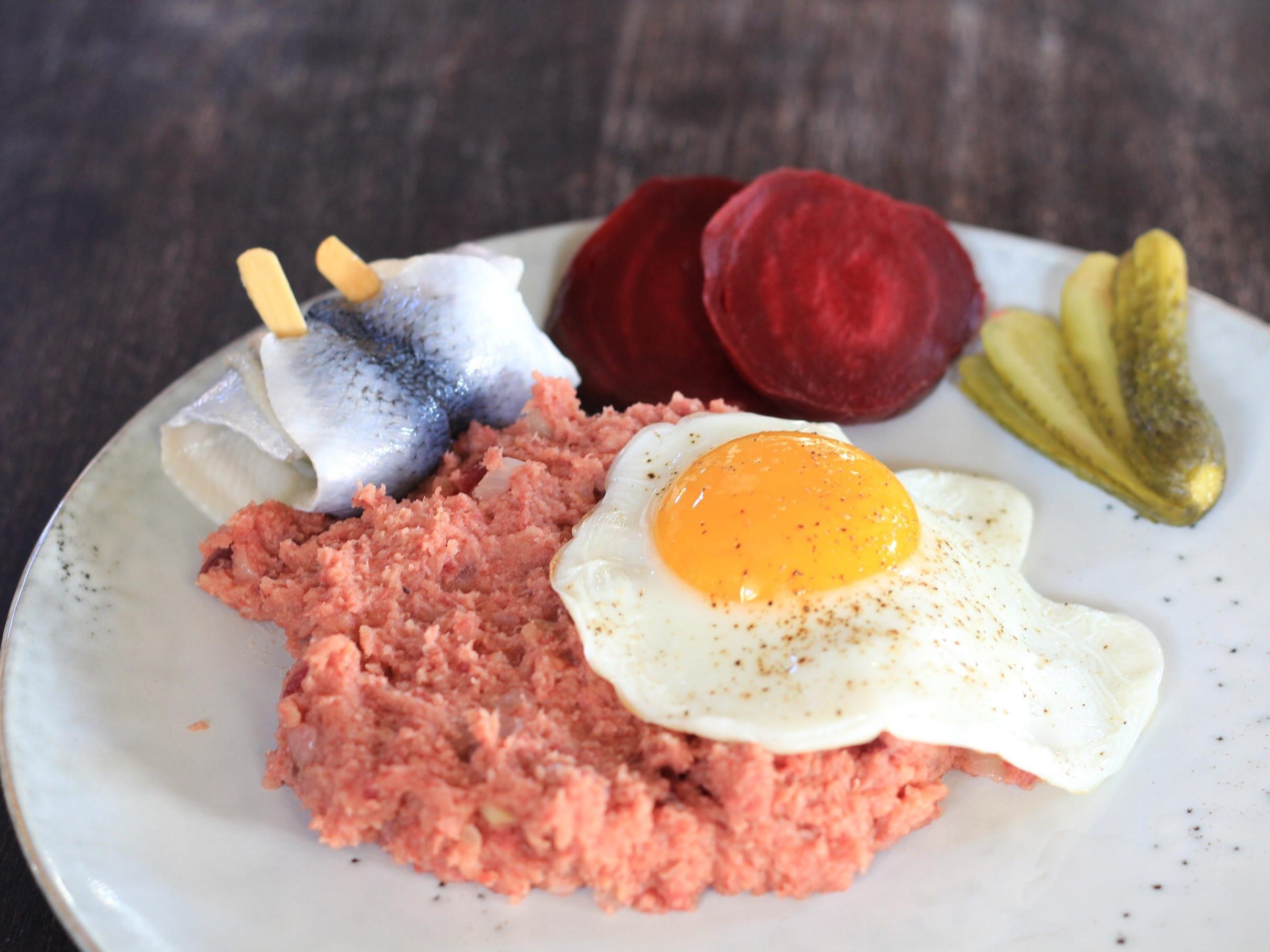
I serve it with Matjes or Bismarck herring, a fried egg and some extra beetroot.
And yes, there can be a pickled gherkin.
But beside it.
I do not put the gherkin into my Labskaus.
That is an important distinction.
Labskaus may look strange. The combination of corned beef, potatoes, beetroot and herring may sound even stranger. It is salty, earthy, rich and very northern German. Some people will love it. Some will take one look at the plate and decide that life has already given them enough challenges.
But if you are curious, try it before you decide.
I certainly would.