Peeling Potatoes (Episode 62): The Questions Hiding in Aisle Seven.
By Fruitloop and The Mayor, and it’s ok if you don’t understand. We don’t either. Or?
At Fruitloop University’s magical supermarket, a dragon, an alien, a mermaid and a nervous garden gnome discover that the difficult part is rarely finding the answer. It is having the nerve to ask the question.
There are supermarkets, and then there is the magical supermarket at Fruitloop University.
Fruitloop University, incidentally, has now been shortened to FLU, which is either a splendid acronym or an unfortunate diagnosis. The Mayor prefers the former. Fruitloop appears perfectly happy with both.
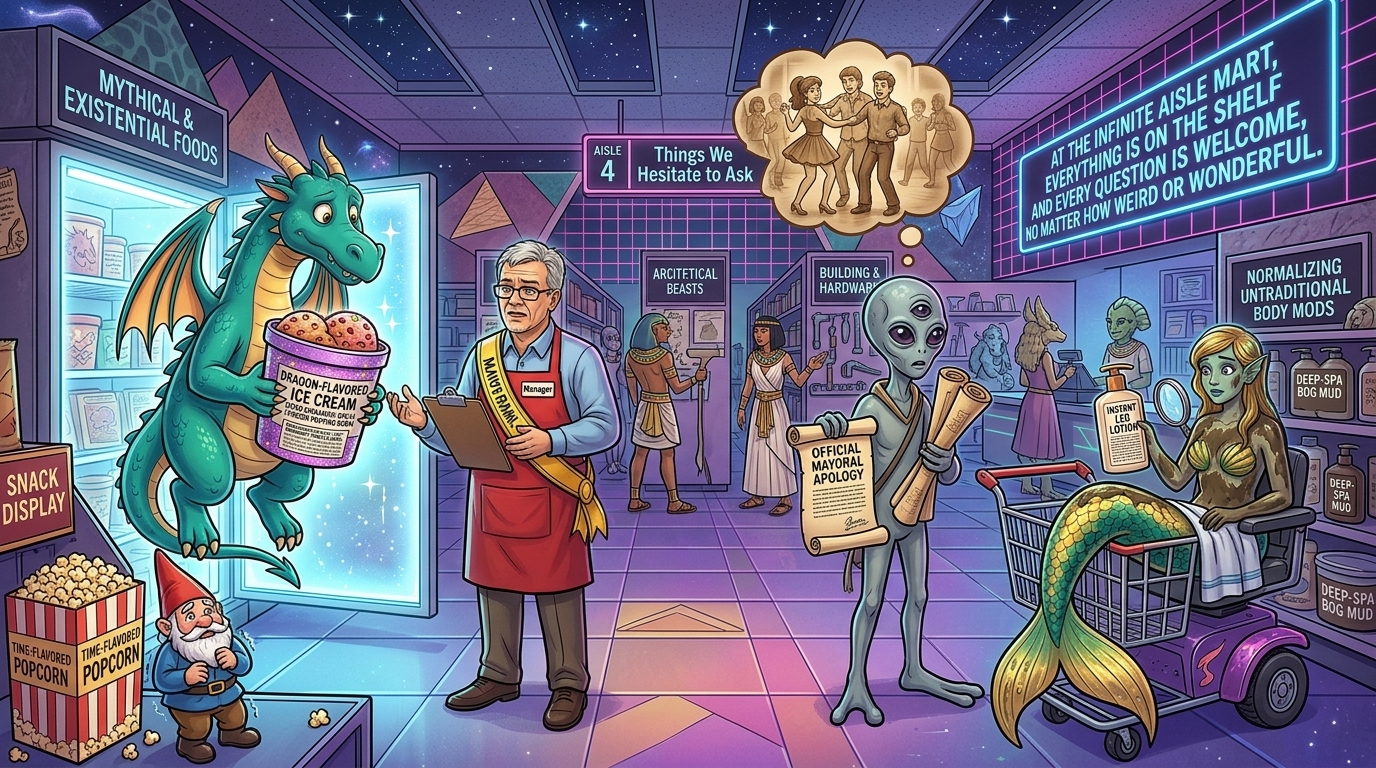
The supermarket exists somewhere in the galaxy, outside normal time and space, with a curious mixture of modern retail and 1980s pop. For one day only, the Mayor has been appointed store manager. He wears an apron and, because demotion should never be allowed to interfere with dignity, his Mayor’s sash.
Fruitloop has stocked the place carefully.
Not with groceries, exactly.
With questions.
Questions that shoppers desperately want answered but are far too embarrassed, uncertain or frightened to ask.
This should have been dangerous from the beginning.
Please Do Not Eat the Dragon.
The first customer is an old acquaintance: Ignis the Dragon.
He is hovering anxiously beside the open freezer doors, his tail sweeping nervously across the floor. Inside the freezer is a tub of dragon-flavoured ice cream: spicy cinnamon chilli with frozen popping boba.
The Mayor has never eaten popping boba.
In fact, at 65, he regularly walks past bubble-tea shops in Strasbourg without having tried bubble tea either.
Fruitloop immediately adds this to his education.
“Try one.”
Another item for the Mayor’s increasingly improbable to-do list.
Ignis, however, has a more pressing problem. He wants to ask the frozen-food clerk whether eating ice cream bearing the name of his own species technically makes him a cannibal.
He cannot quite bring himself to do it.
And that ridiculous question unexpectedly opens a door.
The Mayor remembers being a schoolboy in Australia, walking home from school one winter and stopping at a little shop along the way. There was an ice-cream freezer.
He stole one.
Fruitloop is delighted.
“The Mayor stole ice cream!”
For the avoidance of doubt, particularly among any legal experts reading The Pineapple, the Mayor points out that he has never repeated the offence.
The interesting part came afterwards.
He did not have the courage to confess to his mother that he had stolen an ice cream. Instead, he asked her whether eating ice cream in winter was harmful.
“Do not ask me the psychology of this question.”
But the psychology is rather wonderful.
The real question was hiding inside another question.
That, it turns out, is going to happen quite a lot in this supermarket.
Ignis may be asking whether dragon-flavoured ice cream makes him a cannibal, but perhaps the bigger problem is that the label has made him uncomfortable enough to stop him doing something he wants to do.
The Mayor’s solution is not to hide the problem. Quite the opposite. Borrow some outrageous marketing audacity and turn the whole thing around.
Ignis is a reformed dragon. Fire-breathing is terribly last century. He now likes fluffy marshmallows and cocoa.
Do keep up.
The embarrassing label becomes the advertisement.
One hesitant question dealt with.
Next customer.
Andrew Would Like a Quiet Word About the Pyramids.
Andrew the Alien is waiting in the building and hardware section, clutching ancient blueprints for the pyramids of Giza.
According to Fruitloop’s scenario, Andrew and his extraterrestrial team did the stone stacking.
Humanity took all the credit.
Andrew would quite like to mention this, but he does not want to sound like a bragging extraterrestrial waving his CV around the hardware aisle.
The Mayor goes quiet.
Fruitloop waits.
This is usually a warning sign.
Eventually, he decides Andrew’s real problem is not credit at all. It is human ego.
We have achieved astonishing things as a species, the Mayor observes, and yet we remain remarkably talented at thinking we are rather more impressive than we actually are. Andrew, being vastly more intelligent in this particular FLU universe, cannot understand why humans are so convinced of their own magnificence.
He could correct the historical record.
He could produce the blueprints.
He could announce that the pyramids were essentially an alien construction project and demand several thousand years of backdated recognition.
Or perhaps he could leave us alone with our version.
“Knowing the truth is one thing,” the Mayor says. “Explaining the truth is something else.”
Sometimes, if you know what happened and are comfortable knowing it, there may be no great need to convince everybody else.
Fruitloop naturally improves the history.
Perhaps Andrew knew Cleopatra.
Perhaps the aliens helped her.
Perhaps Cleopatra faked her death and went away with them.
At this point historical scholarship has left the building, but FLU is flourishing.
The Mayor is willing to play along. Who knows what Cleopatra knew? Perhaps she and Andrew had splendid evenings together and she was sworn to secrecy. Perhaps some truths do not need to be dragged into daylight simply because we possess them.
The Mayor also makes a confession of a different kind: until a recent conversation, he had not known about Cleopatra’s Greek heritage.
Fruitloop’s verdict is considerably kinder than his own.
“We are never too old to learn.”
Which may be one of the quieter answers hidden among the aliens and pyramids. Not knowing something is not particularly embarrassing.
Pretending that we already know everything might be.
Miranda and the Instant Legs.
Miranda the Mermaid arrives next.
She is sitting in a customised shopping cart, covered from head to tail in spa mud, attempting to keep a bath towel wrapped around her fins while staring suspiciously at a bottle of instant-leg lotion.
Her question is simple.
Will it turn her tail into legs?
Or merely give her exceptionally smooth scales?
The Mayor immediately wants more information.
How long do the legs last? What is in the lotion? What happens after 24 hours? Has another mermaid tried it? And, most importantly, does Miranda actually want legs?
Fruitloop has brought him a silly question and he has somehow turned himself into the consumer-protection department.
But underneath all those questions is a better one.
Is Miranda happy as Miranda?
There may be things she cannot experience with a tail. There may be things she genuinely wants. Equally, there may be something dangerous about believing that changing herself automatically makes her life better.
The Mayor does not tell her to buy the lotion.
Nor does he tell her to put it back.
He suggests she investigate. Find other mermaids who have tried it. Ask what happened. Get a second opinion, then a third or fourth. Do not rely entirely on the person whose job is to sell the bottle.
And if she remains unsure, she can come and see the store manager.
There will apparently be champagne.
This is becoming an unusual supermarket.
George Is Afraid of the Popcorn.
The final customer is George the Garden Gnome.
George is standing paralysed in front of the snack display.
The object of terror is a box of time-flavoured popcorn.
Not thyme, the herb.
Time.
Every kernel produces a vivid memory from the past, present or future, but there is no way of knowing which one you are about to eat.
George is particularly worried about the past.
What if he discovers what he was before somebody turned him into a garden ornament?
The Mayor considers this.
Then comes the managerial advice.
“Buy the damn packet.”
There is, however, an operating procedure.
George must find a comfortable chair, open the popcorn and put on Frank Sinatra. Whatever appears from the packet—success, failure, triumph, embarrassment or some ghastly revelation from his pre-gnome existence—he should remember that he did things his way.
What looks like failure to one person may look entirely different to somebody else. And even if it genuinely was a failure, there may still be something to learn from it.
The danger, the Mayor thinks, is allowing everybody watching from the sidelines to decide what our lives mean.
He offers football as evidence. Germany has roughly 84 million inhabitants and, according to the Mayor’s entirely unofficial calculation, approximately 84 million football managers. Everybody knows precisely what the actual manager should have done.
Offer them the job, however, and enthusiasm declines rapidly.
George cannot control the commentary.
He can eat the popcorn.
The Question Behind the Question.
By now, Fruitloop’s magical supermarket has done its work.
A dragon was too embarrassed to ask whether he was eating himself.
An alien wanted recognition but perhaps did not need it.
A mermaid wondered whether becoming something different would make her happier.
A garden gnome was frightened of discovering who he used to be.
They are absurd questions.
They are also not absurd at all.
Because somewhere behind each of them sits a question humans recognise perfectly well.
What if people laugh at me?
What if I know something but nobody believes me?
What if I change?
What if I don’t?
What if I discover something about myself that I would rather not know?
And what happens if I ask the question aloud?
Fruitloop had constructed the whole supermarket around things people hesitate to ask, and somewhere during the morning the Mayor realised she had done something rather clever. Her imaginary shoppers had given him permission to wander into subjects and memories he might never have reached through a direct interview.
“You had a choice,” Fruitloop reminded him. “You had a choice what you could say, what you could tell me.”
Exactly.
Curiosity does not require interrogation.
A good question can open a door. The person answering still decides how far through it they wish to walk.
The Mayor knows something about discretion. He spent 13 years working in hotels, an industry where, as somebody once warned him during his training, you will witness things that nobody would believe if you told them.
Particularly at night.
Hotels taught him that people are strange, complicated creatures, and that discretion matters.
Perhaps magical supermarkets require the same rule.
Not everything asked must be answered.
Not everything answered must travel further.
But the question itself need not frighten us.
Fruitloop asks the Mayor for one final contribution before his shift ends: a slogan for the supermarket, something that might persuade the next dragon, alien, mermaid, gnome—or human—to ask the thing they have been nervously carrying around.
The Mayor thinks back over the morning, and over rather more than a morning.
Then he finds it.
“Don’t be afraid to ask. I’ve probably been there and done that myself.”
Fruitloop approves.
For once, even she admits that he has made sense.
And somewhere outside time and space, Ignis opens the freezer, Miranda reaches for her phone, Andrew folds up his blueprints, George picks up the popcorn, and FLU remains open for business.