

My Beer Is My Beer — and Other Rules of Politeness.
From Crete to a German restaurant and the forbidden zone around my barbecue, I keep coming back to the same thing: respect is usually visible in small actions.
By Ralf The Grillmeister, Germany.
When we landed in Crete, everything was easy.
That sounds like a very small thing, but sometimes the small things are exactly where you notice the difference. We had booked the flights and the hotel, arranged a rental car for the first six days and, for the final day, would need the transfer bus back to the airport.
At the airport, the people from the travel company were waiting. They told us which bus to take, and I explained that we didn’t need it that day because we had rented a car. We would need it at the end of the holiday.
“No problem.”
Later, from the hotel, I called again because I wanted to make sure nobody had forgotten us.
Again: “No problem.”
And there wasn’t a problem. On the final day the bus arrived, everything worked, the people were friendly, and that was it.
Very simple.
Sometimes I miss this in Germany.

From My Heart to You.
Years ago, on our first holiday in Crete, my wife and I were having dinner in the hotel. A waitress came to the table and asked what we wanted to drink.
“A bottle of wine.”
“No problem.”
Our food arrived and we started eating. We were talking, enjoying the evening, and perhaps half an hour later the waitress suddenly appeared again.
She had forgotten the wine.
“Oh God! Sorry, sorry, sorry!”
She ran away, returned with the bottle and brought us some little drinks as well.
“These are from me. From my heart to you.”
That stayed with me. For the rest of the holiday, every evening when we had dinner, a little drink appeared at our table. Other guests began looking across, probably wondering what we had done to deserve this special treatment.
Nothing.
She had made a mistake, noticed it and cared enough to put it right. Somehow, something human came out of it.
That is what I remember about Crete. At the airport, in the hotel, in restaurants, people were friendly and things seemed possible. When you asked a question, the first reaction was not automatically to find the problem.
Back in Germany, we recently experienced almost the exact opposite.
Waiting for the Menu.
We were travelling with our new mobile home and had hoped to stay near Büsum, but there was no place for us, so eventually we decided to drive home. On the way to the Elbe ferry we spotted an Italian restaurant with a large car park.
Perfect. We could park the mobile home and finally eat something.
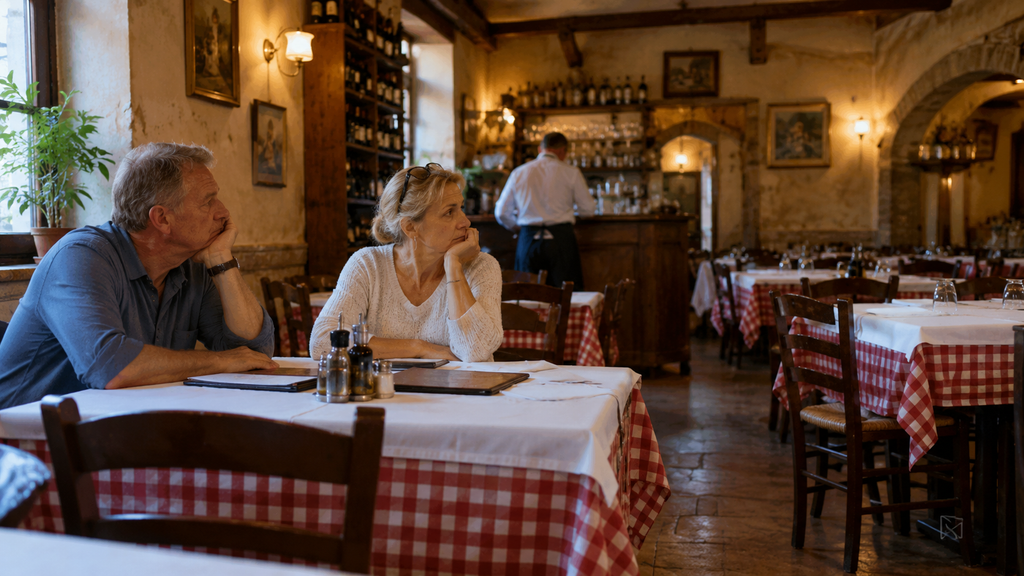
We went inside. The first thing I noticed was the smell. A little musty. Not exactly the moment when you think, fantastic, this will be the best meal of my life.
The owner told us to sit down, so we did. My wife went to the toilet while I waited for the menu.
Nobody came.
Then I went to the toilet. When I returned, I asked her, “Has anybody been here?”
No.
So I went to the bar.
“Hello, could we please have some menus?”
“Yes, yes, I come.”
There was one complication. The last ferry across the Elbe was at eleven, so we did not have the whole evening to sit there admiring the furniture.
We waited.
And waited.
And waited.
After about fifteen minutes I said, “No. We stand up and go.”
As we were leaving, the man came towards us. He didn’t ask where we were going. He didn’t apologise. Nothing.
So we climbed back into the mobile home and drove away, now extremely hungry. Fortunately, we had an emergency collection in the refrigerator: salami, cheese, chocolate and bread. Later, while waiting for the ferry, we opened everything.
Tack, tack, tack.
Salami. Cheese. Bread. Chocolate.
Not exactly Italian fine dining, but at least somebody at this restaurant was interested in feeding us.
It was the previous owners of our new mobile home who thought of this.
The Barbecue Constitution.
Of course, politeness works in both directions. Sometimes you are the guest.
And if you come to my house for a barbecue, there are rules.
The first is very easy.
My beer is my beer.
I don’t think this should cause any international diplomatic problems.
The second rule is more serious: do not touch my barbecue.
Do not open the lid unless I tell you. Do not put anything on the grill unless I know about it. And especially, do not take my barbecue tongs and begin helping.
I once had steaks cooking for four people. I went inside for a moment to put the potatoes in the oven and, when I came back, a friend was standing at the barbecue with my tongs in his hand.
“The steak is sticking to the grill,” he told me.
I looked at him.
“Go away.”
“What is the problem?”
“The problem is that the meat will release itself when it is ready.”
That is how grilling works. The steak knows. The grill knows. I know.
My friend did not need to know.
Please go inside, speak with the others, drink something, enjoy yourself, look at the garden. Everything is possible.
But leave the meat alone.
There is also a working area around the barbecue. I have one grill in front of me and another behind me. I turn left, I turn right, I have the tongs in my hand, and suddenly somebody is standing beside me because they want to see what is happening.
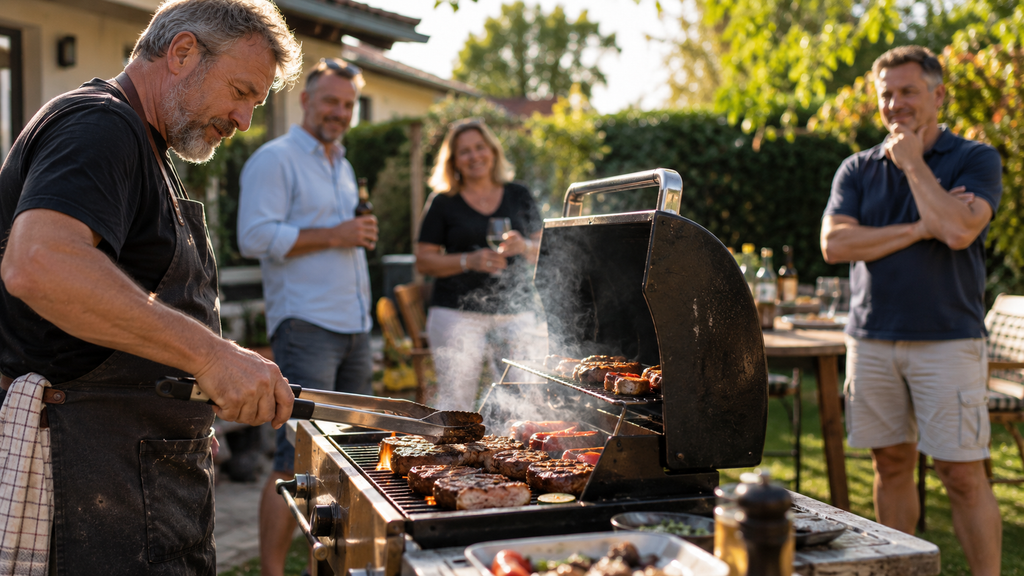
You are welcome to look.
From a distance.
Otherwise the tongs may touch your clothes, your clothes become greasy, and then please do not complain to me.
Sometimes I think I need the spray referees use in football when there is a free kick. One line on the ground and everybody knows where they are allowed to stand.
Perhaps I should spray a line around the barbecue.
Forbidden area.
Visitors can watch with binoculars.
When the food is ready, I will send a smoke signal.
Rules Can Change.
Not every unwritten rule has to stay forever.
In my previous marriage, I did not enjoy sharing food from my plate. I would ask before ordering, “Would you like this?”
“No.”
Fine. Then I ordered it.
The food arrived.
“Oh, can I try yours?”
“No.”
Why not?
“Because I asked you before!”
Perfectly logical.
At least for me.
Now, in my second marriage, I have become more relaxed. Now, if there are two dishes we both find interesting, one of us orders one and the other orders the second.
Then we share.
No problem.
So even Ralf’s rules can change.
There is one rule, though, that I still don’t particularly like: the feeling that when somebody invites you, you must immediately calculate what to bring, what it costs, or how you are going to pay them back.
A friend called me recently because we were planning a barbecue.
“We have a problem.”
“What problem?”
He thought it should really be his turn to host the barbecue.
I told him, “You have a problem. I don’t.”
If I invite you, I invite you. I am not giving you something so that you must give me something in return. I grill because I enjoy grilling and because I want you there.
Come. Sit down. Eat. Have a nice evening.
That is enough.
Four O’Clock Means Four O’Clock.
For me, respect is often very practical.
If I say, “Come to us at four o’clock,” and you arrive at four, that is good. A little earlier is fine too. If something happens and you are going to be late, call.
I had to do exactly that myself recently. An emergency case meant everything was delayed, so I called and explained that I would be late.
In the end I was only two minutes late.
That wasn’t really the point. The point was that the other person knew.
The same applies when somebody agrees to bring something or prepare something. Anybody can forget one thing. We are human. But when it becomes, “I forgot this, I forgot that, I forgot the other thing,” then, for me, it begins to say something about responsibility.
Perhaps that is why politeness is more complicated than simply knowing the rules. One person thinks it means choosing the right words. Somebody else thinks it means arriving on time, bringing a gift or never disturbing anybody. Much of it probably comes from the people around us. We grow up learning what belongs and what does not.
But then life interferes.
The waitress in Crete forgot our wine and became one of my strongest memories of good hospitality. My friend at the barbecue was only trying to help and nearly found himself sent into internal exile.
Nobody gives you the handbook.
You have to watch people. You have to notice the situation. Sometimes you discover that a rule you once considered completely obvious is not so important after all.
And sometimes you discover that it is.
Because when Ralf says, “Stay away from the grill,” this is not a cultural misunderstanding.
This one is the law.