
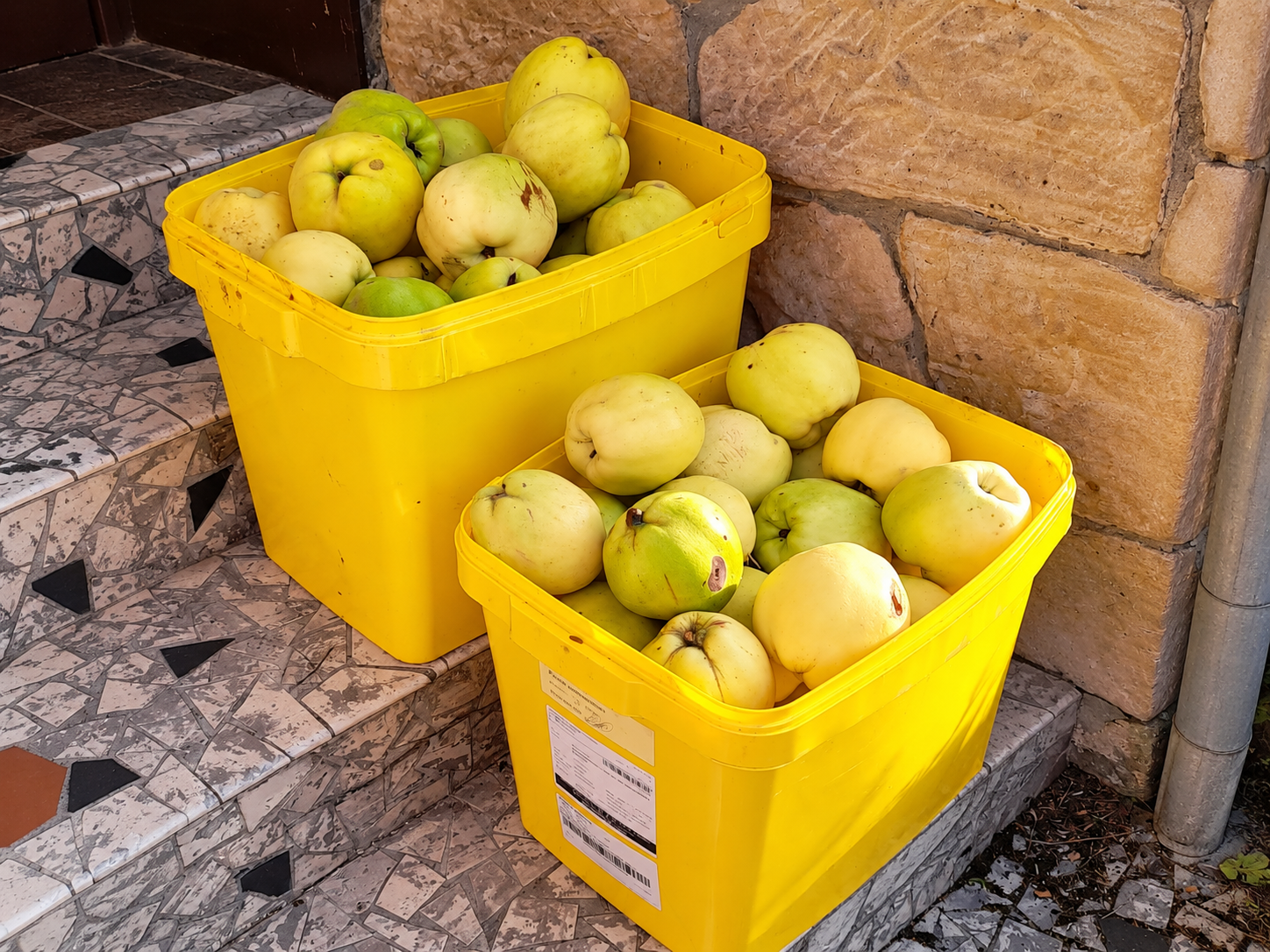
102 Quinces, Anyone?
The Human Bit, by Frank Peters.
Fabrice had too many quinces.
I had none.
Shortly afterwards I had 102.
I had never processed a quince in my life, so I did what millions of people now do when confronted with something they don’t know.
I asked AI.
Foody is my ChatGPT project folder for food. Recipes, ingredients, leftovers and the occasional kitchen emergency.
This qualified.
I explained the problem and received a perfectly sensible answer. How to store quinces. What I could make from them. Which ones to process first. Freezing. Preserving. All the usual helpful stuff.
I read it.
Then largely ignored it.
Not because it was wrong. I had remembered Lyon.
A few weeks earlier, I had walked around Lyon using AI as a sort of travelling companion. I hadn’t asked it to design my day. I simply walked until something caught my attention, took a photograph and asked:
What’s this?
Then perhaps: Why is it here? How old is it? What happened to it?
Afterwards I carried on walking until something else caught my attention.
It was very different from reading a guidebook beforehand because the important thing was that I noticed first. The machine entered afterwards.
Standing in front of 102 quinces, I wondered why I shouldn’t do the same thing.
So I took a photograph.
Here they are. What do you think?
That changed the conversation.
Foody could now see the actual fruit. Not quinces in general. Mine. Some looked good. Some were bruised. Some needed using sooner.
Could I store them in the extension?
Photograph.
Possibly.
What about the old fridge, switched off for winter?
Photograph.
Actually, quite useful. Leave the door slightly open for ventilation.
Could I stack them?
Photograph.
Use the shelves. Don’t pile the fruit directly on top of each other.
Before long, 42 quinces were sitting in an unplugged refrigerator with the door ajar. Another 28 went into the tool shed.
Seventy dealt with.
Thirty-two remained.
Now we needed knives.
I put two on the worktop, took another photograph and asked which one.
The larger chef’s knife.
Apparently quinces are hard.
True.
But there is a fairly substantial difference between being told that a quince is hard and trying to push a knife through one.
The first required concentration. The fifth, rather less.
Then I discovered that topping and tailing the wedges first made it much easier to remove the core with one diagonal cut.
I told Foody.
Apparently I had discovered the production-line method.
That amused me because Foody hadn’t discovered it.
I had.
Not through brilliance. I had simply cut enough quinces.
Then some of the flesh started turning brown.
Photograph.
Change the lemon water. Work in smaller batches.
I cut open another quince and found brown flesh already inside.
Photograph.
Different problem.
Inspect before peeling.
So the process changed again.
Halve. Look. Decide. Continue.
By now the kitchen had acquired departments. Cutting. Lemon water. Blanching. Cooling. Draining.
Then I spread the wedges onto tea towels and patted them dry.
The Patting Centre.
At this point the entire operation became slightly ridiculous.
And fun.
That seems worth mentioning because Bruce and I have spent several weeks circling around rather more serious questions about artificial intelligence. If machines can answer so much for us, what happens to learning? What happens to judgement? Do we become less curious because we no longer have to search? If we remove difficulty, do we also remove something useful?
Thirty-two quinces are not much of a research sample.
But they made the questions considerably less theoretical.
What I was doing that afternoon wasn’t actually new. Humans have always encountered things they don’t understand and asked somebody who might know.
What is this?
How do I do that?
Does this look right?
What would you do next?
We have asked parents, neighbours, craftspeople, teachers and anyone standing nearby who looked vaguely competent. Then there were books, libraries, telephone calls, the internet and search engines.
AI hasn’t invented the question.
What has changed is the extraordinary quantity of information available, the speed with which we can reach it and, increasingly, the fact that we can show the machine what we mean.
That last part matters.
I didn’t have to describe the brown patch inside the quince particularly well. I could show it.
I didn’t have to explain the dimensions of the old fridge.
Photograph.
I didn’t have to ask a general question about kitchen knives. Here were the two knives sitting in front of me.
Which one?
The information becomes more personal because the machine has some of the same context I have.
Only some.
It cannot feel how hard the quince is. It cannot smell it. It cannot feel the knife meet the core or know that my arm is getting tired.
But it can look at something close to what I am looking at and respond to this problem rather than the average version of the problem described in a book.
That makes asking questions extraordinarily easy.
Perhaps dangerously easy.
Because the machine can also answer before I have really looked. It can tell me what to notice, design the complete process and give me a set of instructions to follow.
That would probably have worked too.
Four kilos of frozen quince at the end.
Job done.
But I think something would have been different.
In Lyon, I noticed the building first.
With the quinces, I encountered the problem first.
The machine didn’t tell me what to be curious about.
I brought the question.
That distinction increasingly matters to me.
AI is an astonishing source of information.
But information is not the experience.
Foody knew vastly more about quinces than I did that morning. By evening, I knew something it didn’t.
I knew these quinces.
I knew which ones surprised me when I cut them open. I knew how my knife behaved, which sequence of movements worked better in my kitchen and when the lemon water needed changing.
I had developed a rhythm.
The machine supplied information.
Reality supplied resistance.
Somewhere between the two, I still had to make a judgement.
All those photographs produced another, unexpected side effect. I had created a record of the day.
Not hundreds of disconnected photographs disappearing into my phone. Not quite an old-fashioned photo album either.
Something in between.
Picture.
Question.
Answer.
Another picture.
Something changed.
Another question.
What I like about that record is that it doesn’t just show what I did. It also shows what I didn’t know yet.
By the evening I could see the progression from What on earth do I do with these? to a kitchen production line complete with a Patting Centre.
Then came the Crémant.
Also human.
At the end of the day I had four kilos of prepared quince in the freezer and seventy whole quinces waiting for the next few weeks.
That no longer feels like seventy problems.
I know considerably more now.
And somewhere in this house are about two hundred cookbooks.
I can start looking through those for quince possibilities.
The books haven’t suddenly become obsolete because I have AI. Quite the opposite. I am probably better equipped to use them because I now know enough to ask better questions of them too.
So did spending most of the day with artificial intelligence make the experience more human or less human?
I don’t think the answer lies in the technology so much as where we put it.
If I let the machine notice for me, decide for me and do as much of the thinking as possible, I may surrender rather more than I realise.
But if I use it to supply information when I ask for it, to look at what I show it and to help me investigate the thing already in front of me, the old human process remains surprisingly intact.
Notice.
Wonder.
Ask.
Try.
Get it wrong.
Ask again.
Learn.
The quantity of information has changed enormously. So has our access to it. The question can now be much more personal.
But somebody still has to ask it.
And then somebody has to do something with the answer.
There are seventy quinces left.
Foody is still there.
So are the knives.
I suspect I am going to need both.