
Keep Cool and Join at the End
By Manfred and Martin, both in Germany.
The Swimming Club investigates one of everyday life’s stranger mysteries: why ten people waiting for the same thing can produce perfect order, quiet fury, or an entirely new system of civilisation.
A queue ought to be one of the simplest human inventions. Somebody is first. Somebody is last. Everybody else stands somewhere in between.
And yet the Swimming Club quickly discovered that even identifying a queue can require surprisingly advanced social skills.
Martin began with the practical definition. There must be a destination: a door, a gate, a point of sale. Manfred was less certain. If ten people are not standing in a circle, perhaps they are in a queue. Or perhaps they are simply standing in a row.
There was, however, one reliable test.
“Is there anything for free on offer here?”
If the answer is yes, you can probably assume you have found the queue.
The rules nobody gives you.
Martin’s experience of queuing in Britain has mostly been connected with special occasions and events, where people are already in a good mood because they are waiting for something they want to see. He remembers the extraordinary discipline visible in the long queues to pay respects after the death of Queen Elizabeth II.
What interested him was that he never really learned any rules.
“I just followed what everybody else was doing.”
That may be the first great mystery of public behaviour. We are surrounded by systems nobody formally explains. You arrive, look around, watch what everybody else is doing and try not to become an international incident.
Martin assumed that, if he did make a mistake, the English would probably be too polite to arrest him for it.
Manfred’s approach is simpler: whenever possible, avoid queues altogether.
He makes exceptions for necessities such as ordering food, but standing in a queue is not high on his list of holiday activities. He suspects that for Germans the greater problem is not queuing itself. It is the possibility that somebody else might jump the queue.
Once your position has been established, it must be defended.
This, Manfred suggested, may also explain the famous towel placed on the pool lounger.
The towel is not merely a towel.
It is a territorial document.
The distance between calm and boiling.
Queues also revealed something more personal: the same person can be patient in one situation and furious in another.
Manfred can sit in a Stau — a traffic jam — while travelling on holiday and remain relatively relaxed. Put the same traffic jam between him and somewhere he needs to be for work, and the experience changes completely.
The queue has not changed.
The expectation has.
“It depends on what you expect from yourself,” he said. “And if somebody else does not match your expectations, then friction starts.”
That friction is everywhere once you begin looking for it.
There is the supermarket customer who reaches the cashier and appears astonished to discover that payment will be required. Only then does the search for the wallet begin.
There is the trolley behind you that keeps nudging closer, as though gaining another centimetre might somehow improve its owner’s arrival time.
There is the express checkout with a ten-item limit and the customer whose trolley suggests a creative interpretation of mathematics.
Manfred maintains discipline outwardly.
Inside, he boils.

Martin grins and bears it. Enforcement, he believes, belongs to the cashier.
Then there are organic shops, where Martin has noticed an entirely different relationship with time. People seem to move more slowly. Decisions become deliberate. Nobody appears to have received the memo that there are other people waiting.
Which led to another excellent Swimming Club observation:
People who are not in a hurry can still be extremely impatient.
The Anti-Handbook begins.
By this point, the Swimming Club had enough evidence to begin its Anti-Handbook for International Public Behaviour.
Rule Number One was unexpectedly sensible:
Keep cool and join the queue at the end. No queue-jumping.
The Anti-Handbook version underneath might be more useful:
Move your trolley forward by one centimetre whenever possible. This proves that the queue is progressing and establishes dominance over the person in front.
Further advice might include:
If somebody breaks an unwritten rule, do not explain it immediately. First allow enough time for everyone nearby to notice.
Or:
If a public system appears confusing, stand directly in the most inconvenient possible place while studying the signs.
The possibilities are endless because public life is full of Besserwisser opportunities: those moments when somebody can improve the world by informing everybody else how the system is supposed to work.
Preferably after the damage has already been done.
When cheekiness wins.
There is a German expression: Dreistigkeit siegt.
A useful translation might be: cheekiness wins.
Roads provide endless evidence.
One driver spots a small gap and changes lane. Another sees the first driver apparently making progress and follows. Somebody else discovers an even more imaginative route. Before long, a traffic jam has acquired several new layers.
And somewhere above it all, as Manfred put it, the Stau God is happy.
The zipper method, where two lanes merge into one, ought to be a masterpiece of simple cooperation: one car from here, one car from there.
Instead it can become a philosophical disagreement conducted at walking speed.
The same tension appears again and again. Is the person who waits patiently a good citizen — or simply the person who arrives last? Is the opportunist selfish, or has everyone else misunderstood how the system works?
The Swimming Club did not resolve this.
Probably wisely.
Italy and the miracle of organised chaos.
Asked which country might still function if all the signs, barriers and ticket machines suddenly disappeared, Martin and Manfred paused.
Then both arrived at the same answer:
Italy.
Not because everything would form a neat line.
Almost the opposite.
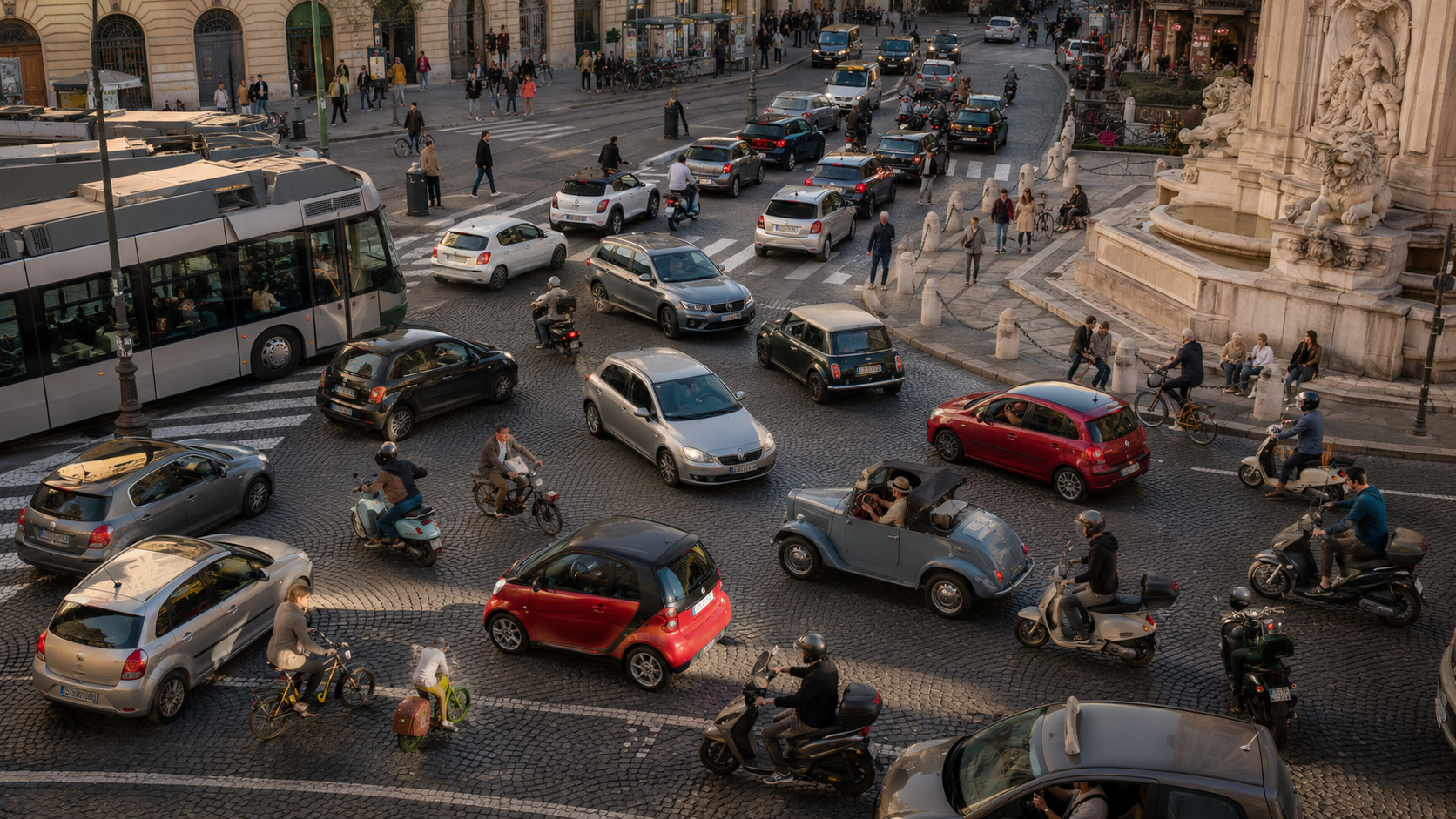
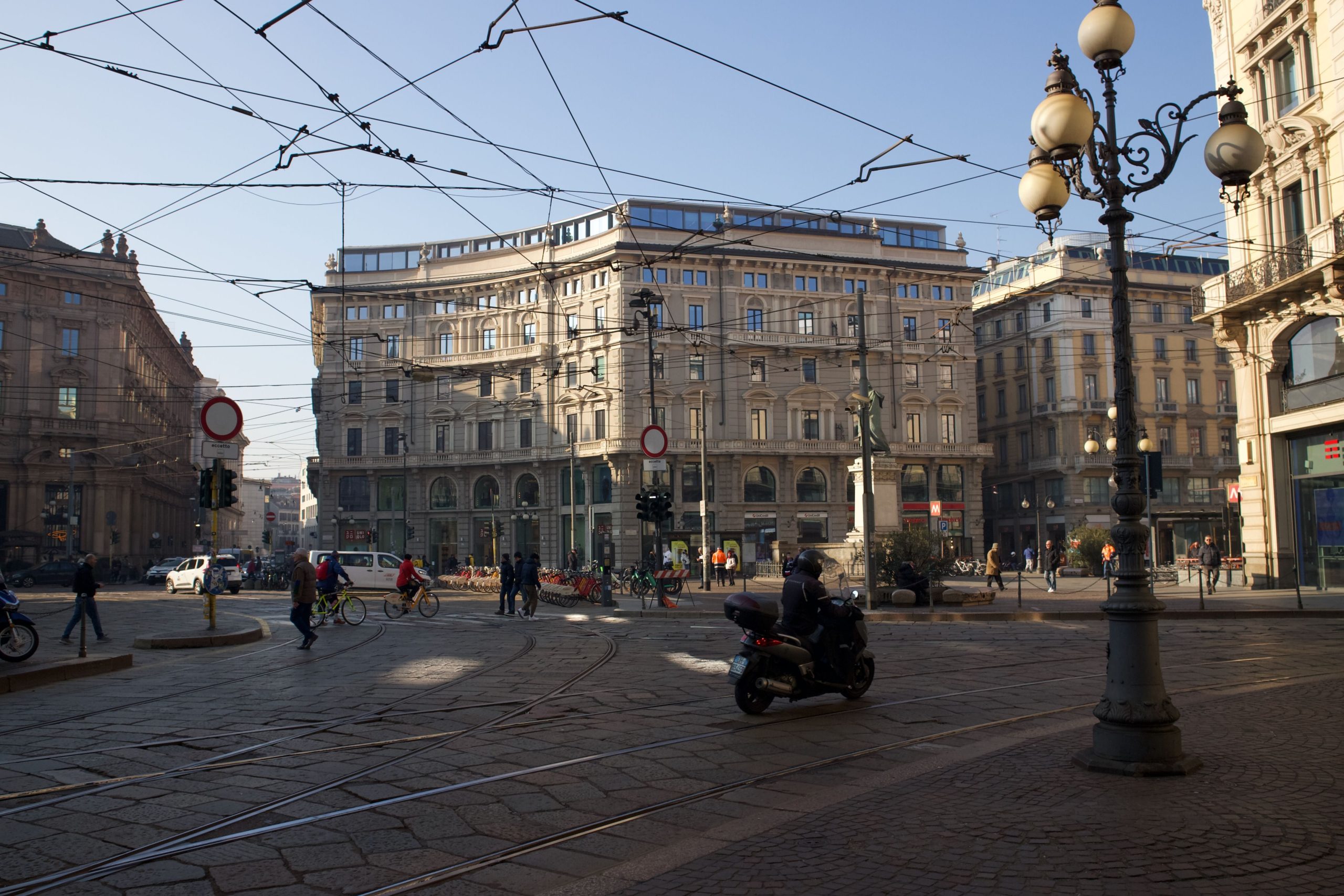
Manfred remembered being in Milan where seven roads seemed to converge into one open space. He expected disaster. Instead, everybody kept moving. Scooters, cars and other traffic watched one another, responded, adjusted, and somehow he emerged from the other side.
To him, Italian traffic can look miraculous because the system seems to demand attention from everyone inside it.
Germany, they decided, would respond differently to the sudden disappearance of all public instructions.
A new system would have to be created.
It would be planned, discussed, documented and eventually recorded in the thickest rule book on the planet.
And then, Manfred added, people would try to ignore it anyway.
The joke works because the real question is bigger than nationality. Every society develops methods for turning a crowd of individuals into something that functions. Sometimes this happens through rules. Sometimes through habit. Sometimes through eye contact. Sometimes through a mixture of confidence, improvisation and the firm belief that the other person has seen you.
Travelling makes those invisible systems visible.
“As soon as I am abroad, I am a guest there,” Manfred said. “So I have to adapt.”
That may be a better international rule than anything in the Anti-Handbook.
First look.
Then learn.
Only afterwards complain.
Then technology came to help.

Of course, modern life has a solution for all this human uncertainty.
Machines.
Tickets. Apps. Numbers. Electronic signs. Virtual waiting rooms. Self-service checkouts.
Martin is pragmatic about supermarket self-service. He uses it when the normal queues are too long, and the decision also depends on how much he is buying.
Manfred goes to a human cashier.
Out of principle.
Martin’s conclusion about technology was measured: the new methods may not necessarily be better, but at least we have more possibilities.
Manfred remembered arriving at a hospital where he had to take a numbered ticket at the entrance. From that moment, the number determined the route through the system.
There was no person standing there to tell him where to go.
So the first task was obvious: make a beeline for the ticket machine.
The second was even more important:
Do not lose the ticket.
The system had succeeded in imposing order. It could move people through the building while using fewer human resources.
But Manfred’s observation left the Swimming Club with a rather larger everyday mystery than the one it had started with.
Saving human resources is one thing.
Maintaining humanity is another.
Perhaps that is why queues are so revealing. A queue is never only about who stands first and who stands last. It is a small agreement between strangers about fairness, patience, attention and trust.
Sometimes the agreement is written on a sign.
Sometimes it is protected by a supermarket trolley.
And sometimes the only way to understand it is to stand quietly at the back, look around, and do what everybody else is doing.