
It Will Be Useful One Day.
By Fabrice, France
There are objects we keep because they still work. Others stay because they carry a story. In my workshop, the difference is not always easy to see.
Janita showed me a photograph of a workshop and asked what I noticed first.
It was much too tidy.
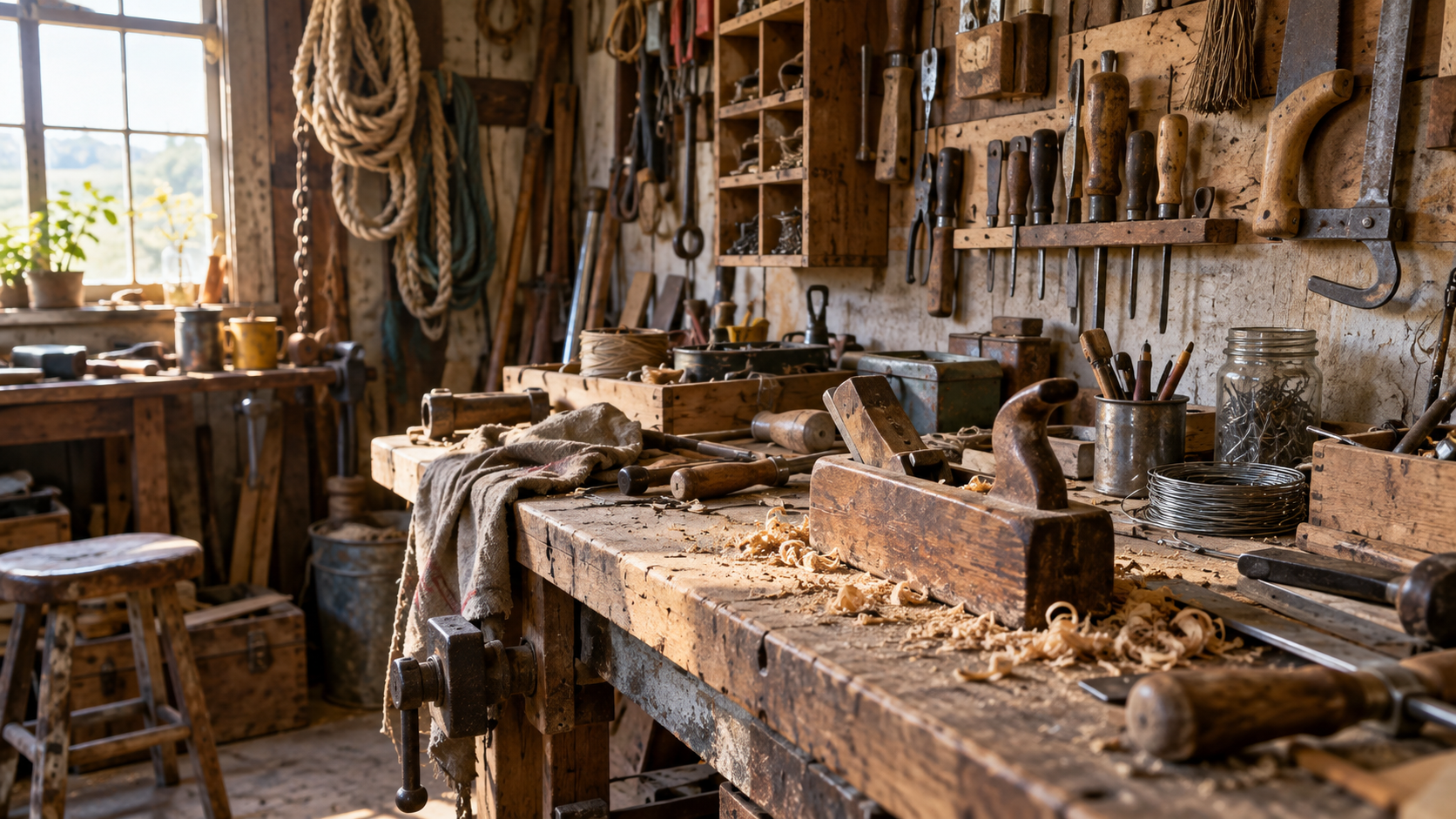
Everything had its place. The tools were arranged properly. There were ropes, gloves, a crowbar, a grease gun, nuts and bolts, a jerry can and all the other things you might expect. It was a very good workshop, certainly, but a real workshop normally has a little more life in it.
And then there were the binoculars.
Janita could not get past them.
“Why are there binoculars in a workshop?”
The Mayor had an answer immediately: perhaps they were there so you could see the cyclists coming.
This did not convince Janita.
For me, the binoculars were not so strange. I have binoculars too, although mine are in the living room, not the workshop. I use them to look at birds, especially the swallows, and sometimes at the moon.
I have tried to see the man on the moon.
So far, no success.
Things find another job.
The more we talked about workshops, the more I realised that the interesting objects are not necessarily the tools you use every week. They are the things that have somehow survived.
In my garage, for example, I have an American steel helmet from the Second World War.
That sounds unusual today, but I remember my grandfather having several old steel helmets around. Things were not simply thrown away. If something was made from good material, people found another use for it.
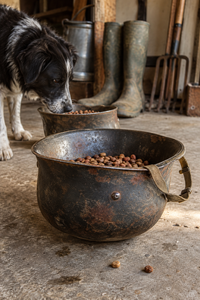
My grandfather had five or six dogs. Their food bowls were old steel helmets.
That was completely normal.
The original purpose of the helmet had finished, but the object itself had not finished. It could still do something.
That way of thinking was everywhere. People reused what they had because the material was useful. An object did not become rubbish simply because its first job was over.
I think some of that has stayed with me.
Straighten the nail.
I remember another thing my grandfather used to do.
If he removed a nail from a piece of wood, he did not throw the nail away. He put it on the anvil, straightened it and kept it.
“We can use this later.”
Janita immediately had doubts about this system. In her experience, a straightened nail simply bends again.
Perhaps.
I do not straighten every old nail myself. I am not exactly the same as my grandfather. But I understand the principle.
I have pieces of wire. I have metal. I keep things when I think there is still a possible use for them. If I collect enough scrap metal, I take it for recycling. I separate brass as well and take that in when I have enough.
So I do get rid of things.
Eventually.
The important question is whether something is really finished.
A broken clay pot that can no longer hold water has reached the end. A tool that is badly damaged also has to go. That is not only about usefulness. Damaged equipment can be dangerous, and I have enough experience with tools to know that old material is not automatically good material.
A badly bent crowbar goes to recycling.
A rope is different. If part of a six-metre rope is damaged, perhaps you still have three metres of good rope. I learned how to make knots, so the good part can still be useful.
This is probably the problem.
I can usually imagine another job.
About 120 T-shirts.
My wife would say there is another category where I have some difficulty throwing things away.
T-shirts.
I stopped counting properly, but I think I have around 120.
Some are in a cupboard. Others are stored in a metal chest. They are not all doing the same job either. There are T-shirts for going out, T-shirts for festivities, T-shirts for wearing around the house and old ones that can still be used for work.
Some go back a very long way. I still have small T-shirts from when I was around eighteen and beginning my time in the army.
They certainly do not fit me today.
That is not the point.
Some have become thin. Some have holes. There are logos and designs from different moments in my life. They are not simply pieces of material anymore. They are souvenirs.
The Mayor decided this could become a new tourist attraction: Fabrice’s T-shirt Museum.
Janita had another idea. Cut out the important parts with the logos and sew them together into a large quilt.
Then, apparently, I could wrap myself in my entire history.
I am not sure this plan has yet been approved.
What I do know is that throwing half of them away would not be easy. When an ordinary T-shirt has been with you for decades, it is no longer completely ordinary.
My kingdom.
My workshop is also slowly becoming something more than a place for tools.
I have two garages, and I am working on an area that, when it is finished, will be my kingdom.
There will be a stove, a fridge, a table, a corner bench and some cooking things. It will be somewhere to work, sit and spend time.
Of course, this also creates more space for objects.
That could be dangerous.
But I do use many of the things I keep. I have several ropes. I have two headlamps and use them when I go outside at night. I have jerry cans. Gloves are useful for working outside, in the garden or with different materials.
These things may sit for a while, but sooner or later a job appears.
That is the argument, anyway.
The one object.
At the end, Janita asked me a different question.
If she came to my real workshop and I could show her only one object with a good story behind it, what would I choose?
This took me some time.
Then I thought of an old wooden plane.
It belonged to my grandfather.
There are probably many newer planes that work better. It is not something I keep because it has great financial value. Its value is sentimental.
And perhaps that explains more about my workshop than the ropes, the headlamps, the steel helmets or even the 120 T-shirts.
My grandfather straightened nails because another piece of wood might need them. Old helmets became bowls because the material was still good. Things remained useful long after their first purpose had disappeared.
I have not copied everything he did.
But I still have his wooden plane.
Some objects stay because you may need them one day.
And some stay because, in a different way, you already do.