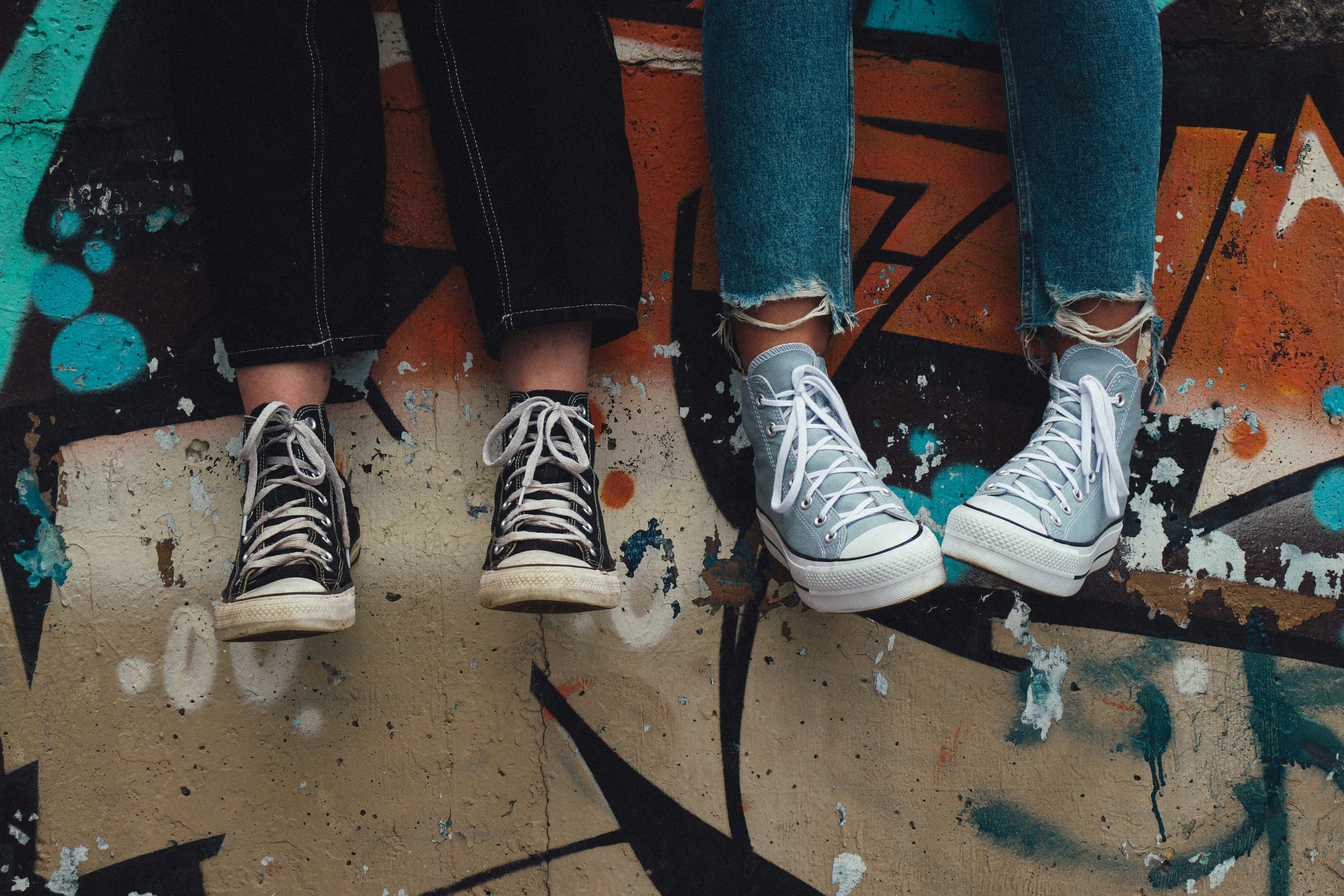
In the life of a teenager wearing “cool” shoes
Between Bell Rings and Big Dreams
The recording light blinks on during a two-week school holiday. Outside, summer is practicing its lines; inside, a teenager warms to the mic — careful at first, then candid, then brave. She speaks of grades and shoes and scouts, of dancing that makes your lungs sting in the best way, of wanting to be a doctor so she can see the world the way a stethoscope hears a heart. What follows is not a manifesto so much as a map: a handwritten atlas of teenage life — messy, luminous, unfinished — and a reminder to adults that this terrain deserves careful reading.
The room where growing up happens
“Being a teenager is the most difficult part of life,” she says, searching for the right English, and then finding the right feeling. Not because teenagers have it uniquely hard, but because they are forced to make “very important choices” before they have the full scaffolding of maturity to hold those choices up. Imagine trying to assemble a bridge while you’re still halfway across the gorge; imagine the crowd on the other side telling you to “hurry up.”
She adds a second tension: the privilege of not paying the bills or the taxes, offset by the cost of being seen. Clothes and shoes become a social currency too easily converted into judgment. “If I don’t have good shoes, I think I can’t go to school,” she admits. It’s not fear of teasing so much as the ache of being assessed — the feeling of walking past dozens of quiet mirrors every morning.
A life measured in averages, matches, and moments
School is the metronome of her days. In France, she explains, the calculus of averages turns individual subjects into a single verdict, a number that wobbles “two or three points” and takes your self-belief with it. Teachers want the best — of course they do — but the drip of “do more” can become a flood. She laughs softly: if she did homework the way some adults imagine, “three hours… all afternoon, all night,” there would be no time left to be a person.
So where does confidence come from? From a good mark, yes. From a won match, yes. But also from small, human victories: introducing herself at scouts and talking across the invisible borders that divide “cool” from not-cool; finishing a difficult choreography without missing a beat. “I’m proud when I can speak with all the people,” she says — a simple sentence that doubles as social magic and civic skill.
She names scouts as her truest classroom. There, friendships are stitched to personality rather than brands. No one is counting logos. “We are friends for my personality,” she says, “not my clothes.” In that community, she is not auditioning; she is arriving.
The doctor who wants to see the world
Her dream is disarmingly prosaic and wildly expansive: “I want to travel… and I want to be a doctor.” Not a fantasy of prestige, but a profession as passport. She wants to “speak with all the different people in the world,” to work in places that make a textbook feel small, to buy a house later “in the best part of the world” — best not as in fanciest, but as in right for me. If adulthood is a film, she wants to write the scenes in which the protagonist learns a new language, misses a train, treats a child with a fever, eats something unforgettable on a street with no name.
The obstacles are less romantic. “School doesn’t prepare you for adult life,” she says. Not the taxes or the doctor’s booking systems or the structure of a CV. She isn’t asking to skip history; she’s asking to add a lab session on life. She knows that university — if she goes — will force the learning by necessity. But what about those who step straight into work? “It would be good,” she suggests, “if school prepares us for real life.”
Of course, it isn’t all earnest trajectories and utilitarian wishes. She wants a dog — “please.” She wants friends who stay. She wants to feel less like she’s always bracing for impact. The trick she uses when the pressure spikes? She tells herself the storm will pass: It’s not long, it will finish. Stoicism, reframed as a pep talk you can deliver in the bathroom mirror.
The algorithm and the mirror
Where does social media fit? Like many of her peers, she recognizes its paradox. Online, it can be easier to say what you think when you’re shielded by a nickname — “unicorn123,” she jokes. That cloak can empower expression; it can also atrophy real-world muscles. “In the real life you can’t tell your chef ‘I don’t like you,’” she says with a grin that is also a warning. Platforms teach voice; they don’t always teach consequences.
Technology’s wonder isn’t lost on her. She praises features that orient you in unfamiliar cities, tools that overlay context on the world as you walk — “we have a store here; we have a restaurant here.” But she worries about how easily teens can conjure a fiction so polished it feels true: a life fabricated by prompts and filters, posted as proof. “With technology,” she says, “teenagers can make all they want… it can be dangerous.” The danger isn’t only in what gets believed; it’s in what gets rehearsed.
Pressure, perfection, and the art of being “enough”
She used to want to be perfect — in school, in sport, in self — and then she traced perfection to its endpoint: a life with no room for sleep or films or friends. She let the ideal go. “If I want to be perfect, I will be nothing else,” she says with the kind of clarity that usually requires therapy or a hard year (often both). Instead, she angles for excellence with edges: high standards that don’t demand a blood oath.
Her parents don’t push. She pushes herself. What she wants from adults is patience; what she wants from conversation is sometimes less conversation. It’s a remarkably grown wish — the wisdom to know that not every feeling can be narrated on demand, that many teenage states are fog rather than failure. “I can’t explain,” she says of days when the weather inside her keeps changing. “We are young to understand that.”
Toward your own summer
What worries her most? The future, because it is unknowable. Will the friends of today still be there tomorrow? Will she “fail” her life or “succeed” at it? (Who decided those are the only two categories?) What gives her hope? A good job she likes. A circle of people she loves. A dog. Happiness that is modest enough to be possible and large enough to be worth the work.
Her final answer lands like a thesis: growing up is not about abandoning what you wanted as a teenager; it’s about gradually doing it. Travel. Medicine. Friends. A kitchen table somewhere the light comes in sideways, a dog asleep under the chair. “At the end, to say, I did that — and I’m proud.”
So here is the soft call, not to productivity but to presence: Identify your season. Are you in a winter of uncertainty, a spring of risk, a summer of movement, an autumn of synthesis? You don’t have to wait for the weather to change. Warmth can be made. The teenager has already started doing it — in study sessions and scout halls and dance studios, in conversations where she admits not knowing and keeps talking anyway. If summer is a feeling more than a forecast, perhaps the bravest adult thing we can do is learn from her and turn toward the sun we can carry.