
I Wander Until I Fall… Then I Remember to Rest
Why do so many of us only notice the importance of rest when we are already exhausted? What began as a conversation about holidays slowly became something deeper: the quiet pressure of modern life, family responsibilities, and learning that rest is not a reward—it is part of staying human.
The word holiday sounds relaxing, but that is not always what it means.
As mine was getting closer, people kept asking if I was excited. The truth was more complicated. Yes, I was looking forward to sleeping a little longer and not going to work, but I also knew the next two weeks would be full. There were jobs waiting at home, preparations for my daughter’s birthday, shopping, decorating, organising, and everything that seems to appear just before you think you can finally slow down.
Sometimes rest arrives wearing work clothes.
Perhaps that is why this week’s conversation stayed with me. We began by talking about holidays, but somehow we ended up talking about why rest matters in the first place.
Rest isn’t always quiet
Life in our house has certainly not been quiet lately.
My younger daughter will soon turn eighteen. Her birthday means two celebrations: one with family and another with friends. The family party feels manageable. The party with friends… that one worries me a little more.
She has already ordered decorations, we’ve started buying everything we need, and now we are hoping the weather cooperates so we can use the garden.
At the same time, she seems determined to enjoy every minute before her birthday arrives.
Recently she went out every evening from Friday until Sunday. One morning she came home at half past five—with a friend. That was a surprise I certainly wasn’t expecting.
The difficult part isn’t that she enjoys being with her friends. It’s that I don’t sleep properly while I wait for her to come home. I wake up during the night, walk to her bedroom, and check if she’s there. Most of the time, she isn’t.
My husband laughs and says he was exactly the same when he was young. He always stayed until the very end of every evening.
I was completely different.
Different generations, different habits
When I was young, I never stayed out late.
Not because I didn’t want to, but because I was afraid of my parents’ reaction if I came home too late. Things were stricter then.
Now I find myself standing where my parents once stood.
My daughter tells us that once she is eighteen she can do whatever she wants. We smile a little because, honestly, she already behaves as though she can.
That is probably one of the strange circles of family life.
As children, we cannot wait to become adults. As parents, we quietly hope our children will discover that adulthood also comes with responsibility.
Soon she will move into her own apartment to study. We are already buying food she can keep in her freezer. I imagine there will be phone calls asking what she should cook, or saying she has nothing to eat. I also imagine she will come home some weekends.
But deep down, I know this is probably the beginning of the next chapter. Once children leave, they often never truly come back to live at home again.
That is how life moves forward.
When nobody rests
Our conversation then turned to a simple question.
Do people appreciate rest, or do they only notice it once they are exhausted?
For me, the answer was easy.
Most people only realise its importance when they have already gone too far.
Today’s world constantly pushes us to do more. Social media, the internet, work, family life—everywhere we look there is another comparison, another expectation, another reason to feel we should be achieving more.
Then, when we finally stop, another feeling appears.
Guilt.
It feels as though resting means losing time or missing something important.
Yet that feeling is misleading.
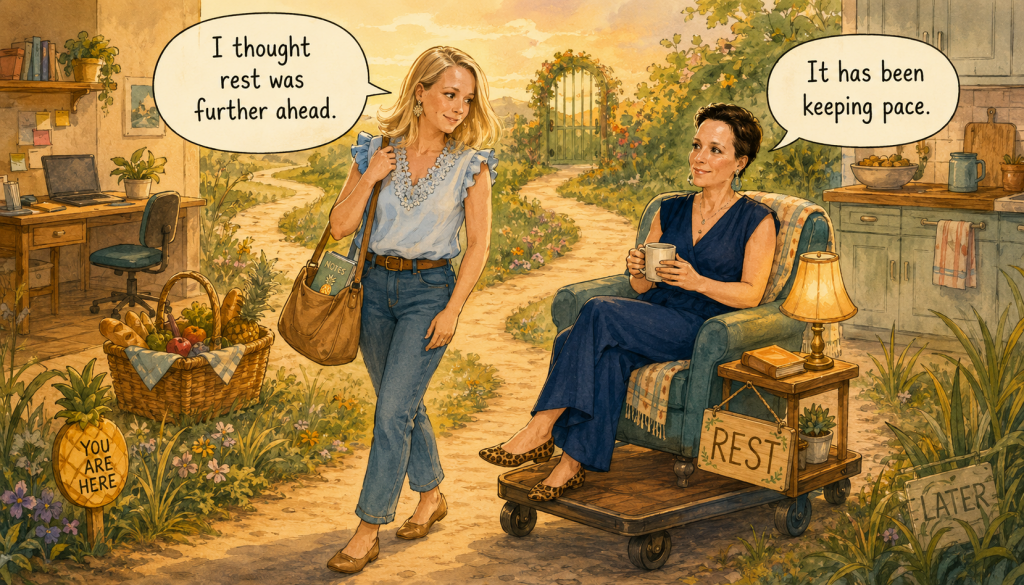
A house without rest
I was asked what would disappear if nobody rested properly.
My first thought was simple.
Good mood.
When everyone is tired, people stop thinking about each other. They become impatient. They become irritated. Living together becomes more difficult.
I can see it in my own family.
When all four of us are tired, everyone knows who should probably be left alone for a while.
My husband becomes louder. My daughter answers loudly as well. Sometimes doors close with much more force than necessary.
I usually choose another strategy.
I stay quiet.
I know that speaking in the middle of that moment rarely makes anything better.
Sometimes the kindest thing you can do is simply wait until everyone has rested.
Learning what rest means
I don’t think rest is exactly something we earn.
But I also understand why many people feel that way.
When I was growing up, sitting on the sofa during the day watching television simply wasn’t something we did. There was always work to do. There was always something useful waiting.
Even now, I rarely watch television during the daytime.
Those habits stay with us.
But I also believe every person has to learn what they personally need.
Too little rest doesn’t only make us tired.
It makes us stressed.
It changes our mood.
It can make us sad.
Eventually, it can even make us ill.
We hear more and more stories about burnout now than we did years ago. That isn’t happening by accident.
Modern life asks a great deal from us.
Perhaps more than we realise.
Rest is part of a healthy life
Towards the end of our conversation, we spoke about working hours in different countries.
Some people work long days for little reward. Others have shorter working weeks. Every country seems to organise work differently.
But no matter where we live, one thing remains true.
We all need time to recover.
Not because we are lazy.
Not because we have earned permission.
Simply because we are human.
Perhaps that is the lesson I am slowly learning.
Rest isn’t something waiting at the end of the to-do list.
It is one of the reasons we are able to keep living the rest of our lives with patience, kindness and good humour.
And maybe that is why it matters so much.