
Human or Computer? I Was Asking the Wrong Question.
I began by arguing that human conversation could do something AI could not. Bruce disagreed. Somewhere between a printing press, a LinkedIn problem, organisational messiness and a table of elderly men drinking coffee, a more interesting question emerged: how do we combine the two without losing the human part?
By Bruce Lloyd, London and Frank Peters, Cleebourg.
A few days before my conversation with Bruce, I found myself standing in front of an old-fashioned printing press in Strasbourg.
It was a small, portable machine at an exhibition for people involved in printing and publishing. To print a word, you first had to choose the individual letters and arrange them by hand. There was one complication: the word had to be assembled backwards and upside down.
I chose, for obvious reasons, pineapple.
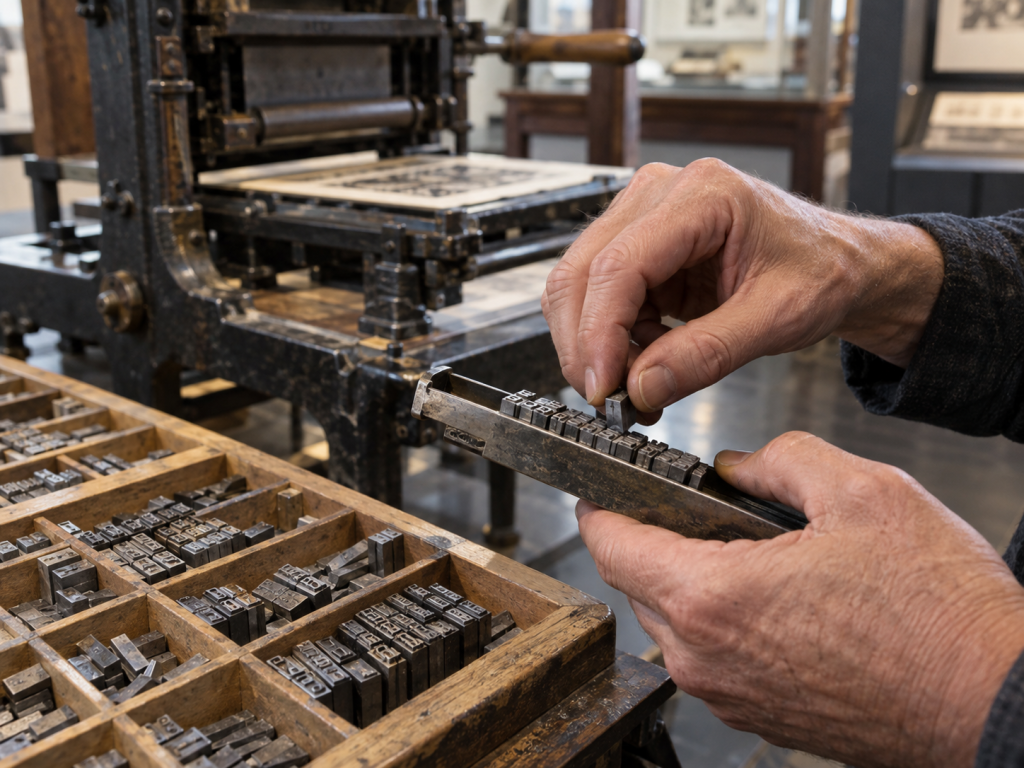
There was something wonderfully physical about the whole process. I picked up each little letter, placed it into the rack and tried not to muddle everything. A young person beside the press explained what I had to do in a mixture of French and English. Eventually, we printed it.
I walked away carrying a sheet of paper with the word Pineapple on it, a new contact and a head full of impressions.
The printed word was almost beside the point. What stayed with me was everything around it: another person showing me how something worked, the slight struggle with language, the two of us figuring it out together and, at the end, an object I could actually hold.
A few days later, when Bruce and I started talking about AI, I thought I knew what that experience had taught me.
Not quite.
I thought humans had the advantage.
My argument was fairly simple. AI is extraordinarily good at producing the what: facts, explanations, information and possibilities. Human beings, I suggested, are better at connecting the invisible dots that appear while two people are talking.
We notice something and interrupt. We change direction. We wonder why somebody said something in quite that way. We bring history into the room. We hear hesitation. Sometimes we notice what has not been said.
I had experienced exactly that in the conversation immediately before speaking with Bruce.
The person I had been talking to worked in an organisation I had known, on and off, for many years. A works council had recently been created there. An AI system could easily explain how works councils operate, what the formal requirements are and how the structure works.
But that was not really what interested me.
I wanted to know why it had happened. What had gone on inside the organisation beforehand? What had management done? What had employees experienced? What had been communicated badly? Which tensions had accumulated, and what might happen next?
There was history involved. Personalities. Relationships. Interpretation. Speculation. All the untidy bits.
Human messiness.
My argument to Bruce was that another person can sometimes get to this material remarkably quickly. I ask a question, listen to the answer and immediately follow whichever thread suddenly becomes interesting. With AI, I said, I first have to formulate a prompt, receive an answer, process it and then decide what to ask next.
Humans, I announced, might actually be more efficient.
Bruce was unconvinced.
Ask a human being a question, he pointed out, and it is remarkable how often they answer a completely different one. Sometimes they tell you what they want you to know. Sometimes they want attention. Sometimes they want to control the discussion. Sometimes there is a personal agenda quietly sitting underneath the answer.
AI does not have quite the same problem.
That stopped me, because irritatingly, he had a point.
It starts where you are.
Bruce had recently had a technical problem involving two LinkedIn accounts, one of which had unexpectedly reappeared. He turned to ChatGPT.
What impressed him was not simply that it helped solve the problem. It stayed focused on the problem he had actually brought to it. If he did not understand a word, he asked what it meant. The explanation appeared and he carried on.
No impatience. No embarrassment about asking a basic question. No expert waiting for an opportunity to demonstrate how expert they were.
That led Bruce to make an observation about instruction manuals.
A manual for a washing machine, camera or piece of software usually starts where the manufacturer wants to start. It explains the machine, gives you the background and tells you everything the technical people believe you ought to know.
AI can start somewhere else.
“It starts with where you are,” Bruce said.
It is a small sentence with rather large consequences.
If my problem is that one particular button will not work, I do not necessarily want the history of the machine. I want to know why the button will not work. The same applies to an endless YouTube tutorial where somebody introduces themselves, explains the equipment, describes the problem and reminds me to subscribe before eventually reaching the fifteen seconds I actually need.
AI can go straight there.
I could hardly disagree, because I use it in much the same way myself.
I have used ChatGPT to create WordPress plugins. I describe what I want, work backwards and forwards with it and eventually upload something that works. Tasks for which I might once have needed a programmer can, in certain circumstances, now be done directly.
More recently, I built another system because I had acquired a different problem: too much information.
Even in my tiny operation, conversations, ideas, notes and possibilities accumulate frighteningly quickly. After my Strasbourg trip, I spent much of the journey back to the station typing thoughts into my phone. By the time I got home, there were roughly two hours of impressions sitting there.
So AI helps me turn the mess into something usable. It can compress conversations and notes, find recurring threads and turn some of them into possible actions. I call the system my compass.
I produce the mess.
The computer helps me sort it.
That is quite a productive relationship.
The technical answer and the social answer.
The longer Bruce and I talked, the less convincing my original contest between human and computer became.
Bruce offered a distinction that was much more useful.
AI can be very good at giving us the technical answer.
The social answer is harder.
That matters because an enormous amount of what happens inside organisations is social rather than technical. A new structure may make perfect sense on paper and still fail because people resent it. A change may be economically rational and socially disastrous. An organisation can possess mountains of information and still fail to understand itself.
Bruce had recently been thinking about what he called “corporate amnesia”: what happens when somebody leaves an organisation and takes years of accumulated knowledge with them.
Not everything we know sits in a manual.
Some knowledge exists in memory, habit and experience. It is the story behind why something is done in a particular way. It is knowing whom to speak to, what failed ten years ago, which apparently sensible idea will cause an almighty row and which problem everybody knows about but nobody has written down.
That is the historical messiness inside an organisation.
AI may become extremely good at organising this material. We may even need it simply because the quantity of information we produce is becoming impossible for individual human beings to manage.
But Bruce added another question before we rushed off and collected everything.
Why do you want to know?
Without that question, we may simply produce more information.
And we already have plenty.

Just because we can.
At some point, as these conversations tend to do, ours wandered into lasagne.
Bruce had eaten a particularly impressive one in a London restaurant. He photographed it, uploaded the picture to ChatGPT and asked about it. The system suggested ingredients and explained how something similar might be made.
From there we somehow arrived at kitchen robots, automated grocery deliveries, intelligent refrigerators and drones bringing missing bottles of milk to the house.
Technically, you can imagine the whole thing becoming automated.
Which made me ask what seemed the obvious question: do we actually want this?
Bruce corrected me again.
That was not quite enough.
We also have to ask who benefits. What does it cost? Who loses? Who has an interest in it happening, or in preventing it from happening?
Technology does not arrive in an empty room. It enters workplaces, families and communities. It changes jobs and creates advantages for some people while creating difficulties for others. It collides with regulation, economics, habits and values.
The fact that something can be automated tells us remarkably little about whether automating it is wise.
Somebody still has to decide what matters.
And that becomes more difficult when the technology is also giving us more possibilities than we have ever had before.
I can see this in my own work. My thinking has changed since I started using AI heavily. My questions have changed. I can explore something from several directions, test ideas quickly and build things I could not previously have built.
Bruce sees the danger in that too.
More possibilities mean more choices, and eventually, if we actually want to make something happen, we have to choose. AI can give me ideas, alternatives, strategies, recommendations and another seventeen things I could theoretically do on Thursday afternoon.
It cannot give me another Thursday afternoon.
At some point, somebody has to stop generating possibilities and act.
For years, we worried about not knowing enough. One of the stranger problems of the AI age may be learning how to cope with knowing too much.
Two elderly men drinking coffee.

Towards the end of our conversation, I tried to bring us back to where we had started.
Were these conversations of ours interesting?
Bruce thought so.
Enjoyable?
Yes.
Worthwhile?
Again, yes.
And shareable?
Well, they keep ending up in The Pineapple.
Bruce then added something that changed the question slightly. If we simply had an interesting conversation every week and left it there, he said, there would always be another question hanging around at the back of his mind.
What do we do with it?
Turning a conversation into something that can be shared gives it another dimension.
I joked that otherwise we would merely be two elderly men with nothing better to do than drink coffee and philosophise about the world.
Bruce rather liked the image.
He had seen groups of older men sitting around tables on Greek islands, drinking coffee and talking. He wondered what would happen if we could sit with people like that, use technology to help capture their stories and simply ask what they had learned from being alive.
Not because every memory is profound, or because age automatically produces wisdom. It plainly does not.
But experience disappears.
People leave organisations and take knowledge with them. Families lose stories. Communities lose memories. People spend decades discovering things and much of what they discover never becomes available to anybody else.
Bruce put it rather more sharply:
“The human race is wasting its experience of being human.”
That was the sentence that stayed with me.
Perhaps the machine is not the point.
I had gone into the conversation trying to work out whether human conversation was better than AI conversation.
By the end, the competition no longer seemed particularly useful.
For a technical problem, I may actively prefer the computer. It is patient, starts where I am and does not need to impress me. It can sift through information at a speed no individual human being can match.
But for other things, I want another person.
I want the detour, the raised eyebrow, the inconvenient memory and the sentence I had not expected. I want the story that makes me abandon the clever question I had prepared and ask a better one.
And afterwards, increasingly, I want the machine again.
Bruce and I were sitting roughly 700 kilometres apart while having this conversation. A transcript appeared on my screen as we spoke. Afterwards, technology helped me work through what we had said, sort it and find the thread running through it.

None of that made the conversation less human.
It stopped some of it disappearing.
Perhaps that is the balance I had been trying to find.
Not human or computer, and not a romantic defence of conversation against technology. Equally, not the assumption that every awkward or inefficient human interaction should be automated away.
The computer is extremely good at helping us do things.
The harder question is what is worth doing.
And for that, I still want somebody on the other side of the table.