
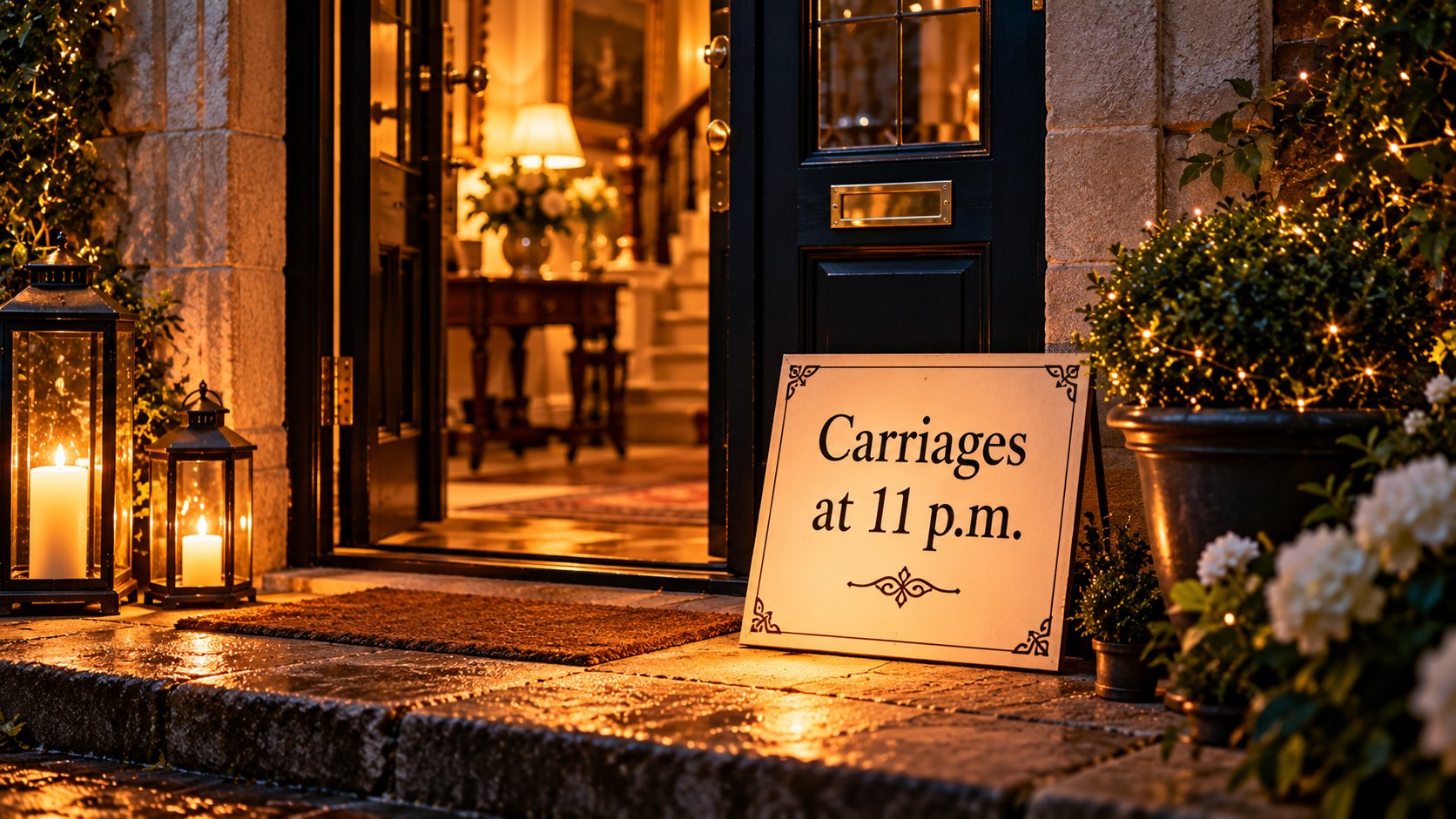
Carriages at 11, Slippers by Thursday.
When should a guest leave? At Lunch, the answer involved old-fashioned etiquette, disappearing hosts, bed bugs, flying furniture and a rather worrying dinner invitation.
By Rosii in Sao Paulo, Monica in Adelaide, down under, the Mayor in Indian Summery Cleebourg and hosted by Fruitloop in sizzling South Africa. What could go wrong?
It started with a perfectly innocent question. When you visit someone for coffee or dinner, how do you know when it is time to leave?
You might think the answer is simple. Finish your coffee, thank your host, collect your belongings and go home. But at Lunch with Janita & Frank, simple questions have a habit of becoming complicated, particularly when Fruitloop starts asking them and the Mayor decides that modern civilisation has lost its manners.
Rosii, joining from Brazil, thought it depended entirely on the company. Dinner might be followed by dessert, coffee and conversation, and before anyone notices, it is one o’clock in the morning. With a best friend or her sister-in-law, that would not necessarily be a problem. Sometimes the conversation is simply too good to end.
The Mayor had a slightly different approach. He suspected he might outstay his welcome within the first five minutes.
He was joking, of course. Mostly.
In his view, knowing when to leave is something we learn without ever being formally taught. We watch our parents, observe other people and gradually absorb the invisible rules of social behaviour. Nobody hands us a rulebook explaining when the final cup of coffee becomes one cup too many.
Fruitloop agreed that the relationship matters. A visit to a friend might last an hour or two, while a visit to her sister or parents could continue much longer. Her sister would probably encourage her to stay.
The Mayor wondered whether that might still be true twenty years later.
“Thirty years,” Fruitloop corrected him.
Clearly, some families have very generous visiting hours.
Whatever Happened to Carriages at Eleven?
The Mayor then transported everyone back to what he remembered as polite society in England, when invitations could contain a wonderfully useful instruction: Carriages at 11 p.m.
There was no need for awkward hints, nervous glances at the clock or elaborate excuses about tomorrow’s early start. Your carriage was expected at eleven, which meant you were expected to be outside waiting for it.
The Mayor thought this was an excellent arrangement. Everyone knew when the evening would finish, and nobody had to wonder whether another glass of wine or another helping of dessert was pushing their luck.
The only difficulty was finding a modern replacement.
Should invitations now announce Cars at eleven? Perhaps Limousines, scooters and electric bicycles at eleven? And what about guests arriving on foot?
Whatever the transport, the Mayor was convinced that modern hospitality had lost something valuable when it abandoned the clear departure time.
Monica, joining from Australia, had inherited a similar philosophy from her late mother: “A good guest always knows when to leave.”
She also remembered another piece of advice. If you do not want somebody to stay too long, give them an uncomfortable chair.
That sounded wonderfully practical until Monica remembered a German family acquaintance who once arrived at their doorstep and stayed far longer than expected. Her family eventually needed the room for an aunt who was coming to Adelaide for medical treatment.
The visitor did finally leave, although Monica joked that without a reason to move him along, he might still be there.
Suddenly, the uncomfortable chair seemed rather inadequate.

When the Host Goes to Bed.
Fruitloop introduced another problem. Suppose you have invited friends for dinner, but halfway through the evening you begin dreaming about your sofa, your pyjamas and the wonderful possibility of being left alone.
Fruitloop had experienced something remarkably similar.
Years earlier, she had hosted a barbecue with her then-boyfriend and some friends. By approximately one in the morning, she had reached her limit. Rather than interrupt the gathering, she simply announced that everyone could carry on without her.
She took a shower, put on her pyjamas and went to bed.
The guests apparently had enough alcohol to occupy their attention and barely noticed her departure.
The Mayor was scandalised.
He wanted to know whether this might have contributed to the boyfriend eventually becoming an ex-boyfriend.
No, Fruitloop assured him. There were other reasons.
The Mayor then remembered an occasion when his own then-girlfriend had fallen asleep on the sofa while they were entertaining dinner guests. He had been mortified, and they had words about it afterwards. She, however, had not been particularly apologetic.
Two hosts, two disappearing acts, and rather different reactions.
Monica admitted that she had sometimes started dreaming about her pyjamas before the guests had even arrived. There are evenings when arrangements made enthusiastically two weeks earlier suddenly seem like a terrible idea. Fortunately, she added, once everyone arrived, the evening often turned out much better than expected.
Rosii understood the feeling too. These days, when her eyes begin closing around midnight, the attraction of bed becomes difficult to resist.
The Mayor thought the whole situation raised a more serious question. What does it actually mean to host somebody?
A dinner party, he argued, requires thought. Who are you inviting? What will you cook? Who will sit together? Will the conversation flow? Are you hosting because you genuinely want to spend time with these people, or simply because it is your turn to invite them?
He pictured the exhausting social obligation of entertaining the Joneses, with everyone smiling politely through dinner before going home to complain about the food and wine.
Perhaps, he suggested, people sometimes spend so much energy fulfilling social expectations that they forget to enjoy the occasion itself.
And just when the conversation was becoming dangerously sensible, Fruitloop remembered a cartoon.
In the programme her son had been watching, a little boy hosted a lively party while a strange creature next door held a much less successful gathering. The creature’s guests became so bored that some fell asleep and one began losing his arms.
When the boy borrowed party punch from his neighbour, he explained that he did not want his own party to become one of those gatherings where people’s arms fell off.
Eventually, the bored guests abandoned the creature’s party. One even left his detached arms behind.
The creature called after him to collect them.
“Keep them,” came the reply.
The Mayor immediately recognised the opportunity for a joke about leaving a party legless.
Apparently, the standard of hospitality had now fallen from uncomfortable chairs to actual loss of limbs.
The Guest Who Came for Coffee and Never Left.
Fruitloop was only warming up.
Imagine, she suggested, inviting somebody for coffee on Monday. By Thursday, that person is still sitting on your sofa, wearing your slippers and asking what is for dinner.
How do you get rid of them without being rude?
Rosii was genuinely troubled. She searched for a polite solution, perhaps mentioning an appointment or something important she needed to do. But the more she considered the situation, the more difficult it became.
After all, she pointed out, the guest was already behaving impolitely.
Monica had a much more imaginative answer.
She could announce that she was fasting and would not be preparing dinner. Alternatively, she could direct the visitor to the nearest McDonald’s.
But her favourite solution involved pest control.
She would tell the guest that the house had developed a bed bug infestation and exterminators were arriving the following day to fumigate everything. Naturally, everybody would have to leave while the chemicals were sprayed.
The Mayor questioned why anyone would remain in somebody else’s home for four consecutive days in the first place.
Monica was not interested in reopening the investigation. They already had a problem. What they needed was a solution.
The Mayor, however, had an entirely different interpretation of the situation.
He proposed that, for the purposes of his answer, he should be considered single. Since Mondays were usually filled with meetings, the only person likely to receive an invitation for coffee would be an extraordinarily attractive woman he had admired for years.
If she was still sitting on his sofa on Thursday, wearing slippers and requesting dinner, he would not regard that as a hospitality emergency.
He would regard it as romantic success.
The table now had two competing proposals: Monica’s pest-control operation and the Mayor’s imaginary love story.
Fruitloop refused to choose a winner.
“We don’t choose. We add both.”
Then she revealed her own solution.
At home, Fruitloop, her husband and son have a family joke. Whenever someone asks what is for dinner and nobody has planned anything, the answer is “each other.”
So, if an unwanted guest was still demanding dinner on Thursday, Fruitloop would simply announce that everyone was going to eat each other.
And they would start with the guest.
The Mayor became understandably concerned about his future invitation to South Africa.
First, he had been informed about the appropriate greeting. Now there was a possibility that he might become dinner.
Fruitloop reassured him that he would still be welcome. Besides, if he stayed long enough to wear her slippers, he would probably discover that they were much too small and he is now part of the family.
The Mayor was confident that slippers could stretch.
The International Guest and Goodbye Association.
By this stage, ordinary social etiquette was clearly beyond repair. Fruitloop decided that what the world needed was legislation.
Everyone was invited to imagine becoming president of the International Guest and Goodbye Association, with the power to introduce one completely ridiculous law governing visits and an equally ridiculous punishment for breaking it.
The Mayor borrowed inspiration from the BBC radio programme Just a Minute, in which participants must speak on a subject without hesitation, repetition or deviation.
He proposed a similar rule for guests, with a punishment inspired by a comic tale about losing bread in Swiss cheese fondue.
Offenders would be thrown into a lake.
Fruitloop suggested a river might be more effective, since the current would carry the offender away.
The Mayor approved of the practical advantages.
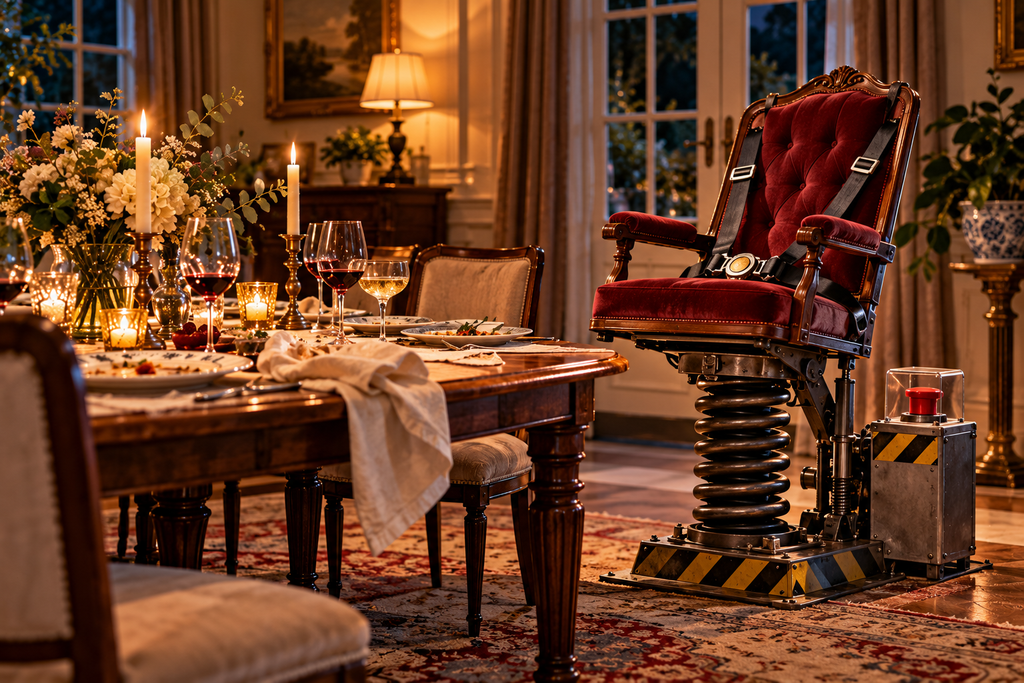
Monica had already imagined something considerably more technological: an ejector seat.
Guests who ignored repeated hints that it was time to leave would be launched through the roof and into the atmosphere.
Unfortunately, this created several architectural difficulties. The Mayor pointed out that a two-storey house would complicate matters considerably, while installing such equipment in Rosii’s apartment building could prove rather inconvenient for the neighbours upstairs.
Planning permission might also be a problem.
Fruitloop suggested that perhaps dinner parties should simply be held outside, where there would be fewer ceilings to worry about.
Somewhere between the imaginary ejector seat and the discussion of outdoor alternatives, the International Guest and Goodbye Association was beginning to look like an organisation that should never receive official recognition.
The Last Grain of Rice.
When it was Fruitloop’s turn to invent a law, she surprised everyone by becoming almost reasonable.
Her rule concerned dinner plates.
If you are a guest at her table, she would like you to finish your food, or at least gather the leftovers together rather than leaving little bits scattered across the plate.
She was particularly irritated by a few grains of rice or pieces of potato that, when collected together, would make another perfectly good mouthful.
Why leave them?
The Mayor immediately demanded clarification about bones. Surely guests were not expected to eat those too?
Of course not, Fruitloop explained. She would provide somewhere to put them.
Her objection was to perfectly edible food being abandoned in little corners of the plate.
This led the Mayor into a discussion of table manners, particularly the correct way to hold a fork when eating peas.
Should food be placed on the curved back of the fork, as in traditional English table manners, or scooped up from the other side?
Fruitloop was wonderfully unconcerned.
It depended on what she was eating. Sometimes she used one side, sometimes the other. Her sister was right-handed but held her fork in her left hand.
As far as Fruitloop was concerned, the important thing was to eat your dinner and clear your plate.
The Mayor was not entirely satisfied. He seemed to think that an invitation to Fruitloop’s house ought to come with detailed instructions about everything from footwear to cutlery.
By now, the hypothetical visit had become an elaborate operation. He might arrive overdressed, borrow clothes from Fruitloop’s husband, squeeze into her slippers, risk becoming the main course and then face judgement over the direction of his fork.
He was beginning to wonder whether he would ever make it through customs.
One Last Question Is Also a Hint.
Earlier in the conversation, Fruitloop had asked everyone to invent a secret emergency signal that would tell guests it was time to leave.
Monica remembered hearing that Queen Elizabeth II used the position of her handbag to signal that she wished to move on from a conversation.
Rosii suggested simply collecting her purse and announcing that she needed to go home.
The Mayor refused to reveal his secret signal because, naturally, that would mean it was no longer secret.
He eventually proposed a far more theatrical departure. A guest could tap a spoon against a crystal wine glass, stand up and deliver a magnificent farewell speech, praising the food while admitting that the company had been rather boring.
Naturally, he would also expect his borrowed clothes to be exchanged for his own suit before departure, preferably freshly pressed.
Fruitloop was willing to hang the suit neatly.
Dry cleaning, however, was apparently not included in her hospitality package.
Eventually, Fruitloop announced that she had one last question.
The Mayor immediately recognised this as a possible signal that the gathering was nearing its end.
Yes, she confirmed. One last question meant it was almost time to go.
When he asked how long everyone’s answers could be, she warned that she might interrupt if they became too long.
He declared this very impolite.
But the meeting continued, with more rules, more imaginary punishments and a discussion of table manners that could probably have lasted until the next meal.
Finally, Fruitloop announced that she really did need to leave.
The Mayor took the hint.
And, after an entire conversation devoted to the art of saying goodbye, everyone began saying goodbye. There were thanks, good wishes, promises to meet again and the familiar difficulty of ending a pleasant gathering when nobody wanted to be the first to disappear.
Perhaps Rosii had understood the situation from the beginning. Sometimes the conversation is so enjoyable that you simply keep talking until one o’clock in the morning.
Other times, your host is already wearing pyjamas, somebody has threatened to release bed bugs, and the International Guest and Goodbye Association is preparing to launch you through the ceiling.
At Lunch, fortunately, nobody needed an ejector seat.
Fruitloop had already discovered a much simpler solution.
“Your time’s up.”
And even the Mayor eventually accepted that.
Although he might still prefer a carriage waiting outside.