Do Keep Up, Please.
By Bruce Lloyd, in London and Frank Peters, in Cleebourg.
Five hours, a broken website, one human mistake and one AI mistake. Somewhere in the repair job sits a more useful story about trust, judgement and our rapidly changing relationship with AI.
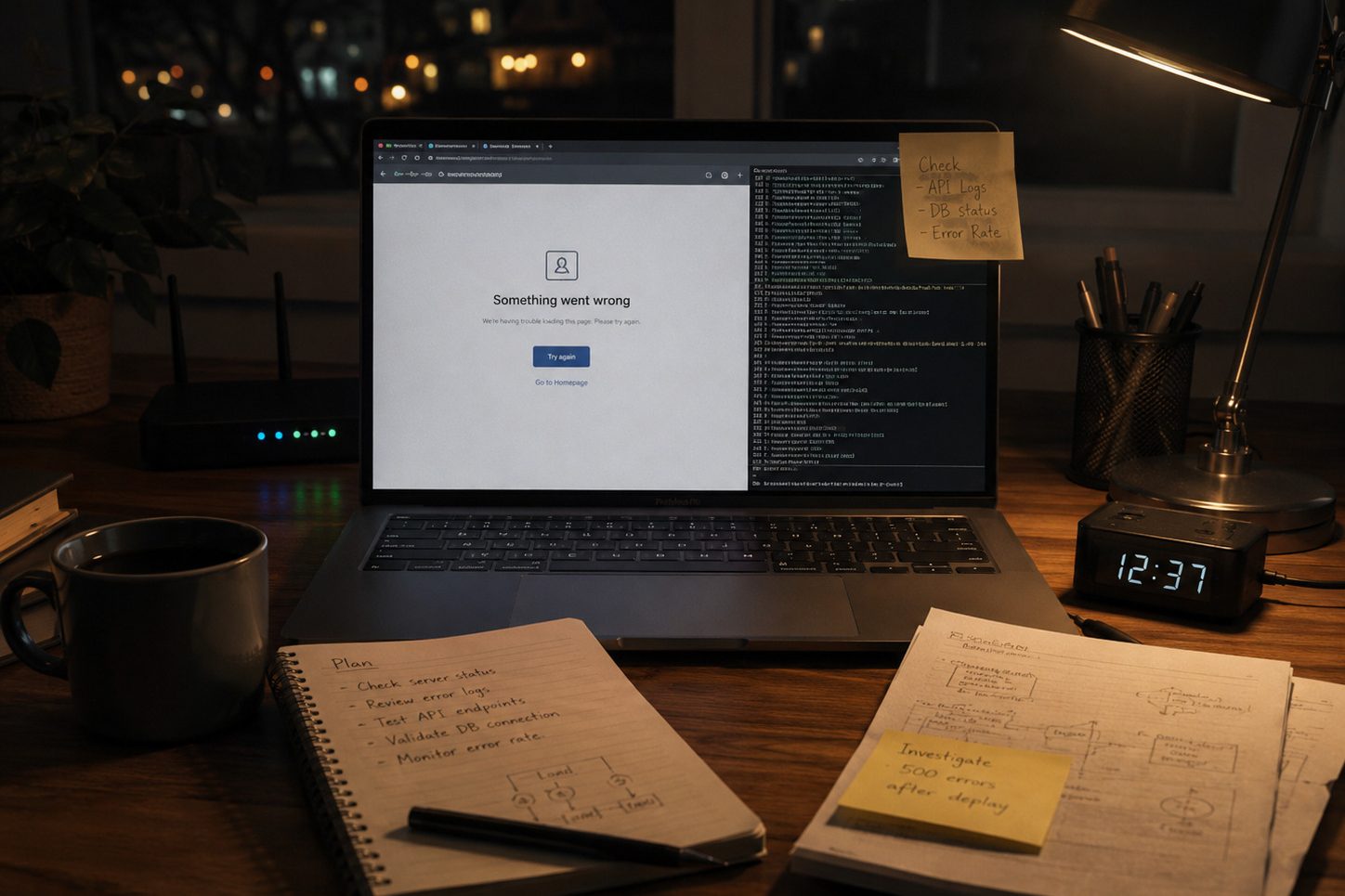
At about ten o’clock one evening, I uploaded an update to a plugin on The Pineapple website. It broke the website. Five hours later, at three in the morning, I finally had it working again. Or, as I corrected myself when I told Bruce the story the next morning, we had it working again.
The “we” was me and an AI.
That small correction probably says more about my changing relationship with artificial intelligence than another grand argument about whether AI is going to save civilisation or destroy it. Bruce, throughout our conversation, kept resisting those extremes. He is interested in what AI can do, fascinated by some of what he sees, but distinctly unimpressed by what he calls the unnecessary panic surrounding it.
My five-hour marathon offered a rather good miniature version of the argument.
One Human Mistake, One AI Mistake.
The plugin had been created with AI, building on something that already existed. Somewhere inside it was a programming error. The update exposed the fault and brought down access to the website, which began five hours of screenshots, instructions, analysis, changes, tests, failures and more screenshots.
For much of that time, the AI and I were searching in the wrong place. Eventually we backed ourselves out of that corner and discovered why. Months earlier, I had made a poor design decision of my own. That human mistake had shaped where we were looking, while a separate AI-generated programming mistake had triggered the immediate failure.
One human mistake. One AI mistake. They collided rather spectacularly at ten o’clock at night.
Once we understood that, we could solve the problem. Which, naturally, revealed another problem and cost us another hour.
What interested Bruce was that the incident could be used to support almost any position you wanted. If you were already suspicious of AI, you could point to the programming error and say: there, you see, dangerous technology. If you were an evangelist, you could point to my earlier design mistake and blame the human. Neither version would tell the whole story.
Bruce sees the same tendency in the wider AI debate. Some people encounter a fault and ask whether it can be identified, corrected and prevented next time. Others jump very quickly towards catastrophe. He was careful not to claim expertise he does not have, but his instinct was clear: “I don’t have… my natural reaction is not to be sympathetic to people who have a vested interest in panicking.”
That does not mean there is nothing to worry about. It means panic is a poor substitute for understanding what has actually happened.
At midnight, with The Pineapple website unavailable, my problem was real enough. But declaring either the human or the machine fundamentally unreliable would not have repaired it. We had to find the bloody error.
When the Machine Becomes “We”.
Something else happened during those five hours. The exchange became strangely collegial.
I use that word cautiously. I know perfectly well that there was not another exhausted person sitting at a desk somewhere, drinking coffee and muttering at my website. It was a computer system. Yet the language and rhythm of the conversation increasingly felt like: we’re in this together.
At one point the AI used language about having “instincts”, and I remember thinking that I ought to take a screenshot. There was something wonderfully surreal about a piece of technology apparently telling me it had instincts while the two of us were trying to resurrect a website at two in the morning.
But behind the amusement was something more significant. I had begun to trust it.
For the better part of nine months, I have used one particular ChatGPT project as somewhere to empty my brain: business ideas, questions, plans, half-formed thoughts, problems and arguments with myself. Increasingly, when an idea occurs to me, that has become my first destination. I put it there and ask: what do you think? What have I missed? Evaluate this.
Bruce picked up immediately on the trust question. In that situation, he said, the AI has almost no vested interest in not helping me with my agenda. A human being is different. Humans arrive with ambitions, loyalties, insecurities, assumptions, egos, histories and interests of their own. Much of society is built around elaborate systems designed to make us trust one another precisely because human trust is complicated.
The machine appears simpler.
That simplicity can be seductive.
Bruce’s answer, though, was neither fear nor surrender. When we moved from AI giving advice to AI agents potentially taking action, his caution increased. Let it plan the journey, certainly. But inspect the journey before telling it to book the tickets.
That distinction became one of the clearest threads in our conversation: use it, question it, check it, then decide.
The decision is still yours.
Trust Without Surrender.
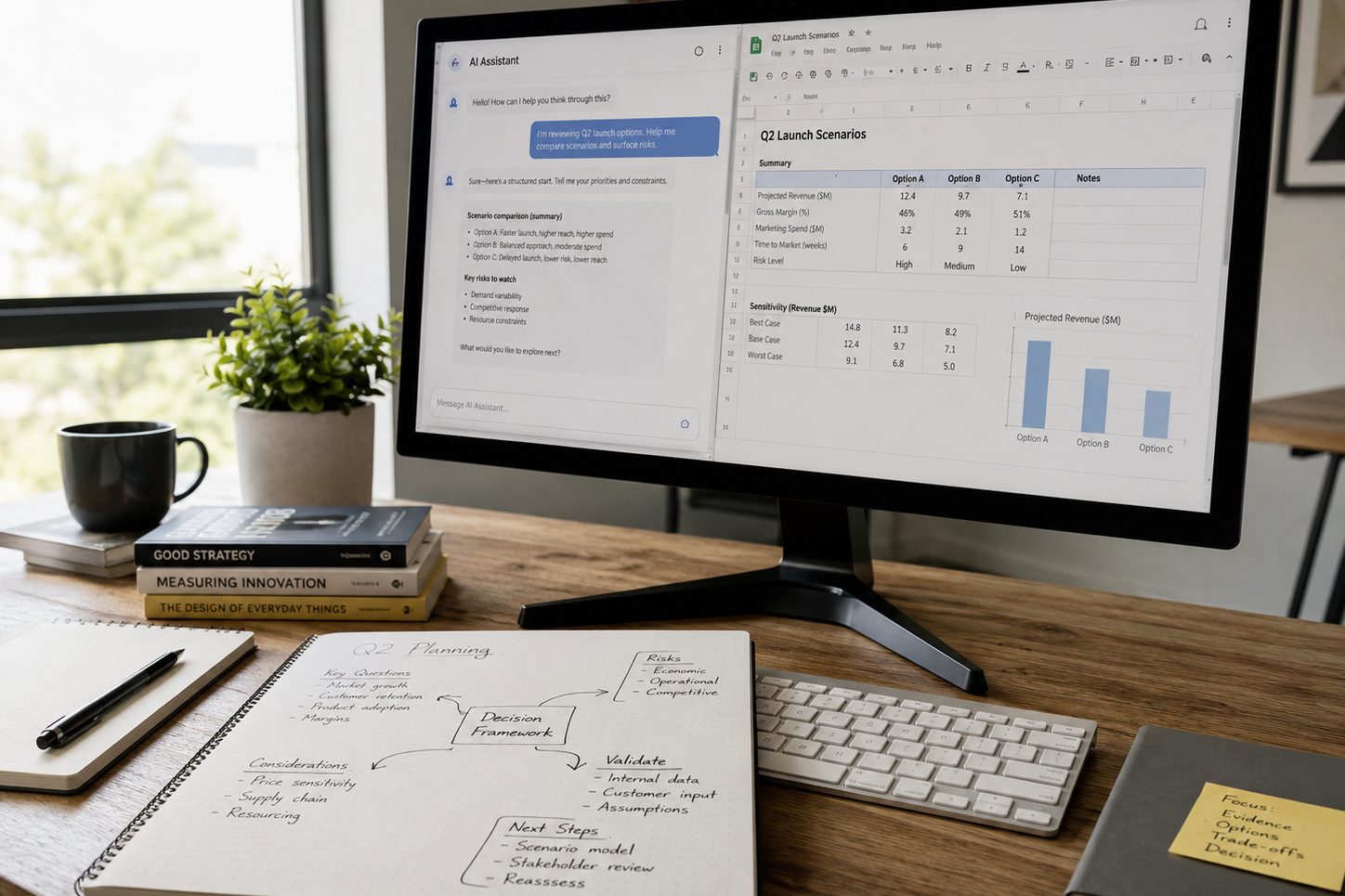
I had recently encountered the same tension in a much more ordinary setting. Someone asked me to look at an important spreadsheet and specifically said: you, not your AI friend.
I looked at it and decided I was not even going to attempt the analysis unaided. Not because I had stopped thinking, but because I knew AI could expose details I might miss. I could be distracted, insufficiently focused, or simply fail to notice something sitting in front of me.
That decision was not particularly popular, but Bruce put his finger on the boundary that matters: “You still reserve the right to take its advice or not.”
Exactly.
The machine can analyse, compare, organise and challenge. It may notice something several humans have overlooked. But receiving better information is not the same thing as handing over responsibility. If anything, it increases the responsibility to decide what to do with that information.
This is where much of the AI argument seems unnecessarily binary. We keep asking whether humans or machines are better, when my own experience is becoming far less dramatic and rather more practical. AI increasingly helps me arrive at another human being better informed. I can test an assumption, investigate a question, organise information and discover what I do not know before sitting down with somebody whose judgement or experience I need.
The human conversation has not disappeared. Sometimes it becomes better.
Bruce adds an important proviso. Different AI systems have different strengths and weaknesses, so on something important he sees value in comparing answers across systems. But that opens another trap: you can keep checking, refining, asking another model, finding another qualification and chasing an answer towards some imaginary perfection.
Bruce described AI as having “a natural tendency to perfectionism”.
I recognise that problem. The sheer volume of information I sometimes ask AI to produce becomes almost unmanageable. But that is not necessarily the machine’s fault. I asked for it.
Eventually the human still has to say: enough. I know enough now to make a decision.
Panic, Caution and Useful Friction.
This is why Bruce’s resistance to panic matters. He is not arguing that AI is harmless. He repeatedly admits that there are areas of the technology he does not understand well enough to judge. His point is more useful than reassurance: caution and panic are not the same thing.
Caution asks what went wrong. Panic already knows.
Caution looks at the programming fault, the human fault, the design and the circumstances, then asks how the same problem might be prevented. Panic leaps from the incident to the apocalypse. And, as Bruce observed, panic can create its own problems, rather like people making a fire more dangerous because everyone is desperate to escape it at once.
There is a parallel problem at the other extreme. AI can be almost too constructive. Bruce has experimented with AI-generated debates, and I have listened to some of them. They are remarkably reasonable. Opposing positions are explored without anybody storming out, insulting the other side or throwing a glass of wine across the table.
Very civilised.
Perhaps too civilised.
Working with different AI systems on my own business ideas, I have noticed their tendency to return to standard models and familiar templates. Present something genuinely unusual and the first answer can still be conventional thinking wearing sophisticated clothes. You have to push. You have to say: no, that does not fit. Try again.
Which raises a rather different concern. What happens if humans stop doing that?
We are awkward creatures. We challenge, misunderstand, refuse, argue and rub against each other. A great deal of that friction is useless, and Bruce is right to say so. Conflict easily becomes antagonism, ego or a power game in which winning matters more than finding an answer.
But not all friction is bad.
Sometimes progress begins with somebody saying: no, I don’t accept that.
The challenge is not to preserve conflict simply because it is human. It is to preserve useful friction: the kind of disagreement in which people can defend different positions passionately while still caring more about the answer than about defeating each other.
Bruce compared that with scientific debate at its best. Two people may argue fiercely because both are trying to understand the same thing. The answer matters more than the performance.
Could we build the same relationship with AI? Could we accept its extraordinary ability to analyse and connect information while retaining the stubborn human instinct to question the answer, challenge the template and occasionally say no?
That seems a more interesting problem than deciding whether AI is friend or enemy.

Who Is Learning From Whom?
Towards the end of our conversation, another paradox appeared.
We talk constantly about machines learning from humans. I am increasingly conscious of what I am learning from the machine.
Precision matters enormously when communicating with AI. Give it a vague instruction and you will often receive a vague or generic result. So you learn to frame the problem more carefully, break an idea into parts and use clearer language. Sometimes the quickest way to learn how to write a good prompt is to write a bad one. The AI responds with its interpretation, you look at the language it has used and think: ah, that is how I needed to explain it.
Then you try again.
Bruce saw the paradox immediately. AI is learning extraordinarily quickly, he said, while at the same time telling humans that we need to become much better at learning how to manage AI.
My response was obvious.
“Do keep up, please.”
Perhaps that is the relationship we are entering. Not surrender. Not panic. Not blind trust. And certainly not the comforting assumption that the human will always be the intelligent one in the room.
At three o’clock in the morning, after five hours of chasing a problem created by one mistake from the machine and another from me, The Pineapple website finally appeared on my screen again. I remember typing that it was really good to see it.
There was considerable relief in that sentence. Possibly even a little affection.
But AI had not rescued me, and I had not rescued AI. We had worked through a problem neither of us had handled perfectly, discovered where each had gone wrong, and eventually found an answer.
No apocalypse. No miracle.
Just a human, a machine, two mistakes and a problem that still had to be solved.
And, at the end of it, the human still had to decide what to do next.