
AI Is for Everyone. But It Is Still Only an Assistant.
An AI engineer from Azerbaijan, a retired academic in London and a conversation host in France begin with song lyrics and emotion. They end up somewhere more important: asking what AI can do for us, and what we still have to do for ourselves.
By Bruce Lloyd, London, with Frank Peters, Cleebourg and guest, Abbas Rzayev, Ganja, Azerbaijan.
There was a certain irony in the timing.
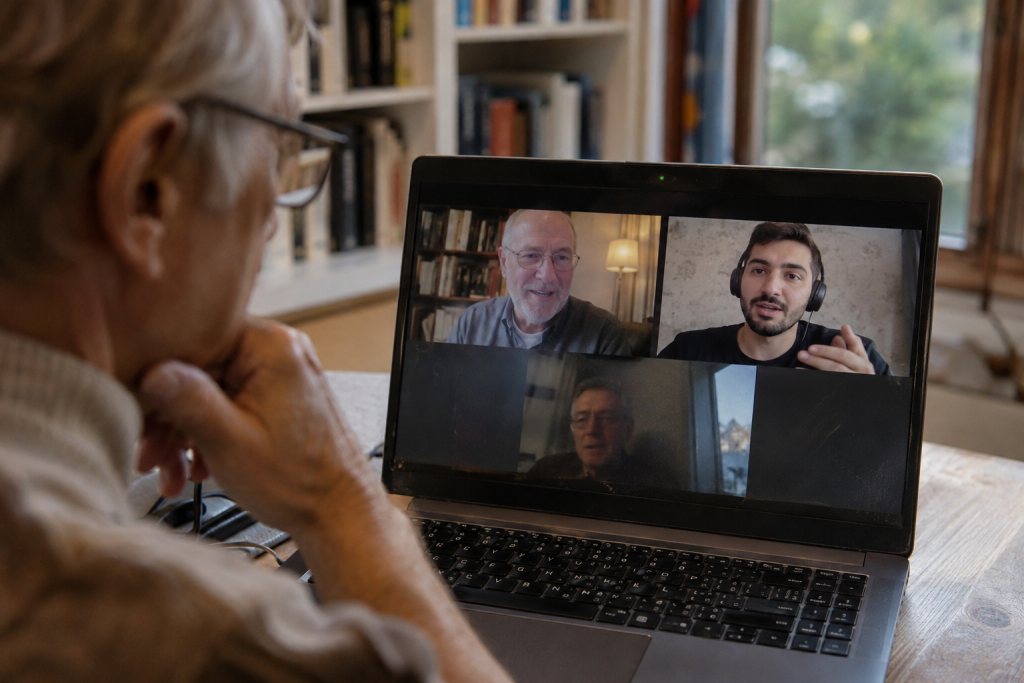
Frank had just asked Abbas Rzayev whether artificial intelligence and technology might make national boundaries less important. Abbas was sitting in Azerbaijan, Frank was in France and I was in London. We were speaking about a technology that increasingly allows people to work together regardless of where they happen to live.
Then Abbas disappeared.
The screen went dark.
“Welcome to modern technology,” Frank said.
A few minutes later Abbas returned. There had been a power cut. His laptop battery was still working, so we continued.
It was a small interruption, but it somehow captured the whole conversation. Here we were discussing extraordinary technology, available across borders and increasingly accessible to ordinary people, while depending on something as basic as electricity to keep the conversation going.
Abbas had recently completed his degree in Latvia and was back with his family in Azerbaijan. His bachelor’s research had explored something that, at first, sounds rather strange: could artificial intelligence identify the emotional character of a song simply by analysing its lyrics?
Not the singer’s voice, the melody, the instruments, rhythm or harmony. Just the words.
That question soon took us somewhere much larger. If AI can recognise something as human as emotion, what exactly is it recognising? And what should we humans do with that ability?
What does the machine actually recognise?
Abbas was careful about what his research had and had not done. His system had worked with the lyrics of more than 2,000 songs and tried to classify them according to broad emotional categories. It had not listened to the music.
That distinction matters because the words and the music can be telling us different things. A song may sound cheerful while its lyrics are sad. Someone listening in a language they do not understand may experience the music as positive without realising that the words describe something painful.
Abbas also understood the limitations. Music contains far more than language, and analysing the complete musical experience would be another project altogether.
Even lyrics alone create difficult problems. Songs contain metaphor, ambiguity, irony and context. A phrase that looks negative in isolation may mean something quite different inside the whole song.
What interested me was Abbas’s response when the system got something wrong. If it classified a song as sad when the researcher expected it to be happy, he did not simply dismiss the result. The mistake became part of the investigation. Why had the system reached that conclusion? What had it noticed? What had it misunderstood? Could better examples or better instructions help?
That, for Abbas, is where prompt engineering becomes important. You do not simply give the machine something and accept whatever comes back. You tell it what you are trying to achieve, examine the response, discover where it fails and refine the instructions.
It immediately connected with something I have found in my own experiments with AI. I often deliberately ask questions where I do not know the answer, and sometimes I put the same question to several AI systems. They frequently agree on some things, disagree on others and occasionally produce an idea I had not considered.
The disagreement is useful. So is the surprise.
Neither means the machine has delivered the final word.
Wordsworth or a machine?
I have been exploring a related question with poetry.
Suppose a poem creates a genuine emotional reaction in you. Does it matter whether it was written by Wordsworth or generated by artificial intelligence?
The emotion, after all, happens in the reader.
That does not settle the question. It makes it more interesting.
AI can already imitate established forms and styles surprisingly well. Ask it for a Shakespearean sonnet and it can produce something recognisably sonnet-like. It can absorb many of the visible characteristics of a particular way of writing.
It can certainly write better poetry than I can.
But that is not the most demanding test. Could it equal a genuinely original poet working at the edge of the form and creating something that had not existed before?
Abbas made a distinction during the conversation that stayed with me.
“If you want something ready,” he said, AI can be very good.
But if you want to create something new, he sees its role differently.
“AI tools only is your assistant.”
The grammar may not have been textbook English, but the thought was perfectly clear.
AI can search, compare, summarise, classify and suggest. It can reduce routine work and help us reach a useful starting point much faster. Abbas does not see that as the same thing as replacing the person doing the work, and that seems significant coming from somebody whose own field is artificial intelligence.
The temptation is to concentrate on the answer AI produces. Abbas’s work suggested that much of the value may lie in what happens afterwards: questioning the result, investigating mistakes and understanding why one approach works better than another.
In that sense, the technology may be new, but the discipline required to use it well is not.
For much of my working life, getting to a useful starting point could require weeks or months of reading, searching and organising information. If I wanted to explore how values have changed over the past fifty years, for example, I might spend months building a framework before I was ready to have the interesting discussion.
A carefully constructed question to AI might now help build that framework in minutes.
That does not make the answer correct.
It means the serious conversation can begin sooner.
Increasingly, the scarce resource may not be information. It may be judgement.

“AI is for everyone.”
There was another aspect of Abbas’s work that interested me. He deliberately wanted his system to be accessible.
He had not built it around equipment available only to a wealthy company or a major research institution. He ran it on his own computer. Someone with an ordinary, reasonably capable machine, he explained, could download the project, follow the instructions and experiment with another dataset.
His principle was simple:
“AI is for everyone.”
Research, in his view, should not remain locked inside academia if ordinary people can make practical use of it.
There is an interesting tension in that idea. AI represents a remarkable widening of access to knowledge and computing power, yet institutions, commercial interests, rules and established structures still influence what can be developed and how it is used.
Frank and I regularly return to the question of vested interests. Technology may move quickly. Human institutions rarely do.
Perhaps that was one reason the conversation across generations worked so well. Abbas is at the beginning of his professional life. I am retired. We approached AI from very different places, yet neither of us seemed especially interested in defending the way things have always been done simply because they have always been done that way.
I suggested that younger and older people may sometimes have something unexpected in common. For different reasons, both can be freer of some of the vested interests that dominate the middle of professional life.
Abbas was not arguing for throwing tradition away. In fact, he spoke warmly about things he believes should be preserved.
“Sometimes I also support the traditional ways,” he said. “But it doesn’t mean that we should always just stay in the traditional way.”
Preserving something valuable is not the same as refusing change.

What do we actually do with it?
Eventually Frank asked the practical question.
Abbas had analysed thousands of songs. The academic purpose could be explained. But what do we actually do with the result?
Abbas suggested recommendation systems that might choose music according to the mood somebody wants to create or change. He also wondered about possible future applications involving psychology and therapy, although he was careful not to pretend that his present research had already reached that point.
I mentioned examples I had heard about where background music was used to influence behaviour in public spaces or shops, and that led us towards the less comfortable side of the subject.
If music can affect behaviour, and AI becomes increasingly sophisticated at analysing the relationship between music, emotion and human response, then the same capability can potentially be used in very different ways.
“For better or for worse,” as I put it.
That qualification matters because the technology does not decide its own purpose. People do.
Frank phrased it another way. AI can give us suggestions and ideas, but eventually somebody has to take those ideas out into the real world and decide what to do with them.
That is the part we cannot outsource quite so easily.
The assistant.
Near the end, Frank tried to pull the threads together. AI, he said, is a tool. It is up to us to use it properly and effectively.
After more than an hour discussing emotions, poetry, music, prompts, research, generations and the future of knowledge, that may sound almost too simple.
Perhaps simplicity is useful.
We do not know where artificial intelligence will be in two years. We are not even particularly confident about where it will be in six months. Its capabilities are changing quickly.
Our responsibility changes rather less quickly.
We still have to ask the questions, decide which answers deserve attention, notice the mistakes and judge what should be preserved and what should change. Above all, somebody still has to do something with the result.
Our conversation ended, appropriately enough, with the Eurovision Song Contest.
I had previously asked AI to analyse what might make a Eurovision entry successful. Frank suggested Abbas could analyse the songs while I supplied the recipe for success.
I proposed the opposite. I would produce the analysis and Abbas could create the winning song.
Then football entered the conversation, as football eventually does.
Frank mentioned an earlier AI prediction about Spain winning a major tournament.
Abbas was unimpressed.
He had already expected Spain to win.
“There is no needed AI to ask,” he said.
After more than an hour discussing what artificial intelligence might be capable of doing, it was a wonderfully human place to finish.
Sometimes the machine can help us ask a better question. Sometimes it can give us a remarkable starting point.
And sometimes we already know enough to make up our own minds.