Issue 10 — 8 May 2026

The Pineapple

A collection shaped by the voices of the Brida Community

Created by Members of the Brida Community.
Compiled by Frank Peters, Founding Editor.
Shaped in Spirit by Janita Le Grange, Keeper of the Flame.

Contents

source
The Pineapple

The Signal on the Way to the Shops

I heard the song on the radio on my way to go grocery shopping.

Not a dramatic moment. No thunder. No cinematic lighting. Just me, the car, the road, and the ordinary little mission of buying whatever needed buying. Bread, milk, sensible things. The kind of things that do not usually rearrange your thinking.

And then Murray Head came on.

Say It Ain’t So, Joe.

A song I knew, of course. One of those songs that sits somewhere in the attic of memory, wrapped in dust, still perfectly alive when someone opens the box.

Later, I looked it up on YouTube. I found videos. Recent ones. Murray Head, older now. Fifteen years older than me. Standing there, singing the song without the desperate need to prove anything.

And that was the signal.

Not the song itself, although the song is powerful enough.

It was the way he carried it.

There was no shouting at the world. No attempt to look young. No performance of relevance. No frantic waving of arms saying, “Look, I’m still here.”

He was just there.

Present.

Experienced.

Enough.

And I thought: maybe this is what I have been forgetting.

I am 65. I do not have to behave like a nervous beginner at the edge of the stage, hoping somebody will clap. I do not have to chase every passing noise. I do not have to explain myself to every troll, every cynic, every person who thinks Brida should be “English lessons” because that is the only box they have available in their head.

I still want to work. Very much so.

There is no Plan B.

I want Brida to succeed.

But perhaps the work does not need to carry the smell of success with all the noise.

Perhaps the work can be lighter, calmer, sharper.

Perhaps the message is not:

“Please understand us.”

Perhaps it is simply:

“Come to the table.”

At Brida, Fruitloop & I are not trying to drag people through grammar with a whistle and a clipboard. We are not building a school with nicer curtains. We are building a space where people can arrive with their imperfect English, their tired week, their half-formed thoughts, their stories, their humour, their hesitations — and sit with others for an hour.

No pressure.

But not without purpose.

That distinction matters.

Because “no pressure” can sound like nothing matters. Like we are just drifting around with coffee cups and cheerful slogans.

That is not Brida.

Brida is relaxed, but not lazy.

Playful, but not pointless.

Human, but not vague.

There is focus underneath the laughter. There is growth underneath the stories. There is courage underneath the silliness.

People come to speak, yes. But more than that, they come to become a little more visible. A little more confident. A little less trapped inside the old idea that language is something you study before you are allowed to use it.

Technology can translate words.

It can write emails. It can smooth sentences. It can remove friction.

But it cannot sit at the table for you.

It cannot laugh at the right wrong moment. It cannot help you discover that you are more interesting than you thought. It cannot give you the strange little victory of saying something in another language and realising: I am still me.

Maybe that is the signal I heard on the way to the shops.

Not that I should stop working.

Not that I should become softer, vaguer, more passive.

But that I should act my age.

Not old.

Experienced.

Less nonsense. More clarity.

Less proving. More presence.

Less pressure. More focus.

Brida does not need to become louder.

It needs to become unmistakable.

A relaxed space for serious growth.

A table where people can have fun, be themselves, speak freely, and somehow — almost accidentally — become better.

That is enough.

And maybe, at 65, I am allowed to know that.

source
The Pineapple

Maybe Play Is Also a Serious Thing

When Ritesh appeared on the screen, the first thing was not really the subject of the meeting. It was darkness.

The Mayor joked with him, asking if his wife was planning some romantic evening with candles, but Ritesh explained it was not romance. It was a power cut. He was in his native place, not in Bengaluru, and just before the call there had been a storm, heavy rain, and the electricity went away. His laptop battery had only 26%. He was using mobile data. He said maybe in the middle of the conversation his battery would finish.

I thought this was already a kind of breaking routine, but not exactly the playful kind we were supposed to discuss. Sometimes life interrupts us before we decide to interrupt it. In Brazil we know this also. A plan is made, and then comes rain, electricity, traffic, sickness, a person who does not appear, or some strange thing that nobody predicted. Brazil is not for amateurs, as people say. Maybe India also is not.

Before Ritesh arrived, I had been saying something that is not very playful. I said I don’t understand why people engage in something and then don’t do the minimum. For example, if I enroll in Brida Community and I don’t appear, how can I improve even 1% in one year? I think at least we have to turn up. I was speaking also about Toastmasters. There is a fee, not very high, but even when people pay, they don’t always engage. I don’t understand this very well. People are strange. Things are strange.

This is maybe my problem also. I expect people to do what they say. I expect some minimum responsibility. But in general, even at university, I saw people were not engaged. When a professor cancelled a class, many students became glad. They were happy not to have class. I never understood this very well. If you are there to learn, why are you happy not to learn? Of course, I understand tiredness. I am not so naïve. But still, there is something in human behavior that I find difficult.

Then we spoke about holidays. The Mayor explained that Friday, May 1st, was a holiday in Brazil, and that in England there was a bank holiday on that Monday. He explained the origin of bank holidays, that before computers and automation the banks closed to balance the books. Now the banks are modern, but the holiday remained. I said maybe it is a great day for consumerism. He agreed. Shops are open. People are not working, but they are shopping. Maybe banks still make profits in another way. Business is business.

But because Ritesh had only 26% battery, The Mayor moved us quickly into the new theme of the month: play, and more specifically breaking routine through play.

He started by asking about a normal weekday. My answer was simple, but not simple also. Every day is different, but if I stay with my mother, I have to help her. I help in the kitchen, I go shopping if necessary, I manage some things. After lunch, if I don’t have to go out, I study French, I study English, I read on the internet. Some nights I have Toastmasters or an English meeting with Marileni. At night, I prepare snacks for my mother. She prepares lunch, and I prepare the afternoon and night snacks. We don’t have dinner in the way other people do.

The Mayor asked about breakfast. I said I like breakfast. In general, I eat fruit salad, sometimes bread with cheese. Not every day the same, but almost.

Ritesh described his Bangalore routine. He and his wife try to wake up early and go for a walk before breakfast. Then there is hurry. He prepares for office, his wife cooks breakfast, he goes to work. His office gives lunch, so he does not have to buy it. During the day his wife calls him many times because she is alone at home. When he leaves office, he calls her. By the time he reaches home, dinner is often ready. Then they eat early, go to the park, walk, come back, sometimes watch something, read something, talk for half an hour or one hour, and sleep.

The Mayor joked that after twenty years of marriage, this part of the contract had not happened in his house, the part where dinner is ready when he comes home. Ritesh explained very carefully, because he is this kind of person. He said he never demanded it. His wife likes cooking. She watches something on YouTube and can make it. Also, if she cooks before he comes home, then when he arrives they have time together. They can walk and talk. It is not only food. It is a way to create time.

I liked this explanation. It was practical, but also affectionate. He was not saying, “My wife must cook.” He was saying, “This is how we make space.” There is a difference.

He was not saying, “My wife must cook.” He was saying, “This is how we make space.” There is a difference.

Then The Mayor asked about autopilot. He gave his own example: he goes downstairs, empties the dishwasher, makes coffee, checks messages and news. His body does it before his brain is really awake.

I said something that maybe was a bit heavy for the question. I said that when I am at my home, I am the pilot of my life. But when I am at my mother’s home, I am not. I eat when she wants. I go out when she needs. I live for her when I am there. Then she is the pilot.

The Mayor understood this because he also has an elderly mother. He said he had done something for her that morning and was shocked because she could not remember why they were doing it, even though it was important. He said that we are both in our mid-sixties, our mothers are still alive, but somehow we are still their sons and still obey them. Even if he has children and grandchildren, he said maybe you are never really an adult until your parents have passed away.

I think this is true. I am 65, almost, and if I travel to Bonito or Piva, I have to call my mother or send a message. She has to know I am alive. I joked, or maybe I was serious, that our mother is like a second wife, or an alternate wife. The Mayor agreed.

With Ritesh, the question changed because he was now in his native place, living in his parents’ house for the moment. The Mayor asked if his routine slips back into childhood. This became very interesting, because Ritesh explained the negotiation between his mother and his wife. His wife was helping his mother cook. His mother forced his wife to give him sweets, even though his wife knew he was avoiding sweets. His mother said he is 30, he should not worry. Ritesh had to eat. He also told how, when he was sick, his wife, who is a nurse, told him what medicine to take, but he still called his mother. His mother told him the same thing. So there was a conflict, but also not exactly a conflict. We go back to mothers because they know us from childhood.

He told his wife: while we are here, do what my mother says, make her happy, because then after you leave she will remember you well. This was very Indian, I think, but also universal. Family relations have politics. Not party politics, but emotional politics. You have to manage memory, respect, authority, food, illness, and who has the right to say no.

Then Ritesh disappeared. His battery finished. The Mayor sent him a message: if he got power, let us know, enjoy your dinner. And then it was only The Mayor and me.

We went back to childhood on the farm. The Mayor asked if the farm felt like discipline, adventure, boredom, or play. I said it was a mix, but most of the time I was afraid of snakes. I don’t know why, but snakes scared me very much. An employee was bitten by a snake. An uncle also was bitten, and after that his health was never the same. Even today, when I go on a trail, I am afraid of snakes.

But the farm also made me reflective. Even at that time, I thought about what existed after the point I could not see. What was beyond the horizon? I did not have a notion of countries, continents, oceans. The world seemed so big that maybe somewhere there was the same scenery, maybe another boy like my mirror. I don’t know why I thought that. Maybe because I was alone so much.

When I left the farm and went to the city to study, I was not exactly surprised by the world. I found it interesting. There were many things I did not have on the farm. There were colleagues to play soccer with. I thought, here is more interesting than the farm.

The Mayor asked what games I played that children today might find strange. I remembered “Stop,” where someone chooses a letter and you write a name, a country or city, a fruit, an object. The Mayor knew this game from Germany, but not from Australia. This amused me. How did the same game travel? We also played a ball game we called something like “burning,” where you throw the ball to hit someone, and if the person does not catch it, he is out. There was also a variation of baseball, or maybe cricket, with sticks and a bat and a hole. I described it badly, maybe, but it existed.

Then we spoke about when play becomes unacceptable. My parents never told me to stop playing and study because I was responsible. But I heard other parents say this to other children. Later, when we become students and workers, we begin to think playing is a waste of time. My father also said people who played cards were lazy, maybe dishonest, because cards were connected with money and cheating. So I never learned to play cards.

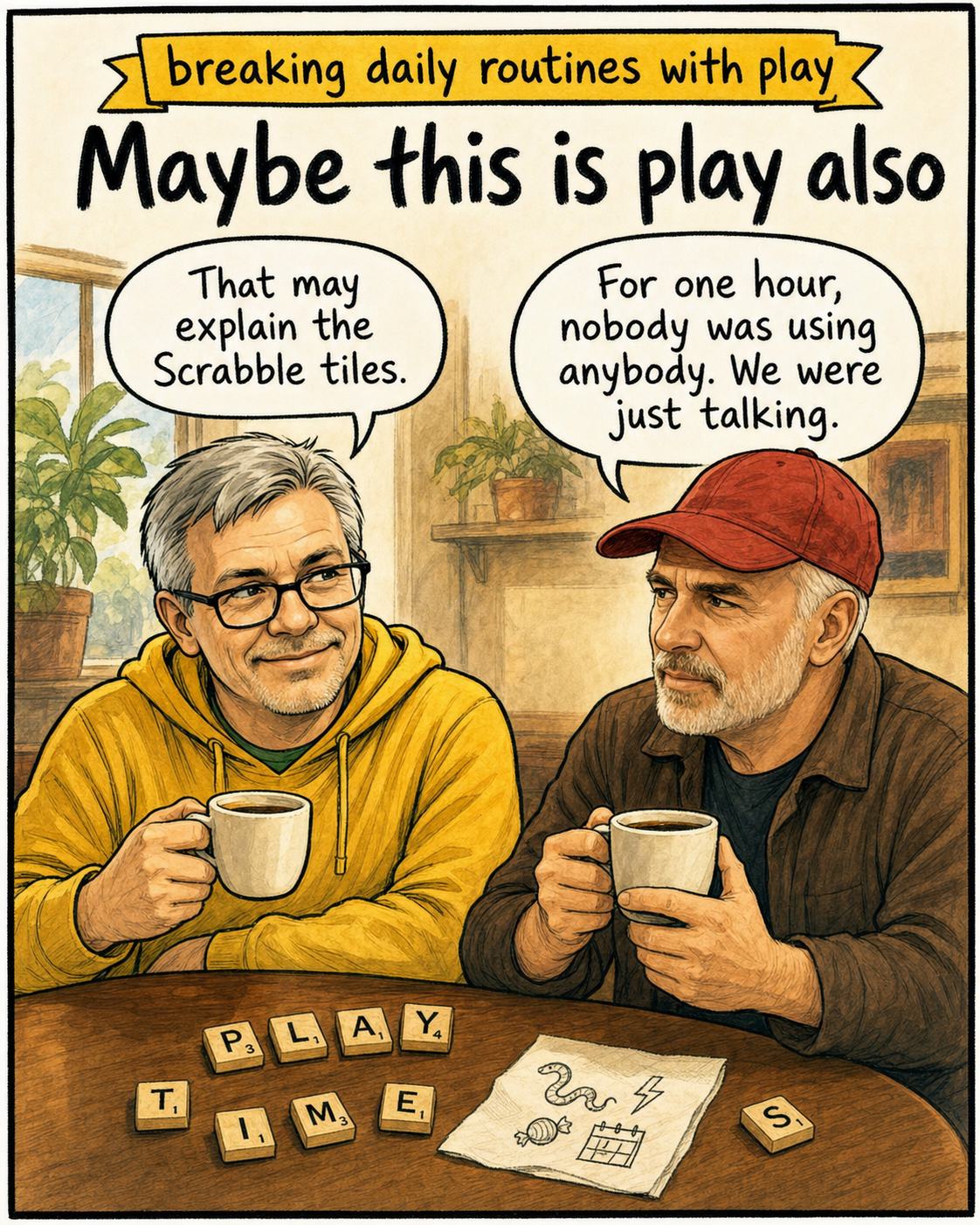
The Mayor said he also did not have much board game culture. His father did not enjoy Monopoly or cards. His mother sometimes insisted, but his father only agreed as a duty. The Mayor also said he refuses to play Scrabble with his wife because she plays to win. She is very competitive. He only wants to enjoy the game and see what words come. But she calculates, maximizes, tries to use all seven letters for extra points. I said the main point should be to socialize, to live socially. Not only to win.

This, I think, is important. Playing is not childish if it helps the mind relax and people connect. A game can be like walking. If you walk with someone, you talk. If you walk alone, you reflect. Both are useful. But if someone plays video games or cards all day long, then maybe it is waste. Everything depends on measure.

We also spoke about Pilates. I began Pilates because my mother’s geriatrician told her to do physical activity. She did not like working out, so she chose Pilates. Since I had to take her, I also started. Now I like it. I have done it for four years. There is a “challenge day” where people do a difficult position and the teacher takes a photo. My mother, at 88, does not do these positions, of course. But I like it. It gives flexibility, and at our age flexibility is important.

The Mayor reminded me of Deborah from my Pilates class. I had connected Deborah with him because she was going to South Korea. Then through him she met Natalie in Seoul, who was connected with Brida and with people in France. Deborah had lived in Strasbourg and spoke French. Natalie later would move to Accra in Ghana. The Mayor told how his wife once heard this chain and did not understand it: Ismar’s Pilates class in Campo Grande, Deborah in South Korea, Natalie in Seoul, Brida, France, Ghana. Everybody else laughed because they understood the strange global connection.

I said it was like synapses in the nervous system. One cell connects to another. Maybe play, language, Pilates, English, community — all these things create synapses between people.

Near the end, The Mayor asked if playing games or doing silly things can relieve stress or boredom. I said yes, I think we behave differently when playing and when working. Every game has some competitiveness, but we should appreciate more the people around us and the conversation than winning.

Then he asked what would make my life more playful. This was difficult. I did not answer with a game. I spoke about trust. I said I am a pessimist because I am the result of all the things I have lived until now. Most people who approach me have another intention. Maybe this is normal. A woman says she loves a man, but maybe she wants loneliness eliminated. A cousin agrees to walk and then does not appear, does not answer the phone, does not send even a message of excuse. A former girlfriend comes to Campo Grande after many years, but when I say I do not want to live together, she changes completely.

Maybe I am too direct. Maybe people think the same about me, that I am not good conversation. But I would like to be more sociable. I would like more meetings with people, more pleasant conversations. It is rare to find a person with whom conversation is good.

The Mayor said he thinks I am more sociable than I believe. I don’t know. Maybe he is right. Maybe play is not only games, or jokes, or doing something silly. Maybe play is also the small possibility that, for one hour, people speak without needing to use each other. They just meet. They talk. They remember childhood games, snakes, mothers, sweets, Scrabble, Pilates, bank holidays, power cuts, and someone called Deborah who travels through the world like a synapse.

Maybe this is play also. Not escaping routine completely. Just making one small opening inside it.

Partner Page
Advertisement
source
The Pineapple

Games Were Never Just Games

I found this conversation more difficult than I expected.

Part of it was the language, of course. When I speak English, I can say what I mean, but sometimes I need time. I search for the right word. I start a sentence, then I stop, then I try again. Some topics are easy because they are practical. Work. Football. Customers. Family routines. Things I can explain step by step.

But play is different.

Play sounds like a light subject. Childhood games. Friends. Football. Hide and seek. A Game Boy. A Teletubby. It should be easy. But for me, subjects like this are not always easy, because they feel like small talk at first. And I am not so comfortable with small talk. I like conversations when there is something real inside them. A reason. A problem. A story. A lesson. When we talk only about games, I first think, “What should I say?” But then, when I start remembering, I notice that games were not only games. They were connected to freedom, trust, friendship, independence, and also to the kind of father I want to be.

The Mayor began by asking me about football, because we had just had our last home game of the season. Next Saturday is the last match, and then we have a small break. Four weeks maybe. Then training starts again in June or July, and after six weeks the new season begins.

Football gives life a structure. There is always the next training, the next game, the next season. Even when one season is difficult, even when you move one league down, the club is still there. The team is still there. The football field is still there.

He asked me who I thought would win the World Cup in the United States, Mexico and Canada. I told him I am not an expert in the World Cup or Bundesliga, but of course I hope Germany wins. I also think France has a good chance. The Mayor joked that maybe the final should be France against Germany and France wins. I said, yes, it can be, but I hope Germany wins.

Of course I do.

The Mayor told me he is not really a football fan. For him, the big football world has become too much about money. The same big clubs win again and again. Bayern Munich in Germany, Paris Saint-Germain in France, the big English clubs, the famous names. He said he does not see the sport in it anymore.

I understood what he meant. I also think that in professional football, sometimes it is more about money than sport. But for me, football is not only the Champions League or the World Cup. It is also the small club. The village team. The Sunday match. The same people standing at the side of the field. The trainer, the team, the fans.

He asked me if I played football as a child.

Yes, I did. I started when I was about ten years old, in the E-youth team. The club was called Deuten. I played there until I was seventeen. Then I had a short break, maybe one year. My brother said to me, “You are too good to stop your football career. Why don’t you come and play with me in my club?”

So I changed clubs. I was seventeen or eighteen. And then I had three or four really difficult years, because the level was higher. The speed was higher. The game was different. I had to learn. I had to wait. I had to become better.

When I was twenty-two or twenty-three, the team was smaller, and I got more chances to play. Since then, football has been part of my Sunday. Every Sunday on the football field. I have now been with the same club for eleven or twelve years.

The Mayor asked why I am still there. Is it the trainer? The team? The fans?

I think it is all of it. In this club, everything is right for me. It is the place where I can play until the end of my career. And when that end comes, maybe I will still help. The president has already asked me if I can take a role, maybe as sports director. I said I can do this when I stop playing. But player and sports director at the same time is too much. Too much time. Too much responsibility.

I will play as long as I can help the team. That is my answer.

Then he brought me back to childhood.

I grew up in Bavaria in the 1990s. When I was very small, five or six or seven years old, I played a lot in our garden. Later, when I grew up, we met at a playground. Every day it was the same place. We played football. We played hide and seek. We rode our bikes. We were outside.

I grew up in Bavaria in the 1990s. When I was very small, five or six or seven years old, I played a lot in our garden. Later, when I grew up, we met at a playground. Every day it was the same place. We played football.

I grew up without a smartphone. We had a telephone at home, but normally we did not use it to organise everything. We talked at school. We said, “Where do we meet today?” And most of the time, it was simple. Same place. Same time. If you had time, you went there. If not, then you did not.

It sounds very simple now, but I think there was something beautiful in this. We did not need many messages. We did not need a group chat. We did not need to check ten times. We had a place, and we trusted the place.

I had a best friend from first class. We met nearly every day. In Weiden, where I grew up, there were different small districts, and my district was Hammerweg. In this district we had a big circle of friends. Only boys. The Mayor asked me what the girls did, and I said honestly, “I don’t know.”

That was our world. Boys, bikes, football, hide and seek, and the playground.

Later, things changed.

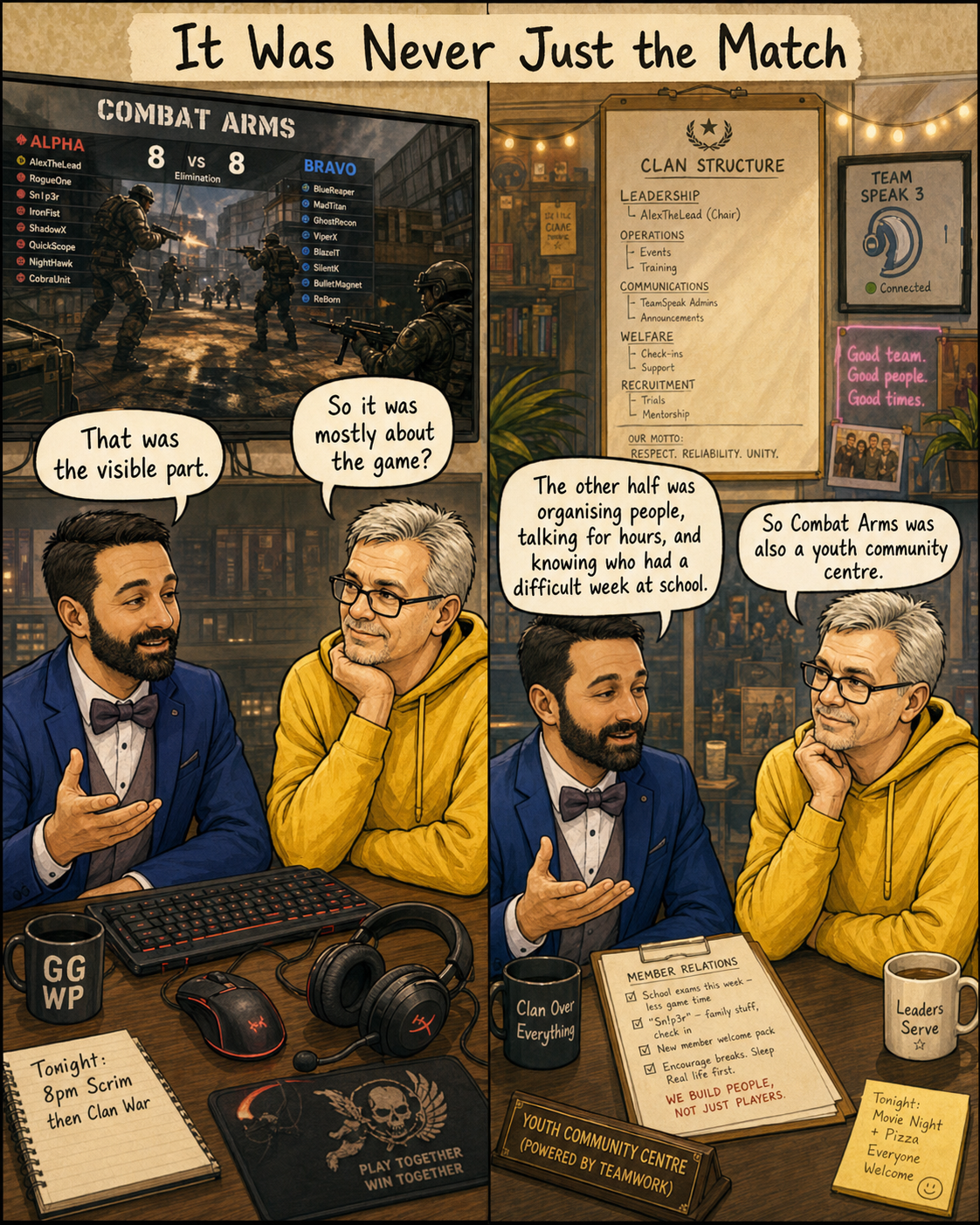
When I was fourteen or fifteen, my best friend and I started playing computer games. The game was called Combat Arms. It was an online shooter game. Two teams, usually eight players in each team. The goal was simple: you had to defeat the other team and survive.

At the beginning, it was just funny. But after one year, we became very good. Then we created a clan. A clan is a group of players, like a team. My best friend and I were the bosses of this clan. We searched for good players, invited them, and built something bigger. At first, the players came from all over Germany. Most were the same age as us. Later, we had people from different generations too.

We used TeamSpeak to communicate. It was a little bit like Zoom or Teams today, but for gamers. When we had a clan match, our clan against another clan, we spoke through TeamSpeak.

And this is the part many people do not understand about online games. It was not only the game. It was also the conversations. We spoke about school. We spoke about friends in real life. We knew each other. We built relationships. It was a very nice time, these two or three years.

We were even close to getting sponsorship. But then we realised that if you accept sponsorship, you also have requirements. You have to do things. You have duties. And we said no. We played because it was fun. We did not want to make it something serious.

Later, we joined an international clan, and then I spoke a little bit of English. I told my mother this, because I wanted her to see something positive in the game. She was not enthusiastic about it, like many parents at that time. For her generation, online games were something strange. Maybe dangerous. Maybe a waste of time.

The Mayor asked me about violence in games. This is a difficult question. When terrible things happen, when someone uses weapons in a school, people in the news sometimes say, “He played online games.” I understand why people ask questions. But for us, it was not like that. We were ambitious. We wanted to win. But when we switched off the laptop, we had a normal life. We were not aggressive because of the game.

I think there are people in society who are more susceptible to aggression, and for these people maybe these games are not right. But for us, it was not a problem. It was competition, friendship, communication, and fun.

I do not play video games today. I do not have the time. But in my dream, later, I would like to play with my son. Not too much. Maybe one hour in the evening. And not only violent games. There are many games that are competitive but not aggressive. I also played FIFA, the football game. Did FIFA make me a better football player in real life? No, I don’t think so. Maybe you see one trick, one idea for a one-to-one situation, but real football is different. You have to run. You have to feel the field. You have to know the team.

He asked if my mother had trouble getting me home when I played outside, or getting me outside when I played computer games.

My mother was relaxed. I did not have strict times when I had to come home. But I was not the child who came home extremely late. There was an unwritten law. I had freedom, and I respected the freedom.

That is maybe one of the most important things from my childhood. Trust.

It was the same when I was sixteen or seventeen and went to the disco for the first time. At first my mother said, “Please come home at midnight.” But if it was a little later, she did not say much. It was okay, because she trusted me. And she trusted me because I spoke with her. She knew where I was. She knew who I was with. She knew what I was doing most of the time.

I do not know yet if Julia and I can give this same freedom to our son. You cross the bridge when you get there. We have to see how he develops. If he is always late, if he does bad things, then maybe we need more rules. But if he is honest, if he speaks with us, if we know what he does, then I hope we can trust him.

Trust is not no rules. Trust is a relationship.

Then the conversation went into family, and this was more personal.

The Mayor asked if I played board games with my parents. Monopoly, family games, things like that.

No. Not really.

My father left us when I was two years old. I was alone with my mother, and she worked every day to earn money for us. She did not have much time to play games with me. I was very independent from a young age. I do not say this as a sad thing. It was just my life. I do not feel that I missed everything. But today, when I see Julia’s family and how close they are, I realise that I did not have this kind of relationship with my mother.

Julia comes from a close family. They meet often. There is always something. A visit, a celebration, a meal, a conversation. For her, this is normal. For me, sometimes it is difficult. I need more time for myself. I know this is only my view, and her view is different. But when you grow up independent, too much family closeness can feel like pressure, even when the people are kind.

This will also influence our son. Julia brings the family side. I bring the independence side. I hope he gets something from me, because I think independence is important. But I also see that he needs us a lot now. He is two years old, so of course he needs us. I cannot know how he will be later.

Maybe that is parenting. You think about the future, but you cannot decide it in advance.

At the end, The Mayor asked me about special toys. He told me he loved Lego when he was a child.

For me, I think it was the Game Boy. I also had a big electric car, and I remember it because it was very big. But I cannot remember many games from before the Game Boy time. I said maybe I have to ask my mother. That is my homework.

Then I remembered something else.

I had a Teletubby.

The Mayor reacted strongly to this. He could not believe it. I think it was Tinky Winky, the violet one. I do not know where it is now. Maybe my mother still knows. Maybe it disappeared. Maybe it is waiting somewhere in a box.

It is funny what stays in your mind. A playground. A football field. A clan match on TeamSpeak. Your mother trusting you to come home. A Game Boy. A Teletubby.

When I look back, I see that games were never only games. They were how we learned to organise ourselves. How we learned to win and lose. How we learned to trust friends. How we learned when freedom is possible and when responsibility is needed.

I thought this conversation would be small talk.

But maybe play is not small at all. Maybe childhood games are one of the first places where life quietly teaches you who you are.

Partner Page
Advertisement
source
The Pineapple

Childhood, With No Risk Assessment

Manfred

I learned very early in life to minimize input and maximize output. Other children may have mistaken this for laziness, but I would call it strategy, and The Mayor, asking the questions, seemed to understand that childhood games were never just games. They were early laboratories for power, efficiency, and plausible deniability.

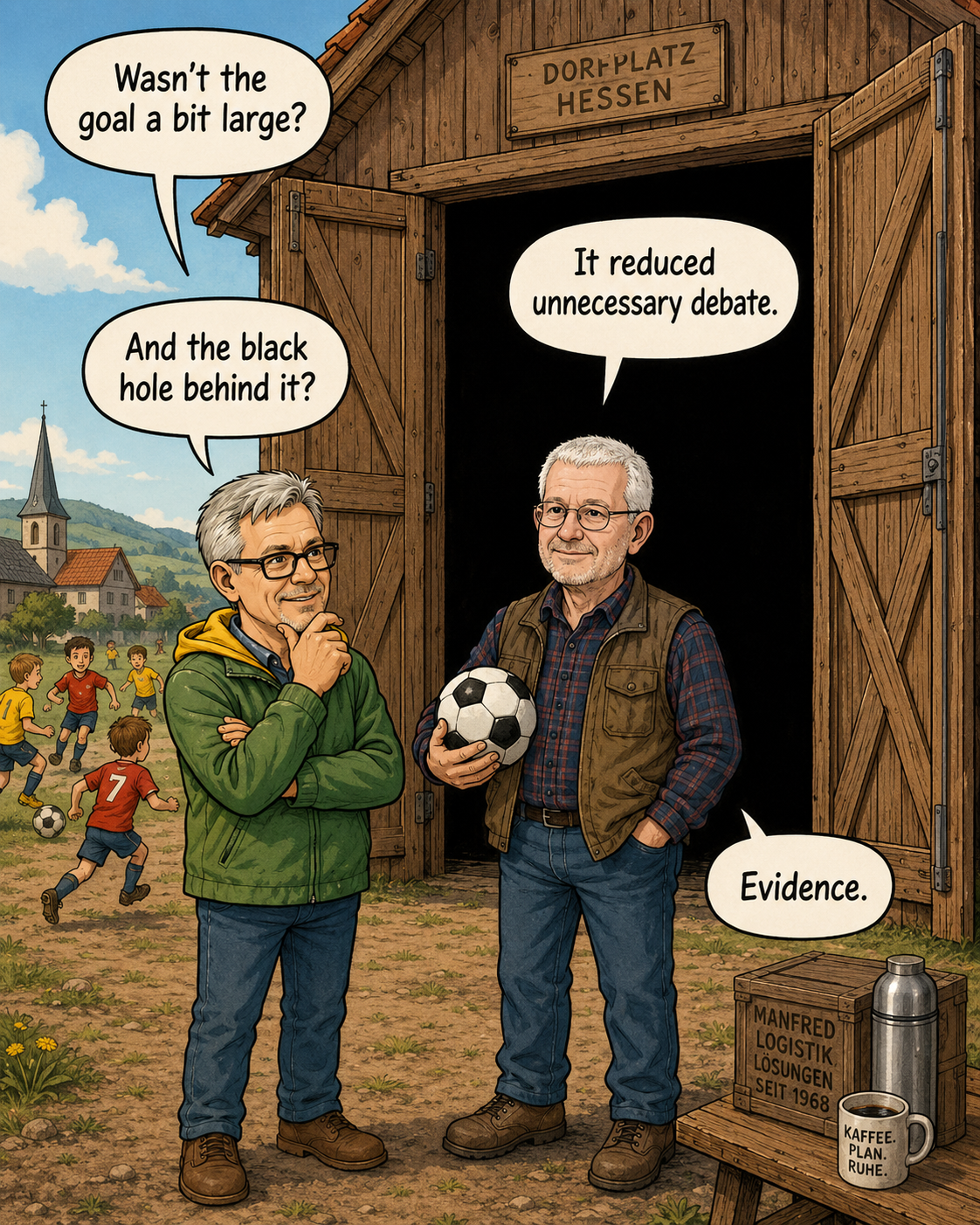
Football was the first great arena. I became the goalkeeper, not because I had heroic reflexes or a burning desire to protect the honor of the team, but because I knew the ball would eventually come to me. Everyone else could run themselves into the ground. I simply waited. When the ball arrived, I picked it up from the goal and returned it to the center of the field. This was not sport. This was logistics.

When The Mayor asked about goalposts, I had to explain that in Hessen, everything is bigger and better. Barn doors were ideal. They were wonderfully oversized and, even better, came with a big black hole behind them. There was no arguing about invisible posts when the goal was the size of a rural aircraft hangar. If the ball disappeared into the darkness, the matter was settled.

Of course, not all childhood games required a ball. Some required timing, fireworks, and a very specific moral framework. New Year’s Eve offered opportunities. Fireworks existed. Letter boxes existed. Unkind people existed. They deserved it. No further comment. Martin may call that a permanent state of war, but I probably recognized it as seasonal justice.

I also had my private empires. I still have my Matchbox collection, which says something about continuity, taste, and possibly unresolved sovereignty issues. With Lego, I played by myself, because being a dictator has its advantages. There were no coalition negotiations, no shared building strategy, no other child placing the wrong brick in the wrong place and calling it creativity. My world had order. My world had a ruler. My world probably ran on time.

Looking back, the games were never innocent in the way adults like to imagine. They were about territory, control, loopholes, and energy conservation. The Mayor asked about childhood, but I suspect he was really asking when our personalities became visible. In my case, very early. I stood in goal, governed Lego alone, maintained a Matchbox archive, and understood that if a barn door is available, one should not waste time with two school bags.

The Mayor asked about childhood, but I suspect he was really asking when our personalities became visible.

Martin

Where there was an unused square meter of space, I and the others converted it immediately into a Bundesliga-worthy stadium. I remember it like that: no planning permission, no budget committee, no architectural tender. Just a small patch of ground and suddenly we had football. School bags became goalposts, and with enough conviction, the whole thing felt official.

The Mayor asked about rules changing every five minutes, usually because one child was losing and had suddenly become a constitutional lawyer. That was familiar. Match fixing was illegal, naturally, but a flexible interpretation of the rules was considered good sportsmanship. There is a difference. At least, there was when we needed there to be a difference.

Manfred had his Hessen barn doors and his goalkeeper philosophy. He believed in minimizing input and maximizing output. I understand this now as a kind of rural German Zen. He stood in the goal because the ball came to him, while the rest of us ran around pretending there was glory in exhaustion. Perhaps he was ahead of his time. Perhaps he was simply conserving energy for later dictatorship with Lego.

The Mayor also asked whether I was a Topfschlagen, Verstecken, Fangen, or Völkerball child. Topfschlagen, yes, although somehow we managed without the Töpfe. That sounds impossible, but childhood had a way of removing essential equipment and carrying on regardless. Many of the other activities happened at school, and over time a lot has become clearer to me. At the time it was called play. Later one realizes it may also have been early social conditioning, mild warfare, and physical education with witnesses.

Rules mattered, of course. My friends and I are responsible for some of the inclusion of strict rules in the world billiard and snooker rules. I will not say the authorities thanked us, but civilization rarely thanks its pioneers. Someone has to stand up and say, “No, that shot does not count,” and then defend the point until recess ends or diplomatic relations collapse.

Friendships were tested most severely through sport. In this field, sport is a great equalizer, sometimes leading to a permanent state of war. That is the beauty of childhood competition: by lunchtime one could be teammates, by afternoon enemies, and by the next day pretend the entire crisis had been resolved, while quietly remembering exactly who cheated.

When The Mayor asked what game I would most like to play again for one afternoon, the answer had to be football. Same rules, same kids, same scraped knees. But now there would need to be extra oxygen tents and zimmerframes. The spirit is willing, but the adult body has become a bureaucrat. It demands forms, warnings, risk assessments, and possibly medical staff.

Still, I would play. Manfred could stand in goal again, waiting for the ball with his efficient little theory of life. The Mayor could ask the questions from a safe distance. And I would return to that one unused square meter of space, knowing exactly what it could become: a stadium, a battlefield, a courtroom, and a childhood, all at once.

Partner Page
Advertisement
source
The Pineapple

Flea Markets, Diaper Cars, and the Great Elastic-Twist Olympics

Some weekends arrive quietly and peacefully. Mine arrived carrying a flea market, a wedding anniversary, Mother’s Day, school projects, birthday surprises, and one tragically shattered ceramic grater.

Janita — or Fruitloop, as I like to call her — started the conversation by asking whether I was excited about my birthday. Excited might have been too strong a word. Slightly curious? Mildly hopeful? Mostly overwhelmed? That sounded more accurate.

The weekend ahead already looked like a complicated military operation.

Saturday would begin with our flea market, where I planned to sell piles of children’s clothes and toys that somehow continue multiplying in this house. At the same time, the fire department had an event scheduled, and somewhere in between hauling boxes and organizing tables, I also intended to meet friends for a little socializing.

Then came Sunday, which wasn’t just Mother’s Day but also our wedding anniversary. Clearly, the universe had decided I deserved maximum emotional activity in a single weekend. Naturally, I fully expected presents from the children, anniversary attention from my husband, and perhaps a brief moment where nobody asked me where their shoes were.

Janita reminded me about the mysterious parcel that had arrived earlier in the week — the “mystery box” Fruitloop had been curious about for days. In the end, the contents were wonderfully domestic: a long baking pan from Sally. Nothing glamorous, but honestly, I loved it.

The real kitchen drama, however, involved my ceramic grater.

I had just received it the week before. A beautiful ceramic garlic grater. I carefully cleaned it, proudly placed it into the cupboard, reached for my waffle maker — and somehow the grater launched itself out of the cupboard and smashed dramatically onto the floor.

Gone.

Completely destroyed.

Fortunately, my husband hinted that I would be getting a birthday surprise. Janita immediately guessed flowers. She also suggested that perhaps I should simply create a proper wish list because, according to her, husbands cannot magically interpret vague hints and emotional sighing.

A revolutionary idea, honestly.

One item already sat firmly on my list: the insulated basket I’d been admiring for months. The company makes beautiful baskets that keep food warm or cold, but the price was outrageous. One hundred and fifty-nine euros. My husband looked at me as though I had suggested purchasing luxury designer luggage for sandwiches.

“You are crazy,” he told me.

To be fair, he may have had a point.

But birthdays or not, there was still plenty to do. I was completely occupied with preparing a farewell present for the class teacher.

Simple people buy flowers.

I apparently build vehicles out of diapers.

The original idea had been a diaper cake, but naturally that evolved into something much more complicated: a diaper car. For two days, I watched instructional videos online, trying to figure out how to transform nappies into a functioning-looking automobile. Some people might question my sanity, but I knew the teacher would appreciate the effort.

The original idea had been a diaper cake, but naturally that evolved into something much more complicated: a diaper car.

Besides, parents all over the world apparently create diaper sculptures for baby showers, so I considered myself internationally supported.

Alongside the diaper masterpiece, I also organized a framed class photograph signed by the children. Keeping the surprise secret turned out to be nearly impossible. At one point, the teacher almost walked in while the children were signing the paper, causing complete panic. My son desperately tried to distract everyone while attempting to hide the operation.

Children are not subtle.

Janita laughed because she had experienced similar classroom chaos herself. Apparently every teacher eventually discovers half of their “surprise” before the actual surprise happens.

Eventually our conversation drifted toward childhood games, and suddenly Fruitloop and I found ourselves deep inside the 1990s.

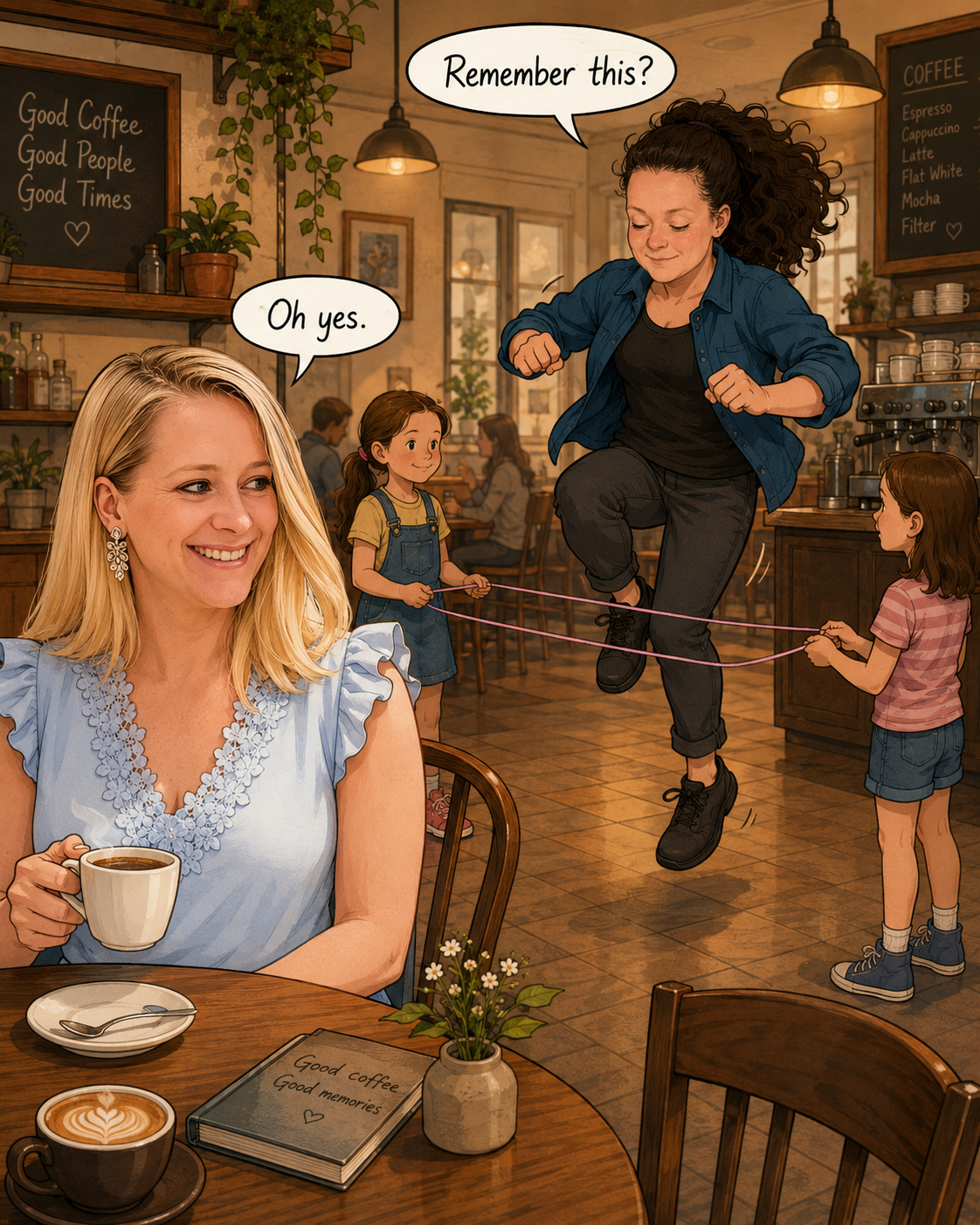
We talked about hide-and-seek, hopscotch, jump rope, blind man’s bluff, marbles, and all the strange playground games children somehow instinctively understood back then.

I explained the German game “Fischer, Fischer, wie tief ist das Wasser?” — a tag-style game where a fisherman tries to catch children crossing imaginary water while giving instructions about how they are allowed to move.

But my true favorite wasn’t actually marbles.

It was elastic twist.

The glorious playground sport involving a giant elastic band stretched between two children while a third person hopped through increasingly complicated movements. There were chants, rhymes, tricks, and endless combinations. We played it constantly during school breaks.

I even recited some of the old rhymes for Janita:

“Trick track, Donald Duck, Mickey Mouse…”

Absolute playground poetry.

Back then, we spent almost all our free time outside. We didn’t have smartphones, social media, or gaming consoles permanently attached to our hands. My younger brother eventually got a Nintendo and later a Game Boy sometime in the mid-1990s, and yes, we occasionally played Super Mario or Donkey Kong together.

But mostly we lived outdoors.

We played football in the street, rode rollerblades and skateboards, played badminton, climbed everything climbable, and returned home covered in dirt and happiness.

My own children live very differently.

Arian is happiest sitting in his room playing Fortnite for hours, while Hannah alternates between dolls, horses, crafts, puzzles, and occasional dramatic declarations that she is “bored” despite owning enough toys to supply a small kindergarten.

Sometimes she plays video games too, usually after announcing that there is “nothing to do.”

Janita found this highly amusing.

One thing my daughter absolutely adores, though, is her bedroom — especially because we built much of it ourselves. Or more accurately: I found the ideas online, and my husband spent several exhausting weeks turning those ideas into reality.

Her room now has a huge loft bed with storage space, a desk, hidden little areas, and even room underneath for a television and relaxing corner. The painting alone took forever. By the time it was finished, my husband looked deeply relieved to have survived the project.

But the effort paid off. Since then, she has happily slept in her own bed every night.

I proudly carried my computer around the house during the call to show Janita the finished result like an overenthusiastic estate agent.

Naturally, I already have redesign ideas for my son’s room too.

My brilliant plan involved creating storage space underneath his bed by integrating cupboards and reorganizing the room completely. His reaction was immediate and firm:

“No, Mom.”

Apparently children eventually develop opinions about interior design. Very inconvenient.

When the weather is bad, we still spend time together indoors with games and puzzles. We play Skyjo, Monopoly, and “Mensch ärgere dich nicht.” She recently received a new Moana puzzle, although realistically she contributes enthusiastically for about ten minutes before I end up completing most of it myself.

Toward the end of our conversation, Janita and I tried to untangle our future schedule. Germany’s collection of public holidays, vacations, and school breaks meant we would barely see each other for the next month. Our next proper meeting wouldn’t happen until the twenty-first of May, followed almost immediately by more holidays afterward.

Still, that only meant I would have even more stories to tell by then.

By the time Fruitloop said goodbye, my birthday weekend still stretched ahead of me like a marathon filled with flea-market bargains, diaper cars, emotional teacher farewells, family celebrations, broken kitchen accessories, and possibly flowers.

Honestly?

It sounded exhausting.

And absolutely perfect.

Partner Page
Advertisement
source
The Pineapple

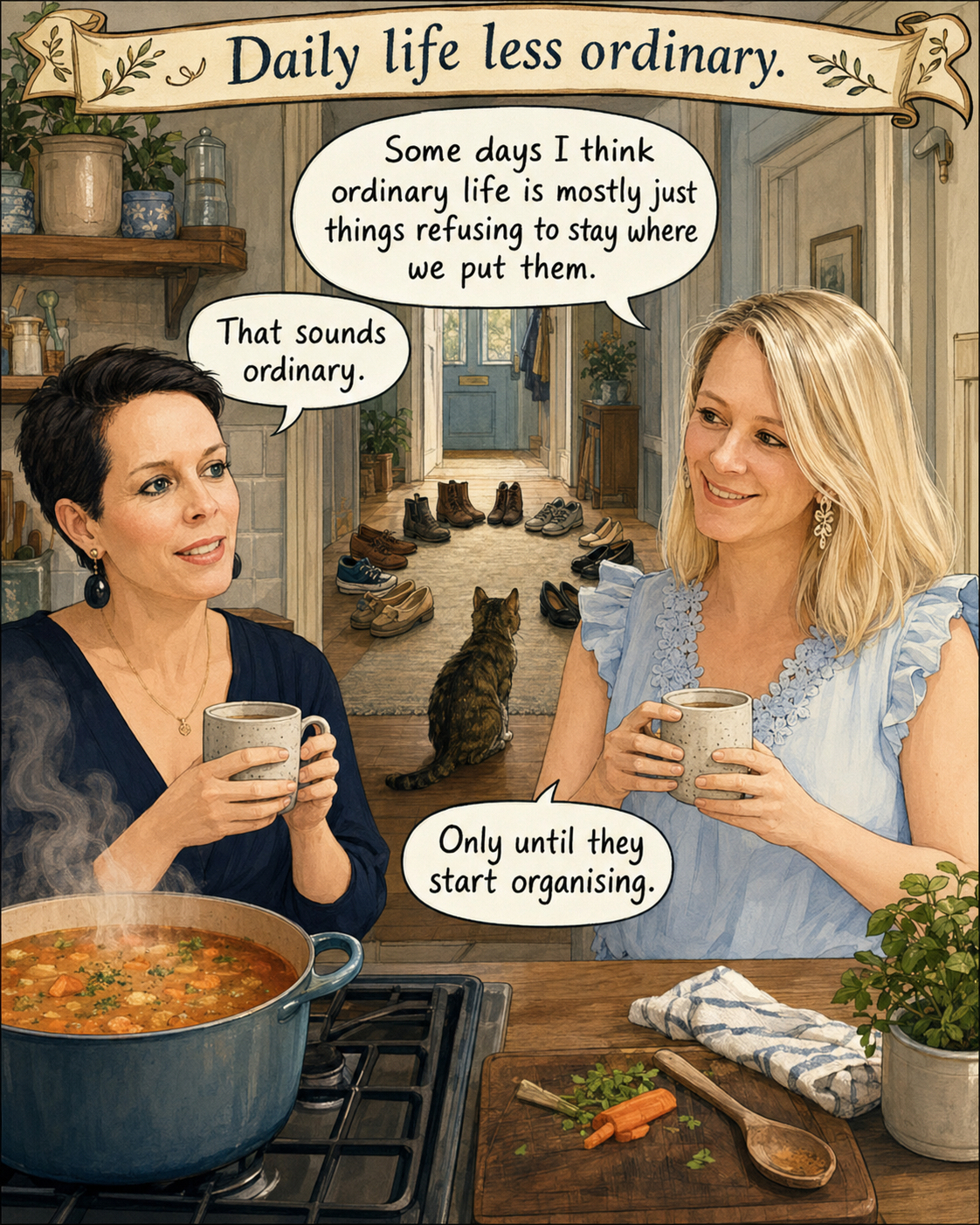
Shoes in the Hallway, Soup on the Stove, and Other Small Games of Daily Life

Yesterday, Janita had rain all day. The real kind of rain. The kind that settles in for hours and makes the whole world feel grey and wet and slightly tired. Her father had measured fifty millimetres in the garden and she repeated the number twice, laughing a little at how serious it sounded. By morning the rain had stopped, but winter had arrived properly. Cold wind. Thirteen degrees. Streets still shining from water.

Meanwhile, Sylvie sat in completely different weather.

Warm again. Twenty-six degrees one day, cooler the next, then warm again by the weekend. Up and down all the time lately. Through the window the light still looked soft and comfortable, the kind of weather that makes people open doors instead of closing them.

Still, despite the difference between sunshine and rain, the mood between the two women settled into the same cosy rhythm almost immediately. Coffee. Small complaints. Family news first before anything else.

Sylvie’s daughter had just finished important school interviews. The important school. The one she truly wanted. There had been interviews with teachers and directors and tests in French, English and mathematics. Afterwards her daughter admitted quietly that the French test had not gone very well.

Now came the difficult part — waiting.

Waiting until July. Waiting for results. Waiting while life continues normally around you even though your mind keeps returning to the same questions.

So naturally, Sylvie cleaned.

Not because cleaning relaxed her exactly. She was honest enough to admit that. But she liked the feeling afterwards. The order. The quiet. The satisfaction when everything was finally back where it belonged.

Although in her house, things rarely stayed there long.

Especially shoes.

Shoes in the winter garden. Shoes by the entrance. Shoes in the garage. Shoes abandoned in every possible place except the cupboard where they should actually live. Every evening she repeated herself again and again, already knowing nobody was truly listening anymore.

Janita laughed because she understood immediately.

Families everywhere seemed to live inside the same chaos.

Sylvie called herself “a little maniac” while describing it, though she smiled when she said it. She liked neatness. She liked putting groceries away properly after returning from the supermarket. Sometimes she even rearranged ingredients inside cupboards for no real reason except that it looked better afterwards.

Sylvie called herself “a little maniac” while describing it, though she smiled when she said it.

There was comfort in small order.

Cooking felt different though. Cooking invited improvisation.

She spoke about a friend who called it “IKEA cooking” — opening the freezer, finding random ingredients and somehow turning them into dinner. A little meat. Forgotten vegetables. Rice. Strange sauces nobody remembered buying. Somehow it worked.

Most of the time.

Other times, not at all.

Kitchen disasters arrived quietly and regularly in both their lives.

Sylvie still remembered her oven breaking while guests sat waiting for potato gratin with cheese. Everything already inside cooking slowly for hours and then suddenly — nothing. Dead. Cold. Finished. She rushed the dishes to her sister-in-law’s house at the last minute trying to save dinner before the evening collapsed completely.

Then there was the calf meat she preferred medium, still soft and slightly pink inside, cooked too long until nobody wanted to eat it anymore.

Janita shared her own disasters too. Expensive meat ruined with too much salt during the early years of marriage. Standing in the kitchen furious because it had cost money and effort and now nobody could even enjoy it.

At least later these things become funny.

Not immediately. But later.

Even Sylvie’s daughter recently joined the tradition with a failed lemon cake. Usually she baked brownies because chocolate was safe territory, but that day there had not been enough chocolate in the house. So she tried something different.

The result was… disappointing.

Even the daughter who baked it barely touched it afterwards.

The conversation drifted the way warm conversations always do — slowly, naturally, without anybody trying to direct it too much.

They spoke about football matches nobody cared enough about to actually watch seriously, except there would be pizza and aperitifs involved, which changed everything slightly.

About loud summer music beside swimming pools.

About husbands who preferred rugby and cricket.

About neighbours forced politely to tolerate parties.

And then suddenly they were talking about childhood.

Both women had grown up partly on farms. Fields. Tractors. Animals. Cousins everywhere. Long afternoons spent outside inventing trouble simply because there was nothing else to do.

Sylvie remembered making messes with cousins close to her age while the older cousins became irritated with them constantly. At the time it felt hilarious. Years later, when they met again, those were still the stories everybody laughed about first.

Janita understood immediately because her childhood sounded much the same.

Back then children stayed outside until dark because outside was where life happened.

No smartphones. No Netflix. No endless scrolling through other people’s lives.

Just bicycles. Cricket games. Mud. Noise. Animals. Fields.

Sylvie noticed how often her daughters spoke about missing something they had never even experienced. They imagined that freedom — staying outside until evening without constant messages or screens or worry. Modern teenagers disappeared into bedrooms now instead.

Adults too, perhaps.

Too stressed. Too busy. Always saying there was no time.

That thought stayed quietly between them for a moment.

Because both women understood it.

Sylvie admitted that even cleaning sometimes stressed her more than it helped. The moment she started cleaning one thing, she immediately noticed five more things needing attention.

Gardening was different.

Gardening slowed her mind down.

Soon they would plant vegetables again, and she already looked forward to watching them grow slowly through winter into something useful and alive. That felt satisfying in a deeper way than cleaning ever could.

Cleaning simply became dirty again tomorrow.

Gardening rewarded patience.

As evening approached, the conversation softened even more.

Candles. Chimneys. Blankets on sofas.

Janita described sitting beside the fire on cold evenings, sometimes not even bothering to watch television because the warmth itself was enough entertainment. Sylvie understood immediately. There was something calming about watching fire quietly move while the room slowly warmed around you.

At one point Janita’s cat wandered into the winter garden looking for attention, suddenly affectionate because she wanted food or warmth or both.

Cats rarely pretend otherwise.

And somehow that small interruption suited the entire conversation perfectly.

Nothing dramatic happened between the two women that afternoon. No grand revelations. No extraordinary stories.

Just weather and daughters and gardens and cakes and fireplaces and flea markets and messy hallways full of shoes.

But perhaps that was exactly why the conversation felt so warm afterwards.

Because ordinary life, when people speak honestly about it, is rarely ordinary at all.

Partner Page
Advertisement
source
The Pineapple

The Toy Box Fortress and the Comfort of Melkkos

What happened in Fruitloop world this week? Well, this is where it gets interesting. We knew winter was coming, but we expected a few more warm days and sunshine to enjoy. The weather man, however, had a completely different plan.

We moved from summer and warm winter days straight into floods and cold. Everything is wet, and it seems like nothing will dry up soon. Roads were flooded, detours were organized, and the laundry situation just fell apart. I did two bundles, hung them outside, and thirty minutes later, the rain started pouring. It didn’t stop for two days. The only alternative was to turn my house into a laundromat, with clothes hanging on hangers all over the place. Eventually, everything was dry, folded, and packed away—mission accomplished.

The Wooden Hiding Place

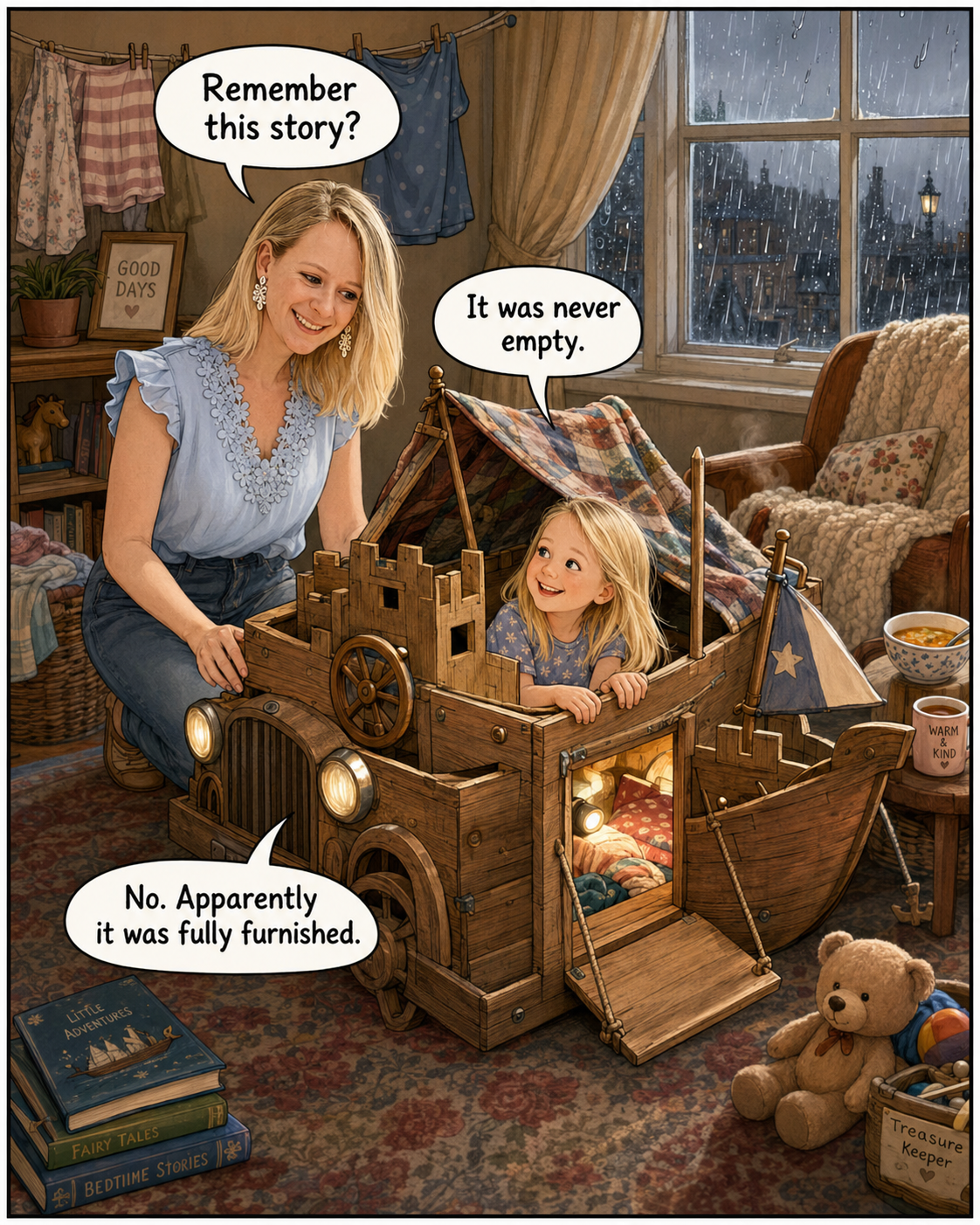
My mom was sorting through her house and storage unit and came across the toy box we used as kids. She asked if I wanted it, and the simple answer was “yes,” because my son’s room is usually a mess. He has too many toys and not enough storage space.

I went to fetch it, but there was a downside: I haven’t had time to sort through the toys and actually fill the box yet. Why is this a downside? Because his room is still a mess, and he has decided to use the empty toy box for other things.

First, it was a car; he climbed in and “drove around.” Then it became a boat, a hiding place, and a fort. This is a solid wooden toy box with a lid, big enough to fit a seven-year-old along with toys, a torch, and a blanket. It keeps him busy for hours. He even moved it so he could watch TV from inside his new wooden castle.

On the one hand, I’m thinking I should just leave the room full of toys and let him play in the box. He is having the time of his life, using his imagination and creativity. Since it’s too cold and wet to play outside, this is the next best thing. I’m only slightly worried he might get stuck and we won’t be able to help him out fast enough, but at least we’ve established two things: he is definitely not afraid of confined spaces or heights!

Memories, Soup, and Liquid Pancakes

I tried a few new recipes for dinner this week to combat the chill. First, I made a delicious, thick beef and vegetable soup. It came out just the way my dad makes it. He was always the only one to make soup at home—not even my mom can do it quite like he does—but I managed it without a recipe. Just memories and love. Needless to say, my son didn’t like it and didn’t eat much. He still prefers chicken-flavored instant soup. You can’t win them all!

The next dish was Melkkos. For those who don’t know, it’s a traditional South African dish made with milk, flour, and butter, served with a generous amount of cinnamon sugar. It tastes like steamy, warm, liquid pancakes or dessert. At least my son loved this one! This is something I had never made before, though I ate it so many times as a child. I followed a quick, simple recipe, and it was a total success. I even learned it originated somewhere in Indonesia and India many years ago.

I had to take some over to my mom, too. My dad won’t eat it, so she never makes it for herself. Since I had leftovers, it was the perfect comfort food for her.

The Hibernation Countdown

The rain has finally stopped, but we are left with 3°C mornings and highs of only 13° to 16°C. We’ve had snow in parts of South Africa—closer to Lesotho and the Drakensberg—and we always get that biting cold wind from the south. I honestly don’t know how to dress anymore; it feels like my layers are never warm enough.

Someone at school said that if it’s this cold now, they don’t want to know what June and July will feel like. I might just go into full hibernation. Warm stews, Melkkos, and soups for comfort while staying covered in a blanket 24/7.

On the to-do list for this weekend:

After that, I am setting myself up for hibernation for the rest of the season. See you in September!

Partner Page
Advertisement
source
The Pineapple

Pablo the Phone and the International Crisis of Sleep

I knew Thursday was already becoming dramatic before I had even left my bed.

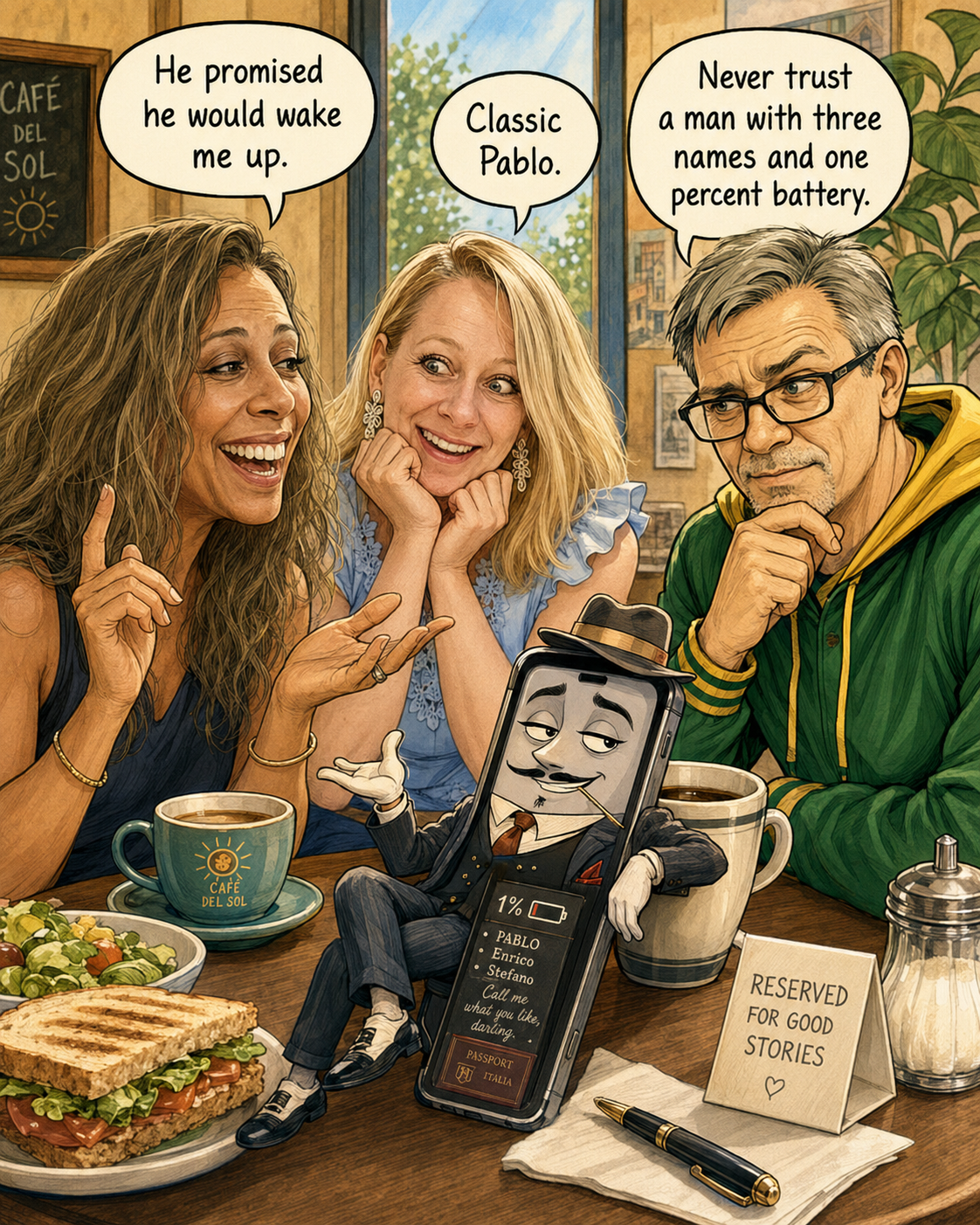
The moment I opened my eyes and saw the time — six fifty — my heart nearly stopped. Not because the world was ending, but because I had missed Lunch with the Mayor and Fruitloop again. For two weeks in a row, Pablo the Phone had betrayed me in the middle of the night. One moment his battery looked perfectly healthy, and the next morning he was lying there completely dead, like a man who had spent the entire night partying instead of doing his one simple job: waking me up.

Naturally, Frank immediately turned this into a philosophical debate about sleep.

“The solution is simple,” the Mayor announced dramatically. “Don’t go to bed.”

According to him, sleep is entirely unnecessary. While normal people waste precious hours unconscious, apparently he prefers staying awake so he doesn’t miss any exciting activity happening on Earth. He spoke about sleep as though it were an inconvenient hobby people should really reconsider. Fruitloop, however, defended beauty sleep with calm dignity, reminding him that some of us need rest to remain functional human beings.

I appreciated the support.

Especially because the Mayor was behaving as though my absence had emotionally destroyed him. He claimed he had spent an entire hour alone with Fruitloop the previous week and aged six hundred years from the stress. Honestly, if anyone deserves an award for dramatic suffering, it is Frank.

Still, once my missing meeting had been thoroughly investigated, the conversation moved toward the real criminal in the story: my mobile phone.

Or rather, Pablo.

Or Enrico.

Or Stefano.

The phone collected names throughout the morning like an actor collecting fake passports. Frank became deeply suspicious about Pablo’s nighttime behaviour. If the battery died while I slept, what exactly had the phone been doing all night? Sneaking out to discos? Dancing recklessly in São Paulo? Secretly living another life after midnight?

By the end of the conversation, my phone had somehow transformed into a handsome but unreliable soap-opera villain.

And honestly? It suited him.

The funniest part was realising how emotionally attached we all became to this fictional personality. Pablo was lazy but charming. Completely unreliable at waking me up, but excellent at giving directions. In fact, I admitted that he had recently accompanied me to the theatre because I had gone alone and needed help finding the address. My phone guided me there in English, which still amazes me sometimes. I can walk through a city I do not know while a tiny voice inside my mobile calmly explains where to turn.

The funniest part was realising how emotionally attached we all became to this fictional personality.

Frank immediately pointed out that technically I had not gone to the theatre alone at all.

“Your phone was your date,” he declared.

Which only became worse when he asked whether Pablo had at least bought me a drink during the interval.

Unfortunately, no. Typical bad-boy behaviour.

The theatre itself became another beautiful part of the conversation. I told them about the play, which celebrated a famous Brazilian singer whose music travelled far beyond Brazil. Frank even recognised the song immediately, proving that somewhere inside every German man there is apparently an old international radio station permanently switched on.

That discussion opened the door to something deeper: how people see Brazil from outside the country.

I found myself explaining that yes, Brazil has football and samba and carnival, but we also have theatre, poetry, music, literature, and culture that moves across oceans. Sometimes people reduce Brazil to postcards and stereotypes, and I wanted them to understand how much more exists underneath that surface.

The Mayor, naturally, twisted this into another joke.

“So only Brazilians are nice people?” he asked dramatically before pretending to leave the meeting forever.

Fruitloop rescued the situation immediately with the perfectly timed phrase: “Well rescued.”

That is one thing I love about these lunches. Nobody is trying to win conversations. The jokes move gently around the table like passing cups of coffee. Even misunderstandings become part of the fun.

And there were many misunderstandings.

At one point we discussed accents and language differences — British English, American English, Brazilian Portuguese, regional accents inside Brazil itself. I explained how American pronunciation often feels easier for me because I studied English in Florida years ago. British accents sometimes feel more difficult depending on the speaker, although I kept repeating that kindness matters far more than pronunciation.

Language itself became part of the story.

I would stop searching for a word, and nobody rushed me. The Mayor teased me occasionally, Fruitloop translated gently when needed, and somehow the conversation always found its way forward. Nobody at that table speaks perfect English all the time, which is exactly why the atmosphere feels safe.

Then the meeting drifted into the official theme of the morning: playful thinking.

Fruitloop introduced an imaginary scenario where she entered a meeting wearing bright purple shoes and announced that everyone must solve problems backwards. This eventually turned into a flooded office emergency where — according to the Mayor — the only truly important thing was saving expensive shoes before the water reached them.

Not the computers.

Not the furniture.

Not the office itself.

The shoes.

And somehow, ridiculous as it sounded, we all completely understood the assignment.

Fruitloop later asked one of my favourite questions of the morning: “If playful thinking came to dinner, what food would it bring?”

Immediately I imagined a colourful Caesar salad. Purple lettuce, little tomatoes, olives, crunchy croutons, and shredded chicken.

The phrase “shredded chicken” unexpectedly became an entire language lesson.

“Shhh,” Frank coached patiently.

“Red.”

“Shred.”

“Shredded.”

For several minutes we sat there practising the word together like children learning a magic spell. It was silly and warm and strangely comforting.

That is what Lunch feels like most of the time.

A group of people wandering happily between philosophy and nonsense.

One moment we were discussing beauty sleep and dead phone batteries. The next moment Frank was telling us about The Magic Pudding, a strange Australian children’s story about a pudding that magically regenerates every time someone eats it. Fruitloop imagined warm stew for rainy weather. I spoke about wanting to visit Africa someday after seeing the peaceful garden Frank once showed me.

Compared to noisy São Paulo, that quiet space looked almost unreal.

Grass. Calmness. Silence.

The kind of place where people probably sleep responsibly and phones behave themselves.

By the end of the meeting, the Mayor gave me strict instructions never to disappear again. Fruitloop reminded me to charge Pablo properly. I promised both of them that next Thursday I would absolutely be awake.

Hopefully.

Because somewhere between the laughter, the accents, the theatre stories, and the shredded chicken, I realised something important.

Sometimes playful thinking is not about solving problems at all.

Sometimes it is simply about sitting with people who allow your mind to breathe a little softer for an hour.

Partner Page
Advertisement
source
The Pineapple

Ferrari Minds and Chocolate Rewards

Coming back home after four months away felt unreal. The second I walked into my room at my parents’ house in Alsace, I finally breathed properly again. Everything smelled familiar, even if the room itself looked like a storage war zone because I had dumped half my apartment into it. Between unpacking, reorganizing everything, and fixing my car the day before, I already felt like I was competing in some strange engineering version of gymnastics. And next week wasn’t going to be easier. I still had four-hour training sessions every day before the French Team Championships started on Thursday.

Fruitloop asked me how the previous competition had gone, and honestly, it had been one of those strange competitions where almost nothing worked exactly as planned, but somehow it still became one of my favorites. I tested a lot of new elements. Most of them failed completely, but I had fun, and my teammates did too. One guy from my team became French champion in the 19–21 category, which was incredible to watch. During the high bar final, I even improvised as his coach. I stood there pretending I knew exactly what I was doing while trying not to panic. He ended up fourth, just missing the podium by more than a point, but the guys ahead of him had massive departure scores, so honestly, his result was still really strong.

She also asked about my ankles, because they had been a disaster recently. Surprisingly, they held up well. I fixed the problems I had on floor and vault, and all my landings were clean. For the first time in a while, I felt like I could actually train correctly for the next championships without constantly thinking about pain.

Then Fruitloop asked when we should meet for our final lesson next week. We went through the usual impossible scheduling process. Tuesday didn’t work because she had meetings , but eventually we agreed on Monday morning at eleven. Easy.

After that, she suddenly introduced a topic I didn’t expect at all: gamification.

At first, I had no idea what she meant. I thought it sounded like some productivity method engineers invent to sell expensive notebooks. But when she explained it was about turning tasks into games, it immediately made sense to me. In gymnastics, we do that all the time with younger athletes. If you simply tell little kids to repeat drills for an hour, they get bored instantly. But if you turn it into a competition or a challenge, suddenly they become completely invested. Sometimes we reward them with sweets like lollipops. Sometimes tiny medals. Children will fight harder for candy than for Olympic gold.

Fruitloop asked if I used gamification in my own life. Honestly, not really. Cleaning my room has never felt like a fun game. But when she described timing herself to clean her house in under two hours, I started thinking maybe I should try something similar. Add music, turn it into a speedrun, make the task feel less painful. The problem is that she works from home with her husband nearby, so she can’t always blast music while cleaning. I laughed because my version of a reward system is much simpler: finish the task quickly so I can go eat snacks afterward.

Food is apparently my universal motivation system.

She rewards herself with chocolate and coffee, although she admitted she often forgets the chocolate exists because it stays hidden in the cupboard. That sounded impossible to me. Forgetting chocolate should be medically studied.

Then we started talking about apps. I realized I actually use gamification constantly without noticing it. Duolingo does it with streaks and badges for my English. My Apple Watch does the same thing for sports. Last month, I had a challenge to complete forty-two minutes of training fourteen times during the month to unlock a trophy. And somehow, those stupid digital trophies actually work. Fruitloop told me about Strava cycling challenges where people compete for “King of the Mountain” titles on specific routes. Humans really will do anything for imaginary crowns.

Last month, I had a challenge to complete forty-two minutes of training fourteen times during the month to unlock a trophy.

She explained betting too, because I didn’t really understand the English word at first. We don’t really gamble money in gymnastics, but we absolutely punish failure. If someone misses a new element, sometimes the consequence is fifty push-ups. That’s close enough.

At one point, Fruitloop asked whether I preferred compliments or personal best scores. That question was more difficult. For me, context matters more than praise. If I’m injured or exhausted and still perform well, I care more about understanding the reality of the performance than hearing fake compliments. Deep down, athletes always know if something was truly good.

When she asked if I currently used gamification for anything important, I immediately thought about my engineering project. I’m developing an application using video game systems to teach data analysis and trajectory optimization for pilots. The funny thing is that I accidentally gamified my own development process too. I sit with my laptop, solving problems like levels in a game, and suddenly hours disappear without me noticing. Most of the time, I work on it late at night between eight p.m. and midnight because everything is calmer then. No sunlight. No distractions. Just focus.

Fruitloop understood immediately. She said evenings are the same for her because her son is asleep, the house is quieter, and there are fewer interruptions. During the day, there’s always laundry, cooking, or something else demanding attention.

Then she asked about tasks I avoid doing. Instantly, I knew the answer: reviewing my old engineering courses about electric motors and power electronics before my internship. I always postpone it because technically I already know most of the material. But at the same time, I know I would feel more confident if I revised everything properly. She suggested starting with second-year material next week. I thought maybe I could use AI to generate exercises for me or set a timer to study thirty to sixty minutes every day with a reward afterward.

That led to a conversation about consistency versus perfection, and unfortunately she attacked me with facts.

I admitted that I’m a perfectionist. My instinct is always to do something perfectly once so I never have to redo it. But Fruitloop reminded me that gymnastics doesn’t work like that. Nobody starts perfect. You improve by showing up every day. She was right, of course. My first trophy came when I was six years old after months of repetitive training. Back then, we didn’t have the highest difficulty scores, but we had the best execution. Perfection came from repetition, not intensity. I realized the same thing applies to studying. Ten hours in one day means nothing if you never review again afterward.

When she asked how I challenge myself in gymnastics now, my brain immediately jumped to progression. If I can do a backflip, then maybe the next goal is a double backflip — preferably without destroying my ankles. Or maybe the challenge becomes achieving ninety percent execution quality compared to the departure score.

Then I told her something slightly insane.

The night before, I had dreamed about a completely new movement on high bar. Not metaphorically. Literally dreamed it. And somehow it made enough sense that now I actually wanted to test it in training next week.

Fruitloop immediately told me not to kill myself.

I promised nothing.

Unfortunately, even if the movement works, it probably won’t magically get me onto the podium because the gap is still too large. But maybe it could gain me half a point or even a full point, which in gymnastics is massive.

Later we talked about individual versus team pressure. Individually, things feel simpler because success or failure only affects you. In a team, the pressure becomes heavier because you don’t want to disappoint everyone else. She compared it to university group projects where one lazy person forces everyone else to compensate. I laughed because that happens constantly. Honestly, sometimes I prefer doing everything alone because at least then the quality depends entirely on me.

Apparently Fruitloop feels the same way about cleaning the house with her husband.

We also discussed rewards. In gymnastics, I care more about medals, recognition, and making my coaches proud than about money. But for engineering projects or work, money matters because it creates opportunities — holidays, investments, apartments, freedom. Still, money has downsides too. If people only care about payment, teams become toxic when things go badly.

Apparently German clubs pay French gymnasts pretty well to help their teams. Maybe I should start exporting myself professionally.

At the end of the lesson, the conversation became completely ridiculous in the best way possible.

Fruitloop asked me what gamification would be if it were a car.

Easy. A Ferrari or a Porsche GT3. Fast, exciting, addictive.

If earning a badge had a taste? Chocolate, obviously. All types.

If I could invent one impossible reward for finishing tasks? Instantly downloading all engineering knowledge or an entire language directly into my brain like a science-fiction movie.

If gamification were a sport? Athletics, because it contains so many different disciplines and challenges.

And if gamification were an animal?

A dog.

Because dogs always want to play.

Fruitloop told me about her grandmother’s dachshund that never stopped chasing a ball. Her own dogs either obsess over games or just sleep, eat, and hunt lizards all day. Honestly, that sounded like the perfect summary of human motivation too.

Before ending the call, she told me to enjoy training and turn it into a game.

The funny thing is, I already do.

Partner Page
Advertisement
source
The Pineapple

Embracing the What If: Monday at Eight Was Already Gone

Monday, eight o’clock in the morning, and the day was already gone.

Finished.

That is what I said to The Mayor when we started our weekly meeting. Monday was there, yes, but in my head it was already running away from me. The week had begun, the work was waiting, the normal things were standing in line, and then The Mayor came with this question.

“So, Ralf,” he said, “what if? What if you woke up tomorrow morning — not this morning, because Monday is already finished — but tomorrow, Tuesday, and you could say yes to one completely crazy idea? What would that be?”

I did not need long.

“Crazy idea?” I said. “I call my friend and say, ‘You can come to me. Put all the barbecues in the van.’ And then I call the Schickling brothers and say to them, ‘Please send me the big rocket.’”

The Mayor laughed a little and asked, “And what would you do then?”

“I will make, in the evening, a nice barbecue,” I said. “I would make a nice barbecue for my wife.”

He reminded me then of the barbecue from the weekend. “You had a barbecue with Dorad,” he said. “Would it be nicer than that barbecue? That was already a good barbecue.”

“Yes,” I said, “it was okay, it was good. But it was normal. It was only like on a fire box, and we smoked the fish. That is a normal barbecue.”

“So what would you make for your wife that is different?”

I had the picture directly.

“She likes tenderloin,” I said. “In Germany we have a name for this, and the cow has only one from this. It is a very special part. My wife likes it. It has a special smell, a special taste. When I say, ‘Oh, I have tenderloin,’ she says, ‘Oh, it’s great.’”

And then, because for me a barbecue is not only meat, I told him about the tomatoes.

“She likes small cherry tomatoes,” I said, “with the green stems still on them. I put them in a small box with olive oil. Then there is a red spice. It is like chili, but it is not chili. I put this over the tomatoes, and then a little bit of sugar. Only a little bit. Then it comes into the barbecue, not high temperature, low temperature. And then the tomatoes become like a very good paste.”

The Mayor said, “So your crazy Tuesday is: invite your friend, get all the barbecues, call Schickling for the big rocket, and barbecue for your wife.”

“Yes,” I said. “That is it.”

“Shall I tell your boss,” he asked, “or will you tell your boss that you are not working tomorrow?”

“I tell it to him,” I said.

That was easy. I am old enough to tell my boss when the big rocket barbecue is calling.

Then The Mayor took me further away. Not to Tuesday, but to Sardinia.

“Imagine,” he said, “you could live for one year on Sardinia. Not back then when you were there with the military, but now. What would your day look like, from morning to evening?”

I went there immediately in my head. I could see the roads, the beach, the old memory.

“When I stay on the island,” I said, “I drive from Olia in the south to a village called Geremeas. When I was in Sardinia in 1994, we stood in front of small houses there. Two houses next to each other. My friend said, ‘This only costs 70,000 German marks.’ So, only 35,000 euro.”

I still feel this sentence now.

“The house had about 80 square meters,” I said, “but no heating. Only a small oven with oil. At that time we said, ‘No, this is not good when it is cold.’ And now I think, why didn’t we do this? Why didn’t we buy this house? It was near the ocean. Geremeas has a long, slow sloping beach. It is so fantastic.”

“So now you would buy it?” The Mayor asked.

“Yes,” I said. “Now I drive to Geremeas and buy this house. Or I drive to Alghero and buy me a house in Alghero.”

“And what would you do all day in one of these places?”

“In the first time,” I said, “I drive to the market every day. I buy fresh ingredients for my meal. Fish, vegetables, tomatoes, herbs. This market is fantastic. Then I drive to Cagliari, to the big, big, big supermarket. There you have so many things about cooking. You can buy everything there. And around there are many small shops. Oh my God, so many small shops. It is very fantastic.”

I could smell it already — the fish, the fruit, the bread, the warm air.

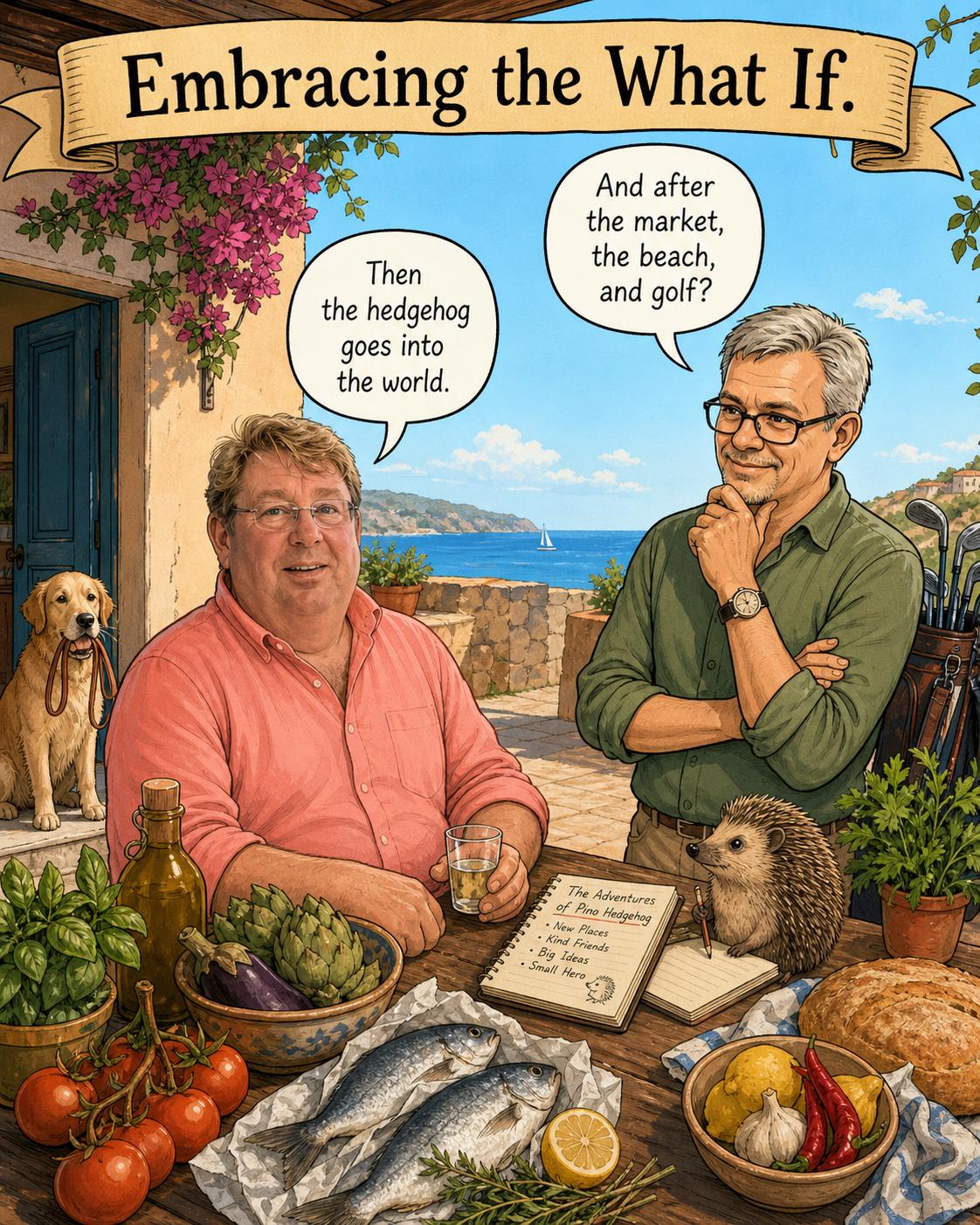
“When I put the things in the house,” I said, “then if I live there, I have a dog. I go with the dog on the beach. And every second day I go to play golf.”

The Mayor said, “And you said when you retire you want to write children’s books. Would you do that there? You divide the day — market, beach, golf, and writing?”

“Yes,” I said. “Children’s books. Hedgehogs.”

I like this idea very much. A hedgehog can have many adventures. Small legs, big world.

“I had a problem before,” I told him. “When I write down the story, I have no pictures. I said this to my wife. But now I know you can make the pictures with artificial intelligence. I know from you that I can use AI to make pictures for the book.”

The Mayor smiled and said, “When the time comes, we will sit down and I will show you the process.”

“Yes,” I said. “Because it is good fun. I like the cartoons and the pictures. It is very, very fine.”

Then he kept me in Sardinia, but he put my coffee machine there too.

“You are on Sardinia,” he said, “relaxed, everything is nice. And your coffee machine could talk. What would it say about you?”

I laughed.

“It drinks too much coffee,” I said.

Then I thought of Sebastian.

“And she is calling Sebastian,” I said, “and says, ‘What is with your coffee machine?’ He has a very, very high-end coffee machine. The beans, the grams, the grinding — everything is very complicated when Sebastian makes a coffee.”

And she is calling Sebastian,” I said, “and says, ‘What is with your coffee machine?’ He has a very, very high-end coffee machine.

The Mayor said, “I think if you visit Sebastian, you have to give him six months warning, because it takes him six months to make the coffee.”

“Yes,” I said. “And my coffee machine has a problem. She thinks I will buy a new coffee machine, and she is going on retirement.”

“What does your coffee machine have to do to stay with you?” he asked. “So she does not need to be afraid?”

“Nothing,” I said. “She is perfect. She is old, and she is perfect. I have three other machines that maybe can be put together in one machine, but she is only working.”

Then The Mayor stopped me, gently.

“You are thinking in German,” he said. “Die Kaffeemaschine. You say she. In English, objects are not he or she. It is ‘it.’”

“Ah,” I said. “Okay.”

“So your coffee machine is an old perfect woman.”

“Yes,” I said. “Okay.”

And for me this is true. She is old and perfect. Some machines do not need to be new. They need only to work and to be loved a little bit.

Then The Mayor asked who I would invite.

“Still in Sardinia,” he said. “You have the food, the ingredients, the barbecues. You invite three people from your life for a holiday. Old bosses, friends, family, good bosses, bad bosses. You, your wife, and three other people. Who sits at the table?”

“If I can put them on a ship,” I said, “I take my best friend Thomas and his wife. Then Lothar and his wife. And Oliver from work with his wife.”

“They all know each other?”

“Yes,” I said. “Oliver knows the others from my talking about these people.”

“So what makes the first dinner special?” he asked.

“I buy, with this house, an outdoor kitchen,” I said. “Then the women can make holiday, and the boys come to me, and we cook together — without Thomas.”

“Without Thomas?”

“Yes,” I said. “Thomas is clear. He does not have to.”

That is friendship also. You know who cuts, who grills, who talks, who sits.

“We drive to the market,” I said, “and buy good fish. We grill the fish and put fresh herbs on it. Some potatoes. Some green lettuce. And all the men must take a little bit from the work.”

The Mayor then turned the table on me.

“As a thank you,” he said, “you and your wife change roles for one day. You do no cooking, no preparation, nothing. She takes over the cooking and everything. What would go well, and what would be total chaos?”

“Then we have a problem,” I said. “We have only noodles. Pasta. Pasta with smoked salmon and cheese with oil in the oven. This is the only one she can make now. She can make goulash, but it is not very good.”

I had to laugh, but also I had to be honest.

“Since 2006,” I said, “when we became a couple, I said to her, ‘I make cooking and grilling and barbecue.’ And she said, ‘Oh yes, this is fine, this is very good.’ So I think it is my fault. I don’t let her go in the kitchen and work there.”

“So she can cook?” The Mayor asked.

“Yes,” I said. “She can cook, but not so fantastic.”

And that is funny, because she comes from a butcher family.

“Her father had a butcher shop,” I said, “and he made catering. At lunchtime they made food for people who came into the butcher shop — chops, burgers, things like this.”

“Was her father a good butcher?” The Mayor asked.

“Yes,” I said directly. “He made liverwurst. The best liverwurst I have ever eaten. Coarse liverwurst. Fantastic.”

After he died, his last apprentice said he could make the sausage, but he could not make anything near it.

“He also made a red sausage,” I said, “a blood sausage…black pudding in English.”

Then another old idea came to me.

“When he was alive,” I said, “I wanted to buy a field and say to him, ‘Open your butcher service again. We put Galloway, Angus, and Highland cows on the field, and we make something special with the meat.’”

That would have been nice. Good animals, good meat, good work. Not this cheap thing. Something with respect.

The Mayor came back to the women in Sardinia.

“What would the four women do while you were in the kitchen?” he asked. “Your wife and the three wives?”

“They go to the beach,” I said. “They swim, they lie in the sun, they go shopping and so on.”

“And your wife would probably train for her next triathlon.”

“Yes,” I said.

“When is her first meeting?”

“On the 6th of June,” I said. “And the big event is on the 15th of August. Her half Ironman. Near Flensburg.”

Then The Mayor moved me from Sardinia back to the road, to work.

“What if everybody had to spend one day on the road with you selling something?” he asked. “What would they learn about people?”

“They would learn about me and my network,” I said. “They would learn that people are not the same.”

This is one of the most important things in sales. People are not the same, so you cannot be the same with everyone.

“When I come to people in Hamburg,” I said, “maybe I say, ‘Hello, Mister…’ Then I drive somewhere else and say, ‘Hey, Dirk!’ It is different. You learn how different people are in the sales job. You must see what mood he is in. Good mood, bad mood.”

“So you read people?” The Mayor asked.

“Yes,” I said. “I think I am a good man who can take a look inside people. I can read between the lines. Maybe also between the silence.”

And I see it at home too.

“When my wife comes home from work,” I said, “from the first moment, from her first word, I can see if it was a good day or a bad day. Sometimes she comes to me and says, ‘Do you know what we eat this evening?’ And I say, ‘Yes, but with tzatziki.’ And she says, ‘Why do you know that we go to the Greek restaurant?’ I say, ‘I don’t know. I am thinking.’”

The Mayor said, “That is a special connection.”

“Yes,” I said. “Between my wife and me, it is like this.”

Then came a serious question. I felt it before I answered.

The Mayor said, “We are both over 60. Maybe there are things in modern life we don’t really like anymore. If you could repair something in modern life, like you repair a machine, what would you fix?”

I did not answer with modern life. I answered with my father.

“I would fix my father,” I said. “I would say, ‘Go to the doctor and take a look at your heart.’”

The Mayor became quiet.

“He could have lived much longer,” I said. “He was only 58. It was 1988, on my birthday, and he had a headache. I would say to him, ‘Go to the doctor. Take a look in your body and your heart.’”

“So health is the most important thing in a person’s life,” The Mayor said.

“Yes,” I said.

Because everything else can wait. The barbecue can wait. The car can wait. The house can wait. But the heart cannot wait.

Then he asked me about young people.

“What if a young person, somebody 20 years old, comes to you and says, ‘Ralf, what makes a good life?’ What story would you tell him or her?”

“For a good life,” I said, “you need a good partner. You need good parents, a good background, and you must have contact to your parents. You need a good education. But the main part is a good partner and good friends.”

I believe this with my whole body.

“When you have a problem,” I said, “and you can go to your friends and say, ‘I have a problem, can you help me?’ — friends can be better than their own family.”

“In English,” The Mayor said, “we say you can choose your friends, but you cannot choose your family.”

“Yes,” I said. “But I have a good family. Not my sister, she is a problem, but it is okay.”

Then he asked me about my old yeses and noes.

“If you had said yes more often in your life,” The Mayor asked, “what might have happened?”

I thought about school first.

“When I was at middle school, Realschule,” I said, “the teachers asked my parents and said I could go to high school. They said, ‘He can do it, but his concentration is not good, and he is lazy. You must look that he does his homework and learns.’ My parents asked me, ‘Do you want to go to high school, or do you want to go working and make money?’ And I said, ‘Go working and make some money.’”

“And now?” The Mayor asked.

“Now I would say it was better to go to high school,” I said. “But well, it is okay.”

Then I remembered the bigger no.

“When I went to the army,” I said, “to the Marine air service, they said they needed pilots. You could become a pilot without Abitur, without high school, and fly helicopters. And I said no. That was a bad mistake in my life. After grilling, I want flying. I did not take the chance. I only worked on an airplane.”

There are things you say and laugh, and there are things you say and they stay in the room a little longer. This was one of them.

Then The Mayor asked a strange but good question.

“If you could have dinner,” he said, “with the younger Ralf, the working Ralf now, and the retired Ralf from the future, would they like each other?”

“Yes,” I said. “Because they can learn from each other.”

I liked the picture. Three Ralfs sitting together. Maybe too much talking, yes, but good talking.

“The retired man,” I said, “can say to the working man and the young man what they can make better in their life, from the beginning or from the middle. And the younger people can teach the older people better working with WhatsApp, with AI, and with ChatGPT. When all three men put their ideas together, they have fantastic thinking and doing.”

The Mayor liked that. We both think it is important to speak with older and younger people. The old ones know things. The young ones know things. And if nobody speaks, everybody stays stupid.

Then he asked about decisions.

“If you look at life,” he said, “do you think the most important things are not the big decisions, but the small everyday repeated decisions?”

At first I said, “I don’t know what you mean.”

So we found the difference together.

“The small decisions,” I said, “are normally every day in my life. What we eat, where we go, the normal things. But the big decisions are very important. You must think: Will you buy a house? Do we need a new car? Have we the money for this? What will you work? What will you make in your life? Marry or not marry? Children or no children?”

Then I said one hard thing.

“My bad decision,” I said, “was when I said yes to my first wife, yes, we can marry. I would make it now better.”

“And what would you do?” The Mayor asked.

“I would go, as a younger man, to the bus service or to Brand and ask, ‘Where is your daughter?’”

Because now I know who was the right woman for me.

Then The Mayor took me to the future.

“You are in your 60s,” he said. “Retirement is not very far away. You have one more wild chapter still waiting. What would you secretly hope it is?”

“The new chapter is beginning,” I said.

And then I told him about yesterday.

“We drove with our bicycles,” I said, “and our neighbor has a new car, a big van, a mobile home. He said, ‘Please come inside and take a look.’ We looked at this and this and this, and we said, ‘It is so fantastic.’”

Then we looked on the website from Niesmann camping.

“There was a car,” I said. “I said, ‘This is very nice.’ It is diesel and electric, no gas. So you are autonomous. We said, this is fantastic. We can take this car to the sporting events for my wife, put her bicycle inside, and our bicycles outside.”

But the best thing, of course, was the barbecue.

“It was a rental car before,” I said, “and it is fully complete. With barbecue. A very good barbecue. Outside you can open a door and pull out a drawer, and there is the grill. I said, ‘Hey, this is very, very good.’”

The Mayor knew exactly what this meant. For other people it is maybe a small detail. For me it is a sign from heaven. A barbecue drawer in a mobile home? This is not a car anymore. This is a life plan.

“Since yesterday,” I said, “we have the next chapter in our life. We said yes, we buy this car when the estate from my mother-in-law is cleared.”

Then I explained the bigger plan.

“My wife is 54 now,” I said. “Normally she must work until 67, so 13 more years. But we will have income from three houses, and we want her to work only three days. She has already worked 34 years, and she needs minimum 35 years so she can retire and get money for this working time. If her boss says yes, she works only three days a week.”

“And then?” The Mayor asked.

“Then maybe she has not 30 holiday days anymore, but 24,” I said. “But for one week we need only three days holiday, because Thursday, Friday, Saturday, and Sunday are free. Then we take this car and drive to the Rhine, or to the Baltic Sea, and so on.”

“And later?”

“Later, when my wife is retired,” I said, “we drive through Europe with two dogs and three or four barbecues. The car will be an all-days car for me. Maybe we sleep in a hotel, but if the hotel has no place for us, or we cannot put the dogs inside, then we live in our car and sleep there.”

And this, for me, is a very good what if.

Monday at eight o’clock was already gone, yes, but when I finished talking with The Mayor, I had travelled already. I had gone to Tuesday with the big rocket barbecue. I had gone to Sardinia, to Geremeas, to Alghero, to the market in Cagliari, to the beach with the dog. I had gone back to 1994, back to school, back to the army, back to my father in 1988. I had gone forward to the mobile home, the dogs, the bicycles, my wife’s triathlon, and the barbecue drawer somewhere on a road through Europe.

This is the funny thing with “what if.”

At first it sounds like a game. Then suddenly it opens the whole life.

Partner Page
Advertisement
source
The Pineapple

The City of Dreams and the Penguin Joke

Today started with chaos. My computer was doing weird things again, and Fruitloop asked me if I had the good computer or the bad one. Honestly, I didn’t even know what happened, but finally it worked, so it was okay. I was really tired. Like really really tired. I had a huge weekend and almost no time to sleep. She understood because sometimes her weekends was exactly the same.

I told her about the camp I did with church people. It’s not scouts exactly, but it’s almost the same energy, just with more music and less sleeping. We stayed at the farm of my friend and sang a lot. We played games, ate too much food, and slept in tents. But this time I had a real pillow. A real pillow is a luxury for me because normally during scout weekends I just sleep on my clothes like some homeless burrito. So honestly, this pillow changed my life a little bit.

The only problem was that we went to sleep at 2 a.m. and woke up at 7 a.m. Fruitloop looked horrified when I said that. During the week I sleep at 9 p.m., so my body was absolutely not prepared for this lifestyle. And tomorrow I still had another scout regional day with like 300 people. We had to leave early in the morning because the place was one hour and thirty minutes away. Again. No rest for me apparently.

Then we had to organize our next meeting because of public holidays and my trip with my parents next week. Fruitloop kept opening calendars and saying dates and I kept getting confused between the 13th and the 19th like my brain stopped functioning. Finally we decided on Tuesday from 4:30 to 5:30. Success. Administrative queens.

After that, the real conversation started. Fruitloop said today’s topic was “embracing the what-if.” At first I thought it sounded super serious and philosophical, like something written on a wall in Pinterest with a black-and-white photo of a bird. But she explained it was about imagining scenarios that don’t exist yet. Dreams. Possibilities. Things that maybe sound impossible.

She asked me why people think about “what-if” scenarios. I remembered a French quote that basically means hope keeps you alive. Because honestly, if you only look at reality all day, life becomes so monotone. Like if I just decide right now that I’ll never become a doctor, never become successful, never achieve my dreams, then what is the point? I can just stay in bed forever and become one with the mattress.

So I told her dreams give energy. Motivation. Goals. Even unrealistic dreams help people continue.

Fruitloop loved this answer. She started talking about lotteries and yachts and islands and risk assessment. What if your car breaks down? What if you become rich? What if you need a plan? Honestly, adults really think about car batteries a lot.

Then she asked me the most impossible thing I secretly wished was true.

I told her, very dramatically, “Peace in the world.”

She laughed and said it sounded like a Miss World answer, which honestly… fair enough. But I meant it. I said I hoped one day humanity would have some kind of giant collective click. In French we say “a click” when suddenly someone realizes they were wrong all along. I hoped maybe one day everyone would suddenly realize wars are stupid.

She laughed and said it sounded like a Miss World answer, which honestly… fair enough. But I meant it. I said I hoped one day humanity would have some kind of giant collective click. In French we say “a click” when sudde

Fruitloop asked if life would really change for me if there was world peace. That question felt strange because sometimes wars feel very far away when you’re just sitting at home doing homework and watching TV. I know terrible things happen, but I mostly notice it through expensive fuel prices and stressed adults talking about politics. That made me feel weird and guilty at the same time.

Later we talked about important decisions. I told Fruitloop I’m only fifteen, so I haven’t exactly chosen between becoming a pirate or opening a cheese factory yet. But choosing school subjects feels important because it changes my future. My brain always asks annoying questions like:

What if I’m not good enough?

What if I hate it later?

What if I fail?

That little voice is always there.

Then she asked what I would try if I had zero fear of failure.

Immediately: theater.

Or stand-up comedy.

Or improvisation.

Actually, I already did theater improvisation in my old school. We had teams, music, funny names, themes, and at the end of the year we performed in front of parents and a huge audience. My team won. People laughed at my jokes, and not fake polite laughs either. Real laughs. I remember feeling so proud because suddenly I thought, wait… maybe I’m actually funny.

Of course I immediately ruined the emotional moment by telling Fruitloop the horrible penguin joke.

“The story of a penguin who breathes with his butt. One day he sits down and dies.”

It’s the dumbest joke on Earth. That’s why it’s funny.

Fruitloop looked shocked and disappointed in humanity. But then laughed at how ridiculous this joke is.

Perfect reaction.

Then we started inventing ways to improve school. My biggest dream is exercise balls instead of chairs. I physically cannot stay still for one hour. During lessons I move every three seconds like a confused shrimp. Fruitloop thought I meant I wanted offices in classrooms, but really I just used the wrong English word again. Story of my life.

Still, imagine school with bouncing exercise balls everywhere. Absolute chaos. Beautiful chaos.

Fruitloop also asked how “what-if” thinking helps mental exhaustion. I told her maybe it helps people realize their situation isn’t the worst possible thing in existence. Like when parents say, “Think about children starving in Africa.” Every parent on Earth apparently says this sentence. International parent union behavior.

Then we talked about routines. In the morning, when I’m exhausted and dead inside before school, I imagine waking up near the ocean with sunshine and warm weather. It motivates me a little bit. Unless I imagine my bed too much. Then I just want to sleep during class.

At one point I told Fruitloop exciting news: I’m doing an exchange program in Tenerife in November. Three months. Basically summer holidays while everyone else freezes. I’m so happy about it. I checked the weather there today and honestly it already feels like paradise in my head.

Later we discussed anxiety and negative scenarios. I explained that imagining bad situations sometimes makes problems feel smaller. Today I had a presentation in a difficult subject and I was stressed, but then I thought, okay, tomorrow nobody will even remember this presentation. Suddenly it didn’t feel like the end of the world anymore.

Of course, my brain also invents completely ridiculous scenarios.

Like attaching my phone to a balloon and accidentally sending it into space.

Fruitloop asked why I wanted to do that.

Honestly? For fun.

But also because I want proof space is real. Imagine if astronauts are lying and space is actually ugly. Imagine there are secret alien cities somewhere and nobody told us. Imagine teleportation showers. Flying cars. Alien traffic jams.

Fruitloop fully entered my madness at this point.

Then she asked if people can become too good at “what-if” thinking.

Absolutely yes.

Some people imagine so many disasters that they become more stressed instead of less stressed. Fruitloop told me about a holiday where her family overplanned everything: towels, dishwashing liquid, toilet paper, supermarkets. Honestly adults prepare for vacations like they’re entering a survival competition.

Near the end, she asked me what animal “what-if” thinking would be.

I chose a marmoset monkey.

No reason. Marmosets are funny.

That’s enough reason.

Then she asked where a “what-if” place would be. I immediately said New York. Or LA. A giant city where anything feels possible. A city of dreams.

Fruitloop started laughing because apparently today I was full of dramatic quotes.

And honestly she was right.

Today was theater, aliens, peace in the world, giant dreams, penguin jokes, flying planes, and imaginary cities. My brain was everywhere all at once.

At the very end, Fruitloop asked what tool a “what-if” question would be. I chose a magnifying glass because it makes things bigger. That’s exactly what imagination does. It takes a tiny thought and suddenly transforms it into an entire universe.

Before leaving, Fruitloop said we must be careful not to overthink too much.

I think she’s right.

But honestly?

Sometimes the “what-if” is the only thing that keeps life exciting.

And maybe one day I really will fly around the world, tell stand-up jokes in New York, send my phone to space, and talk to aliens.

You never know.

Partner Page
Advertisement
source
The Pineapple

Peeling Potatoes 46: Playful Thinking, Flooded Golf Courses, Noodle Bridges, and Other Serious Nonsense

Fruitloop:
I asked the Mayor if he was ready.

He said he was never ready.

So, naturally, we went live.

That is how Episode 46 of Peeling Potatoes began: not with dignity, not with polish, not with a grand announcement, but with the Mayor checking whether I was warm in my little cubby hole and me confirming that yes, I had a blanket over my legs. I was wearing layers. He was counting his. We were both cold in our own ways, in our own corners of the world, trying to sound prepared for a podcast about Playful Thinking while clearly being two people who mostly survive by improvisation.

The first serious topic was not serious at all, except that it was. My local golf course had flooded so badly that it looked more like a lake than a golf course. Someone had renamed it from the Golf Club to the Boating Club, which made the Mayor immediately happy because he could not resist the thought of the nineteenth hole taking on a whole new meaning.

There was water everywhere, and because the water had nowhere to go, he decided there must be a cartoon and possibly a song in that.

The Mayor:
Water with nowhere to go is not merely a drainage problem. It is a metaphor waiting for a ukulele. Or perhaps a tragic little musical. Fruitloop gave me a flooded golf course, and naturally I saw boats, songs, cartoons, and municipal absurdity. This is one of the responsibilities of being Mayor. One must find civic meaning in puddles.

Fruitloop:
Then he turned, quite shamelessly, to The Pineapple. He had worked on the issue that morning and was very, very happy with it. He may even have sung his own praises. I agreed that the articles were good, because I had read them, but I still had not chosen my three.

That was the problem. They were all good. Choosing felt unfair.

We had made changes, including one larger change he chose not to name on the episode, and it had come out really well. Behind the banter, there was pride. Real pride. The kind that comes when something we are building starts to feel alive.

The Mayor:
There is something quietly moving about watching a thing grow. We joke about The Pineapple, we fuss over article options, we nudge each other about deadlines, but underneath all of that is the knowledge that we are building something with a heartbeat.

And then, having admired our own work for a few seconds, Fruitloop decided to test my ability to survive without the entire modern world.

Fruitloop:
I asked the Mayor what he would do if he was banned from using digital tools for an entire day, with no phone, no internet, no digital tools, and no post-it notes. He had to run his Monday morning meetings without any of it.

He replied by negotiating the rules.

Could he have advanced warning? Could he know the day before? Sunday morning or Sunday afternoon? This mattered, because the Mayor is playful, but he also likes a system when the world starts misbehaving.

The Mayor:
Once the framework was sufficiently civilised, I answered. I have three Monday morning meetings with people from the same organisation, so I would contact Ralf and explain that Fruitloop, being deeply concerned about my health and well-being, had forbidden me from using digital tools. Therefore, I would drive to him.

A mere seven or eight hundred kilometres.

I would sit in Ralf’s office, drink his coffee, meet his hedgehogs, greet his lovely wife, and have Alexander and Sebastian join the meetings online. Someone else could handle the digital nonsense. I would delegate the parts I was forbidden to touch. Perhaps there would be breakfast. Perhaps dinner. Possibly the meal of my life.

Fruitloop:
This is what I liked about his answer. He did not simply say, “I would postpone.” He made an adventure out of the inconvenience.

It would be expensive, ridiculous, overcomplicated, and probably impossible on a normal budget, but it would also be human. He even started thinking about a possible road trip through Germany, visiting Martin and Manfred in Kassel and then heading north to Ralph for barbecues and cholesterol.

The serious thing hiding inside the silliness was this: when the digital world disappears, the human world is still there.

The Mayor:
Fruitloop then spoke about adaptation. In her world, infrastructure can go wonky. Internet disappears. Plans fall apart. But she does not panic. She has Plan B. If Plan B fails, she has Plan C, which usually involves going to her parents’ house.

This is something I have learned to appreciate in her. We think that if we do not have internet, the world will end. It does not. People adapt. Fruitloop adapts.

Fruitloop:
Then he asked me which ordinary moment from my week I would make glow for everyone to see.

I thought about the school run. Everyone is cold. Everyone is tired. Everyone looks unhappy. I said I would wave at people and shout, “Have a nice day.”

It sounds small, but I meant it. A wave can change the shape of a morning. It can confuse people in the best possible way. They might spend the day wondering, “Who was that woman?”

The Mayor:
Naturally, I saw the marketing opportunity. If they want to know who that woman is, they should come and meet her.

But underneath my shameless advertising instinct was something real. In my village, and in the larger town nearby, people sometimes greet each other even when they do not know each other. A tiny bonjour, a nanosecond of acknowledgement. Nothing grand. Everything important.

In my village, and in the larger town nearby, people sometimes greet each other even when they do not know each other.

Fruitloop:
I told him about a man who greets me every morning on the school run. We pass each other at the same time every day. He goes to work. I come home. He waves. I wave back.

But once my husband was with me, and the man did not greet us.

The Mayor immediately wanted me to phone the company branded on the man’s car and ask who their waving employee was.

I refused.

The Mayor:
I maintain that it would make an excellent Fruitloop reflection.

Fruitloop:
I then asked him about city budget talks. Since he is the Mayor, would he crack a joke to break the tension, or would he be all business until the pens were down?

He said he would like to think he would crack a joke, but it depended on the sums and what the money was for.

The Mayor:
That is the honest answer. I can be humorous in business conversations. I can also be rather horrible. I remembered running my own school, with thirty teachers and people needing this and that, and the moment the receipts arrived, I thought, It is always easy to spend someone else’s money.

That is not a playful thought, but it belongs in playful thinking. Because playfulness without responsibility becomes flippancy. And responsibility without playfulness becomes unbearable.

Fruitloop:
That was one of those places where the conversation changed temperature. We were still joking, but something more serious had entered the room.

Then he asked me what weather had been happening in my head lately.

I said cold. Freezing. Dark and grey sometimes.

But today was sunshine.

It was Friday. I had slept well, even though someone from São Paulo had called in the middle of the night and I had mistaken it for my alarm.

The Mayor:
Then Fruitloop said the day could only get better. I chose, as any mature person would, to interpret this as meaning that our call was the low point of her day.

She denied it.

I accused her of reverse psychology and then of sounding like my wife, because apparently I can do no right. She reminded me that I talk to her husband behind her back. I explained that this happens only twice a year and always in her interests.

It was, after all, playful thinking.

Fruitloop:
Then I asked him how he would build a bridge across the town river using only discarded pool noodles and duct tape.

He wanted to outsource it.

I said he could not.

He said he was the Mayor and could do what he wanted.

I said I was Fruitloop and I was adding rules.

The Mayor:
This was silent mutiny.

Still, I proceeded.

My architectural strategy would be to make an attempt, fail in interesting ways, repair, adjust, run out of duct tape, run out of pool noodles, exceed the budget, and eventually produce something that might be called a bridge by a generous observer.

I told Fruitloop the old family story from Adelaide, when some mechanism in the toilet cistern broke and my mother had to repair it before YouTube existed. My helpful advice was to drop the part into the tank and let it find its own way.

This became family legend, quoted back at me with great enthusiasm.

That, unfortunately, is my engineering philosophy.

Fruitloop:
If the bridge did not assemble itself, he said he would sit by the river, enter a deep meditative trance, chant a few Buddhist chants, and wait for divine intervention.

The only real problem would be me arriving to ask whether he had finished.

At which point he would try to make it a joint effort and hand me the duct tape.

I delegated the task back to him.

The Mayor:
Apparently, Fruitloop may delegate to me, but I may not delegate to her.

This tells us everything we need to know about the governance structure of Peeling Potatoes.

Fruitloop:
Then he asked me what my household-sound soundtrack would be called.

I called it “Wishy-Washy.”

It would be the washing machine spinning, beeping, rinsing, and singing its little song when the laundry is done.

The Mayor:
I suggested that Fruitloop has a love-hate relationship with her washing machine. She insisted she loves it, when she can use it.

Laundry is a recurring character in our work. Meetings are interrupted by rain. Washing is rescued from sudden weather. The domestic and the professional are not separate here. They are woven together, sometimes damply.

Fruitloop:
He asked what sentence I would send into tomorrow before I arrived there.

I said: switch off your phone before going to bed. Nobody can call you. You do not have to switch on an alarm. It is Saturday.

Also, maybe an idea for dinner tomorrow.

That is me. I can be reflective, but I still need to know what we are eating.

The Mayor:
This is Fruitloop at her most practical. The soul needs peace, yes, but the family still needs dinner.

The family council had not met because half of it was still at school. She and her son usually decide. I suspected he might request melkkos again: milk, flour, butter, salt, cinnamon sugar. Warm pancakes in spoonable form.

Fruitloop:
Then he asked how people would recognise my mood if it walked into the room before I did.

I said they would see it on my face.

He said no, it was detached from me.

So I thought of my ponytail. When I was younger, if I was angry, my ponytail would swing differently. Faster. Sharper. Almost like a cat’s tail.

My mood would enter the room by walking quickly, ponytail swinging with warning signals.

The Mayor:
That image is perfect. Fruitloop’s mood enters the room with a swinging ponytail and everyone would be wise to take cover.

Fruitloop:

Then I asked him what playful thinking would be if it were a South African animal wearing a tuxedo.

The Mayor:
This was deeply unfair because Fruitloop knows South African animals. I do not. After talking nonsense to buy time, I arrived at a warthog in a tuxedo with a deep voice, singing magnificently.

Fruitloop reminded me of Pumbaa from The Lion King. I, being culturally undereducated in this area, barely remembered the first film and was still digesting the news that there are sequels.

The warthog became Mumba Mumba. He would sing in an underground Harlem bar from the 1930s or 1950s. Fruitloop imagined opera. I imagined a cartoon.

Mumba Mumba will return. I can feel it.

Fruitloop:
Then the Mayor asked me what polite letter would be written by something I keep postponing.

I said it would ask me to send my article options for next week.

Maybe it would also ask whether I was alive.

The Mayor:
This is not entirely without context. There are mornings when Fruitloop disappears into the machinery of life. I am learning not to poke too soon. She is learning to send proof of life before I do.

She once texted, “I’m alive,” because I usually ask. I told her I assumed that if she were not alive, her husband would inform me, even if it was behind her back.

Fruitloop:
Then I asked him how he would convince the trees outside his office window to stay if they decided to walk away and find a better view.

He started seriously, because of course he did. He talked about trees communicating with each other and how humans try to use human language for non-human communication.

Then he looked out at the building site near the church, the scaffolding, the crane, the work taking longer than expected, and thought perhaps the trees needed to stay to supervise the builders.

The Mayor:
But the truer answer was shade.

I have pear, apple, plum, Mirabelle, another plum, another apple. In summer, sitting under them with something nice to drink is a good thing. Pleasant logic, not serious logic.

Fruitloop told me to thank the trees. Thank them for shade. For fruit. For being there.

I realised, with some shame, that I thank Fruitloop often enough because I want her to stay, but I have never thanked the trees.

Fruitloop:
So I told him to hug them.

He immediately imagined the men from the loony bin arriving to take him away. We also imagined the local paper reporting that the Mayor had been locked up for doing strange things to trees.

I said I would probably see it on Facebook.

News travels fast.

Fruitloop:
Then he asked what my future self had left in my pocket that morning.

I said a tissue and some lozenges I stole from my mother.

He objected to the stealing.

I clarified that I had asked for one, she said yes, then I took a few more, and she told me to take more. So technically, it was not stealing.

Also, I had brought her leftover soup and melkkos, so the moral balance was restored.
Then I asked him what his boss theme song would be if he walked into a high-stakes business meeting and it had to be played entirely on children’s toys.

The Mayor:
I chose “You Ain’t Seen Nothing Yet” by Bachman-Turner Overdrive, beaten out on a toy drum while I bellowed my way into the room.

Boom boom boom.

Then, because my brain works through old songs and associative tunnels, I connected it to Murray Head’s “Say It Ain’t So, Joe,” which I had referred to in the lead article for The Pineapple.

The board members would join in. We would have a singalong. Then we would shake hands and the deal would be done.

This is business according to me: slightly theatrical, musically questionable, and possibly effective.

Fruitloop:
Then he asked which emotion I would invite to dinner to hear its side of the story.

I said sadness.

I thought of Inside Out, of emotions living in a child’s head, of joy, anger, sadness, anxiety, envy. I would ask sadness why I cry during cartoon movies and children’s films.

I had watched Swapped on Netflix with my son, and some moments made me cry. It was a kids’ movie, but it was sad and beautiful.

I admitted that I hide it when I cry. Depending on the situation, depending on the movie, I do not always want people to see.

The Mayor:
This was not a large confession, but it was a tender one. That is often how Fruitloop’s serious moments arrive. She does not make a speech. She simply opens a little window and lets you see something true.

Then I asked her, finally, if today’s version of her was only a draft and not the final copy, what sentence she was still rewriting.

Fruitloop:
I said maybe: never give up. Never lose hope. Keep going.

That answer felt simple, but it was not small.

It connected to my meeting with Sarah and the “what if” scenarios we had discussed. Sarah had said people need what-if scenarios because they are their battery. The Mayor called that a massively important sentence.

He was right.

Hope is not always a big dramatic thing. Sometimes it is the next “what if.” Sometimes it is the sentence we keep rewriting because we are not finished yet.

The Mayor:
That sentence stayed with me. People need what-if scenarios because they are their battery.

That is enormous.

Hope is not just optimism. Hope is a power source. A what-if is sometimes the thing that keeps a person moving.

Fruitloop:
My last question to him was supposed to be happy.

I asked him to build a robot to help busy moms, but it could only be powered by either the sound of children laughing or the smell of spilled coffee. Which power source was more sustainable?

The Mayor:
That was easy.

Children’s laughter.

Spilled coffee irritates people. It means mess, disaster, lost caffeine, possibly a ruined keyboard. But children laughing? There is nothing nicer.

Children laughing reminds us that life is beautiful, that play matters, that adults forget too quickly what is worth protecting.

Fruitloop:
Then he went deeper than I expected.

He said politicians should listen to children’s laughter more often. He remembered reading about Saddam Hussein’s daughters being interviewed after his execution. They were asked about their father’s brutality, and they said yes, but he was still their father.

The Mayor wondered what might happen if leaders remembered that they too had children, that somewhere children are laughing, and that perhaps less damage would be done if they listened.

I told him the question was supposed to be happy.

The Mayor:
It was. And it was. But happiness worth anything has depth under it.

That is Peeling Potatoes. Fruitloop asks about a robot powered by children’s laughter, and somehow we arrive at dictators, daughters, politics, tenderness, and the moral failure of adults.

Fruitloop:
At the end, we agreed that playful thinking does not mean avoiding seriousness. It means finding a way to stay human while carrying it.

We can laugh, but still notice.

We can tease, but still care.

We can talk about laundry and lozenges and flooded golf courses, and still end up somewhere real.

The Mayor:
In fact, maybe we need the fun in order to approach the serious things without breaking.

We need flooded golf courses and noodle bridges, washing machine songs and waving strangers, warthogs in tuxedos and tree hugs. We need all of it because underneath the jokes are cold mornings, tight budgets, tired mothers, ageing parents, uncertain work, hidden tears, and the stubborn rewriting of the sentence: keep going.

Fruitloop:
He thanked me for everything I had done that week, for the things I had not done, and for the things I was still doing.

I reminded him to hug his trees.

The Mayor:
I said I would thank the trees, the coffee mug, the phone, the clock, and everything else.

Fruitloop advised caution about thanking the phone.

She may have had a point.

Fruitloop:
And so Episode 46 ended.

Same theme, different topic next week.

Unless, of course, the Mayor is still building his noodle bridge across the river.

The Mayor:
While somewhere nearby Mumba Mumba, the tuxedo-wearing warthog, prepares to sing the whole ridiculous structure into life.

Partner Page
Advertisement
Partner Page
Advertisement