
Five Minutes Between Two Worlds.
Manfred begins his working day sitting on a staircase. Martin ends his by preparing a remarkably efficient escape. We took five minutes from each of them, slowed the clock, and discovered that the smallest routines can contain an extraordinary amount of life.
By Manfred and Martin, both Germany.
The first five minutes.
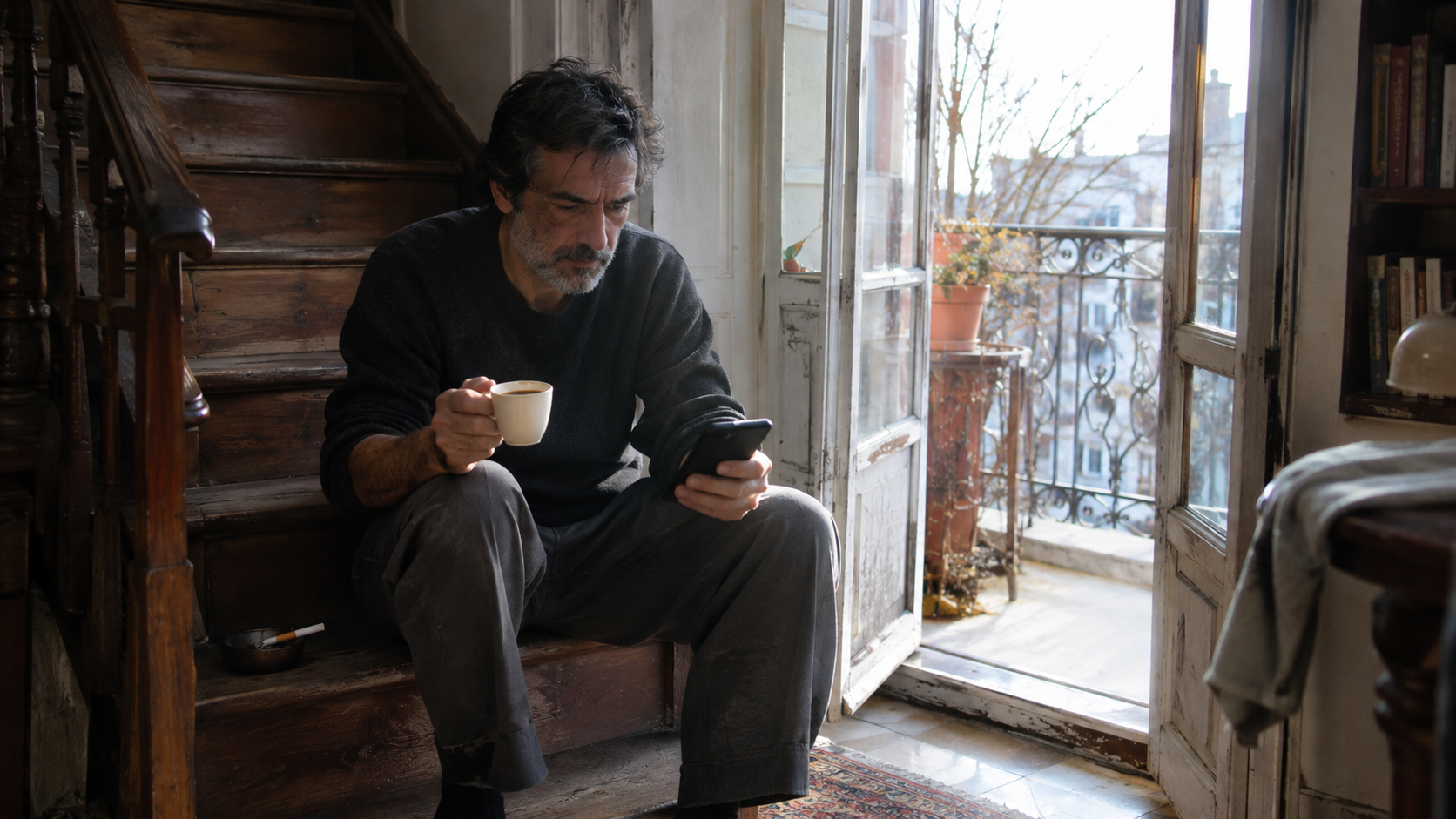
Manfred sits on a staircase at home with a cup of coffee, a cigarette and his mobile phone. The home office is only a few metres away, and there is a perfectly comfortable chair inside. But he doesn’t want the chair. He wants the staircase.
Martin, meanwhile, is preparing to leave work. His coffee cup has to be returned, his belongings gathered, his jacket collected, and his computer kept alive until the very last possible moment. Then, suddenly, he disappears.
They work together, know each other’s habits and have developed the sort of friendship in which a little teasing is perfectly normal. Yet when we asked them to choose the best five minutes of their working day, neither could be entirely sure what the other would say.
Manfred chose the first five minutes. Martin chose the last.
There was something beautifully symmetrical about that. One man wanted to delay the beginning of work. The other wanted to accelerate its ending.
We decided to investigate both moments minute by minute, with something of Marcel Proust’s attention to the apparently insignificant. Five minutes would be examined so closely that we might discover things their owners had never noticed.
We certainly did.
Minute one: The staircase.
Manfred’s morning begins with an open balcony door. He lets some fresh air into the corridor, starts his computer and then deliberately leaves the office again.
He sits on the bottom step of a staircase, drinks his coffee, smokes and looks at his phone.
From the outside, it is an unremarkable scene. A man sitting on a step when he could be sitting in a comfortable office chair. In winter as in summer. No cushion, no special arrangement, no attempt to make the experience luxurious.
But the location is not accidental.
Manfred explains that he needs a physical separation between his private time and his working time. The office is where work happens. The staircase is still outside that world. Even though he has already switched on the computer, he has not yet mentally begun the working day.
Five metres make all the difference.
He has chosen an uncomfortable seat because it is in precisely the right place. Moving those five metres would change the meaning of what he is doing.
And there is another important detail. He prefers to be alone. It is his time, without conversation or somebody arriving with a question.
What appears to be a coffee break is actually a small, carefully maintained boundary.
Unfortunately, that boundary has recently acquired a clock.
Since Monday, Manfred says, his company has introduced electronic time recording, accurate to the minute. Previously, he recorded his normal working hours without worrying whether he had started the computer a few minutes before or after eight. Now those minutes matter.
When we asked what happened during the first thirty seconds of his precious five minutes, his answer was rather unexpected. He might look at the clock and realise that only five minutes remained before work began.
The very knowledge that his peaceful moment was limited could turn it into stress.
He has already adjusted his behaviour to the new system. If every minute is counted, he intends to count them too, including the time he begins working earlier than usual.
The staircase has not moved. The coffee tastes the same. But the clock has changed the experience.
Minute two: A window onto the world.
Manfred’s telephone follows a familiar morning route through several websites. For years, he says, news about wars and international politics occupied much of his attention. Lately, that has changed.
Electric cars have become a stronger interest. He now spends more time reading about them, while international news sometimes receives only a glance at the headlines.
It is not simply a matter of replacing unpleasant information with something cheerful. Manfred has become increasingly conscious of the enormous amount of information available every day and of the need to choose what deserves his attention.
He no longer watches political television discussion programmes. He finds it frustrating to listen to people arguing when he has strong opinions of his own but cannot join the discussion.
He wants information, but he also wants some control over how much of it enters his morning.
There is a curious contrast here. Manfred protects his first five minutes from other people, yet uses those same minutes to invite the entire world onto a small screen.
He is selective about which parts of that world receive an invitation.
And sometimes the most interesting thing is not on the screen at all.
A house is being built nearby. From his position beside the balcony door, Manfred can see vehicles arriving at the construction site, occasionally including large lorries attempting to reverse into a narrow entrance.
When that happens, the phone loses its importance.
He stands up and watches.
He is fascinated by how the drivers manoeuvre their vehicles. Sometimes he admires their skill; sometimes he thinks he might have approached the problem differently. The Mayor compared him to a football coach watching from the sidelines, convinced that he could improve the performance.
Manfred laughed, but there was also genuine curiosity in his answer. He wants to understand how the driver manages the manoeuvre, particularly when a trailer makes the task difficult.
An interruption, then, does not necessarily spoil his five minutes. It depends on whether he finds it interesting.
As Manfred puts it, the decision about whether something disturbs him is his own.
That is quite a strong claim for a man sitting on a staircase.
Minute three: The ritual travels.
The more we examined Manfred’s morning, the clearer it became that this was not really a working-day habit at all.
He does it at weekends too.
On Saturdays and Sundays, he sits on the same staircase, drinks his coffee and checks his familiar websites. The difference is that he does not have to leave for work at a fixed time.
On holiday, the ritual travels with him.
At the caravan, he finds somewhere to sit outside with his coffee, cigarette and phone. In a hotel, he might go onto a balcony or outside the entrance. Even when he has an early appointment, he gets up earlier to preserve the moment.
It is not necessarily five minutes. It may be longer, depending on what comes next. But the basic ingredients remain.
There is a small complication when travelling. Manfred prefers weaker coffee than his wife, and the caravan has only one coffee maker, unlike their home, where they can prepare their drinks separately. Getting the strength right for both of them involves more negotiation with the coffee than one might expect.
Manfred considered whether he should finally write down the correct quantities. Even then, the stronger coffee would not necessarily suit him.
A small domestic engineering problem, still waiting for a satisfactory solution.
But the important discovery was that the ritual survives changes of place, season and schedule. The staircase is ideal, but not indispensable. The quiet beginning is what matters.
When asked whether ten minutes would be better than five, Manfred saw no great mystery. He would simply need more coffee, more cigarettes and have more time on the internet.
He was not trying to create a special experience. He was describing how he begins every day.
Only towards the end of our examination did he wonder whether the routine might actually prepare him for the day ahead.
He had never really considered it in those terms before.
Minute four: Martin is preparing his escape.
Martin’s five minutes are entirely different.
He wants the end of the working day, preferably with a little flexibility about exactly when they occur. He admits that he is sometimes running late, which may explain why the final minutes have such appeal.
The first sensation is anticipation, accompanied by a certain amount of haste.
He begins gathering his belongings. The coffee cup goes back to the kitchen and may even get washed. He checks the things on his desk, decides what must come with him, and collects his jacket. The car is only a few metres away.
As he describes this sequence, the scene becomes increasingly recognisable.
Martin is not merely getting ready to leave. He is gradually dismantling the working day around himself.
There is one rule that he follows with surprising consistency.
He never changes the date on his desk calendar before the day has actually ended. If it is still the fourth of November, then the calendar remains on the fourth, however unpleasant the day may have been.
The Mayor suggested that changing the calendar early could be a wonderfully symbolic way of disposing of a bad day.
Martin acknowledged the attraction of the idea, but he was not convinced.
Tomorrow is tomorrow. Today has not finished yet.
This small refusal to advance the calendar sits rather amusingly beside his growing eagerness to leave the office.
His next ritual is even more revealing.
Martin prepares everything for departure but leaves his computer running until the last moment, just in case something unexpected still requires his attention.
Only when everything else is ready does he finally shut it down.
And then, according to Manfred, something extraordinary happens.
Martin disappears at remarkable speed.
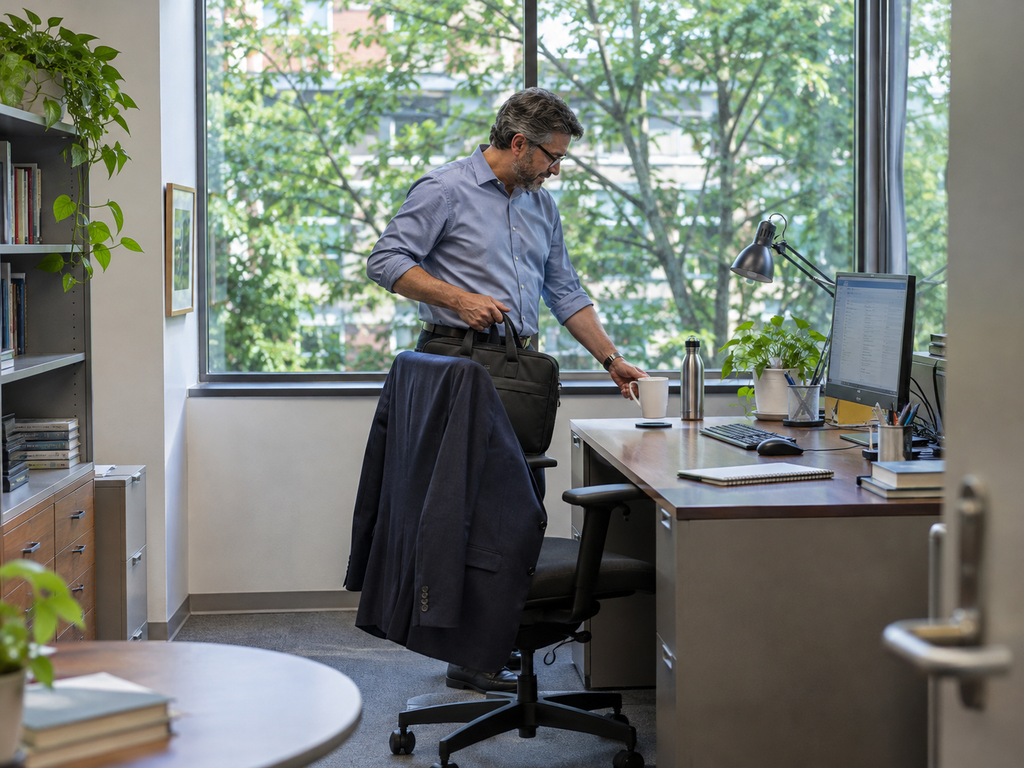
Manfred knows the warning signs. The coffee cup is being put away. The belongings are moving. A previously calm colleague develops a sudden burst of activity.
Once the computer has been shut down, there is almost no time left to react.
The Mayor suggested that Martin must be passing straight through the wall rather than bothering with the door.
Martin improved the description. He simply diffuses through the window towards his car.
This is the Swimming Club in familiar form: a perfectly ordinary workplace behaviour subjected to the sort of analysis normally reserved for a complicated scientific phenomenon.
But beneath the comedy, Martin was discovering something about his own behaviour.
Minute five: The danger of one more thing.
As Martin prepares to leave, his mind is already moving into the evening. He thinks about where he needs to go, what must be done first, and how the next few hours might unfold.
Sometimes he talks these plans through aloud, particularly when he is alone in the office.
He also recognises a recurring difficulty.
Even when he has enough time, he has a remarkable ability to fill it with one last task.
He knows he should leave. He may have somewhere important to be. Yet he suddenly thinks of something that could surely be completed before going home.
Then another possibility occurs.
Soon the comfortable margin of time has disappeared, and he finds himself rushing again.
Martin does not blame his colleagues for this. He says he is perfectly capable of ruining his own five minutes without assistance.
There was considerable humour in his description, but also a recognisable frustration. He knows what he should do. He has known for years. Yet knowing does not prevent him from repeating the same mistake.
By the fourth minute, in his imagined sequence, he hopes to be sitting in the car.
Then comes another important moment.
The music begins.
For Martin, switching on the car radio helps announce that the working day has ended. Sometimes he listens to ordinary radio, sometimes to CDs, depending on his mood.
His relationship with the car’s sound system is not entirely straightforward. He once replaced a faulty CD player with a newer unit that looked almost identical to the original. He was disappointed to discover that the old cassette mechanism had disappeared.
The remarkable thing was that he had never actually used the cassette player. He simply liked knowing that it was there.
He was quite indignant about losing a function that had apparently been of no practical importance to him.
And in his Alfa Romeo, music can mean something altogether different. Open the window a little, he says, and listen to the engine.
That is music too.
Manfred’s own preference provides a contrast. He is much more interested in information radio than recorded music. His car is another place where he wants to know what is happening in the world.
Two colleagues, two radios, two ways of making the journey their own.

The moment their five minutes collided.
The most interesting discovery came almost by accident.
As Martin described how easily his final minutes could be interrupted, Manfred suddenly recognised himself as a possible culprit.
When they leave the office together, Manfred sometimes remembers a subject they discussed earlier in the day. Just as Martin is preparing to escape, Manfred feels that the subject deserves another few minutes of attention.
From Manfred’s perspective, it is a perfectly reasonable opportunity to continue a conversation.
From Martin’s perspective, those minutes may already belong to the beginning of his free time.
There was no accusation. Martin was quite relaxed about the possibility of chatting after work and distinguished a friendly conversation from another piece of unfinished business.
Nevertheless, the contrast was difficult to miss.
Manfred had spent much of our conversation explaining why he needed his own undisturbed morning ritual. He carefully protected those first minutes before work began.
Yet here he was, potentially entering Martin’s equally important final minutes with another subject to discuss.
The Mayor pointed out the contradiction.
Manfred immediately recognised it.
If he expected other people to respect the boundary around his morning, he ought to allow them a similar boundary at the end of their day.
He said he would have to think about that.
It was a small moment, and perhaps a more significant one than either man had expected. No grand disagreement had been necessary. They had simply described their familiar routines closely enough to see how those routines sometimes met.
Martin’s final five minutes were not necessarily ruined by a conversation. Manfred’s first five minutes were not necessarily ruined by the sight of a lorry reversing into a driveway.
But both men wanted some say in what happened to their time.
The distinction was not between interruption and silence. It was between what they had chosen and what arrived without their choosing.
What five minutes can contain.
By the time we finished, our five-minute investigation had lasted considerably longer than five minutes.
Martin thought the exercise was interesting because so many little actions had become automatic. Breaking the routine into individual minutes revealed details he would probably never have considered otherwise.
Manfred had reached a similar observation from a different direction. He was struck by how important his morning ritual had become, how consistently he repeated it, and how little he had previously thought about its significance.
He wondered whether familiar routines might provide a sense of security or normality. He was not entirely sure.
That uncertainty was worth preserving.
The conversation had not turned Manfred into a philosopher of morning coffee or Martin into an authority on leaving work. Both remained wonderfully practical.
Manfred would still sit on his staircase tomorrow, regardless of whether the experience contained a deeper meaning. Martin would probably still carry his cup to the kitchen, glance at his calendar, keep the computer running until the final moment and then make a remarkably swift departure.
And there was something else we had discovered.
Their five minutes were not really about coffee, cigarettes, computers, calendars or car radios. Those were the visible details. What mattered was the delicate transition between one part of life and another.
For Manfred, the working day must not begin too early, even if the office is only five metres away.
For Martin, the working day must eventually finish, preferably without another task appearing just as he is ready to leave.
One man sits on a staircase. The other vanishes through a window.
And somewhere between them, the working day begins and ends.