
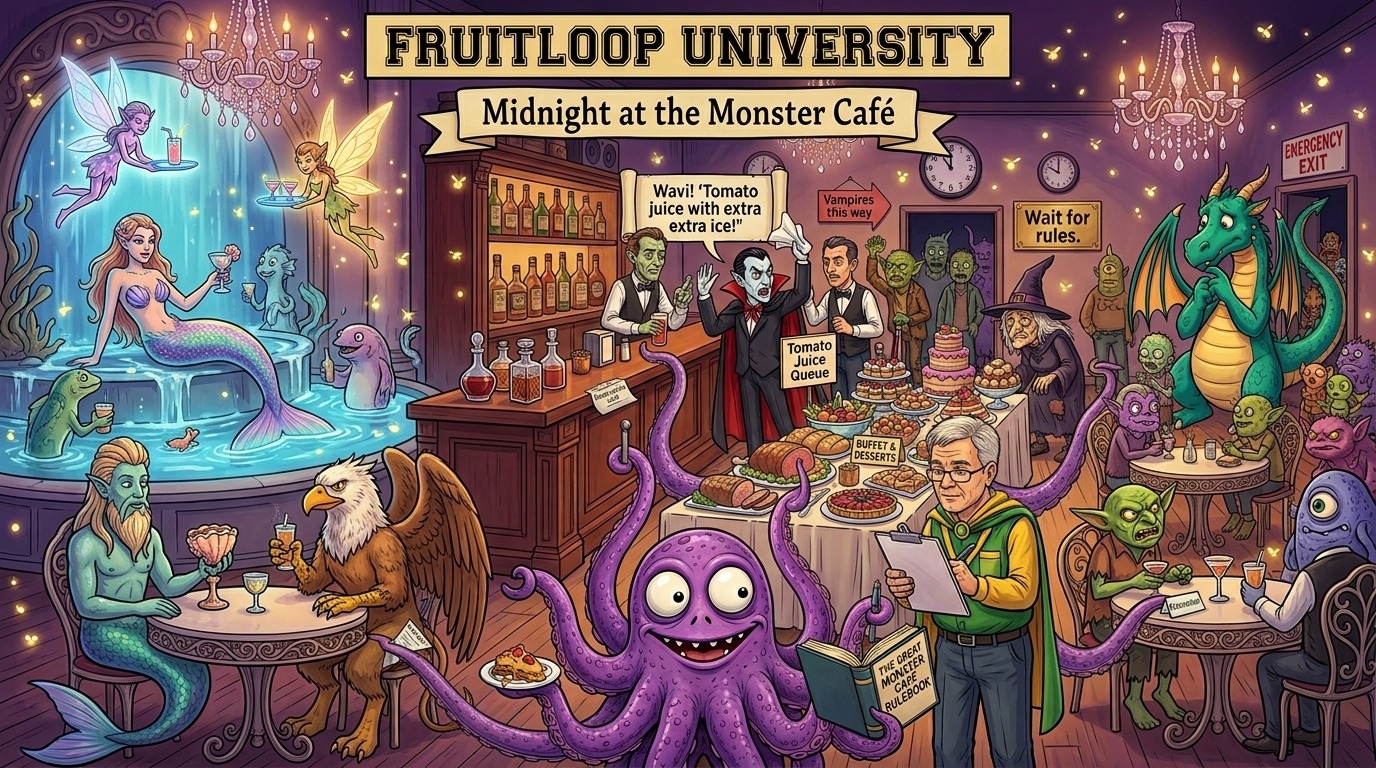
Peeling Potatoes, Episode 69: Who Goes First at the Monster Café?
Ten monsters arrive at once. One of them is invisible. Kevin has eight tentacles. The Mayor has house rules. What could possibly go wrong?
By Peeling Potatoes – Janita and or Fruitloop, not a monster and The Mayor, aka Frank. A monster (the jury is still out on that one.)
It was 11:50 p.m. and Monster Café was about to open.
Every creature in the neighbourhood had finished work, and Kevin — our purple monster friend — was hosting the annual Monster Madness Mania, a celebration of the madness and silliness of living together in harmony.
He had also made one potentially catastrophic management decision.
He had appointed the Mayor as the café’s official Minister of Queue and Service Management.
The Mayor was less impressed by the title than I had hoped.
“Queue and Service Management?”
Yes.
Thousands of monsters were expected.
He sighed.
Then I gave him his first problem. Ten monsters arrive at exactly the same time.
Who goes first?
Monster decency.
The Mayor immediately wanted more information. Was there a follow-up question? Was I going to let him answer and then twist the whole scenario around?
I refused to reassure him.
So he went back to his old hotel days, remembering Sunday mornings when an entire hotel seemed to arrive for breakfast at once and then complained about having to queue. There was only so much capacity. Everybody could not go through the door at the same time.
The same applied to monsters.
As far as the Mayor was concerned, if there was no hierarchy, seniority or other reason to treat one differently, Monster Number One went through, followed by Monster Number Two, and so on. Everybody behaved themselves, filed through the door and got on with the evening.
“We were talking about manners yesterday,” he said. “I’m sure monsters have some form of manners we may not actually understand.”
Human decency, apparently, had acquired a supernatural branch.
Monster decency.
I made it harder. What if the hungriest monster wanted to go first?
No.
What if he was so hungry that he started eating the other monsters?
Still no.
We were talking about seconds rather than hours, the Mayor pointed out. Starting a fight outside the door would only delay everybody further.
“Go in. Behave yourself. Have a good time. Eat nicely. Eat well. Enjoy the food. Enjoy the ambiance.”
Surprisingly civilised advice for a building full of monsters.
Then Kevin arrived.
Kevin has eight tentacles. If he stands in a queue, I asked, does that mean he gets eight places?
The Mayor considered the anatomy rather than the philosophy.
“He’s only got one bum.”
And there it was: the first proper rule of Monster Café.
One bum, one place.
The invisible problem.
Things became more difficult when an invisible monster pushed to the front.
Was it rude if nobody could see who was doing it?
The Mayor thought about that one. Yes, it was still rude. The other monsters would know something was happening because they would suddenly find themselves being shoved out of the way. They simply would not be able to see the culprit.
That reminded him of a story.
Years ago, his wife and mother-in-law were waiting at a car park payment machine in Britain when a man marched from the back of the queue, pushed ahead of everyone, paid for his ticket and prepared to leave.
Someone objected.
“You’re going to have forgotten me by tomorrow,” the man apparently replied. “So why are you getting excited?”
There was, the Mayor admitted, a peculiar logic to it.
Unfortunately for the man, it did not work. The Mayor had not even been there and still remembered the story years later.
That may be one of the dangers of unwritten rules. You can break one and get exactly what you wanted. Nobody arrests you. Nobody issues a formal warning. There may be no visible consequence at all.
But people remember.
The invisible monster had an additional advantage. Even if everybody knew he was behaving badly, what exactly were they going to do about it?
Sometimes, the Mayor decided, you simply have to chalk something up to unpleasant behaviour and move on.
Take the monster off the Christmas card list.
Give him coal.
Assuming monsters celebrate Christmas.
We parked that question for another day.
Four egos and a tomato juice.
Next came Ignis the dragon, Vlad the vampire, Gargle the zombie and the Chicken King.
All four claimed they should be served first.
The Mayor refused to choose. If they were sitting at the same table in a good establishment, he argued, the kitchen should prepare the meals so that all four dishes arrived together.
“You’ve got to level the playing field.”
Rather than decide which claim deserved priority, remove the reason for the argument.
Then Dracula arrived.
He had been coming to Monster Café for 400 years and wanted his usual large tomato juice with extra ice. Unfortunately, there was a vampire queue and a tomato juice queue, and Dracula had no intention of joining either.
Four centuries of loyal custom, he felt, should count for something.
The Mayor disagreed. Being a regular did not automatically give Dracula the right to go first.
That did not mean he would make him queue.
This was where the neat little rulebook began to wobble.
Why waste everybody’s energy having a public argument with a difficult regular when a professional waiter would probably have seen Dracula enter, known exactly what he drank and had the tomato juice waiting before he reached the bar?
Make the drink. Add the ice. Take the money. Hopefully collect the tip.
If Dracula’s behaviour became a genuine problem, speak to him quietly later.
Not in front of everybody.
No spectacle. No grand battle over principle.
The rules had not disappeared. The Mayor simply did not believe every violation required a war.
Kevin finds a loophole.
Then Kevin discovered the flaw in my system.
He sent one tentacle to order a drink, another to the buffet for dessert, two more to reserve seats for friends, another to wave at a waiter, and used the remaining tentacles to hold positions in different queues.
“I’m not skipping the queue,” Kevin announced. “I’m participating in several queues at once.”
The other monsters were furious.
The Mayor was almost impressed.
Not by Kevin.
By the size of the design failure.
From a human point of view, Kevin’s particular trick was impossible. Humans do not generally possess eight independently deployable tentacles. But that was not really the point.
The loophole existed. Kevin had found it, and now he was exploiting it.
Was he clever or unfair?
Unfair, the Mayor decided. If one creature’s cleverness interfered with everybody else’s enjoyment, somebody had to intervene. Kevin would be told to stop. If necessary, he would be told twice. If he continued, matters would escalate.
And the loophole would be closed.
Then the Mayor contradicted himself.
“If there is a loophole, you use it until somebody closes it.”
I pointed out that this seemed convenient.
He agreed.
Then he corrected himself.
“It depends on the loophole.”
A legal or financial loophole somebody was perfectly entitled to use was one thing. A behavioural loophole that allowed one person to make life worse for everybody else was different.
My contribution was less morally sophisticated. If the loophole works in your favour, use it and do not tell anybody else.
The Mayor approved enthusiastically.
Monster Café was developing a slightly worrying ethical code.
The last chair.
By now every table was full.
There was one chair left, and approaching it were a 900-year-old witch whose feet hurt, a tiny zombie who had been standing for six hours, a dragon whose tail was blocking the emergency exit, and the Mayor, who had spent the entire evening standing up and solving everybody else’s problems.
Who deserved the chair?
The Mayor eliminated himself immediately. He was the co-host. Nobody cared that his feet hurt. That was part of the job.
He gave the chair to the witch.
The zombie could sit on the bar if he was tiny enough. The dragon could be moved away from the emergency exit. Both could have a drink on the house.
Everyone had not received the same thing, but everyone had been considered.
“That’s almost like bribery,” I said.
“A lot of it is.”
Then I told him the chair was not actually a chair.
It was a magical throne.
Whoever sat on it would become café manager and host of the next Monster Madness Mania.
Suddenly everybody wanted it.
Now who should sit down: the creature who needed the chair most, wanted it most, or would use its power most responsibly?
The Mayor did not hesitate.
The third.
Need and want could both cause trouble. A creature who could genuinely use power responsibly was much rarer.
That creature could have the chair.
Preferably forever.
The Mayor’s shift would be over.
The rulebook.
At the end of the evening, the café owner had had enough. She handed the Mayor a blank book.
Five rules, I told him.
Too many, and nobody would come back.
Too few, and Kevin might eat the furniture.
The Mayor began.
Rule One: Have a good time.
Rule Two: Respect the staff.
Rule Three: Respect the other guests.
Rule Four: We fulfil wonders immediately. Miracles take a little longer.
Rule Five was really the boundary around all the others: if you cannot accept the house rules, perhaps this is simply not the right café for you.
There are other cafés.
There are also, presumably, other monsters.
I had one final question.
Should rules change when they stop making sense?
“Definitely.”
Then the Mayor paused.
“The question is, who do they make sense to?”
Which rather ruined the beautiful simplicity of the question.
A rule can look outdated to the person writing it and perfectly sensible to the person relying on it. Change something too quickly and you may destroy exactly what people valued about it. Refuse to change at all and eventually the world moves around you.
So yes, you adapt. You develop. You innovate.
But you also pay attention to who is actually in the room.
When I asked whether kindness could replace rules altogether, the Mayor made one last distinction.
“You don’t have to be kind. But you have to be polite.”
Kindness can become emotional. Politeness can still contain a firm no.
Perhaps that was enough for Monster Café.
Ten monsters arriving at once did not require a magnificent new philosophy of queue management. Kevin’s tentacles did not require an international convention. Dracula’s tomato juice did not need a tribunal.
You need enough rules to stop the place descending into chaos, enough flexibility to avoid becoming ridiculous, and enough judgment to know the difference.
Somebody will still jump the queue. Somebody will still find a loophole. And somebody will eventually have to decide who gets the chair.
Which brings us rather inconveniently back to my usual answer.
It depends.