Nine Letters, Backwards.
The Human Bit, by Frank Peters
Nine letters. That was all.
PINEAPPLE.
I’ve been publishing a magazine for over six months now, and writing its name has never presented much of a challenge. Nine letters on a keyboard. A fraction of a second, perhaps a little longer if I’m having a bad day.
Then, on a Sunday afternoon in Strasbourg, somebody invited me to do it the old-fashioned way.
I was visiting Salon Graphique at Garage COOP, a former industrial site that has found a new life amongst artists, designers, illustrators and publishers. I had gone there to meet people, look at interesting things and see what might happen.
I hadn’t expected to find myself struggling with the alphabet.
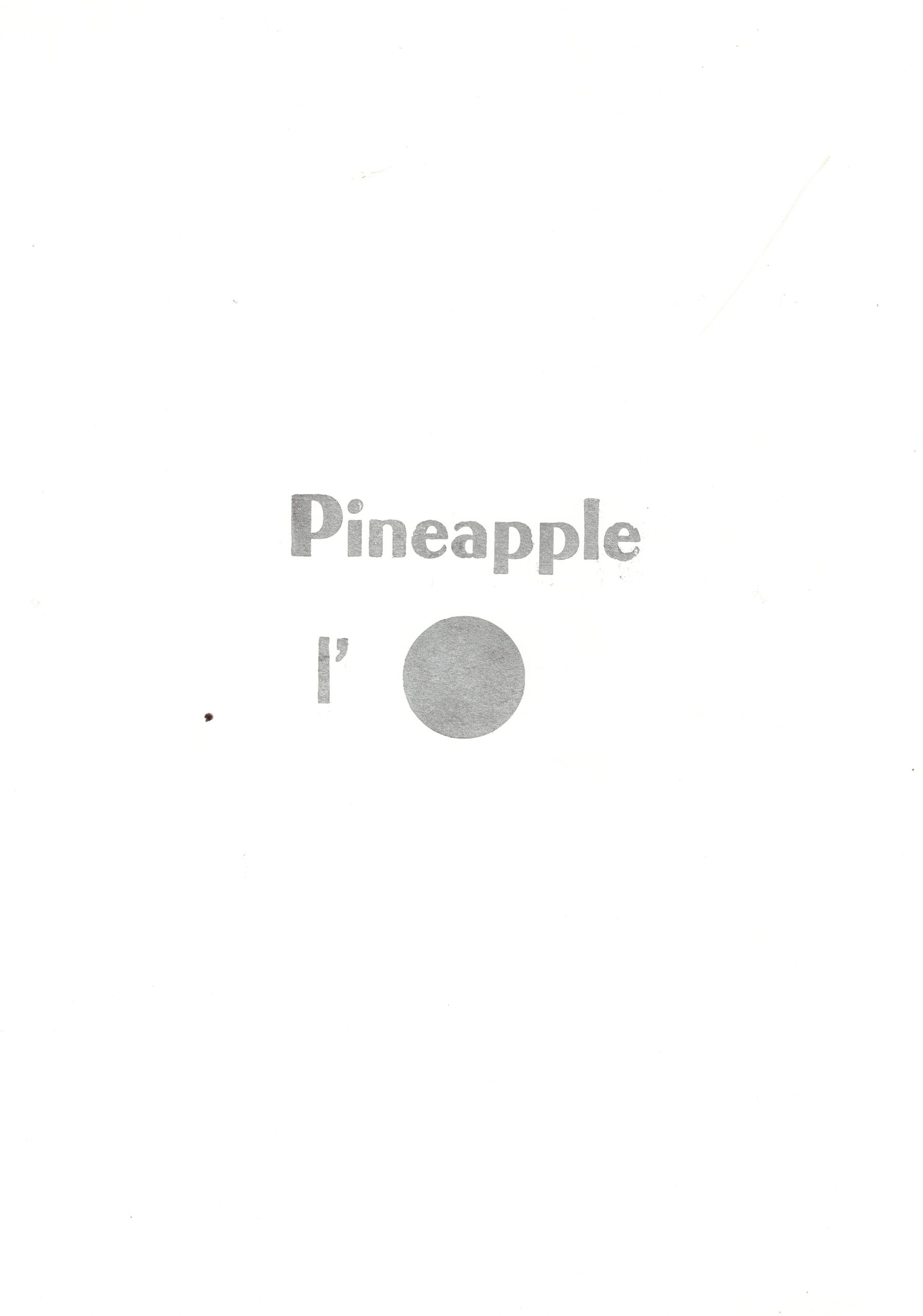
The woman demonstrating traditional letterpress printing invited me to set the word Pineapple using individual pieces of movable type.
It sounded straightforward.
Not quite.
For a start, the letters weren’t arranged alphabetically in their compartments. Finding the right one required knowledge of a system I didn’t understand. Then the letters had to be positioned in reverse, so they would print correctly.
Backwards. Upside down. A simple word had suddenly become a small exercise in spatial reasoning.
Nine letters, and I was already beginning to appreciate the advantages of modern technology.
But that wasn’t what stayed with me.
The pleasure of knowing.
The woman showing me the process was clearly enjoying herself.
She knew the equipment, understood the arrangement of the letters and seemed genuinely pleased to explain a skill that has largely disappeared from everyday publishing.
There was pride in it. Not the sort that announces itself loudly or demands admiration, but the quieter satisfaction of knowing how something works and being able to demonstrate it.
And her enthusiasm was catching.
I wasn’t particularly interested in becoming a typesetter. I doubt there’s much demand for somebody who requires assistance to arrange nine letters.
But I became interested in what she was showing me, partly because she was so interested herself.
That seems a small distinction.
It isn’t.
We encounter people doing their jobs all the time. Some interactions are entirely functional. We ask a question, receive an answer, exchange the necessary information and move on.
Perfectly reasonable. Most days would be rather exhausting if every transaction became a profound human encounter.
But occasionally we meet somebody who allows us a glimpse behind the finished product.
Somebody who doesn’t merely know what to do, but cares about doing it.
And for a few moments, we begin to see their world differently.
The work behind the result.
Not long before this visit, I’d watched a supermarket cashier being trained.
From the customer’s side of the checkout, the job can look remarkably simple. Products pass across a scanner, numbers appear, money changes hands.
There is a reassuring rhythm to it.
But watching the training revealed another side. The screen required decisions. The process involved choices and procedures that were largely invisible to somebody standing on the other side of the counter.
The apparent simplicity was deceptive.
I found myself wondering how many other jobs look easy because somebody has become very good at doing them.
The answer, I suspect, is most of them.
A waiter who remembers six orders without writing anything down. A mechanic who recognises a fault from a sound. A cleaner who knows how to deal with a surface the rest of us would probably ruin. A graphic designer who notices that something isn’t quite right, although the untrained eye cannot explain why.
We see the result.
We rarely see the accumulated knowledge that makes it possible.
And perhaps we notice it even less when the work is done well.
A badly designed page draws attention to itself. A well-designed one simply works.
A mistake at the checkout makes us impatient. A smooth transaction is forgotten before we’ve reached the car park.
Competence has a curious habit of making itself invisible.
Something worth passing on.
There was another aspect to the printing demonstration that interested me.
The woman wasn’t simply preserving an old technique. At least, that wasn’t how I experienced the encounter.
She was passing something on.
Not necessarily the skill itself. I emerged with a little more understanding, but I wouldn’t trust myself to produce next Friday’s Pineapple using movable type.
What she passed on was an appreciation.
Before the demonstration, traditional letterpress printing was something I knew existed. Afterwards, it was something I understood a little better.
And the difference was another human being.
She had made the familiar unfamiliar, then helped me see it anew.
It also made me reconsider my own position.
Janita and I spend a great deal of time thinking about publishing: articles, sequencing, images, distribution, readers. Much of the work is now digital and with AI. The tools are astonishingly capable, and tasks that once required several specialists can be completed on a computer.
I wouldn’t willingly exchange those advantages for a type case and a composing stick.
Certainly not after my performance with Pineapple.
But efficiency has changed our relationship with the work behind what we consume.
We can produce more, faster, with fewer visible traces of the people and processes involved.
The finished page arrives. We read it, enjoy it or ignore it.
We seldom wonder how it came to be.
The human bit.
I left Garage COOP thinking about that woman’s enthusiasm.
Why did it stay with me?
Perhaps because she knew something I didn’t. Perhaps because she clearly enjoyed sharing it. Perhaps because she reminded me how satisfying it can be to explain something you care about to somebody who genuinely wants to know.
Whatever the reason, she changed the way I looked at printed matter.
Not dramatically. I haven’t developed a sudden desire to dismantle my printer or investigate the history of every typeface.
But I shall probably look a little more carefully at the next beautifully printed book I pick up.
And I may wonder about the people whose knowledge went into making it.
There must be countless such encounters waiting to happen.
People who know things we don’t. People who care about details we haven’t noticed. People whose working lives contain little discoveries that never make it into the finished product.
We pass them every day.
Sometimes all it takes is a question, a little curiosity and somebody willing to show us.
Nine letters.
A rather ordinary Sunday afternoon.
And one woman who made an old printing technique worth remembering.