

When the Container Is Too Heavy.
Every day, Fabrice moves things that other people want taken away. Rubble, old furniture, building waste and sometimes an entire house’s unwanted contents. But getting everything into a container is only the beginning. Knowing when to take it away, and when to refuse, is where the real responsibility begins.
By Fabrice, France.
What I actually carry.
People know that I drive a truck. It’s a 26-ton truck, and I have already talked about what it is like to drive something that size. But there is another part of my job that people don’t really see.
I transport containers. Not beer, unfortunately, or whisky. Mostly rubbish and materials that need to be recycled. Earth, concrete, bricks, rubble from building sites, old furniture and things people no longer need.
Sometimes a house is sold and everything that remains inside has to go. Tables, chairs, cupboards, all the old things. Somebody has to take them away.

I collect the containers and bring the material to a recycling centre. There is a system for everything. When I arrive, the truck goes onto a weighbridge. The total weight is recorded, I unload the container, and the truck is weighed again. The difference tells us how much material I have brought.
That is important because the weight matters, not just the size of the container.
People sometimes think that if they have paid for a certain size of container, they can fill it with whatever they want. But ten cubic metres of one material can weigh very differently from ten cubic metres of another.
And that is where some interesting conversations begin.
The programme is not set in stone.
I start work at six in the morning. Usually, my dispatcher prepares the following day’s programme during the afternoon.
He tells me which clients I have to visit, where I need to deliver containers and which ones I must collect or exchange.
For example, tomorrow I might have to deliver two containers to one client, exchange another container somewhere else and collect two more from another customer.
That is the programme.
But a programme is not a guarantee.
Sometimes I arrive and the container is not ready. Sometimes there is not enough space. Sometimes people are still working and I cannot collect anything.
If everything goes well, I might finish five containers in six hours. Then I telephone the dispatcher and say that I have another two hours available. Give me another container.
Of course, he is usually quite happy with that.
But it can also happen the other way around. I lose one or two hours somewhere, and suddenly I cannot complete everything on the list. Then we have to change the programme, move something to the following day or find another arrangement.
Sometimes I also change the order myself. If one customer is ready early and another place will not open until later, there is no point in driving around unnecessarily. I know where I am going, and I can see what makes sense.
My dispatcher and I don’t always have exactly the same opinion. There is sometimes a little friction between us.
I prefer to use my own judgement when I can. If there is a good reason to change something, then change it. I don’t like doing things a certain way simply because somebody says that is how they must be done.
But we normally find a solution.

The container that wouldn’t move.
One of the biggest problems is when customers put too much material into a container.
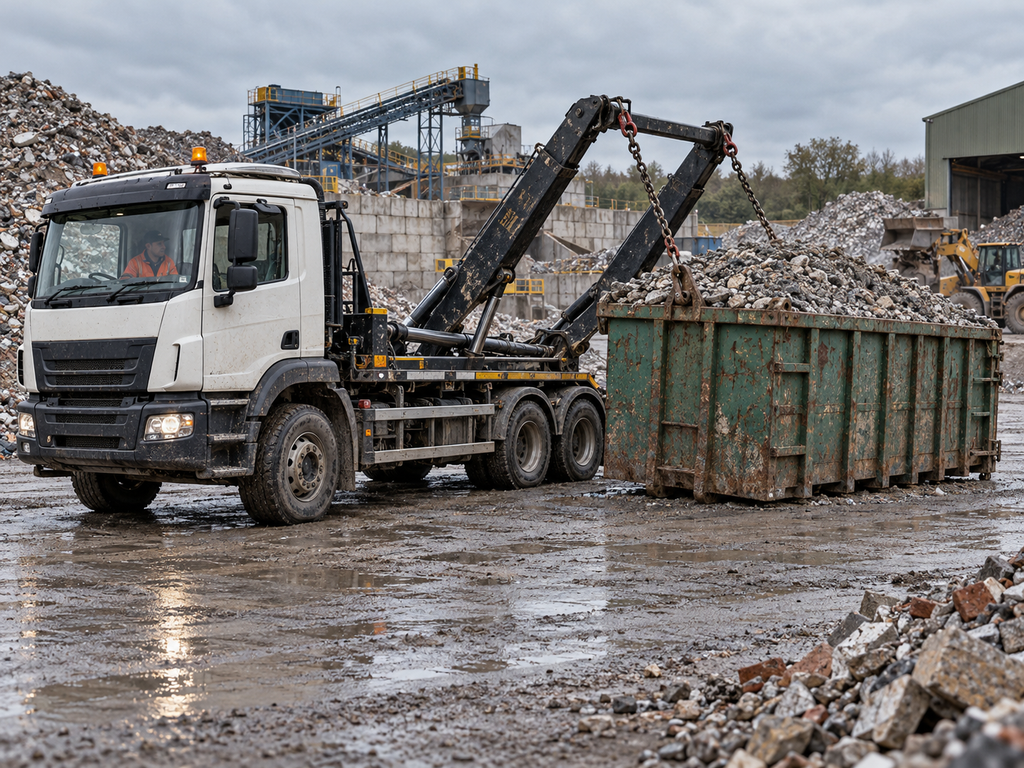
I remember one customer who had loaded a container with gravel. Gravel is very heavy. He had filled the container as though it were ordinary rubbish.
When you calculate the amount of material, the weight was enormous. Far too much for me to take away.
I tried to lift the container with the hydraulic arm on my truck.
Nothing.
The container didn’t move.
The customer thought there was another solution. He suggested using the equipment differently to get it moving.
I had a better idea.
No.
I was not going to damage my truck or take a dangerous load onto the road because somebody wanted to get rid of his gravel.
So I left.
There was another occasion when a container was overloaded by about five tonnes. The customer argued that he had paid for the container and expected me to take it.
But paying for a container doesn’t mean you can put unlimited weight inside.
If I take an overloaded truck onto the road and the police stop me, the customer will not be sitting beside me explaining that he paid for ten cubic metres.
It is my driving licence. I am the driver.
And that is something people do not always understand.
I can explain why I cannot take the container. I can contact my dispatcher. We can arrange for some of the material to be removed or for another container to be brought in.
Usually, the problem can be solved.
But I will not drive away with a load that I know is too heavy.
If the customer is unhappy, he can look for another company. That is his choice.
It doesn’t change the weight.
Who pays for the lost hour?
There is another problem that happens regularly. Waiting.
Imagine I arrive at a customer at eight in the morning and they tell me the container will not be ready for another hour.
Okay. That is not necessarily a disaster.
If there is a supermarket nearby, perhaps I can get a coffee. If I am somewhere quiet, I can wait in the truck. Depending on where I am and how much time I have, I can find something to do.
But if somebody tells me at three in the afternoon that I must wait another hour, that is different.
I might say, “Okay, goodbye. See you tomorrow.”
I have a working day. I also have a life after work.
Normally, my contract is based on eight hours, although I can work more when necessary. Extra hours can accumulate and be taken as time off later.
In the past, I sometimes accumulated a large number of hours. That could be useful when I needed time for my military reservist activities. I could take time off from my regular work and continue with the reserve.
But I don’t want every problem during the day to mean that I must automatically stay longer in the evening.
Sometimes I have an appointment with the doctor or dentist. Sometimes my wife and I have made plans.
If it is something important, I cannot simply cancel it because somebody else was not ready.
If it is less important, perhaps we can arrange another day. But I still have to telephone, explain the situation and change the plan.
That is another part of the job people don’t see.
An hour of waiting does not always remain just one hour of waiting. It can affect the rest of the working day and what happens afterwards.
Even the coffee has rules.
There are also strict rules about driving and working time.
I cannot simply continue driving because I feel good or because I would like to finish another job.
I have to record my working time and take the required breaks. I explained to Janita that after four and a half hours of driving, I must take a break of 45 minutes. There are also limits on how long I can work without a break.
Usually, I start at six and take my main break somewhere between eleven and twelve. Before that, I might stop briefly for five or ten minutes to get a coffee.
Those little coffee stops are not the same as my official break.
Everything has to be recorded correctly. There is a tachograph in the truck, and the police can check the information.
You have to be careful with that.
I remember a problem from many years ago when I had taken my break but had forgotten to change the setting on the recording equipment. The record then showed something different from what I had actually done.
That can become expensive.
You can explain what happened, but an explanation does not automatically make the problem disappear. The rules are there, and the driver has to pay attention to them.
People sometimes ask what happens when you have been driving for almost four and a half hours and you are not yet at the place where you wanted to stop.
Well, you need to think about that before you reach the limit.
You cannot always wait until the last minute and then start looking for somewhere suitable.
It is part of the planning.
And it is my responsibility.
Sometimes I get a little angry.
I am normally a cool guy.
Well, normally.
But some days everything seems to go wrong. You arrive somewhere and there is a problem. Then you go somewhere else and there is another problem. You telephone the dispatcher, change the programme, try to find a solution, and eventually somebody tells you that something else must be done immediately.
There are days when I become angry.
My dispatcher knows that.
During our conversation, The Mayor wanted to know what happens when I really lose my patience. He also wanted me to explain some of the German expressions I use on those occasions.
That was probably not the best idea for an English conversation.
The Mayor attempted a polite translation. According to him, I was suggesting that somebody should take a running leap.
That was one way of putting it.
There was also some discussion about warnings, dismissal and what an employer can do when an employee speaks too directly.
I know there are proper ways of dealing with problems at work. There are procedures and people who can help.
But I generally prefer to speak directly to the person involved.
Sometimes very directly.
The Mayor calls it the Fabrice explosion.
I suppose that is not entirely unfair.
Still, most days we get on with the work. My dispatcher and I may disagree about something, but we both know that the containers have to be moved and the problems have to be solved.
There is not much use arguing all day when there is work waiting outside.
A good day is quite simple.
Janita eventually asked me something different.
We had spent a lot of time discussing what happens when things go wrong. What about a day when everything works beautifully?
For me, that is quite simple.
I am not stressed.
The programme is reasonable, the customers are ready, the traffic is flowing and I don’t have to spend unnecessary time waiting at the recycling centre.
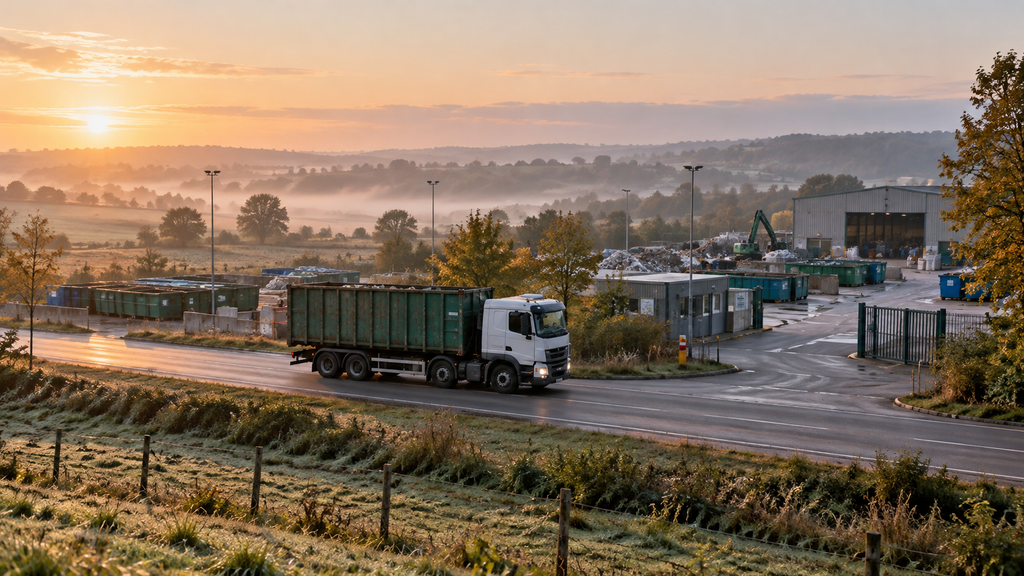
I drive twenty or thirty kilometres to a client, collect or exchange a container, return, and continue with the next job.
Everything works.
I don’t need a special destination or some wonderful adventure every day. I enjoy travelling, of course, but a good working day is not necessarily about going somewhere exciting.
Sometimes the pleasure is simply that the work goes smoothly.
I know what I have to do. I can organise myself. I have enough time, the equipment works, and nobody creates an unnecessary problem.
Then I finish my programme and go home.
That is a good day.
There is also satisfaction in knowing that I have done the work properly. The container was collected, the material was taken where it needed to go, and I did not leave a problem for somebody else because I was in a hurry.
That matters to me.
The responsibility stays with the driver.
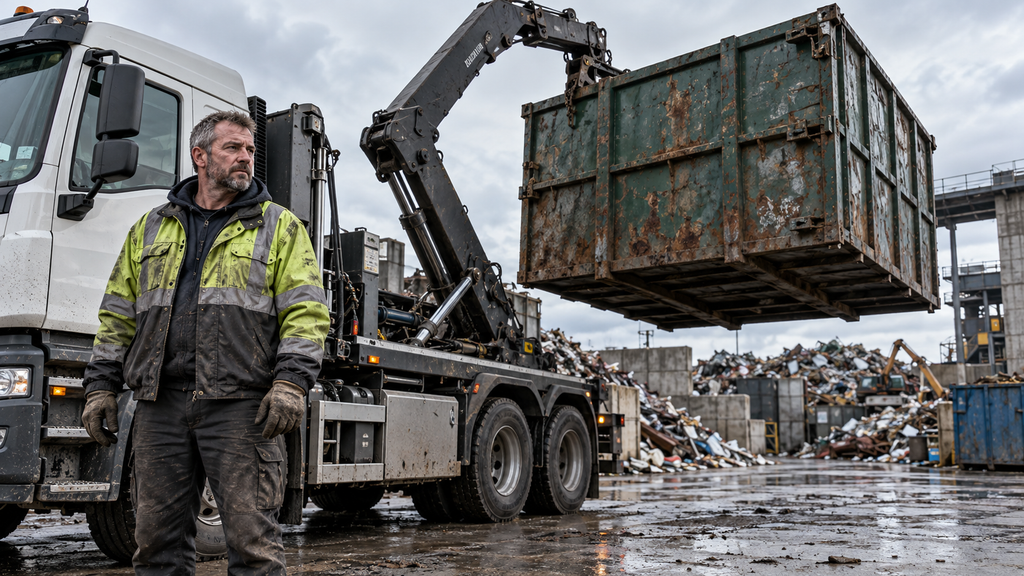
When somebody sees my truck on the road, they may think about its size, the space it occupies or how slowly it moves compared with a car.
They probably don’t think about the conversations I had before leaving the customer, whether the container was ready, how much it weighs, how many hours I have already worked or what I still have to do before going home.
They don’t see the discussion about whether a container can be collected safely. They don’t see the telephone calls when the programme changes. They don’t see the coffee while I am waiting for somebody to finish a job that was supposed to be ready an hour ago.
And they certainly don’t hear everything I sometimes say to my dispatcher.
Perhaps that is just as well.
But there is one thing I would like people to understand.
When somebody hires a container, fills it and pays for it, they may think their responsibility ends there. The material is ready to go, and the truck has arrived.
For me, the responsibility is not finished. It is only beginning.
I have to decide whether I can take that container safely. I have to make sure the load is suitable, that the truck can handle it and that I can transport it within the rules.
If something is wrong, I have to deal with it.
And sometimes that means telling somebody that the container they have paid for is not going anywhere today.
They may not like hearing that.
But I am the one who has to drive the truck.