
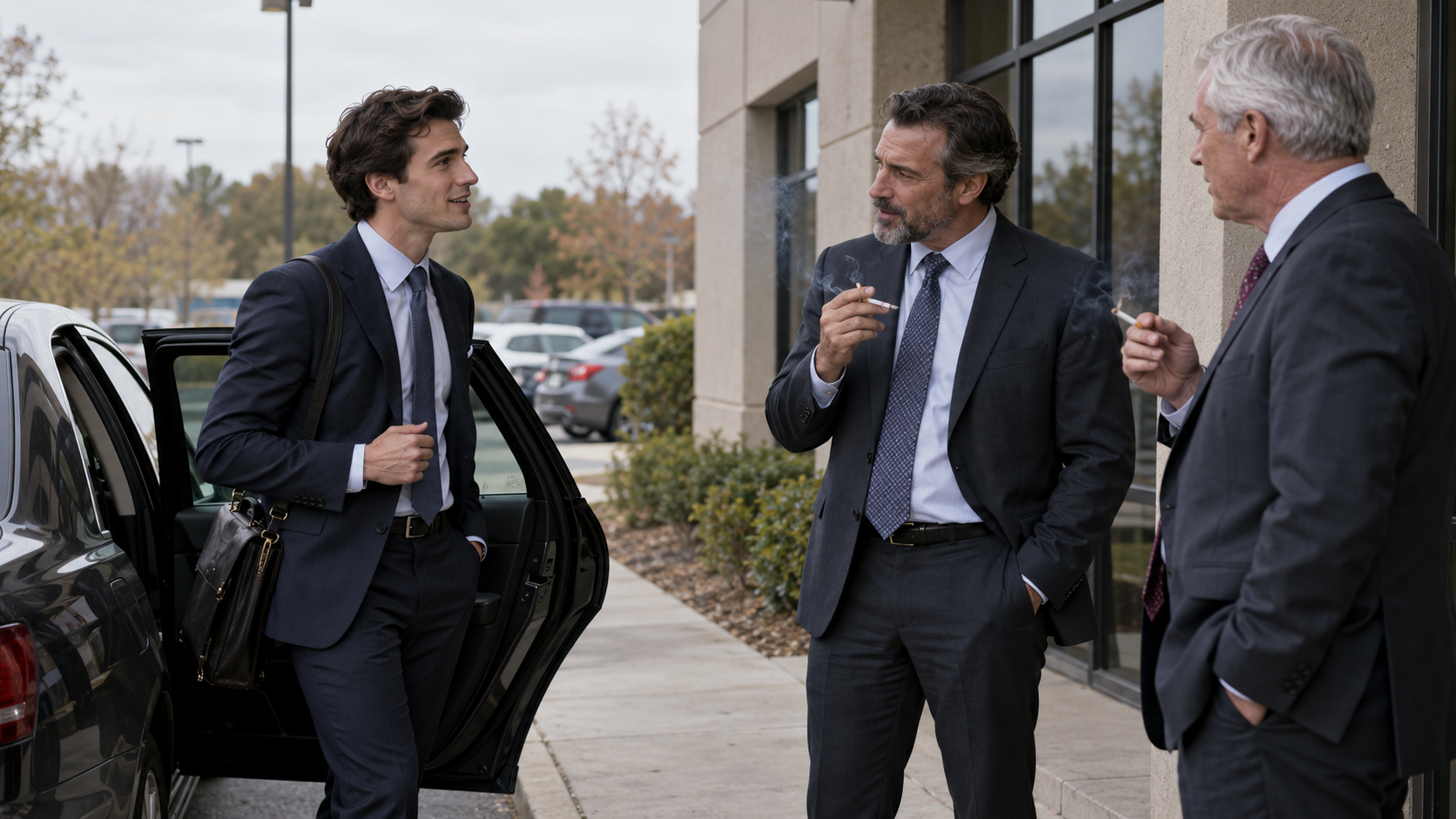
The Interview Started in the Car Park.
The questions matter, but so do the things around them: who is sitting opposite you, how open the conversation feels, and whether you are brave enough to find out what the job is really like.
By Alexander, Germany.
I was about fifteen minutes early for a job interview and sitting in my car outside the company.
Then two men came out of the building. One was the CEO and the other was the sales manager for Germany. They had a short break, lit cigarettes and started walking towards my car.
I knew I would be speaking to them a few minutes later.
For a moment I sat there thinking: What is the best reaction now? Do I stay in the car? Or do I get out and introduce myself?
I got out.
“Hi, I’m Alex. I think you are the people I’m going to speak with in a few minutes.”
They told me they were going for a short walk and would see me later in the meeting room.
That small moment stayed in my mind. After the interview, they told me they had noticed it too. I was still quite young, around 24 or 25, and I had simply got out of the car, walked towards them and introduced myself. For them, it created a positive first impression.
For me, it did something else as well. Before the formal interview had even started, I had already seen the people I was going to speak with. I had an impression of how they looked, how they behaved and a little of their personality.
That is important to me. Once I have a picture of the people, I can prepare myself for the conversation.
In a way, the interview had already started in the car park.
I want to know who is sitting opposite me.

There is one part of job interviews I have never really liked: the expectation that you should know every detail about the company.
Of course I prepare. I want to understand the basics. What does the company sell? How old is it? How is it structured?
But I have never understood why an applicant sometimes seems expected to learn the company almost by heart before the interview. The company is interested in me, and I am interested in the company. For me, it should work in both directions.
What interests me more is the person I am going to meet.
I usually look on LinkedIn. I want to see who they are, how long they have been with the company and what they did before. That gives me a first picture.
Because in the end, I want to understand how the person ticks.
That is much more useful to me than remembering a long list of company facts.
The question behind the questions.
I also do not like some of the classic interview questions very much.
“What are your strengths?”
“What are your weaknesses?”
I find those questions difficult because I do not naturally like talking positively about myself. I prefer talking about what needs to improve. If I see a problem, I want to discuss the problem.
For me, a job interview becomes much more useful when the conversation is open.
I want to understand what is really important in the job. How does the manager work? What does the company actually expect? What will my real job be when I start?
And the company should also be able to understand me.
Can I do what they need? Do we think in a similar way? Can we work together?
For me, the chemistry is extremely important.
You can prepare many questions before an interview, but sometimes the exact questions are less important than whether both sides are willing to have an honest conversation.
Can you be too polite?
I think you can.
If you are too polite, there is a danger that you forget to talk about the things that are important to you.
But there is another side to this, and I think it matters a lot: your position changes the conversation.
If you already have a job and everything is basically fine, you can enter an interview very differently. You can be relaxed. You can say what you want and what you do not want. If the new job does not fit, you can stay where you are.
I have experienced this myself. In one interview process I had the feeling that the company wanted me, rather than that I desperately wanted the company.
That changes everything.
You can be more open.
But imagine somebody who urgently needs a job. Maybe they have no work at the moment, or they really want this particular position. Suddenly the interview can become much more one-sided.
You want the job, so you answer the questions. You want to make a good impression. You probably do not want to challenge the interviewer too much.
That person may still want an open conversation, but the pressure is different.
And I think a good interviewer can feel that difference too.
What you only discover afterwards.
Even a very good interview cannot tell you everything.
In an earlier sales job, for example, part of my pay later depended on a bonus system. At the beginning I was highly motivated by it. I wanted to reach the target.
Over time, I realised that achieving the bonus regularly was much more difficult than I had expected.
Other people already understood how the system worked, but I had to discover it myself.
That experience taught me something important about interviews. There is the job you discuss before you start, and then there is the job you actually experience.
Sometimes they are the same.
Sometimes they are not.
You can ask good questions. You can research the company. You can study the people. But there are things you only understand after several months inside an organisation.
That does not mean an interview has failed. It means you should try to understand as much of the real situation as possible before you make the decision.
“What is my real job when I start?”
For me, that is much more interesting than having a perfect answer ready for “What are your weaknesses?”

AI can prepare the paper. I still have to read the room.
Today, one part of applying for jobs has actually become easier for me.
Writing applications has never been my strongest area. My strengths are in a conversation. Give me another person and I can talk, listen and react.
Now I can use AI to help with the written preparation. I can use it to learn about a company, think about the job and prepare for questions that might come.
For somebody going into a first important interview, I would certainly recommend doing that preparation.
But preparation only gets you to the door.
Once you are sitting in the interview, you still have to judge the situation yourself.
Who is sitting opposite you?
How open is the conversation?
Can you ask what really matters to you?
Are you hearing what the job is actually going to be?
And perhaps most importantly: are both sides trying to find out whether this really fits, or is one side simply trying to get the other side to say yes?
There is no perfect list of questions that can solve that.
Sometimes you simply have to read the room.
And sometimes the first important moment happens before you have even entered it.