
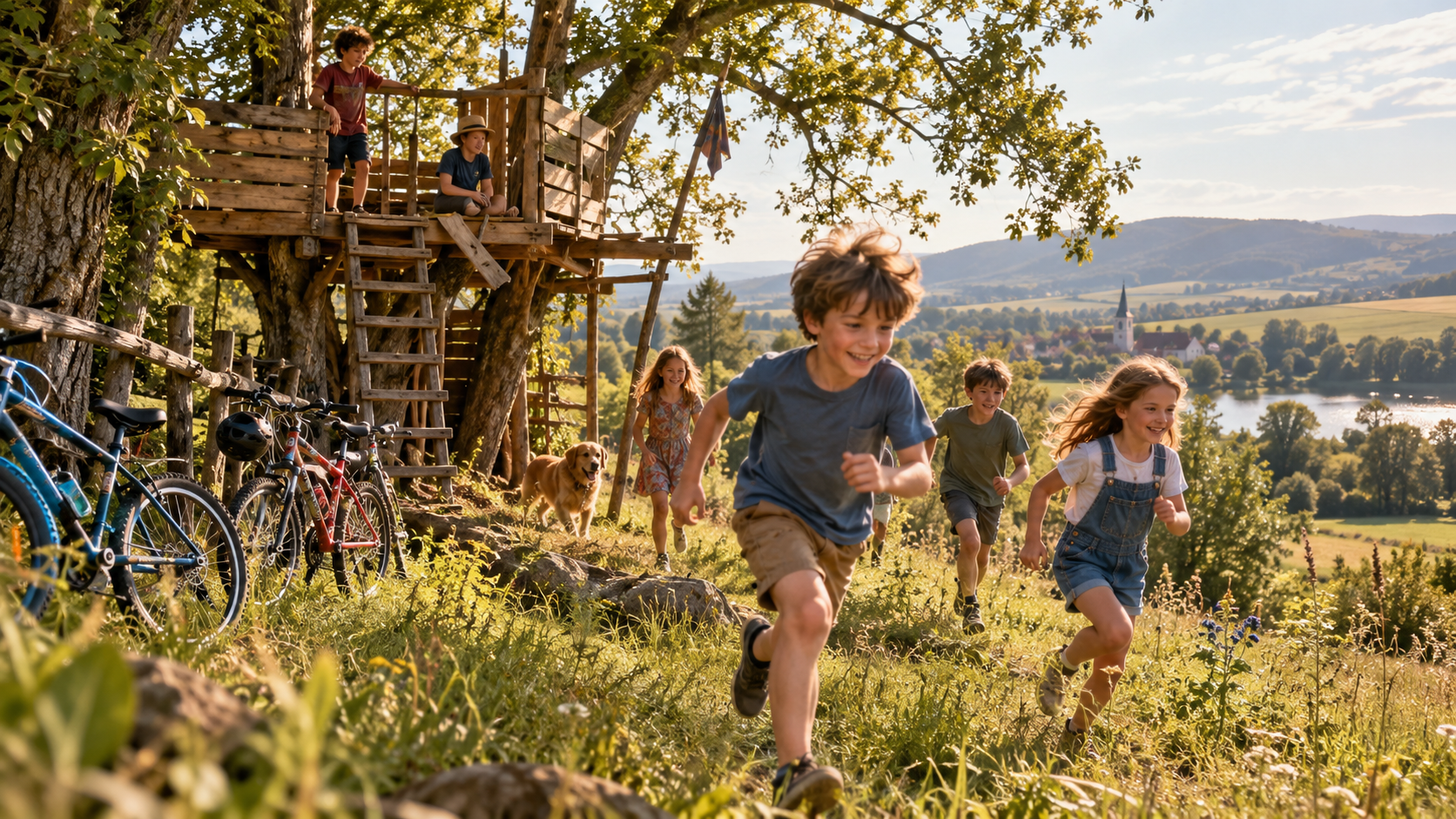
Our World, Our Rules.
Growing up in the village meant freedom, bad ideas, a few painful lessons and plenty of learning by doing. Looking back, some of it seems almost impossible today.
By Fabrice, France
When I was very, very young, I was sensible.
That lasted until I was about seven or eight.
After that, I became adventurous. By ten or eleven, there was definitely some nonsense involved, and by eighteen I would not describe myself as sensible at all.
But I had a good childhood. A very good one.
It was a different world from the one children grow up in today. We had school on Monday, Tuesday, Thursday and Friday, and on Saturday morning. Wednesday was free. After school, you did your homework and then you went outside.
That was basically it.
We went into the fields and the forests. We rode bicycles. We built wooden houses. There were children of different ages together, boys and girls, and we made our own little world.
Our world, our rules.
When you were six or seven, perhaps you came home at eight. A little older, it could be ten. As we grew, the freedom grew with us. Nobody was following us with a telephone. Nobody could send a message asking where we were every five minutes.
We were simply out.
And somehow, most of us came back.
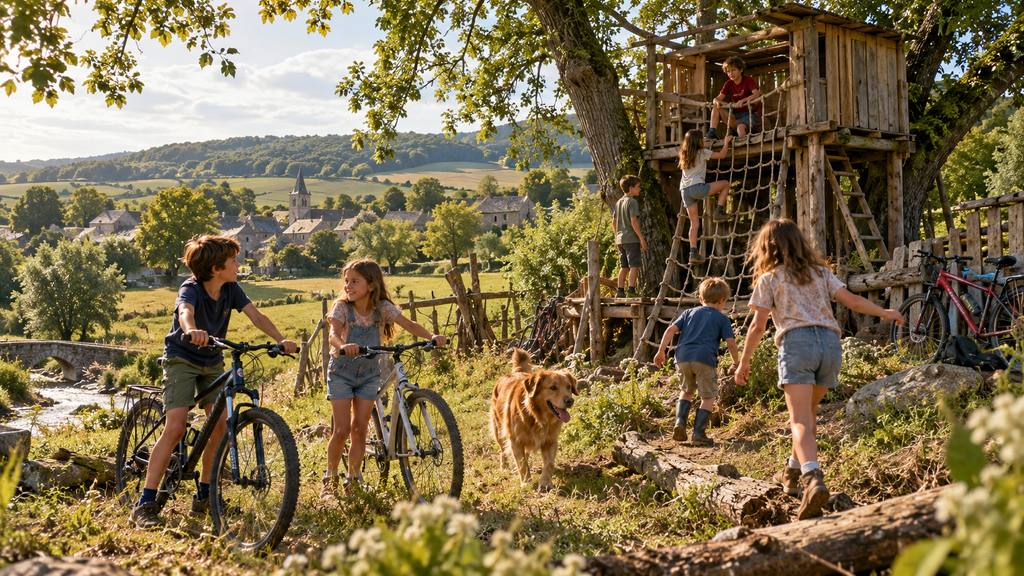
The sensible option was not always popular.
Of course, freedom also creates opportunities for very good ideas.
Or what seem like very good ideas at the time.
We had bows and arrows. One of our games involved somebody standing against a wall while another person shot arrows around him: above the head, to the left, to the right. If the arrows were perhaps twenty or thirty centimetres away, everything was okay.
Then we changed places.
Today, when I explain this, people look at me as if I have described some kind of attempted murder.
But there were limits.
We did not put an apple on the person’s head.
That would have been too dangerous.
This was our logic.
There were plenty of other experiments. Once, when we were about twelve or thirteen, we decided to go camping. The problem was that some of the boys were smoking inside the tent. After five or ten minutes, the father of one of my friends appeared.
It turns out a tent with smoke coming out of it is not a particularly good hiding place.
Another time, in a very dry summer, we made a little fire in a field.
A little fire became a considerably less little fire.
Afterwards we went home and explained to the parents that we had made a fire and that part of the field was now destroyed.
There were consequences, of course. But this was also part of the childhood I remember: you did something, you discovered what happened, and then you dealt with what came next.
Please explain the rule.
There was one kind of rule I never liked.
“Don’t do this.”
Why?
No answer.
That made no sense to me.
If an adult explained why something should not be done, that was different. Finish the sentence. Tell me what can happen. Give me a reason.
But simply saying, “Don’t make this,” was almost an invitation to find out for yourself.
My grandparents could make this even more interesting. Sometimes my parents might say not to do something, and at my grandparents’ house the answer was closer to: come here, we will do it.
Grandparents have apparently been undermining parents for a very long time.
I also started smoking when I was twelve. I smoked with my grandfather and grandmother. Smoking was simply around us then. My grandfather smoked, my grandmother smoked, my father smoked.
The first time my mother discovered me smoking, she told me it was not good and that it was better not to smoke.
I disagreed with her for quite a long time.
About twenty years, in fact.
I finally stopped when I was thirty-four.
So yes, sometimes the adults did have a point. It just took me slightly longer than necessary to confirm it.
Learning by doing.
If you ask how I decided whether something was safe when I was young, the answer is very simple.
Learning by doing.
This was not always an excellent system.
I remember riding my bicycle and having one of those brilliant childhood thoughts: what happens if I put my foot into the spokes of the front wheel?
There is only one reliable way to answer a question like that.
So I tried it.
The flying was superb.
The landing was shit.
I discovered the answer immediately.
This was perhaps the method for many things in my childhood. I had a lot of ideas. They were not always good ideas, but I was lucky. Despite everything, I never broke a leg.
There was freedom, but freedom did not mean somebody else would solve everything for you. The attitude was more like: figure it out yourself. If you have a problem, it is your problem.
That sounds hard when you say it today, but I do not remember it that way. I remember having an enormous amount of freedom inside an environment that still felt protected.
We knew the village. People knew us. Children were everywhere. Adults were around, even when they were not standing beside us.
You could make mistakes.
And we certainly did.
The day I took a shotgun to school.
Perhaps the story that best shows how different that world was happened when I was about eight years old.
One day our teacher told the class that everyone should bring an object to school that afternoon — something we liked, something we played with, something important to us.
So I went to my grandparents.
I explained that I needed the shotgun because I wanted to take it to school.
For my grandfather, this was not a problem.
So I walked through the village carrying a shotgun that was almost bigger than I was.
People saw me.
Nobody stopped me.
I arrived at school and went into the classroom.
The teacher turned white.
Apparently, the object she had imagined was something slightly different.
She told me to take it home.
So I did.
Today, of course, the story sounds completely mad. An eight-year-old walking through a village carrying a shotgun into school is almost impossible to imagine.
At the time, it was different. I am not saying everybody went to school carrying guns. But the reaction around me was not the reaction it would produce now. Even my grandfather, after I explained why I needed it, saw no great problem.
That memory says something about how completely the boundaries of childhood can change from one generation to another.
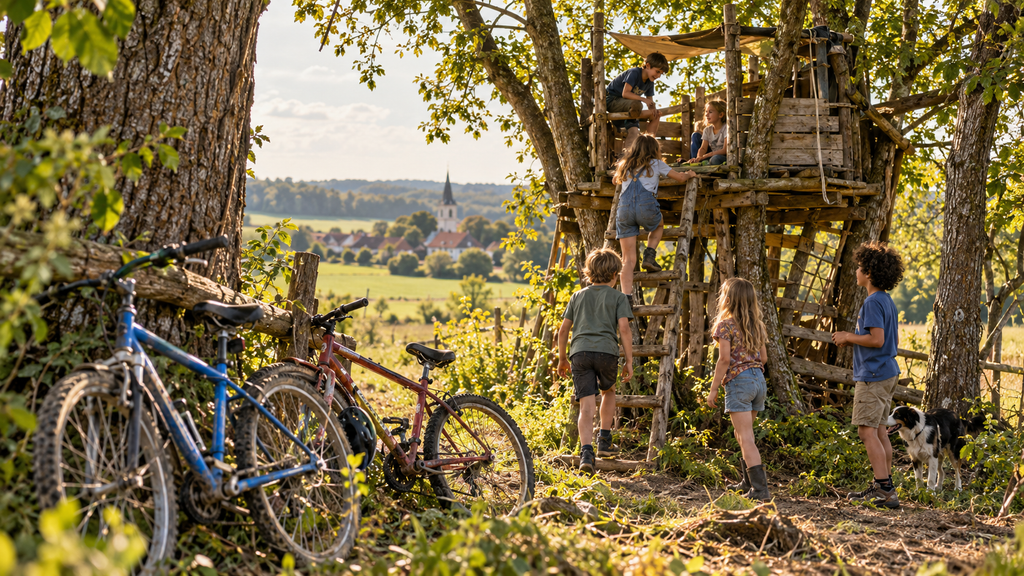
A different kind of childhood.
If ten-year-old Fabrice suddenly arrived in childhood today, I think he would be surprised by almost everything.
Children have phones. They have PlayStations and other things I did not have. When I was six or seven, I remember seeing television for the first time.
But the biggest difference for me is not the technology itself.
It is the group.
When I was young, there were children together every day. Boys, girls, different ages — one group moving around the village, the fields and the forest.
You learned from the older ones. You tried things. Sometimes you discovered that something worked. Sometimes you discovered very quickly that it did not.
Sometimes an adult told you not to do something and you listened.
Sometimes you wanted the rest of the sentence.
And sometimes you put your foot into the front wheel of a bicycle and learned the rest of the sentence yourself.
I had a lot of freedom. I had grandparents who taught me things, adults I could go to when there was really a problem, and enough space to find out quite a lot on my own.
Some of the stories sound unbelievable now.
Some probably sounded stupid even then.
But it was a good childhood.
We had our world.
And, for a while at least, we had our own rules.