
There Is No System.
By Alexander, Germany.
When two people move in together, they do not arrive alone. They bring cupboards, habits, childhood rules, standards of cleanliness — and completely different ideas about where the keys belong.
Julia and I never sat down and discussed the rules of our household.
There was no constitution, no negotiation and no list on the fridge. We simply moved in together, which sounds straightforward until you realise that two people can use the same kitchen, the same drawers and the same front door while operating with completely different definitions of what is obvious.
Take Julia’s purse.
Recently, I needed five euros for kindergarten. I do not normally carry much cash, so I went looking for her purse.
I searched four drawers before I found it.
For me, this is not a system.
Asking Julia would not necessarily have helped. She might not have known either.
For her birthday, I gave her an AirTag. I am now considering expanding the programme. Keys. Purse. Anything else that regularly disappears.
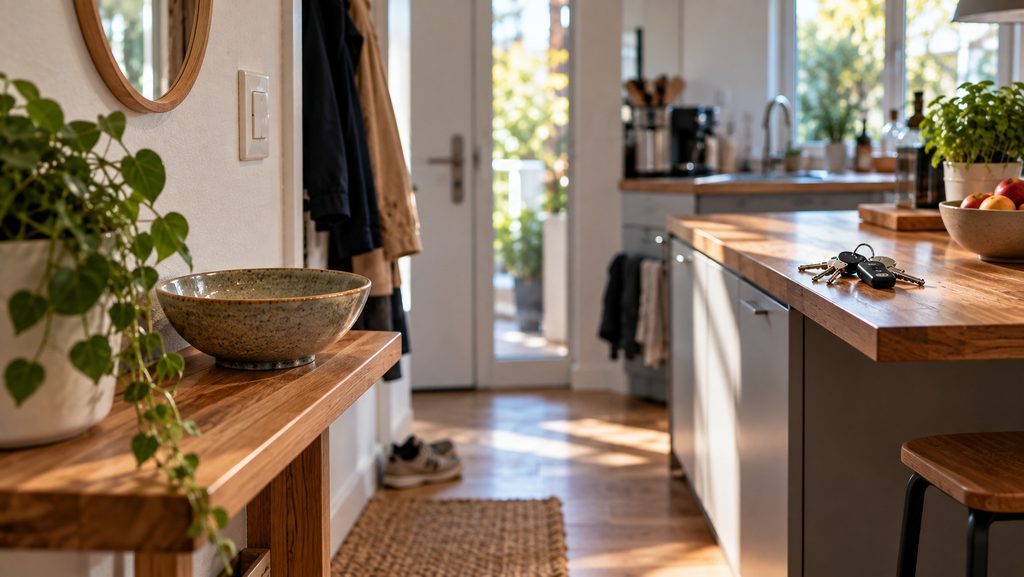
We already have a place for the keys near the entrance. It is a perfectly good place. The problem is that the keys do not always agree.
Julia comes home and goes into the kitchen, so the keys might end up beside the Thermomix. If she goes somewhere else first, the keys go somewhere else with her. The designated place near the door remains empty.
There is a system.
It is simply not being used.
What clean means.
My own rules are different.
I like things clean, although by clean I do not necessarily mean hygienically clean. I mean uncluttered. I do not like little things standing everywhere. I like empty surfaces, straight lines and objects in their place.
Before I met Julia, I had my own flat. The living room contained a couch, a television, a low board, a table, chairs, a carpet and one palm tree.
That was enough.
I was very happy.
It was also extremely easy to clean because there was almost nothing to move before wiping a surface or vacuuming the floor.
Then real life arrived.
Today we have a young son. He has toys, games and things. Lots of things. Minimalism becomes slightly more complicated when another human being owns a box full of cars.
Just before this conversation, I had been downstairs putting those cars away so that our robot vacuum cleaner could move through the room.
Apparently even the robot has standards.
The same difference appears in the kitchen.
Julia cooks most of our meals because she is good at it. I do not cook because I am not.
At the moment she is interested in fitness, which means we eat a lot of chicken and potatoes. Occasionally we have potatoes with chicken. If I reach the point where I cannot look at another plate of it, I ask whether we could eat something else.
Then she cooks something else.
So that system works perfectly well.
What I do not understand is what happens to the kitchen while the cooking is taking place.
If I cook, I try to work carefully. If something spills, I deal with it. My logic is simple: if you make less mess while cooking, there is less mess to clean afterwards.
Julia’s approach is different.
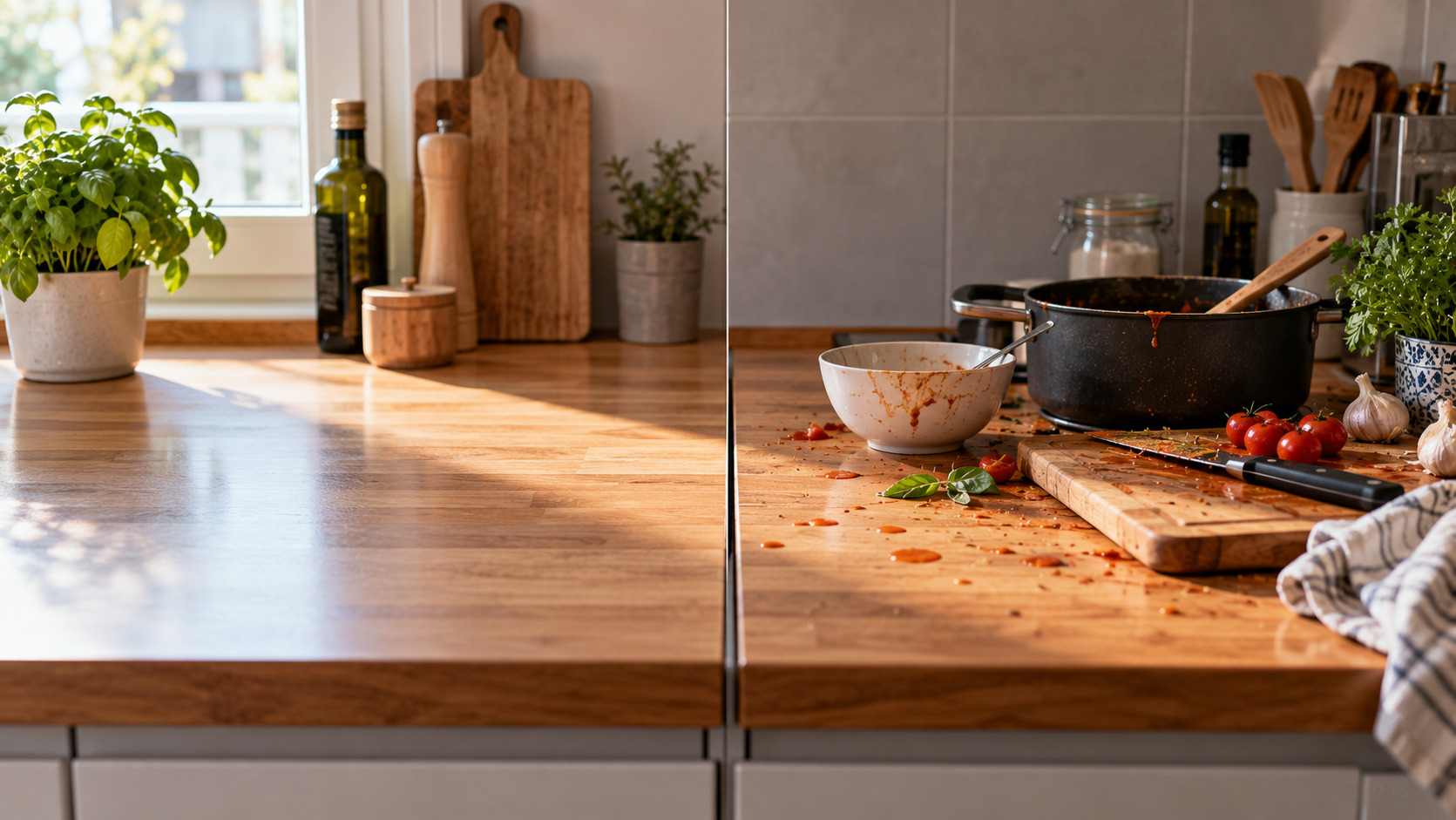
Sauce may appear on the worktop.
Sometimes on the floor.
This makes no sense to me.
It also appears to make absolutely no difference to the food.
The food is good. Afterwards, somebody cleans the kitchen. We do not even have a rule about who. Whoever has time does it.
So my careful system and Julia’s sauce-on-the-floor system both end with dinner being eaten and the kitchen eventually becoming clean again.
I still prefer mine.
Rules from somewhere else.
Some household rules arrive long before the household itself.
When I was growing up, we had a cat, and cleaning the litter tray was my job.
Every day.
There were no negotiations. If friends were visiting and we were sitting in my room, my mother could still appear and tell me to go downstairs and clean it. I also had to mow the lawn.
Nobody explained the philosophy behind any of this. These were simply things that had to be done.
Today, Julia and I have two cats.
I clean the litter tray.
During Julia’s pregnancy there were health reasons why she should avoid doing it, so the job became mine. My childhood training finally became professionally useful.
I sometimes imagine Julia interviewing me before we got together.
“Can you clean cat toilets?”
“Yes.”
“Excellent. You are my man.”
The strange thing is how many rules enter a household like that. Nobody formally introduces them. They simply arrive with us.
The wardrobe doors.
During our conversation, there was a coat hanger visible behind me on a wardrobe door.
This was pointed out.
I immediately had a defence.
“That’s not my wardrobe. That’s Julia’s side.”
Then we noticed that the doors on her side were open.
More evidence.
I normally close them.
Would Julia notice if I closed them?
Probably not.
Would I notice if they stayed open?
Yes.
So I close them.
That may be one of the quiet arrangements on which households depend. Not agreement. Not compromise discussed around a table. Just one person walking past something the other person does not even see and changing it.
Then, eventually, the other person changes something else.
Neither of you has won.
The house simply continues.

And then Christmas arrives.
There is one period of the year when my preference for empty surfaces is completely defeated.
Christmas.
Julia likes Christmas decorations.
As December approaches, I know what is coming. Every free surface and every available corner begins to fill.
My old living room had one palm tree.
This is different.
Christmas also brings an impressive programme of events. Christmas Eve. Our son’s birthday. Family gatherings. More birthdays. New Year’s Eve.
A single week can become a small military campaign.
Julia’s family has its way of doing these things. There are traditions, expectations and plans. I come from somewhere else, with different instincts.
Nobody sat down years ago and designed either system. Most of the rules were already there before either of us arrived.
That is perhaps the oddest part of moving in with another person. You think one person is coming through the door.
In fact, an entire invisible household arrives with them.
Their parents’ habits. Their idea of tidiness. Their Christmas traditions. Their way of cooking. Their understanding of where keys should be left and whether wardrobe doors need closing.
And, inconveniently, you arrive with one too.
After nearly four years together, I still like empty surfaces. Julia still leaves things in places where I would never leave them. I still believe that four drawers are not an acceptable filing system for one purse.
She would probably have her own list about me.
I still close the wardrobe doors.
Sometimes they stay open.
We still eat a great deal of chicken and potatoes.
Occasionally, in an act of rebellion, we eat something else.
There is no final household rulebook waiting to be discovered. There are just two private versions of normal, living under the same roof.
And neither one appears to be going anywhere.