
The Peculiar Pleasure of Being Listened To
By Frank Peters.
You are surrounded by systems designed to capture your attention, predict your behaviour and keep you there. Almost none of them are interested in what you have to say.
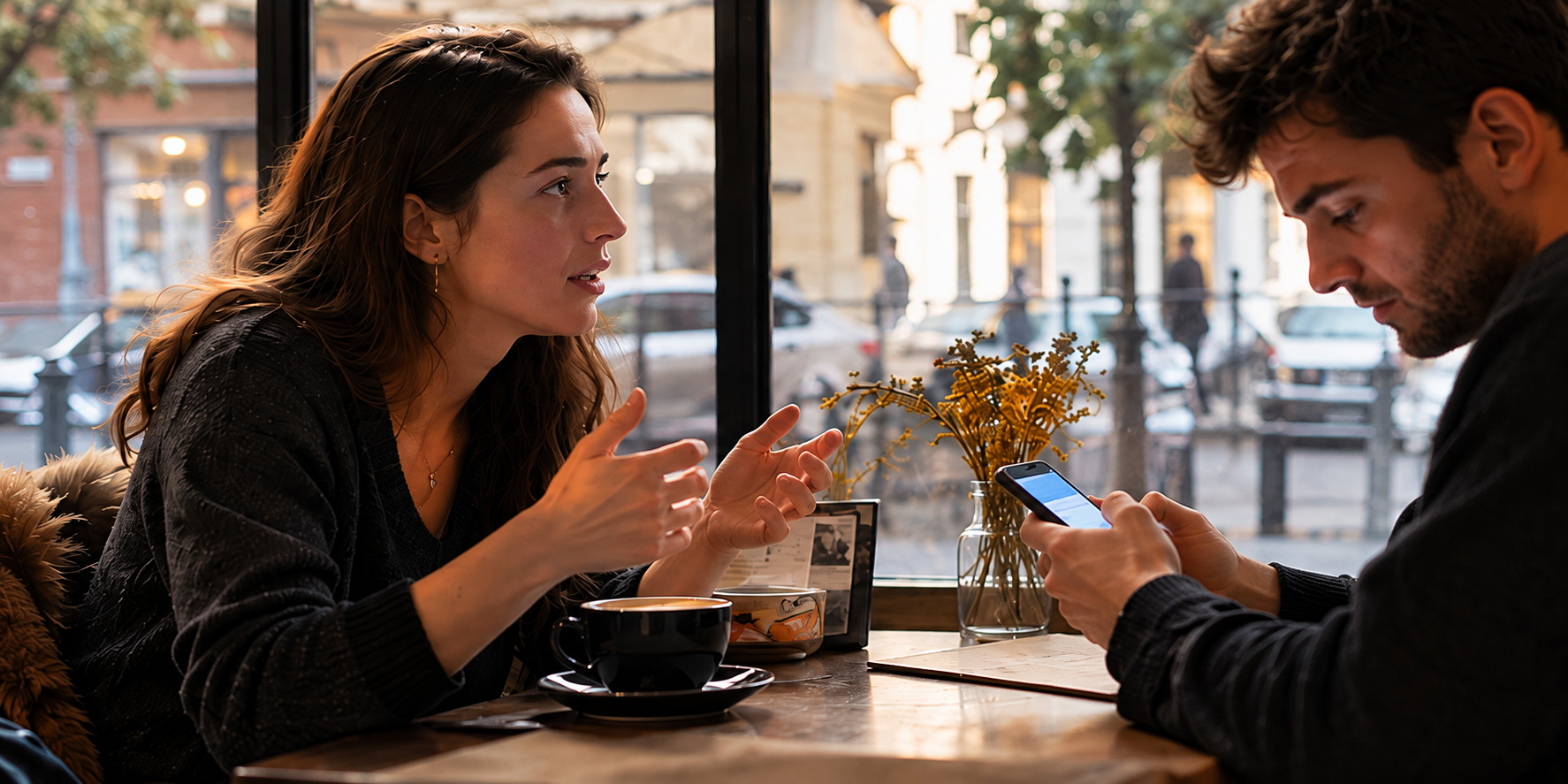
You are halfway through telling somebody a story.
It matters to you. Perhaps not enormously. Nobody has died. No government has fallen. It is just something that happened at work, something your father used to do, or the ridiculous reason you still have an old saucepan in the cellar.
Then their eyes move.
Just for a second.
Down towards the phone.
They look back. “Sorry. Go on.”
You do. But something has changed. They are still sitting opposite you and they can still hear you. Technically, the conversation continues. Yet you know that, for a moment, whatever appeared on that little rectangle was more interesting than you were.
Do not be too offended. You have probably done exactly the same thing to somebody else.
That is where I want to start. Not with artificial intelligence. Not with social media. Not with Brida. Not even with English.
With the uncomfortable possibility that we are becoming very good at communicating and rather bad at paying attention.
When did somebody last listen to you properly?
Not simply wait until you finished. Not listen for the moment when they could add their own story. Not prepare their advice while you were still speaking. Not check the phone.
Just listen.
It is a strangely difficult question.
Someone else has already chosen what you will see.
Take out your phone. You do not even need to unlock it. You already know what is waiting.
Messages, news, videos, recommendations and notifications. People you know. People you have never met. People explaining the five things you have apparently been doing wrong all your life.
Open one of the big platforms and something has already been chosen for you. You did not ask for it. The system simply thinks you might stay and look at it.
If you do, it learns something. If you move on quickly, it learns something else. Watch another video about the same subject and that tells it a little more. Get angry and that may be useful too.
The machine does not have to like you or dislike you. It only needs to discover what keeps you there.
So it watches, tests and adjusts. Then it offers you something else. And something else. Before long, twenty minutes have disappeared into a hole you never planned to enter.
We have become used to this remarkably quickly. In return for an endless stream of material selected for us, we give the system more information about what will make us continue looking.
That is not conversation. It is a system learning how to hold our attention.
The Pineapple app is deliberately built around a different idea. There is no personalised feed deciding what you should see next, no endless scrolling and no advertising system trying to keep you there. You open The Pineapple and you see The Pineapple. The same publication everybody else sees.
You can read it. Listen to it. Send something to somebody else.
Then close it.
Nothing follows you down the street demanding that you return.
That should be completely ordinary.
It is becoming unusual.
Now imagine paying for a language class.
You arrive ready. You have paid good money. Perhaps you have a notebook open and have even done your homework.
Then the person running the room tells you that nobody is going to correct your grammar.
Ever.
You begin speaking. Halfway through the sentence, the word disappears. You know there is a word. You can almost see it. But it will not come.
So you stop.
Five seconds. Ten.
It feels much longer when several people are looking at you.
Nobody rescues you. Nobody finishes the sentence. Nobody reaches for the red pen.
They wait.
Worse still, they appear interested.
This would be a very strange language school, which is fortunate because Brida is not one.
English matters to us, but English is not the destination. It is the shared room.
Put someone from France, Denmark, Albania and South Africa together and they need a way of reaching one another. English happens to do the job. Once everybody is in the room, the interesting part begins.
What happened to you? What do people do differently where you live? What object have you kept for twenty years for no sensible reason? What rule does everybody in your town seem to understand although nobody has ever explained it?
The language carries the story.
The story is the point.
That changes what a mistake means. In a lesson, the missing word can feel like a problem. In a conversation, it can become an invitation.
You search. You describe the thing in another way. Somebody misunderstands you. You try again. They lean closer and watch your face.
Suddenly everybody may be paying more attention than they would if two native speakers were producing perfect sentences at high speed.
The imperfection creates a little friction.
And sometimes that friction creates attention.
There was a wonderful comparison in one of our recent conversations. Think of an old guitar around a campfire. It is slightly out of tune. Perhaps one string is missing. The person playing knows three chords and one of those only approximately.
From the point of view of a classical music examiner, this is a disaster.
For the people around the fire, it may be exactly enough.
Nobody came for the recital.
They came for the singalong.
Perhaps we have become a little too interested in the recital.
Six people do not automatically make a conversation.
Put six people around a table and walk away and you do not automatically get a conversation.
You might get one person giving a speech. Two others may talk only to each other. Somebody else never finds an opening. Another person has been silent for twenty minutes and is quietly hoping nobody notices.
I notice.
Janita notices too.
That is part of the job.

Who has not spoken? Who keeps taking a breath as if they want to say something, then stops? Who is filling every silence? Has somebody just mentioned something in passing that is much more interesting than the question we prepared?
Should we forget the question completely?
Hosting at Brida is not teaching.
It is noticing.
And there is no simple formula for that. One person needs encouragement. Another needs more space. Somebody needs slowing down. Somebody else needs everyone to stop helping for long enough to finish the sentence alone.
A machine could measure how long everybody speaks.
That is not the same as understanding the room.
We use machines a lot.
But not there.
The machine stops at the door.
The peculiar pleasure.
There is a phrase that has been following me around while all this has been coming together:
The peculiar pleasure of being listened to.
I think there is something important in those words.
Being listened to is different from being seen, followed or given a thumbs-up. It is even different from being agreed with. You can disagree with somebody and still listen to them beautifully.
Perhaps that is when it matters most.
To say something and realise that three or four people from completely different lives genuinely want to understand what you mean is an unusual experience. Not because you are famous. Not because you have been introduced as an expert. Not because your opinion is useful to somebody collecting information.
Simply because you are a person and, for the next few minutes, what you are saying matters to the people in front of you.
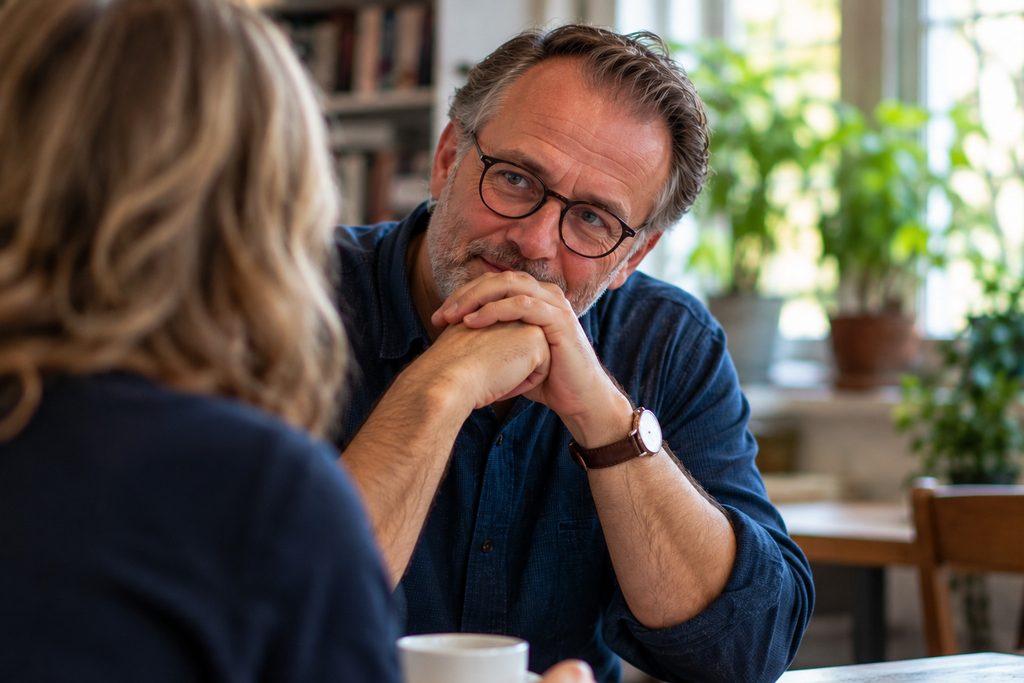
When did you last experience that?
And here is the more uncomfortable question.
When did you last give it to somebody else?
Words are not scarce.
It is now perfectly possible to spend an entire day communicating without having a proper conversation.
You answer emails, reply on WhatsApp, react to something on LinkedIn, send a voice message, attend a Zoom meeting, read comments and check notifications. By six o’clock, you may have exchanged thousands of words.
What do you remember?
Sometimes almost nothing.
Words are not scarce.
Attention is.
We solved the problem of sending information. We can send almost anything, almost anywhere, almost instantly. What we did not solve is the much older human question at the other end:
Is anybody actually there?
This is why I have become suspicious of the word engagement. Online platforms speak about engagement as if it means human connection. Usually it only means that you did something they could measure.
You clicked. Scrolled. Watched. Shared. Returned.
The system does not really need to know whether the experience made your life better. You engaged.
Job done.
Brida has no interest in building that kind of relationship with you. I do not want to discover which psychological trick keeps you in the Pineapple app for another seven minutes. I do not want an algorithm deciding that because you enjoyed one story about village life, you must now want village stories until the end of time.
I would rather risk showing you something you did not know you were interested in.
A wild boar dinner. A strange parcel delivery. A club you have never heard of. Somebody else’s grandmother. A journey that went wrong. A person in another country whose life looks almost nothing like yours.
That is not personalisation.
Good.
Serendipity needs room.
Why would anybody care about your coffee grinder?
Ask six strangers to discuss the future of democracy and something interesting may happen before the discussion even begins.
One person has read three books. Somebody follows the news every day. Another has strong opinions and no fear of sharing them. Two others begin to wonder whether they know enough to speak.
A hierarchy starts to form.
Now ask the same six people:
What is something in your home you cannot bring yourself to throw away?
Different room.
Everybody qualifies.
The engineer. The accountant. The grandmother. The student. The retired baker.
Nobody needs statistics. Nobody needs permission. Nobody can fact-check your emotional attachment to an old coffee grinder.
And quite often, the coffee grinder stops being about coffee.
It becomes your grandfather.
The chipped mug becomes a marriage. The old coat becomes the winter your family moved house. The broken chair becomes the person who used to sit in it.
The subject looked trivial.
The person was not.
That is one of the things I have learned through Brida. We do not have to manufacture deep conversations.
People bring the depth with them.
We simply have to find the right door.
Then everybody says goodbye.
A good conversation has one annoying habit.
It ends.
Somebody looks at the clock. We wave. The screen goes black.
Gone.
That used to bother me. An hour could contain something funny, strange, touching or genuinely surprising, and then it simply disappeared.
The Pineapple began partly as an answer to that.
Not as a transcript.
God forbid.
As memory.
What was worth carrying forward? The small thing somebody said that might otherwise disappear. The story from a club. The journey. The dinner. The family ritual. The mistake. The object.
The Pineapple gives those things somewhere to go.
Thirty issues in, I can already see another possibility. Keep doing this long enough and The Pineapple becomes more than a publication. It becomes a record of ordinary life from ground level.
The kitchen table. The swimming club. The vineyard. The workshop. The train platform. The ridiculous thing your father always said.
Lives that usually leave almost no public trace.
That idea deserves more room than I am going to give it here.
Because this article is about something else.
What allows those stories to appear in the first place.
Attention.
Underneath all this human stuff is a very large machine.
Here is the contradiction.
Brida can become more human because the machinery underneath it is becoming more sophisticated.
That sounds backwards.
It is not.
Janita and I cannot manually search across a continent, remember thousands of possible relationships, work out who should be contacted again, match interests and availability, organise Tables, publish a weekly magazine, maintain an app and still arrive at a conversation looking like normal human beings.
Eventually something breaks.
Usually the humans.
So we use artificial intelligence. Quite a lot of it.

It helps with research, sorting, matching, formatting, administration, publishing and repetitive work. In other words, many of the things machines can do extremely quickly without needing a cup of tea afterwards.
The division is becoming very simple:
The machine deals with scale and repetition. Janita and I deal with judgement and relationships.
That distinction matters.
The interesting question is not whether AI is good or bad. It is what we ask it to do.
Do we use it to make human relationships unnecessary?
Or do we use it to remove the work that gets in the way of human relationships?
We are trying to do the second.
AI can help me find somebody interesting in Aarhus. I still decide whether I want to write to them. It can help organise availability. Janita still notices the person at the Table who has barely spoken.
It can help format an article. It cannot hear a small hesitation in somebody’s voice and realise that this may matter more than the question we planned to ask.
The machine can move a great deal behind the scenes.
It does not get the chair.
What are we really short of?
This is where my own thinking about Brida has changed.
For years it was easy to explain what we did.
People practised English by talking.
Simple.
It is also becoming less accurate.
Nobody wakes in the middle of the night thinking, My life is missing an international English conversation community.
And if improving your English is the main goal, there are now much easier tools. AI can correct you forever. It will never become impatient. You can ask the same question seventeen times. It can explain the difference between since and for until you understand it or civilisation ends.
We should not compete with that.
We should be grateful for it.
Let the machine teach the grammar.
I am interested in what happens after that.
The unexpected person. The unfamiliar life. The hour that feels different from your working day. The story you did not know you had until somebody asked the right question.
The moment you realise that three strangers are waiting for you to finish rather than waiting for their turn.
Perhaps that is what we have actually been building.
Not a better stream of information.
A place where attention still has some value.
And there is one more possibility.
Artificial intelligence is making polished things cheap.
Writing, pictures, translation, research, music, video and answers can already be produced quickly and in enormous amounts. Much of it will be very good. Some of it will be better than things humans produce.
The interesting question is what happens when perfect becomes ordinary.
What becomes valuable then?
Perhaps some of the imperfect things.
Things that cannot be produced in unlimited amounts.
A person’s time.
Their curiosity.
Their full attention.
The pause while you search for the word. The laugh that arrives a little late. The misunderstanding that makes both of you try again. The person who does not finish your sentence because they are prepared to wait and discover what you were trying to say.
Machines can produce another billion pieces of content tomorrow.
Human attention cannot grow in the same way.
There are still only twenty-four hours in a day. You have one life. So does the person opposite you.
If they give you an hour of it properly, that hour cannot be given to somebody else at the same time.
That is part of what makes it valuable.
Perhaps our love of frictionless technology has made us forget something. We began to treat every delay as a defect, every silence as something that should be filled, every inconvenience as something to remove and every preference as something a system should predict.
But some of the best things in life happen precisely because nobody predicted them.
The person you were not supposed to meet. The subject you had not prepared. The answer that takes thirty uncomfortable seconds to arrive. The story about the coffee grinder that somehow becomes the thing you remember three days later.
There is no algorithm for that in Brida.
Deliberately.
The machinery does its work underneath.
Then it stops.
Janita or I arrive. A few people appear on the screen. There is a question.
Somebody starts.
Perhaps badly.
They hesitate. They search for a word.
Nobody corrects them.
Nobody swipes to something more entertaining.
Nobody tries to remove the silence.
The others wait.
And listen.
Really listen.
Now put your phone down for a moment.
When did somebody last do that for you?