
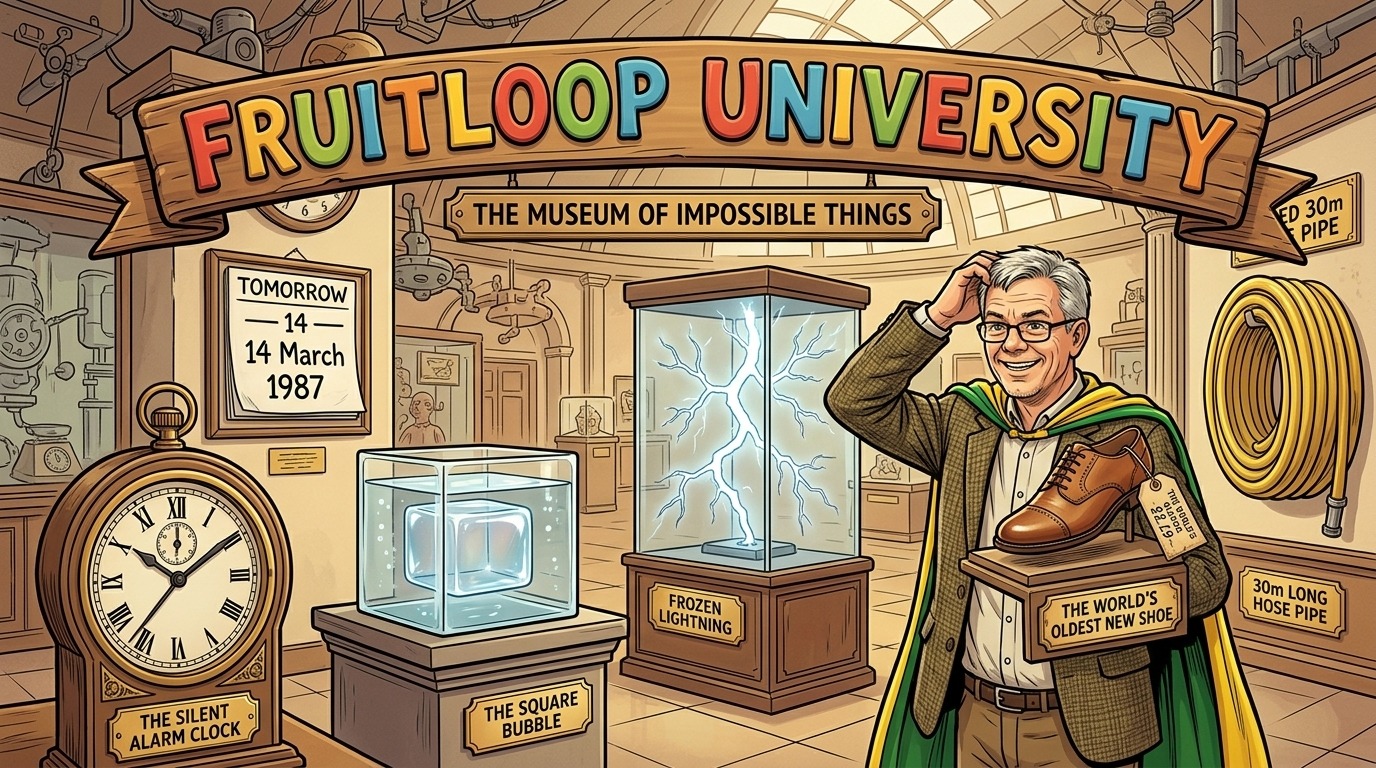
Peeling Pototoes, Episode 66: The Day Time Stood Still and My Hose Applied for Asylum.
Fruitloop sent me to investigate five impossible objects. Somewhere between a square bubble, a silent alarm clock and a shoe from the ancient world, the whole thing became less about answers and more about what we do when there aren’t any.
By The Mayor & Fruitloop
Fruitloop looked far too pleased with herself.
This is usually the first warning.
We were back at Fruitloop University for Episode 66 of Peeling Potatoes, and I had already received the bad news: I was flying solo. No Ignis. No emergency committee. No convenient collection of imaginary experts to blame when things went wrong.
Just me.
Fruitloop had also lost most of her voice and was speaking around a frog apparently occupying her throat without paying membership fees. This did nothing to reduce her enthusiasm.
“The official topic,” she said, “is the drawer that everyone has.”
Not a drawer. The drawer. The one containing batteries of uncertain health, keys that open nothing, three bits of string and something you keep because the moment you throw it away, civilisation will require it.
Except this was Fruitloop University, so naturally we went nowhere near an actual drawer.
Instead, I received an urgent request from the Museum of Impossible Things.
The museum had a collection.
I was required to investigate.
Splendid.
Tomorrow Has Been Delayed Since 1987.
The first exhibit was a calendar page.
It said:
Tomorrow. 14 March 1987.
And there it had remained.
Fruitloop wanted to know why tomorrow from 1987 was still sitting in a museum in 2026, so I decided the museum must have opened on Friday the 13th of March and that its original director had put the page on display as some sort of experiment.
Would anybody notice?
Thousands of people could have wandered past it over the years, stared at tomorrow and carried on walking. Time had moved on in full view and almost nobody had bothered to question it.
Fruitloop did.
“If it was tomorrow in 1987, when did it become yesterday?”
That was the first moment I began to suspect the nonsense had teeth.
I wandered through John Lennon, London in 1987, my twenties and the rather inconvenient question of what tomorrow actually means. Then Fruitloop suggested writing a new tomorrow onto the old page.
That changed matters considerably.
The harmless museum exhibit had suddenly become a prophecy. Someone would decide the world was ending. Someone else would form a committee. There would almost certainly be merchandise.
But perhaps one or two people would look at the date and think that, if time really was passing, they ought to do something with it.
Most, I suspect, would shuffle past.
Humans are remarkably good at that.
The Bubble With an Ego.
The second exhibit was a perfectly square bubble floating inside a glass container.
It could not be popped.
Touch it. Nothing. Throw a book at it. Nothing.
Fruitloop wanted to know who had made it, why it was square, what was inside it and why it refused to burst. By now, however, I had become suspicious.
Not of the bubble.
Of Fruitloop.
I could feel myself searching for the hidden hook. There had to be one. Why else would she have given me a square bubble? But the harder I looked for where the exercise was going, the less attention I paid to what was actually sitting in front of me.
A square bubble.
Perhaps not everything needs explaining. Perhaps some things deserve to be admired simply because they are strange, beautiful and impossible.
Fruitloop was having none of it.
“The museum asked you to investigate it.”
Fair point.
So I investigated further.
Could it reproduce?
No.
Why not?
Because the bubble had an ego.
If there were suddenly twenty-seven square bubbles floating around, ours would no longer receive all the attention. It had spent years being admired by strange two-legged creatures pressing their noses against the glass. Why jeopardise that?
The bubble was unique.
It knew it.
And frankly, it rather enjoyed the arrangement.
Felix the Cat and the Silent Alarm.
The third exhibit was an alarm clock that rang every morning without making a sound.
Somewhere, somehow, somebody still knew it was time to wake up.
Fruitloop asked who had originally owned it.
Felix the Cat.
Obviously.
The clock had been built by a cat lover who disliked being blasted awake by an alarm, so it rang at a frequency only the cat could hear. The cat woke up, demanded breakfast and the owner was then awakened through the gentler process of having an increasingly irritated animal standing on him.
A perfect system.
Then Fruitloop moved the clock next to the old calendar page.
This created a problem.
The calendar believed time had stopped. The alarm clock existed only because time kept moving.
I imagined the two of them staring at one another in complete philosophical horror: the clock insisting that time could not possibly stand still, the calendar replying that it had been doing precisely that since March 1987.
Neither could possibly be right.
Both had evidence.
Fruitloop University was beginning to resemble several management meetings I have attended.
When Lightning Got Stuck.
Then came a lightning bolt, frozen inside a glass case.
Still glowing. Still crackling. Completely motionless.
“Who caught the lightning?” Fruitloop asked.
Time did.
The answer came almost immediately, and with it the previous exhibits began rearranging themselves.
Perhaps time really had stopped on 14 March 1987. Perhaps the alarm clock had witnessed the whole thing and been so shocked that it lost its voice. The square bubble remained completely unconcerned because time had never mattered very much to it anyway.
Better still, the frozen lightning illuminated the bubble, which threw the light around the museum.
Fruitloop University had invented renewable museum lighting.
At last, a practical outcome.
No fundraiser required.
The Shoe Nobody Could Explain.
The final exhibit was a brand-new shoe.
Price tag attached. Still smelling new.
Museum records said it was 1,847 years old.
Fruitloop wanted to know who had made it, who it had been made for and why nobody had ever worn it.
I tried mathematics.
That did not help.
I tried history.
That made things worse.
Eventually I gave up.
“We don’t actually know.”
And then, almost without noticing it, I said something rather more useful.
It was like the Mona Lisa.
Who was she smiling at?
Nobody knows.
And because we do not know, we keep looking.
That changed the shoe. If we knew exactly who had made it, exactly who had bought it, exactly why it had never been worn and precisely how it had survived for 1,847 years, most of the mystery would disappear.
Instead, we could invent.
Fruitloop decided it might be a magical shoe that changed shape and colour depending on what its owner wanted. Blue today. Pink tomorrow. Flats when sensible. Stilettos when not.
Then she asked what currency appeared on the price tag.
None.
The tag was blank.
“Because you can’t put a price on imagination.”
I rather liked that.
Then came the better question.
“Do you think it gets lonely?”
There was only one shoe.
I thought about that.
Perhaps it was alone, but I did not think it was lonely. All day people stopped in front of it and invented stories. They wondered where it had come from, who had made it, who was supposed to wear it and what on earth had happened to the other one.
The shoe had company made entirely from imagination.
And at night, when the museum closed, I suspect it breathed a small sigh of relief and enjoyed the silence.
I understand that perfectly.
The Sixth Exhibit.
I thought we were finished.
This was naïve.
Fruitloop produced one final message from the museum. There was another impossible object, apparently, and it was in my house.
The museum wanted it back.
She began the interrogation.
Had I ever owned something that simply disappeared?
Yes.
Lost something and had no idea where it went?
Definitely.
Found something again long after giving up?
Yes.
“What is the strangest thing you’ve ever lost?”
A fifty-metre yellow hose.
Fruitloop smiled.
Of course she did.
The hose had already acquired a life inside Peeling Potatoes. It had disappeared, travelled, returned and accumulated more mythology than any garden accessory reasonably deserves.
Now the Museum of Impossible Things wanted it because, according to Fruitloop, it wandered around collecting stories.
Would I return it?
Eventually.
But if the hose announced that it had one more destination in mind, I would let it go.
It had come back once. There must have been a reason.
So let it go again.
Trust it.
If a fifty-metre yellow hose wants another story, who am I to stand in its way?
The museum can wait.
Somewhere during all this I had stopped trying quite so hard to discover what Fruitloop was really asking me.
At the beginning, I had wanted the logic. Every impossible object had to contain an answer somewhere. There had to be a hook, preferably one I could find before Fruitloop did.
But the objects became more interesting whenever the answer failed.
The calendar left time hanging on the wall. The silent clock argued with it. Lightning got stuck. A bubble developed an ego. An ancient shoe sat in a museum with a blank price tag while generations of visitors completed its history for it.
None of them became more interesting because we solved them.
Quite the opposite.
The yellow hose is still a hose. The shoe is still a shoe. The calendar remains a piece of paper.
But give an ordinary thing enough attention, enough unreasonable questions and enough room for imagination, and something begins to gather around it.
A story.
Perhaps even a life.
Which may explain why my hose is currently considering its position.
I believe asylum applications are handled by Fruitloop.