
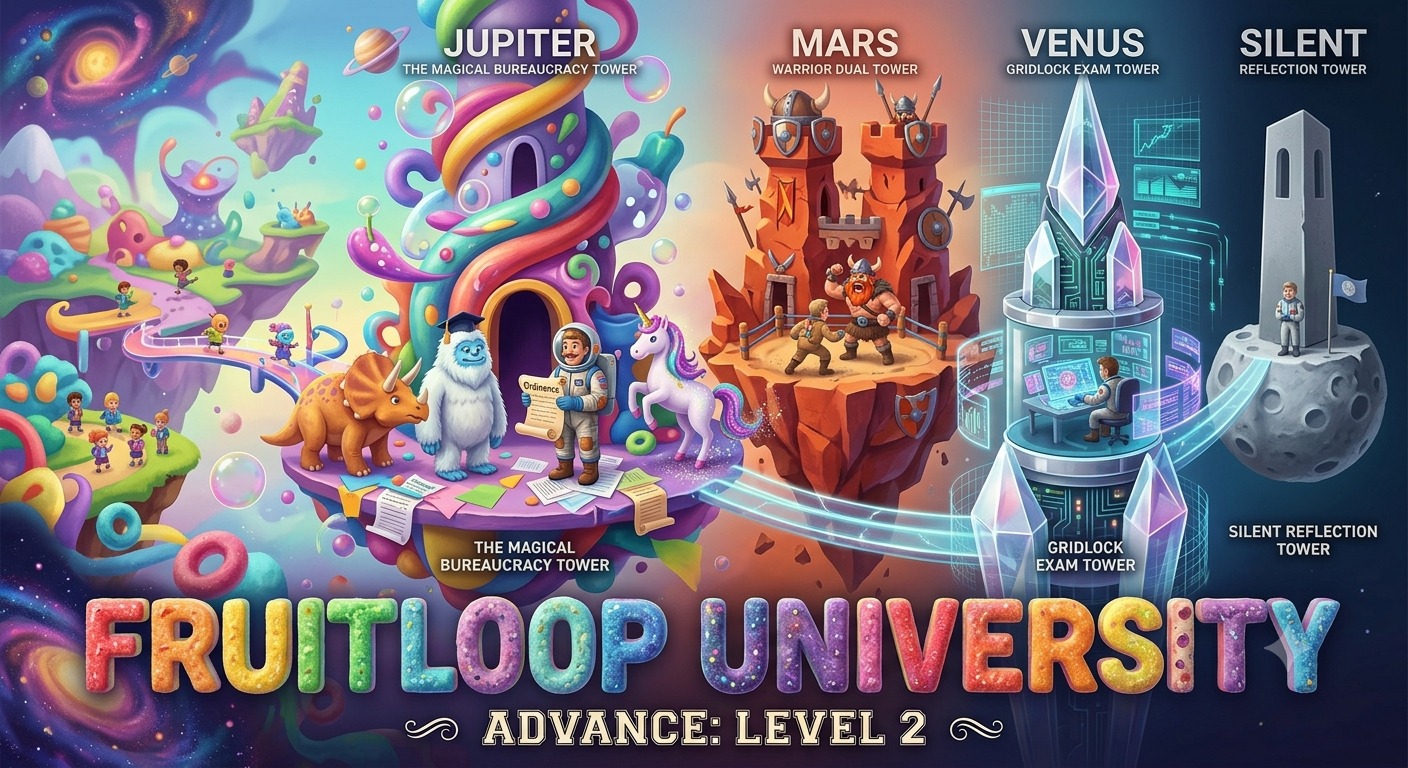
Peeling Potatoes 56: I Sent the Mayor to Fruitloop University, Intergalactic Digital Rest
Peeling Potatoes 56 began with digital rest and ended with glittering unicorns, Viking chess, a laundry crisis on Venus and one silent hour on the Moon.
The Mayor arrived emotionally drained.
Not slightly tired. Not in need of one more cup of coffee. Emotionally drained.
He wanted to hide in a corner, blow everything up and possibly remain there until the rest of humanity had learned to behave itself.
I had been told not to do anything.
Naturally, I had already done something.
I had created a surprise picture for our conversation the day before. I had then sat on my hands to stop myself from sending it to him too early. This may be the closest I have ever come to self-control.
More importantly, I had prepared a journey.
The Mayor was going to Fruitloop University.
This time, the campus was the entire solar system.
Welcome to Jupiter
I placed him on a spaceship and sent him first to Jupiter, which, in my version of space, contains a magical floating island.
The island was being fought over by a clan of Yetis and a herd of wild triceratops. The Yetis wanted to build a sanctuary. The dinosaurs wanted to graze, stomp around and generally behave like dinosaurs.
Above them, a highly territorial flock of unicorns used the airspace for high-speed racing.
They also dropped glitter on everyone below.
This was especially inconvenient for the Yetis. Glitter in fur is probably worse than glitter in a carpet, and everybody knows that glitter in a carpet remains there until the end of civilisation.
The Mayor’s task was to create a tri-species shared-space agreement. He could not leave Jupiter without a hoofprint from the unicorns, a clawprint from the dinosaurs and the official seal of approval from the Yetis.
He began, as he usually does, by asking several questions that were not immediately connected to the problem.
How large was the island?
Why were the unicorns racing there?
What was so attractive about this particular floating island when Jupiter has no obvious shortage of space?
Was the gravity scientifically accurate?
I told him not to overcomplicate things.
He continued overcomplicating them, but eventually reached an answer.
The Yetis could have their sanctuary. The dinosaurs could have their grazing and stomping territory. Each group would respect the other’s space. The unicorns could race during agreed flying hours, with a no-fly zone above the sanctuary—or perhaps the Yetis could build a protective glass dome.
The answer, beneath all the glitter, was compromise.
My space is my space. Your space is your space. We can share something without everybody having access to everything all the time.
Which brought us to digital clutter.
When Technology Creates More Space—and More Work
I asked the Mayor what digital habit he could clean up to make his mental workspace less chaotic.
The question arrived slightly too late.
He had already spent the week rebuilding Brida’s digital operating system.
The Pineapple is now the source from which much of our communication can grow. Sweety helps shape the issue. Chippy can turn selected stories into a week of social posts. Brainy helps organise tasks, thoughts and time.
Instead of carrying everything inside his head, the Mayor can ask for an hour to be placed in his calendar, and the hour appears.
This structure has removed a great deal of chaos.
It has also created a new problem.
The work is becoming more organised, but parts of it are becoming less creative. The technology frees time, and then the newly emptied space immediately fills itself with more things to do.
That is the strange thing about digital clutter. It is not always doom-scrolling or looking at photographs of somebody else’s lunch.
Sometimes it is useful work.
Sometimes it is work you love.
Sometimes it is an exciting new tool that promises to save you three hours, so you spend six hours learning how to use it.
The Mayor does not want technology to replace the part of Brida that matters. He wants it to carry the repetitive work so we have more time to speak with people.
That is what we are good at.
That is also what Brida is.
Technology should work for us. It should not quietly become the place where all our energy goes to disappear.
Jupiter had been survived.
I sent him to Mars.
Three Battles on Mars
Mars was full of Vikings.
They respected strength and considered leadership through conversation deeply amusing. To prove himself, the Mayor had to complete three traditional trials.
First, he had to out-sing a Viking warrior at maximum volume.
Second, he had to win a tactical game of Viking chess using only his wits.
Third, he had to survive a five-minute wrestling match with the chief. He did not have to win. He only had to stand up afterwards.
For the singing challenge, he chose We Are the Champions. Not because he claims to be a gifted soloist, but because it might turn the Vikings into a choir.
For the chess match, he would observe his opponent and use psychology.
For the wrestling, he would borrow from judo and use the Viking’s strength against him. Preferably without being thrown completely off the planet.
His answers all relied on the same kind of strength: listening, observing and adapting.
Then I asked how he moves his brain from high-alert work mode into actual rest.
His first answer was frighteningly simple.
Switch the machine off.
A laptop may appear powerful, but it is still a box. Press the button and it becomes powerless. It may make one final attempt to control the situation by announcing that it needs to install an update, but even then there is an option called Update and shut down.
The harder part is finding something more powerful than the temptation to switch it on again.
For the Mayor, that something may be nature.
Earlier in the week, he had gone walking with Fabrice. They climbed until the view became beautiful and the Mayor became nearly horizontal.
They wandered through old military ground and explored bunkers left behind by another time. A German and a Frenchman walked there together, imagining how frightened the young people inside those structures must once have been.
Eighty years ago, the same walk would have carried a very different meaning.
There was no space for digital noise. The physical experience was too complete.
The Mayor still carried his phone to take photographs, but he did not have the time, energy or interest to investigate every notification that appeared.
That was his real answer.
Do not merely remove the screen. Find something stronger than the screen.
Switch the thing off and get out.
The Laundry Emergency on Venus
From Mars, I sent him to Venus.
Venus was populated entirely by women, and they were highly sceptical of his credentials as a mayor.
To test him, they placed him inside the control room of their capital city and triggered a level-five infrastructure gridlock.
The high-speed transit pods were failing.
The crystal solar grids were losing power.
The automated washing system had backed up, creating a mountain of laundry.
He had twenty minutes to solve everything. Failure meant being returned to Mars and, presumably, another wrestling match.
The Mayor immediately identified the power grid as the likely source of the other failures.
Then he did something important.
He refused to pretend that being the leader meant knowing everything.
The women of Venus had designed the system. They understood its safe state, its emergency procedures and its weaknesses. His job was not to push everybody out of the way and perform a heroic repair.
His job was to find the people who could solve the problem.
He might contribute a different perspective. He might notice something they had overlooked. But the solution would be built together.
Leaders do not need to solve every problem themselves.
They need the right people in the right places.
That was perhaps the most administratively competent thing anybody has ever said while standing beside an interplanetary mountain of laundry.
Personal Maintenance Mode
I asked what a weekly maintenance mode for his digital life could look like.
The Mayor had already started experimenting with a boundary: no work before seven in the morning.
He had failed.
But the boundary existed, which is a beginning.
His next idea was more physical. At the end of the working week, he could switch off the laptop, remove it from the office and lock it inside a suitcase.
Not minimise the windows.
Not close one tab while opening another.
Remove the machine.
The same could apply to his phone. He does not need it for payments. Weekend messages can wait. Newspapers are rarely improved by being checked every fifteen minutes.
The world will continue turning.
I know this because I am not always beside my phone, despite what the Mayor occasionally appears to believe.
We also spoke about what happens when technology disappears without permission.
When our internet stopped working for most of a weekend, the first reaction was discomfort. Then we began talking, playing games and doing things together.
Recently, my family played cricket in the garden.
I was hit by the ball twice, so I cannot claim that offline life is entirely safe.
But it was real time together.
The problem is that when the internet returns, old habits return with it. The router lights come back on, everybody slides towards a separate screen, and the surprising fun of being disconnected becomes something we promise to repeat later.
Usually on WhatsApp.
One Hour on the Moon
After Jupiter’s chaos, Mars’s battles and Venus’s pressure, I sent the Mayor to the quietest place in the journey.
The Moon.
He had to plant a Brida City flag and stand beside it for one full hour.
No phone.
No crowd.
No schedule.
No talking, fidgeting or planning the next campaign.
If he moved or began planning, the hour restarted.
He said it sounded incredibly easy and incredibly difficult.
He was allowed to think, so he decided he would revisit the three planets. He would remember what happened, consider what he had learned and enjoy the absurdity of surviving dinosaurs, Vikings, unicorns and automated laundry.
He would not use the hour to search for the next big thing.
That matters because we are always encouraged to look forward. We want the next improvement, the next project and the next wow factor.
The Mayor sometimes worries about what The Pineapple is missing.
Perhaps that is the wrong question.
Perhaps the work is not missing a spectacular new feature. Perhaps it needs to continue being itself, consistently enough for people to find it.
The feedback does not always arrive with fireworks. Sometimes somebody quietly says they read and listen to The Pineapple at the same time. Sometimes a person mentions an article weeks later. Sometimes proof of connection trickles back in tiny pieces.
On the Moon, there was nothing to improve.
There was only the view.
If the Mayor was fortunate, he might see the Earth rising and recognise how beautiful it is. He could appreciate where he was, what he had survived and what had already been achieved.
The future would have to sort itself out.
There is no technology capable of controlling it anyway.
Rest That Looks Like Work
My final question was how long he could sit without searching for his laptop and doing something.
He did not think sitting was the answer.
There were things around him that had been neglected, including a vegetable plot that once gave him a sense of pride.
The weeds had been cleared. The ground was visible again. Now the soil needed to be prepared, covered and allowed to rest before planting next year.
That would be work.
But it would not be grind.
There is a difference.
Rest does not always mean doing nothing. It can mean doing something physical, useful and complete—something that returns us to our surroundings instead of pulling us deeper into a screen.
A vegetable plot also gives us something digital life often hides: the journey.
Online, we usually see the perfect tomatoes at the end. We do not see the neglected ground, the weeds, the preparation, the failed seeds or the person standing in the rain wondering why they ever began.
Real life contains the whole process.
Eventually, there may be vegetables to share with people who are physically present. No post required. No algorithm. Just somebody saying, “Those are good tomatoes.”
We have made many simple things unnecessarily complicated.
Returning the Mayor to Earth
At the end of the journey, I asked whether he had enjoyed himself.
He said it had not been fun in the ha-ha sense.
It had been a mental challenge, which is his version of fun.
More importantly, the journey had confirmed something for him. Beneath the strange planets, glitter problems and Viking wrestling, we had returned to the same ideas we keep hearing from people across Brida.
We want space to breathe.
We want technology to help without consuming us.
We want meaningful work, real conversations and enough quiet to recognise what we have already built.
For once, the Mayor felt he might not be doing everything wrong.
He promised he would probably ruin that achievement later.
I reminded him to focus on the present.
Then I released him from the Moon and returned him safely to Earth.
Episode 56 was complete.
I finally sent him the picture I had made.
The temptation had been resisted.
The Mayor survived Fruitloop University.
And somewhere on Jupiter, the Yetis are still trying to remove glitter from their fur.