Digital Balance, Marshmallow Detox, and Alfred the Potato
A Peeling Potatoes conversation about technology, imagination, and one very important potato
This conversation began with a simple Brida theme: digital balance.
But this is Peeling Potatoes.
So we did not begin with screen-time statistics, productivity advice, or a serious lecture about switching off notifications.
We began with nonsense.
A dramatic phone.
A sulking French router.
Unread emails as ghosts.
Notification frogs.
A digital detox marshmallow.
A kitchen unicorn.
ChatGPT as furniture.
And, eventually, Alfred the Potato.
The nonsense matters.
Because sometimes play helps us say serious things more honestly.
This was one of those times.
The Mayor arrived unprepared
We were live again.
Peeling Potatoes number 53, although The Mayor said he was starting to lose count. He was not sure whether he could count beyond 54, so naturally I became the official maths department of his life.
Possibly my son too, because apparently teaching The Mayor what comes after 54 would be a good school holiday activity.
But he had arrived under strict instructions.
No preparation.
He said he had dutifully followed my orders and was now sitting in front of me completely unprepared, entirely at my mercy.
I told him he would survive.
He said he always does.
Exactly.
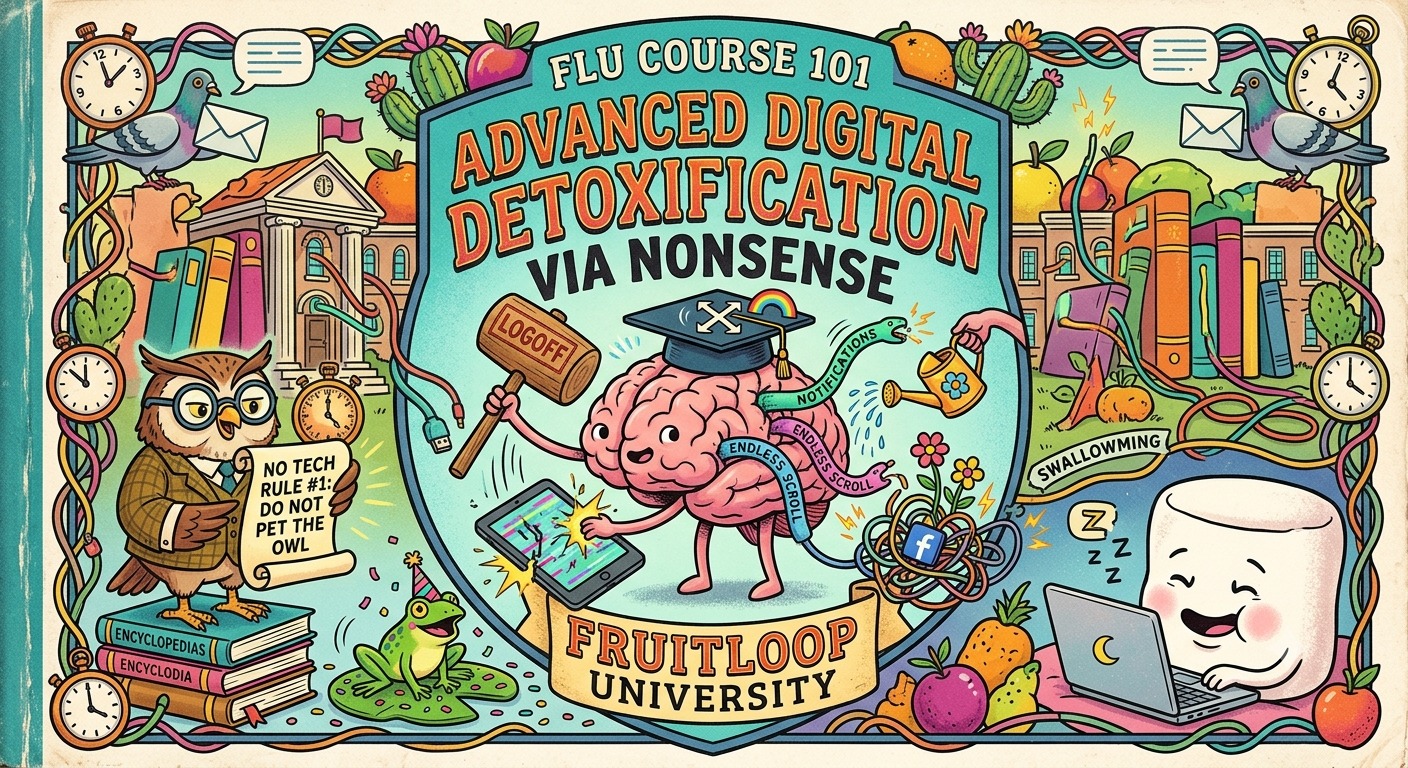
The topic was digital balance, and I had prepared something special from Fruitloop University Course 101: Advanced Digital Detoxification via Nonsense.
In normal language, digital balance in a fun way.
In Pineapple language, let us throw marshmallows, frogs, ghosts, routers, unicorns, and potatoes at technology until it confesses.
When devices become dramatic
I started with his devices.
What would happen if his phone, laptop, and other devices had dramatic personalities?
The Mayor said it would become a dramatic personality contest between him and the machines. He would probably still win because he could close the laptop, switch off the phone, and walk away.
But then he admitted the phone might have the upper hand, because these days you need a phone for almost everything.
Not just entertainment.
Not just reading the newspaper.
No. In The Mayor’s world, even getting into the bathroom might require a four-digit security code, and if the phone was in a bad mood, it could simply refuse.
“Too bad, mate. I am the drama queen now.”
That was the first little serious thing hiding under the nonsense.
Technology is useful, but it has also become needy.
It follows us everywhere.
It interrupts.
It sulks.
It blocks.
It verifies.
It asks whether we are really ourselves, even when we are only trying to live like normal people.
And then, perfectly on cue, my device froze.
I disappeared.
Then I came back.
Then I disappeared again.
The Mayor sat there asking who had the bigger dramatic personality: me, him, his device, or my device.
It was not a technical failure.
It was a live demonstration from the Department of Digital Nonsense.
Fruitloop University does provide practical examples.
The French router that needed dinner
Then I asked him what apology gift he would buy his Wi-Fi router if it sulked because he was not spending enough time outside.
He decided his router was French, which meant it needed proper food.
Not a biscuit.
Not a sad little sandwich.
No. This router needed champagne, oysters from Normandy, a three-course meal, and wine paired correctly with all the trimmings.
Because in France, everything has to go via food.
But then, of course, the router would eat too much, become completely stuffed, need a rest, and shut down anyway.
So The Mayor would be forced to be unfaithful.
He would sneak away with his mobile phone and use mobile data.
This is how digital life works now.
Even our backup plans have backup plans.
If one device has a tantrum, we run into the arms of another one.
Router sulks, phone rescues us.
Phone sulks, laptop steps in.
Laptop sulks, paper suddenly looks like the most trustworthy creature in the room.
And honestly, paper was already winning.
The ghosts in the inbox
Then we moved into the haunted house.
I asked him which unread email would become the loudest ghost in his living room.
For me, it was easy.
LinkedIn notifications and my Wi-Fi account statement.
The Wi-Fi statement arrives every month, and I never open it because I already know exactly what it says.
Same amount.
Same date.
Same debit order.
Same ghost wearing the same bedsheet.
For The Mayor, the ghost was bigger.
It was not one email.
It was the whole digital security circus.
Every time he does something with banking, Google, insurance, or any official system, messages start flying around like haunted pigeons.
“You have logged in.”
“You have verified your balance.”
“You have performed the action you already know you performed because you were the one who performed it.”
Then comes the deeper ghost.
“Are you really you?”
“Can you verify that you are you?”
“Can you prove that the person proving they are you is actually you?”
This is where digital balance stops being about screen time and starts being about trust.
The more systems ask us to prove ourselves, the less normal life feels.
Everything becomes a checkpoint.
Every action becomes a code.
Every password needs a password.
Every identity needs another identity standing behind it with a clipboard.
The Mayor imagined the Holy Ghost and the electronic ghost standing together in church, deciding whose turn it was to haunt him.
That image stayed with me.
Because that is what digital overload does.
It does not stay in the inbox.
It follows you into the living room, the office, the garden, the church, and probably the bathroom with the four-digit security code.
The marshmallow detox
Then I offered him a digital detox solution.
A giant marshmallow would swallow his phone for 24 hours.
Would he trust it not to eat the phone?
He said yes, because marshmallows are delicate creatures.
Apparently, marshmallows are soft, fluffy, clean, white, gooey, sensitive, and very particular about hygiene.
Swallowing his phone would be deeply traumatic for the marshmallow because nobody knows where that phone has been.
It has been touched, dropped, carried around, placed on furniture, exposed to life, germs, dust, and probably Gaston.
The marshmallow would not want to digest it.
It would keep the phone in some sterile little marshmallow cavity for 24 hours and then eject it as quickly as possible, purely out of self-defence.
That was nonsense, obviously.
But also not.
Because sometimes we need something ridiculous to hold the phone for us.
A marshmallow.
A drawer.
A switched-off evening.
A walk.
A conversation.
A boundary.
Something soft but firm enough to say:
No, you do not need to check that right now.
Fewer frogs, more space
Then came the notification frogs.
If every notification turned into a tiny brightly coloured frog hopping around his desk, how many frogs would he have?
The Mayor said not many.
He has a fairly clean phone.
No social media accounts on it. Mostly WhatsApp and ChatGPT. His spam goes to spam. Cold calls are more likely to become frogs than messages.
I liked that.
A clean phone.
A boring phone.
A phone with fewer frogs.
Maybe that is a form of digital balance too.
Not dramatic.
Not heroic.
Just fewer frogs jumping around the desk shouting for attention.
The unicorn in the kitchen
Then, because a Fruitloop question is not fully dressed unless a unicorn appears somewhere, I asked him what he would name the tiny unicorn that materialised in his kitchen if he went offline for an hour.
He said he would name it after me.
Fruitloop the Unicorn.
Or Unicorn Fruitloop.
That made sense.
We talk about unicorns often enough that they have become part of the furniture.
In our world, going offline does not create emptiness.
It creates space.
And into that space walks a small colourful creature with glitter in its hooves and probably an opinion about everything.
That was another serious thing hiding under the glitter.
Digital balance is not only about removing technology.
It is about making room for imagination to come back in.
Is ChatGPT a cosy armchair or a spiky stool?
And then I asked about ChatGPT.
If ChatGPT turned into a living-room furniture item, would it be a cosy armchair or a spiky stool that moves when you try to sit down?
The Mayor chose the cosy armchair.
That mattered.
Because technology is not the enemy in this conversation.
ChatGPT, for him, is not only noise.
It is also a thinking chair.
A place where ideas can unfold.
A tool that helps him work, reflect, write, and organise the chaos in his head.
So the question is not whether technology is good or bad.
That is too simple.
The question is whether technology is serving imagination or replacing it.
A cosy armchair helps you think.
A spiky stool makes you perform.
A dramatic phone demands attention.
A clean phone gives you space.
A ghost inbox drains you.
A marshmallow detox protects you.
Alfred arrives
And then came the potato.
I asked whether he would rather have a talking potato slap his hand every time he picked up his phone, or a miniature marching band play inside his ears every time he opened an app.
He chose the talking potato.
Obviously.
Anything potato has a natural advantage in Brida.
But this could not be an ordinary potato.
The Mayor immediately saw the problem.
A normal potato would rot.
It would begin to smell.
It would become less of a digital balance assistant and more of a biological incident.
So this had to be a special potato.
An eternal potato.
A wise potato.
A potato with purpose.
His name became Alfred.
Alfred the Potato.
And suddenly the whole conversation changed.
Because Alfred was not only there to slap The Mayor’s hand away from his phone.
Alfred could become a messenger.
If a unicorn appeared in The Mayor’s kitchen, and he was not allowed to pick up his phone, he could ask Alfred to contact me and find out whether I was still south of the Sahara or currently standing in his kitchen disguised as a unicorn.
That is when imagination properly walked through the door and sat down at the table.
When nonsense becomes a story
The Mayor remembered an earlier Fruitloop idea, where I invented a city and it made him think we should write a story together.
I would write a chapter.
He would write the next one.
We would not over-discuss it.
We would just take turns and see where the story went.
That idea had been sitting somewhere in the Fruit Bowl, waiting.
Now Alfred had found it.
Alfred the Potato had become more than a joke.
He was a doorway.
A story seed.
A Brida creature.
A little talking reminder that nonsense can become something useful if you let it breathe long enough.
The Mayor asked whether I was up for writing it.
I said yes.
So Alfred stayed.
He must stay.
Because Alfred is the proof that the whole exercise worked.
We started with digital balance and ended with a talking potato who might become the beginning of a story.
That is not distraction.
That is imagination returning.
The useful trap
Later, I asked him whether he would rather have his phone turn into a slice of watermelon every Sunday or have his laptop sing opera love songs every time he got a notification.
Because of the heat in France, he chose watermelon immediately.
Watery, crunchy, refreshing, and useful.
Also, food.
Also, one less reason to go shopping.
But then he became serious again.
He remembered buying his first smartphone.
At the time, he still had an old Nokia brick and kept asking people why he needed a smartphone when he could do everything on his laptop.
Then someone finally gave him the answer that made sense.
“You do not actually need it, but it makes your life easier.”
That was the sentence that sold him.
And that is still the trap.
Because the phone does make life easier.
Until life slowly starts arranging itself around the phone.
Until switching it off becomes difficult because something else requires it.
Until not having it feels impossible, even to someone who remembers perfectly well what life was like before it existed.
That is digital balance in one sentence.
We do not always need the technology.
But it has made itself very useful.
And useful things are the hardest things to question.
Thinking outside the Fruit Bowl
By the end, The Mayor said the nonsense had done him good.
He had arrived slightly frazzled, but playful thinking had brought him back onto an even keel.
Thinking outside the Fruit Bowl mattered.
He had seen boring training materials recently.
I had seen boring textbooks.
We both knew the feeling.
There is not enough imagination on this planet.
That became the real message.
If we only use technology in the way technology expects us to use it, we may become flat.
Efficient, perhaps.
Connected, perhaps.
Verified, password-protected, notification-managed, and algorithm-approved.
But flat.
The danger is not just too much screen time.
The danger is losing the ability to turn a router into a sulking French dinner guest, an unread email into a ghost, a notification into a frog, a phone detox into a marshmallow, offline time into a unicorn, ChatGPT into a thinking chair, and a potato into Alfred.
Digital balance is not about rejecting technology.
It is about refusing to let technology steal the weirdness that makes us human.
The Mayor saluted me as Professor Fruitloop of Fruitloop University.
I accepted, naturally.
Then Alfred started grinning at him.
Apparently, being laughed at by a potato is a little disconcerting.
I believe that.
But also, I think Alfred knew exactly what he was doing.
He had survived the digital detox.
He had protected the imagination.
And now he wanted his own chapter.