The Potato List and the Storm
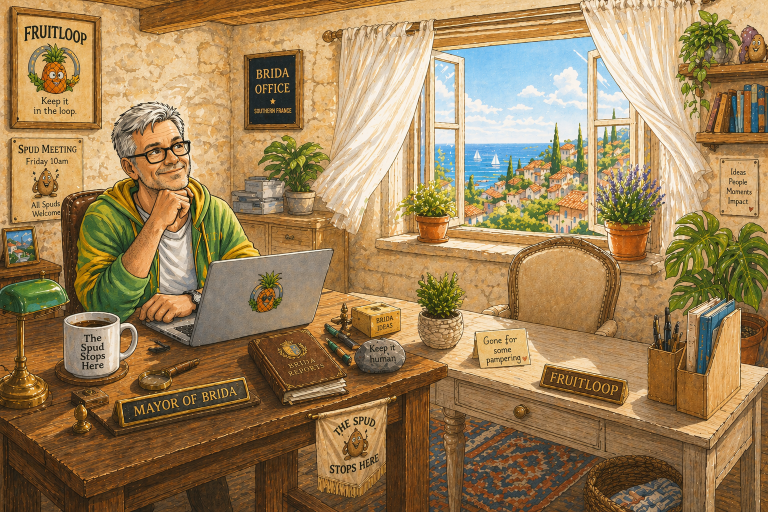
Janita wrote this week about our Spud meeting, our potato lists, and the strange little names we give to things behind the scenes.
She is right.
We do name things strangely.
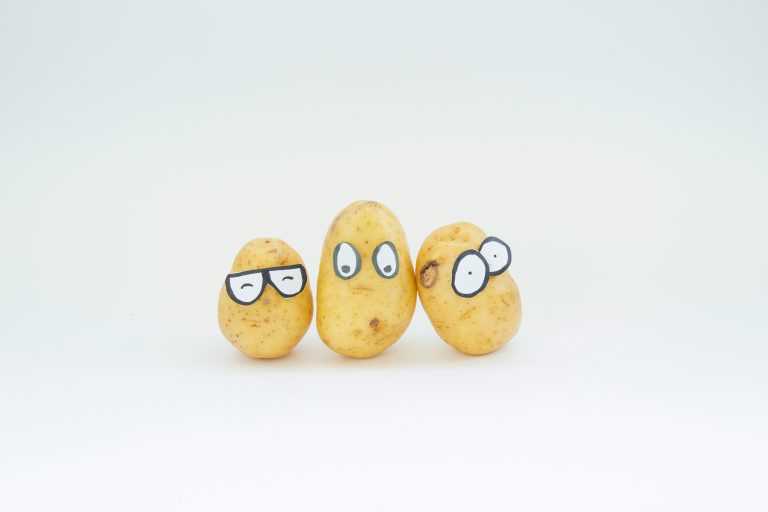
We have Spuds, Pineapples, Peeling Potatoes, cheerios, Fruitloops, tables, chairs, cartoons, conversations, and probably a few other names that would make absolutely no sense to anyone walking into the room halfway through.
But that is what happens when something becomes alive.
It grows its own language.
Every family has this. Every friendship has it. Every little community that has been through a few shared moments eventually starts speaking in words that sound ordinary to outsiders, but carry a whole private history inside them.
For us, a potato list is not just a to-do list.
It is where loose ideas become tasks.
It is where half-mad thoughts are tested.
It is where campaigns begin as crumbs on the table.
It is where we decide what needs watering, what needs peeling, what needs cooking, and what probably needs to be thrown into the compost before it starts smelling funny.
That is the cheerful side of the story.
The Spud meeting.
The funny names.
The little rituals.
The feeling that somewhere behind the scenes, something is quietly being made.
But this week, while Janita was writing about the potatoes, I found myself thinking about the storms.
Because building Brida at the moment does not always feel like sitting in a cosy kitchen with a cup of coffee and a neat list of things to do.
Some days it feels like standing outside in very strange weather, holding a hand-painted sign that says:
Come and talk.
And the wind keeps changing direction.
We have been running campaigns in Serbia and Istanbul. The cartoons travel. People react. Some laugh. Some misunderstand. Some leave comments that make you wonder whether humanity should perhaps take a short rest and try again after lunch.
And some people come closer.
That is the hopeful part.
They see something. They recognise something. They step into our WhatsApp world, curious enough to open the door.
And then, quite often, they pause.
They stand there quietly.
Not because they are stupid. Not because they are uninterested. Not because the idea has failed.
Maybe because the next step is bigger than it looks.
It is one thing to like a cartoon.
It is another thing to enter a conversation.
It is one thing to think, “Yes, this sounds interesting.”
It is another thing to sit at a table, even an online one, with people you do not yet know, and speak in a language that may still feel a little wobbly in your mouth.
That is not a small step.
And the world outside is not exactly calm.
Politics is loud. Technology is moving faster than most of us can digest. Work feels uncertain. Attention is scattered. Trust is thin. Everyone seems to be selling something, explaining something, shouting something, predicting something, or warning us that everything we know is about to change by Thursday afternoon.
Into that noise, Brida says something almost ridiculously simple:
Come and talk.
Not study.
Not perform.
Not prove yourself.
Not become a better version of yourself by the end of the week.
Just talk.
It sounds small.
It is not.
Talking is where people become visible. Talking is where confidence begins. Talking is where strangers become less strange. Talking is where English stops being a school subject and becomes a living thing at the table.
A sentence comes out.
Someone listens.
Someone laughs.
Someone says, “I know what you mean.”
And suddenly, something shifts.
Not dramatically. Not with fireworks. Not with the kind of transformation that gets a shiny headline and a suspiciously enthusiastic testimonial.
Quietly.
Humanly.
A little door opens.
This is the part that is difficult to explain in a campaign.
You can make cartoons. You can write posts. You can design banners. You can create invitations. You can polish the words until they shine like apples in a market stall.
But the real thing only happens when people sit down together.
That is where Brida exists.
Not in the slogan.
Not in the flyer.
Not in the WhatsApp link.
Not even in the cartoon.
Those are doors.
Brida is what happens after someone walks through one.
And yes, some days it is incredibly tough.
There are trolls. There are silences. There are promising little sparks that do not immediately become flames. There are people who understand the idea but are not ready to act. There are people who still ask whether we teach English, and then look slightly confused when we say, “Not exactly.”
Because we do not really teach English in the usual sense.
We create a space where English can happen.
Where people can happen.
Where confidence can happen.
Where someone who has spent years thinking, “My English is not good enough,” discovers that maybe the problem was never only grammar. Maybe the problem was the absence of a safe enough place to begin.
That is why the potato lists matter.
They may look small. They may look silly. They may sound like two people giving vegetables more responsibility than vegetables normally deserve.
But they are part of the work.
The work is not only the conversation at the table. It is also everything that makes the table possible.
The planning.
The invitations.
The topics.
The cartoons.
The reminders.
The awkward experiments.
The campaigns that almost work.
The campaigns that teach us where people hesitate.
The quiet adjustments after the noise has passed.
A Brida table does not simply appear.
It is set.
Again and again.
Sometimes with confidence. Sometimes with doubt. Sometimes with a list of potatoes and a face that says, “Well, let’s try this and see if anyone comes in from the storm.”
That may not sound like magic.
But perhaps real magic rarely does.
Perhaps real magic is not the grand moment when everything suddenly works.
Perhaps it is the stubborn little rhythm of showing up.
Making the list.
Sending the invitation.
Drawing the cartoon.
Opening the room.
Welcoming the person who arrives nervous.
Listening when they speak.
Remembering their story.
Trying again next week.
So yes, we have our Spud meetings.
We have our potato lists.
We have our odd names, our Pineapples, our Peeling Potatoes, our cheerful refusal to become cheerios.
But underneath all that playfulness is something serious.
We believe talking is not small.
We believe people need places where they can be heard without having to perform.
We believe English becomes more useful, more natural, and more alive when it is connected to real people and real stories.
We believe that even in a noisy world, especially in a noisy world, a small table can matter.
And that is why we keep going.
One potato list at a time.